Progression
Progression is the forward movement toward your goals, marked by visible improvement and sustained momentum. It's not about reaching the destination instantly—it's about the steady climb that builds confidence, resilience, and happiness along the way. Research shows that experiencing progression activates reward centers in your brain, triggering dopamine release and creating a positive feedback loop that keeps you motivated. Whether in your career, health, relationships, or personal development, progression transforms abstract aspirations into concrete, measurable steps you can celebrate.
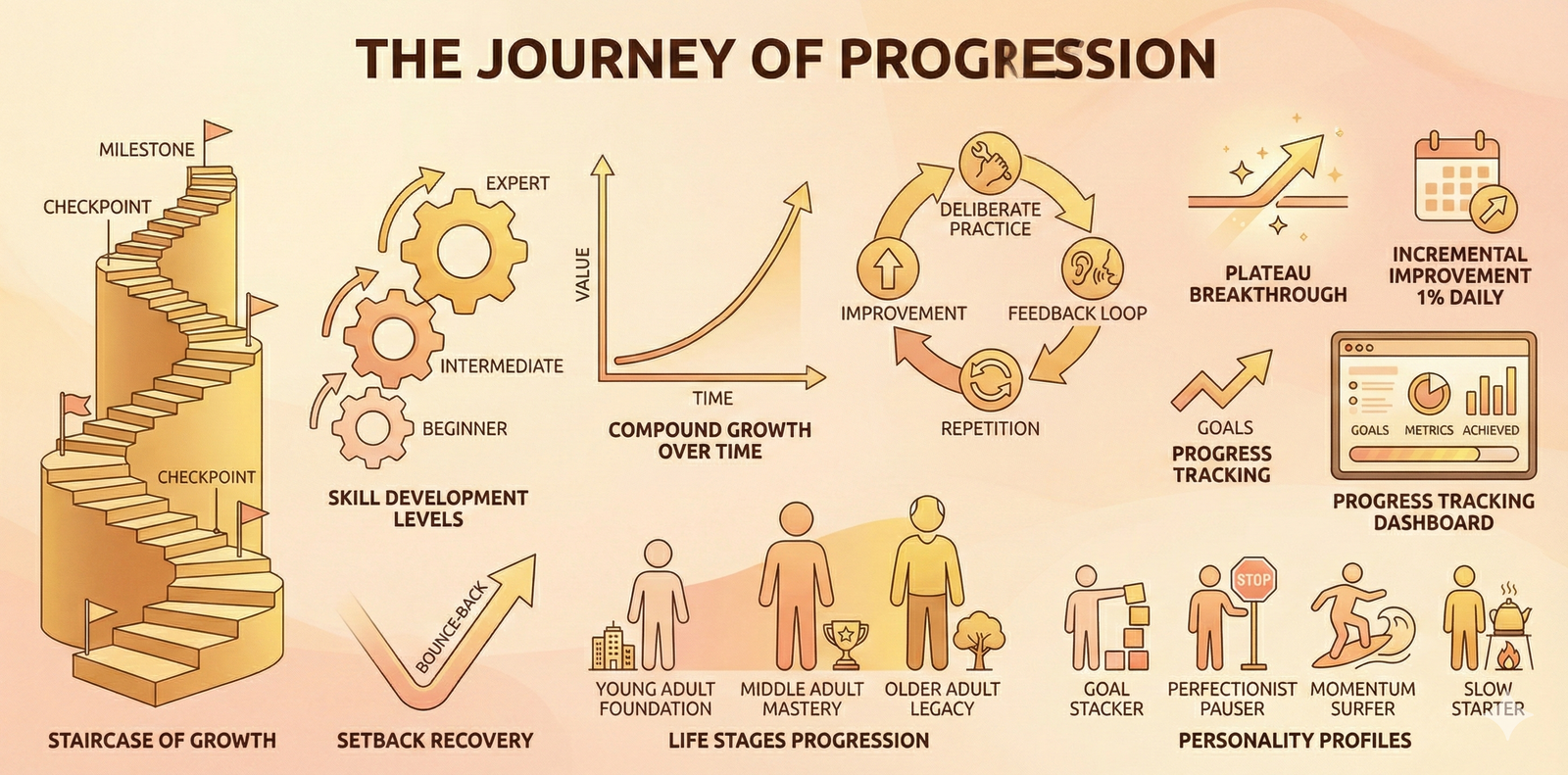
In a world obsessed with overnight success, progression teaches a counter-intuitive truth: small, consistent forward movements compound into extraordinary results. The happiness you feel from progression isn't just about reaching milestones—it's about knowing you're moving in the right direction.
This guide explores the science behind progression, why it matters for your wellbeing, and practical methods to create measurable momentum in every area of your life.
What Is Progression?
Progression is the measurable forward movement toward a meaningful goal, characterized by visible improvement, increasing competence, and sustained momentum. Unlike perfection, progression embraces the imperfect journey. It's the acknowledgment that you're better today than you were yesterday, even if only slightly. Progression exists on a spectrum—it can mean mastering a new skill, improving your health metrics, deepening relationships, or advancing your career. The key ingredient is that progress must be visible enough for you to recognize and celebrate it.
Not medical advice.
Progression differs fundamentally from motivation. Motivation is the desire to act; progression is evidence that action is working. When you experience progression, motivation strengthens because your brain receives confirmation that effort produces results. This creates what psychologists call a 'positive feedback loop'—your progress fuels motivation, which fuels more action, which generates more progress.
Surprising Insight: Surprising Insight: The happiness boost from progression is neurochemical. When you achieve progress, your brain releases dopamine—the same neurotransmitter involved in reward, motivation, and pleasure. This means experiencing progression literally makes you happier and more motivated to continue.
The Progression Cycle
Shows how small actions lead to visible progress, which triggers motivation through dopamine release, creating continued effort and sustained momentum.
🔍 Click to enlarge
Why Progression Matters in 2026
In 2026, we face unprecedented complexity. The pace of change is faster, career paths are less linear, and the pressure to achieve quickly is constant. Yet research shows that sustainable happiness comes not from speed but from steady progression. World Happiness Report data indicates that individuals who experience regular progression toward meaningful goals report significantly higher life satisfaction, better mental health, and greater resilience during difficult times.
Progression addresses modern burnout directly. Burnout occurs when effort feels futile—when you're working without seeing results. Progression creates meaning by making results visible. Even small forward movements counter burnout by providing evidence that your effort matters. Studies on achievement motivation show that individuals focused on mastery and progression (rather than comparison and performance) experience less anxiety and more intrinsic motivation.
Personal growth research from 2024 emphasizes that progression is a 'multi-dimensional skill set' that helps individuals navigate life's challenges, transitions, and stressors. It's not optional—it's fundamental to psychological wellbeing and long-term happiness.
The Science Behind Progression
The neuroscience of progression reveals why tracking progress is so powerful. When you experience progression, several brain systems activate simultaneously. The reward pathway releases dopamine, creating the motivation to repeat the behavior. The limbic system (emotional center) registers positive feelings. The prefrontal cortex (planning center) updates your mental model of what's possible. Together, these systems create a neurochemical state where you feel good, motivated, and capable.
Achievement Goal Theory, a leading framework in motivation psychology, distinguishes between two goal orientations: mastery goals (focused on improvement and learning) and performance goals (focused on outperforming others). Research consistently shows that mastery-oriented progression—focusing on personal improvement rather than comparison—leads to greater intrinsic motivation, lower anxiety, and longer-term persistence. When you measure yourself against your own progress rather than others' achievements, progression becomes sustainable.
Mastery vs. Performance Goal Orientation
Compares mastery-based progression (internal reference, long-term motivation) with performance-based progression (external reference, short-term motivation).
🔍 Click to enlarge
Key Components of Progression
Clarity of Direction
Progression requires knowing where you're heading. Without a clear goal, forward movement is impossible to define. Clarity means understanding both your destination and why it matters to you. This clarity activates your brain's goal-tracking systems and enables you to recognize progress when it occurs. Without it, you might be moving but feel aimless.
Measurable Milestones
You cannot celebrate progress you cannot see. Measurable milestones transform abstract goals into concrete checkpoints. Whether it's reading 10 pages daily toward a book, losing 1 pound weekly toward a weight goal, or completing one project per month in your career, milestones make progression tangible and triggering repeated dopamine release.
Consistent Effort
Progression is built on consistency, not intensity. Research on habit formation shows that small, frequent actions compound faster than sporadic large efforts. Daily micro-efforts toward your goal create psychological momentum and keep motivation high. Consistency also prevents the boom-bust cycles that derail progress.
Recognition and Celebration
Your brain needs acknowledgment. When you achieve a milestone, pause to recognize it. This conscious celebration strengthens the neural pathways associated with that behavior, making future progress more likely. Without recognition, progress can feel invisible, undermining motivation.
| Domain | Example Progression | Key Metric |
|---|---|---|
| Health | Running 5K by March | Distance + Time |
| Career | Mastering new software | Projects completed |
| Relationships | Weekly quality time | Hours together |
| Learning | Reading 30 books yearly | Books completed |
| Finance | Saving $500/month | Savings growth |
How to Apply Progression: Step by Step
- Step 1: Define one meaningful goal that aligns with your values and matters to you personally, not just what you think you should want.
- Step 2: Break the goal into smaller sub-goals, each achievable within 1-3 months, making the journey less overwhelming.
- Step 3: Create a tracking system that captures your progress visibly—a chart, journal, app, or spreadsheet that you check regularly.
- Step 4: Commit to consistent, small daily or weekly actions toward the goal, understanding that frequency matters more than intensity.
- Step 5: Review your progress weekly, noting what's working and what needs adjustment, treating setbacks as data, not failure.
- Step 6: Celebrate milestones publicly or privately—tell someone, write it down, or reward yourself to strengthen the psychological impact.
- Step 7: Connect each achievement back to your original 'why' to maintain emotional motivation alongside achievement motivation.
- Step 8: When progress plateaus, reassess your approach rather than your goal, experimenting with new strategies while maintaining direction.
- Step 9: Track not just outcome progress but process progress—did you show up consistently, did you try new approaches, did you learn?
- Step 10: Share your progression journey with others, as accountability and community support significantly enhance long-term adherence.
Progression Across Life Stages
Adultez joven (18-35)
This stage is characterized by rapid change and identity formation. Progression here often focuses on skill development, career launches, and relationship building. The advantage of this stage is high neuroplasticity—your brain is optimized for learning and forming new habits. Focus on building progression habits now that will serve you for decades. Common progressions include educational achievement, early career advancement, fitness improvements, and deepening meaningful relationships.
Edad media (35-55)
This stage often involves balancing multiple responsibilities—career advancement, family, aging parents, personal health. Progression becomes more complex but also more meaningful. Research shows that middle-aged adults experience significant happiness gains from mastery-oriented progression in specialized domains. This is an ideal time to achieve progression in leadership, financial security, health optimization, and deepening relationships. The key is focusing on fewer, higher-impact goals rather than scattered efforts.
Adultez tardía (55+)
Contrary to stereotypes, progression is crucial in later adulthood. Research on aging shows that individuals who continue pursuing meaningful progression maintain better cognitive health, higher life satisfaction, and greater resilience. Progression in this stage might involve legacy-building, mastering new technologies, deepening spiritual practice, maintaining physical vitality, or mentoring others. The key is maintaining a growth orientation regardless of age.
Profiles: Your Progression Approach
The Goal Stacker
- Clear systems for tracking multiple goals
- Prioritization framework to prevent overwhelm
- Accountability partnerships to maintain focus
Common pitfall: Spreading effort so thin that no single goal receives enough momentum, creating the illusion of progress without real progression.
Best move: Pick one primary goal per quarter, with 1-2 secondary goals maximum. Deep progression beats shallow motion.
The Perfectionist Pauser
- Permission to be imperfect during progression
- Definition of 'good enough' milestones
- Celebration of process, not just perfect outcomes
Common pitfall: Waiting for the 'perfect' starting point or approach, never beginning because conditions aren't ideal, confusing perfection with progression.
Best move: Start with visible, imperfect action. One page written is more progressive than a perfectly outlined book never started.
The Momentum Surfer
- Structured feedback loops to maintain awareness of progress
- Planned celebration rituals after milestones
- External tracking to override optimism bias
Common pitfall: Riding momentum without checking actual progress, confusing busyness with progression, losing direction in the enthusiasm of the journey.
Best move: Combine your momentum with measurement. Track numbers, not just feelings, to ensure your activity is actually progressive.
The Slow Starter
- Smaller initial milestones to prove progress
- Understanding of compound returns over time
- Permission to progress at your own pace
Common pitfall: Underestimating how small, consistent actions compound, giving up because initial progress feels slow compared to others' journeys.
Best move: Embrace the compound nature of progression. Track weekly improvements; they'll surprise you when reviewed quarterly.
Common Progression Mistakes
The Comparison Trap: Measuring your progression against someone else's progress undermines intrinsic motivation and creates artificial urgency. Their starting point, resources, and path are different. Focus on personal mastery progression—comparing yourself only to your past self.
All-or-Nothing Thinking: Many people believe progression must be dramatic or constant. A week without visible progress triggers the belief that 'progress stopped.' In reality, some weeks consolidate learning; some weeks build foundations. Sustained progression includes plateaus.
Invisible Progress: You work hard but don't track visible milestones, so your brain doesn't register progression. Effort without evidence doesn't trigger dopamine. Make progress visible through tracking, journaling, or sharing—this tiny shift transforms psychological experience.
Progression Pitfalls and Solutions
Shows common mistakes that derail progression and the corresponding solutions to maintain momentum.
🔍 Click to enlarge
Ciencia y estudios
The science of progression draws from multiple disciplines. Neuroscience reveals the dopamine pathway underlying progress-triggered motivation. Psychology contributes Achievement Goal Theory and research on intrinsic vs. extrinsic motivation. Organizational research shows progression's role in engagement and retention. Together, these fields demonstrate that progression is not merely motivational—it's fundamental to psychological wellbeing and sustainable happiness.
- World Happiness Report 2025: Individuals experiencing regular progression toward meaningful goals report significantly higher life satisfaction and mental health resilience.
- Achievement Goal Theory (2024 meta-analysis, Japanese Psychological Research): Mastery-goal progression shows stronger correlation with persistent effort and lower anxiety than performance-goal progression.
- Personal Growth Initiative Scale Studies (ScienceDirect 2024): Personal growth initiative—the intentional drive toward progression—predicts college student resilience and success across academic and personal domains.
- Neuroscience of Progress (Frontiers in Psychology 2025): Visible progress triggers dopamine release in the brain's reward pathway, creating motivation for continued effort and sustained progression.
- Organizational Progression Research (Academy of Management 2023): Employees who experience clear progression pathways show 2.4x higher engagement and 1.8x lower turnover.
Tu primer micro hábito
Comienza pequeño hoy
Today's action: Choose one goal you care about and create one measurable milestone for this week. Write it down and commit to one small daily action toward it. Review your progress Sunday evening and celebrate what you accomplished, regardless of size.
This micro habit activates all components of progression: clarity (you know your goal), measurability (you can verify if you hit the milestone), consistency (daily action), and celebration (you acknowledge progress). These elements compound rapidly, creating momentum that accelerates.
Track your micro habits and get personalized AI coaching with our app.
Evaluación rápida
When you think about your current goals, how clear is your sense of progression toward them?
Your answer reveals whether you're already capturing the happiness benefits of progression or if you need to make your progress more visible and measurable.
Which best describes your goal-setting pattern?
Mastery-focused progressions (option 1) build lasting motivation and resilience, while comparison-based progressions (option 3) create stress. Your answer shows which path would serve your wellbeing best.
How do you typically respond when progression feels slow or stalls?
This reveals your resilience in progression. Those who adjust approach (option 1) maintain momentum through plateaus. Those who pivot frequently (option 4) miss the compounding benefits of sustained progression.
Take our full assessment to get personalized recommendations.
Discover Your Style →Preguntas frecuentes
Próximos pasos
Progression is available to you right now, starting with one small commitment. You don't need ideal conditions, perfect clarity, or guaranteed success. You need one goal, one measurement system, and one daily action. This is the foundation of momentum that compounds into extraordinary results.
Begin this week by choosing one goal that genuinely matters to you—not what you think should matter, but what calls to you. Define one measurable milestone for the next 30 days. Commit to one daily action. Track it visibly. Celebrate when you hit your milestone. This single-month cycle will show you the power of progression and build the habits that sustain it for years.
Get personalized guidance with AI coaching.
Start Your Journey →Research Sources
This article is based on peer-reviewed research and authoritative sources. Below are the key references we consulted:
Related Glossary Articles
Frequently Asked Questions
How quickly should I see progression?
Visible progression typically appears within 2-4 weeks of consistent effort, though foundational changes happen sooner. Neuroscience research shows that the brain needs repetition to strengthen neural pathways. Daily action toward your goal creates weekly visible progress within a month. Patience with the timeline accelerates the process; rushing undermines it.
What if I don't see progress despite consistent effort?
This often means your measurement system isn't sensitive enough or your action isn't aligned with your goal. Adjust your tracking to capture smaller increments. For example, instead of 'lost weight,' track 'completed 5 gym sessions this week.' Process progress (effort, showing up, trying new approaches) always exists, even when outcome progress is slower.
Does progression always feel positive?
No. Early progression often feels positive due to novelty and momentum. Mid-stage progression can feel routine or plateaued. Late-stage progression may feel challenging as you approach mastery. All are normal. Knowing this prevents the misconception that slowing motivation means lost progression.
Can I pursue multiple progressions simultaneously?
Yes, but with limits. Research shows that 1 primary goal with 1-2 secondary goals maintains optimal motivation. Beyond that, effort becomes scattered and none reach transformative progression. Quality of progression beats quantity of goals.
How do I maintain progression during setbacks?
Reframe setbacks as data, not failure. A setback reveals what doesn't work, moving you closer to solutions. Progression includes wrong turns; what matters is resuming forward motion. People with high progression resilience maintain effort through setbacks by viewing them as experiments, not defeats.
Take the Next Step
Ready to improve your wellbeing? Take our free assessment to get personalized recommendations based on your unique situation.
- Discover your strengths and gaps
- Get personalized quick wins
- Track your progress over time
- Evidence-based strategies