Bienestar Personal
Personal wellbeing is more than the absence of illness—it's a dynamic state of fulfillment across all dimensions of your life. When you feel genuine wellbeing, you experience positive emotions, maintain meaningful relationships, pursue purposeful work, and care for your physical and mental health. This holistic approach recognizes that true satisfaction comes from integrating all aspects of your existence into a coherent, values-aligned lifestyle. Whether you're struggling with stress, seeking greater life meaning, or wanting to optimize your health, understanding personal wellbeing provides the foundation for lasting positive change.
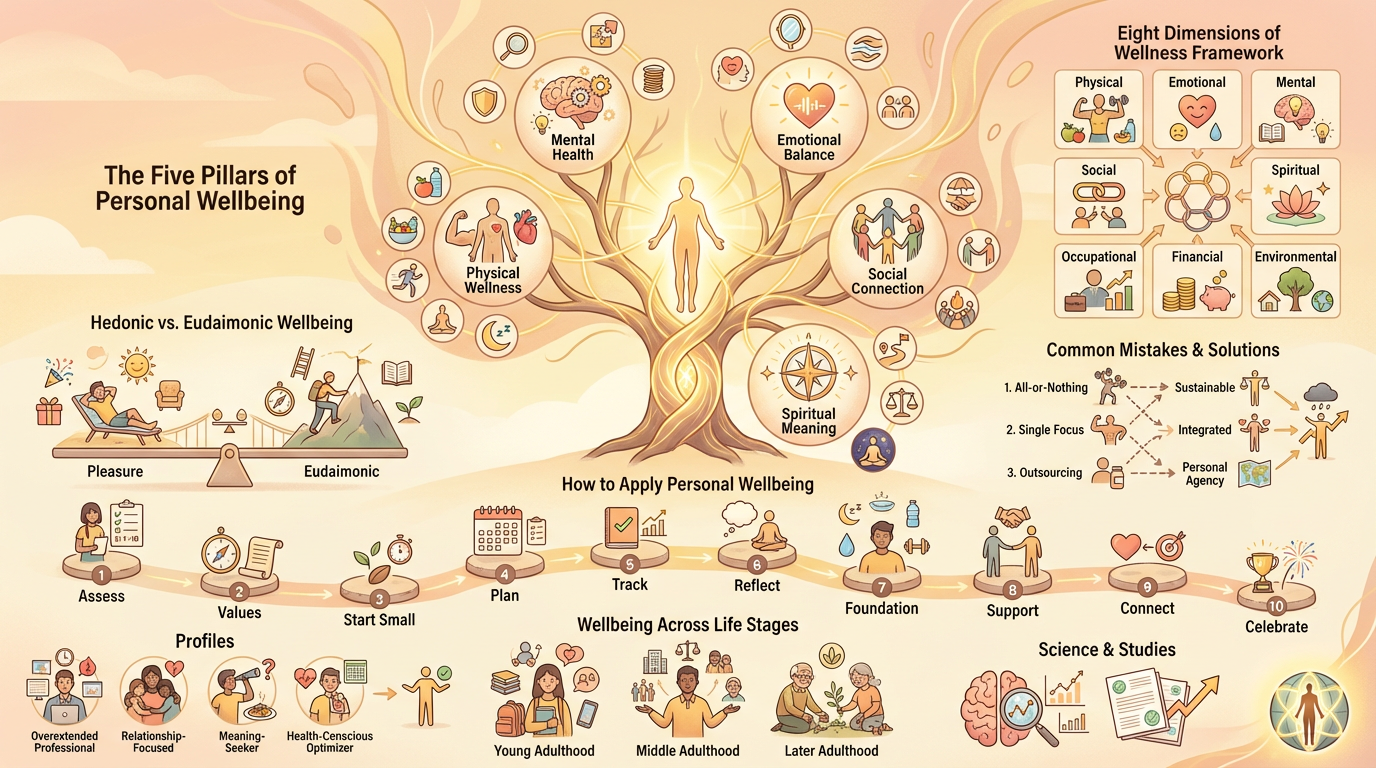
The journey toward personal wellbeing isn't about perfection—it's about creating sustainable practices that support your unique needs and values.
Research shows that people with strong wellbeing experience better health outcomes, greater resilience, improved relationships, and higher productivity—making it one of the most valuable investments you can make in yourself.
Qué es Bienestar Personal?
Personal wellbeing is a multidimensional construct encompassing physical, mental, emotional, and social health factors. The World Health Organization defines health itself as 'a state of complete physical, mental and social well-being and not merely the absence of disease or infirmity.' This foundational definition emphasizes that wellbeing is proactive and holistic, not simply the absence of problems. Personal wellbeing is the experience of personally valued fulfillment within your life—what contributes to your wellness depends on what is uniquely important to you based on your values, personality, and life circumstances.
No es asesoramiento médico.
Modern research has identified that wellbeing operates across interconnected dimensions. You can't achieve true wellbeing by focusing only on physical health while neglecting emotional fulfillment, or building successful relationships while ignoring your own mental health. Each dimension influences the others, creating a dynamic system where improvement in one area often catalyzes positive changes throughout your life. This interconnectedness means that creating a wellbeing plan requires attention to multiple areas simultaneously.
Surprising Insight: Perspectiva Sorprendente: Recent research shows that mental health is so integral to overall health that there is effectively no health without mental health. This paradigm shift recognizes that psychological wellbeing isn't optional—it's foundational.
The Five Pillars of Bienestar Personal
Visual representation of how physical, mental, emotional, social, and spiritual wellbeing interconnect and support overall life satisfaction.
🔍 Click to enlarge
Por qué Bienestar Personal Importa en 2026
In 2026, personal wellbeing has become increasingly recognized as essential to individual and collective health. Mental health challenges have reached unprecedented levels globally, with stress, anxiety, and burnout affecting people across all demographics. Organizations now understand that employee wellbeing directly impacts productivity and retention, making it a strategic priority. Additionally, the digital age has created new challenges to wellbeing—constant connectivity, social comparison, and information overload all strain our psychological resources. Prioritizing personal wellbeing is no longer a luxury; it's a necessity for navigating modern life effectively.
Personal wellbeing serves as a protective factor against burnout, chronic disease, and mental health disorders. Studies consistently show that people with strong wellbeing have better immune function, lower rates of cardiovascular disease, and improved cognitive performance. This creates a powerful incentive to invest in wellbeing practices—they're simultaneously preventive medicine and performance enhancement. The evidence base continues to grow, with neuroscience revealing that practices like meditation, exercise, and social connection create measurable changes in brain structure and function.
Perhaps most importantly, personal wellbeing enables meaningful living. When your basic needs for health, security, and connection are met, you have the psychological space and energy to pursue what truly matters to you. Whether that's creative expression, helping others, building something new, or deepening your relationships, personal wellbeing provides the foundation for a life well-lived rather than merely a life lived.
La Ciencia Detrás de Bienestar Personal
The Hierarchical Framework of Wellbeing (HiFWB) represents one of the most comprehensive modern syntheses of wellbeing research, organizing decades of scientific findings into an integrated model. This framework demonstrates that personal wellbeing operates at multiple levels—from immediate emotional states to long-term life satisfaction to spiritual fulfillment. Neuroscience research has revealed that wellbeing isn't simply a subjective feeling; it creates measurable changes in brain structures associated with emotional regulation, social connection, and resilience. When you engage in wellbeing practices, you're literally rewiring your brain for better functioning.
Contemporary psychology has moved beyond the simple happiness-focused model (hedonic wellbeing) to embrace a more complete picture that includes eudaimonic wellbeing—the sense of fulfillment that comes from living meaningfully and developing your potential. The integrative hedo-eudaimonic approach recognizes that true wellbeing requires both pleasure and purpose, both joy and growth. This explains why simply accumulating pleasant experiences doesn't create lasting wellbeing; you also need challenges that help you grow and goals that align with your deepest values.
Hedonic vs. Eudaimonic Wellbeing
Comparison of pleasure-focused and meaning-focused approaches to wellbeing, showing how both contribute to complete personal wellbeing.
🔍 Click to enlarge
Componentes Clave of Bienestar Personal
Bienestar Físico
Physical wellness encompasses all aspects of body health including nutrition, exercise, sleep quality, disease prevention, and body composition. Your physical state directly influences your mental and emotional wellbeing—regular movement improves mood and cognitive function, quality sleep supports emotional regulation and healing, and proper nutrition fuels your brain and body. Physical wellness isn't about achieving an ideal body; it's about cultivating habits that keep your body functioning optimally and feeling energetic. This includes strength training, cardiovascular exercise, flexibility work, and adequate recovery. The connection between physical health and overall wellbeing is bidirectional: caring for your body improves your mental state, and mental wellbeing motivates better physical self-care.
Mental & Emotional Health
Mental wellness involves the ability to manage stress, adapt to change, and maintain psychological resilience. Emotional wellness encompasses self-awareness, the ability to identify and appropriately express your feelings, and emotional regulation—the capacity to respond to emotions rather than being overwhelmed by them. The National Institutes of Health defines emotional wellness as the ability to successfully handle life's stresses and adapt during difficult times. This dimension includes building stress tolerance, developing healthy coping mechanisms, processing emotions productively, and maintaining psychological flexibility. Strong mental and emotional health creates the psychological foundation for all other forms of wellbeing.
Social Connection
Social wellness focuses on building and nurturing meaningful, supportive relationships with individuals, groups, and communities. Humans are fundamentally social creatures, and the quality of your relationships is one of the strongest predictors of overall wellbeing and longevity. Social connection includes family relationships, friendships, romantic partnerships, and community involvement. It requires communication skills, emotional understanding, the ability to give and receive support, and a sense of belonging. Social isolation is one of the most damaging threats to wellbeing, while strong social bonds provide resilience, joy, and meaning. This dimension also includes setting appropriate boundaries, contributing to others, and being part of something larger than yourself.
Spiritual & Meaning
Spiritual wellbeing involves having a sense of purpose, meaning, and alignment with your core values. This doesn't necessarily mean religious faith, though it can include that—it means having a coherent understanding of what matters to you and why. Research shows that people with strong sense of purpose have better health outcomes, greater resilience, and higher life satisfaction. Spiritual wellbeing includes exploring your values, pursuing meaningful work, contributing to causes you believe in, and maintaining practices that connect you to something beyond yourself. This might include meditation, time in nature, creative expression, service to others, or any activity that creates a sense of transcendence and purpose.
| Dimension | Key Focus | Example Practices |
|---|---|---|
| Physical | Movement, nutrition, sleep, disease prevention | Exercise, meal planning, sleep hygiene, health screenings |
| Emotional | Self-awareness, emotion regulation, resilience | Journaling, therapy, mindfulness, stress management |
| Mental | Cognitive function, learning, clarity, problem-solving | Reading, learning new skills, meditation, intellectual engagement |
| Social | Relationships, communication, community, belonging | Spending time with loved ones, volunteering, group activities |
| Spiritual | Purpose, meaning, values alignment, transcendence | Meditation, service, creative expression, time in nature |
| Occupational | Meaningful work, growth, contribution, satisfaction | Career development, skill building, pursuing passions |
| Financial | Security, stability, generosity, resources for wellbeing | Budgeting, saving, investing, giving to others |
| Environmental | Safe spaces, nature connection, sustainable living | Creating calm spaces, outdoor time, reducing environmental impact |
Cómo Aplicar Bienestar Personal: Paso a Paso
- Step 1: Assess your current wellbeing across all dimensions by honestly evaluating your physical health, mental state, emotional balance, social connections, and sense of purpose. Use a simple 1-10 scale for each area to identify where you're thriving and where you need support.
- Step 2: Identify your core values by reflecting on what truly matters to you. Write down the 5-7 values that, when honored, make you feel most alive and aligned. These become your compass for wellbeing decisions.
- Step 3: Start with one foundational habit in each major dimension. Rather than overhauling everything, choose one physical practice (like 20-minute walks), one mental practice (like 5-minute meditation), and one social commitment (like a weekly coffee with a friend).
- Step 4: Create an implementation plan with specific, measurable goals for each dimension. Instead of 'exercise more,' say 'walk for 30 minutes Monday, Wednesday, Friday.' Specificity dramatically increases follow-through.
- Step 5: Track your practices using a simple habit tracker or app. Research shows that visible progress reinforces motivation and helps you notice the benefits of your efforts.
- Step 6: Establish regular reflection time, at least weekly, to assess what's working and what needs adjustment. Wellbeing practices should feel sustainable, not punitive.
- Step 7: Address your physical foundation first—sleep, nutrition, and movement improvements often create a cascade of positive changes in mental and emotional wellbeing.
- Step 8: Build your social support intentionally. Communicate to friends and family about your wellbeing goals; many people will want to support you and join you in these practices.
- Step 9: Connect your wellbeing practices to your deeper purpose and values. When you understand why these practices matter (not just that they're 'good for you'), motivation becomes intrinsic.
- Step 10: Review your progress monthly and celebrate improvements, no matter how small. Building wellbeing is a marathon, and acknowledging progress maintains motivation for the long term.
Bienestar Personal En Todas las Etapas de la Vida
Adultez joven (18-35)
In young adulthood, personal wellbeing often focuses on building foundational habits and exploring identity. This stage frequently involves educational pursuits, career development, establishing intimate relationships, and gaining independence. The wellbeing priority is developing healthy patterns for physical activity, sleep, and nutrition that will support you for decades. Young adults benefit from prioritizing mental health support, building a strong social foundation, and exploring what creates meaning in your work. This is an ideal time to establish exercise routines, mindfulness practices, and healthy relationship patterns that become increasingly difficult to develop later.
Edad media (35-55)
Middle adulthood typically involves managing multiple responsibilities—career advancement, family obligations, supporting aging parents—while maintaining your own wellbeing. Personal wellbeing challenges include burnout, stress management, maintaining health as metabolism changes, and renegotiating relationships and identity. The wellbeing focus shifts toward resilience, work-life balance, and preventing chronic disease. Middle adults often need to be intentional about self-care, as the demands on their time are substantial. This stage also offers the advantage of experience and often greater clarity about what truly matters, making it a powerful time for aligning life with core values.
Adultez tardía (55+)
Later adulthood brings opportunities to refine wellbeing practices and focus on what creates deepest satisfaction. Personal wellbeing in this stage often emphasizes cognitive engagement, maintaining physical function, deepening relationships, and exploring wisdom and legacy. Many older adults experience greater peace and life satisfaction as they release some external pressures and focus on what truly matters. The wellbeing priorities include staying cognitively active, maintaining physical strength and flexibility, nurturing relationships, pursuing interests with time freedom not available earlier, and contributing meaningfully to others. Strong social connection becomes increasingly protective for health and wellbeing in later years.
Perfiles: Your Bienestar Personal Enfoque
The Overextended Professional
- Boundary setting to protect sleep and recovery time
- Quick wellness practices that fit a busy schedule
- Permission to prioritize health alongside career goals
Common pitfall: Treating wellbeing as another task to optimize rather than a foundation for sustainable performance
Best move: Start with two non-negotiables: consistent sleep schedule and 15-minute daily movement. This foundation makes other wellbeing improvements possible.
The Relationship-Focused Person
- Recognizing that personal wellbeing enables better relationships
- Balance between caring for others and self-care
- Community connection that extends beyond immediate relationships
Common pitfall: Neglecting personal wellbeing while prioritizing others' needs, leading to resentment and eventual burnout
Best move: Frame self-care as necessary maintenance for your capacity to show up for people you love. Schedule personal wellbeing time with the same commitment you give to relationships.
The Meaning-Seeker
- Connection between physical practices and deeper purpose
- Work and activities aligned with core values
- Opportunities to contribute to something meaningful
Common pitfall: Neglecting physical health while pursuing spiritual or meaningful goals, creating imbalance
Best move: Integrate your physical practice with your larger purpose. If you value helping others, volunteer work where you're also physically active. Connect the dots.
The Health-Conscious Optimizer
- Evidence-based guidance to channel optimization energy productively
- Understanding of wellbeing as multidimensional, not just physical metrics
- Permission to prioritize consistency over perfection
Common pitfall: Over-optimization of single dimensions while neglecting others, creating imbalance and eventual burnout
Best move: Use your research skills to understand all dimensions of wellbeing. Create a balanced approach that you can sustain long-term rather than cycling through intense optimization phases.
Común Bienestar Personal Errores
One frequent mistake is treating personal wellbeing as something that needs to be 'fixed' rather than continuously supported. Many people approach wellbeing with an all-or-nothing mentality, committing to perfect routines that become unsustainable, then abandoning the effort entirely when life disrupts their plans. Instead, wellbeing is best approached as a system of consistent, sustainable practices adjusted for your life's circumstances. What works during a calm period needs modification during stress, and that's normal, not failure.
Another common error is focusing exclusively on one dimension while neglecting others. Someone might become very fit physically while remaining socially isolated or emotionally disconnected. This fragmented approach creates instability—when one area inevitably struggles, your overall wellbeing collapses because you lack support from other dimensions. The integrated approach ensures that strength in relationships, meaning, and emotional health support you through physical challenges, while physical wellbeing provides energy for relationships and purpose-driven work.
A third mistake is outsourcing responsibility for your wellbeing entirely—expecting therapy, supplements, apps, or other external solutions to create wellbeing without your active participation. While these tools can be helpful, they work best as support for your own commitment and effort. Personal wellbeing requires personal agency; you must be the primary author of your health practices and the monitor of what's working.
Común Wellbeing Errores & Solutions
Visual mapping of frequent wellbeing errors and how to redirect toward balanced, sustainable approaches.
🔍 Click to enlarge
Ciencia y estudios
Personal wellbeing research has evolved substantially over the past decade, moving from simple happiness metrics to comprehensive frameworks encompassing multiple dimensions. Recent research from Frontiers in Psychology (2025) presents the Spectral Model of Bienestar Personal and the Hierarchical Framework of Wellbeing, demonstrating that modern science increasingly recognizes wellbeing as multidimensional and interconnected. Harvard's Human Flourishing Program has developed validated assessment tools that measure wellbeing across multiple domains, providing evidence-based approaches to understanding and improving personal wellness. The integration of neuroscience with psychology reveals that wellbeing practices create measurable changes in brain structure and function.
- Frontiers in Psychology: 'The Spectral Model of Bienestar Personal and the Validity of the Bienestar Personal Spectral Questionnaire' (2025) - Establishes new validated measurement framework for personal wellbeing across multiple dimensions.
- Harvard Human Flourishing Program: 'Well-Being Assessment Tools' - Provides 24-item validated assessment measuring wellbeing across emotional, physical, social, and purposeful domains.
- BMC Public Health: 'The Fundamental Association Between Mental Health and Life Satisfaction' - Demonstrates strong causal relationship between mental health improvements and overall life satisfaction.
- Frontiers in Psychology: 'Development of a Pragmatic and Brief Wellbeing Tool for Public Health Promotion' - Introduces the Mental Wellbeing Indicator for efficient population-level wellbeing assessment and tracking.
- WHO Health and Well-Being Data Portal: Global health metrics showing wellbeing as central to public health strategy and population health outcomes.
Tu primer micro hábito
Comienza pequeño hoy
Today's action: Spend 5 minutes identifying one dimension of wellbeing that feels most neglected right now, then commit to one small action in that area this week (e.g., a 10-minute walk for physical wellness, a text to a friend for social wellness, or 5 minutes outdoors for spiritual wellness).
This micro habit creates awareness without overwhelm, connects you to what matters most, and builds the momentum of taking one small action. Small actions compound into sustainable transformation.
Realiza un seguimiento de tus microhábitos and obtén entrenamiento personalizado de IA con nuestra aplicación.
Evaluación rápida
Which dimension of your wellbeing feels most challenged right now?
Understanding where your greatest wellbeing challenge lies helps you prioritize support and practices that will have the most impact on your overall satisfaction.
What would improve your wellbeing most in the next 30 days?
Your immediate priority points you toward the highest-leverage change for your current situation. Focus there first for fastest progress.
How do you prefer to approach wellbeing improvements?
Your preferred approach determines which strategies and communities will support your success. Working with your natural style dramatically increases follow-through.
Realiza nuestra evaluación completa to get personalized recommendations.
Descubre tu Estilo →Preguntas frecuentes
Próximos pasos
Begin by taking 15 minutes to assess your personal wellbeing across the major dimensions. Using a simple 1-10 scale, rate your current satisfaction with physical health, mental clarity, emotional balance, social connection, and sense of purpose. This baseline assessment reveals where to focus your initial efforts. You don't need to improve everything simultaneously; strategic focus creates faster, more sustainable progress.
Choose one dimension to prioritize this month and select one small, specific practice to build. Maybe it's 20-minute walks three times weekly for physical wellness, a weekly call with a friend for social connection, or morning coffee with a journal for emotional awareness. Start there, build consistency, then expand. Personal wellbeing improves through accumulated small actions, not dramatic transformation. Trust the process, be patient with yourself, and celebrate small wins along the way.
Obtén orientación personalizada with AI coaching.
Comienza tu Viaje →Research Sources
This article is based on peer-reviewed research and authoritative sources. Below are the key references we consulted:
Related Glossary Articles
Frequently Asked Questions
What's the difference between wellbeing and wellness?
Wellness typically refers to practices and behaviors that support health (exercise, nutrition, sleep), while wellbeing encompasses the overall state of being well across all life dimensions. Wellness is what you do; wellbeing is how you feel and function as a result.
Can I improve my wellbeing if I have depression or anxiety?
Absolutely. While professional treatment is important for clinical mental health conditions, wellbeing practices like movement, social connection, sleep improvement, and meaningful activity support recovery and are recommended alongside professional care. These aren't either-or approaches—they work together.
How long does it take to feel improvements in personal wellbeing?
Some improvements happen quickly—better sleep quality within days of prioritizing it, mood improvements from movement within weeks. However, deeply integrated wellbeing typically requires 2-3 months of consistent practice before feeling fully established. Give yourself that timeline for sustainable change.
Is personal wellbeing selfish?
No. Personal wellbeing is the foundation that enables you to show up better for others. When you neglect your wellbeing to care for others, you eventually become depleted and less effective. Maintaining your wellbeing is an act of service—it ensures you have energy and emotional capacity for the people and causes you care about.
What if I don't have time for a comprehensive wellbeing practice?
Start small. Even 10 minutes daily of movement, 5 minutes of mindfulness, or regular connection with one meaningful person creates substantial wellbeing improvements. The 80/20 principle applies: a few consistent practices create most of the benefits. Perfect isn't necessary; consistent is.
Take the Next Step
Ready to improve your wellbeing? Take our free assessment to get personalized recommendations based on your unique situation.
- Discover your strengths and gaps
- Get personalized quick wins
- Track your progress over time
- Evidence-based strategies