Marketing
Marketing is the strategic process of creating, communicating, and delivering value to customers while building profitable relationships that drive business growth. Far more than advertising, modern marketing connects your unique offerings with people who genuinely need them, creating the foundation for sustainable wealth building. When done well, marketing transforms customer awareness into loyal relationships, loyal customers into repeat buyers, and repeat buyers into brand advocates who fuel your growth without additional acquisition costs. In 2025, effective marketing combines human connection with data-driven strategies, personalization with authenticity, and strategic planning with rapid experimentation. Understanding marketing principles isn't just for corporate teams—it's essential for every entrepreneur, freelancer, and business owner who wants to build lasting wealth.
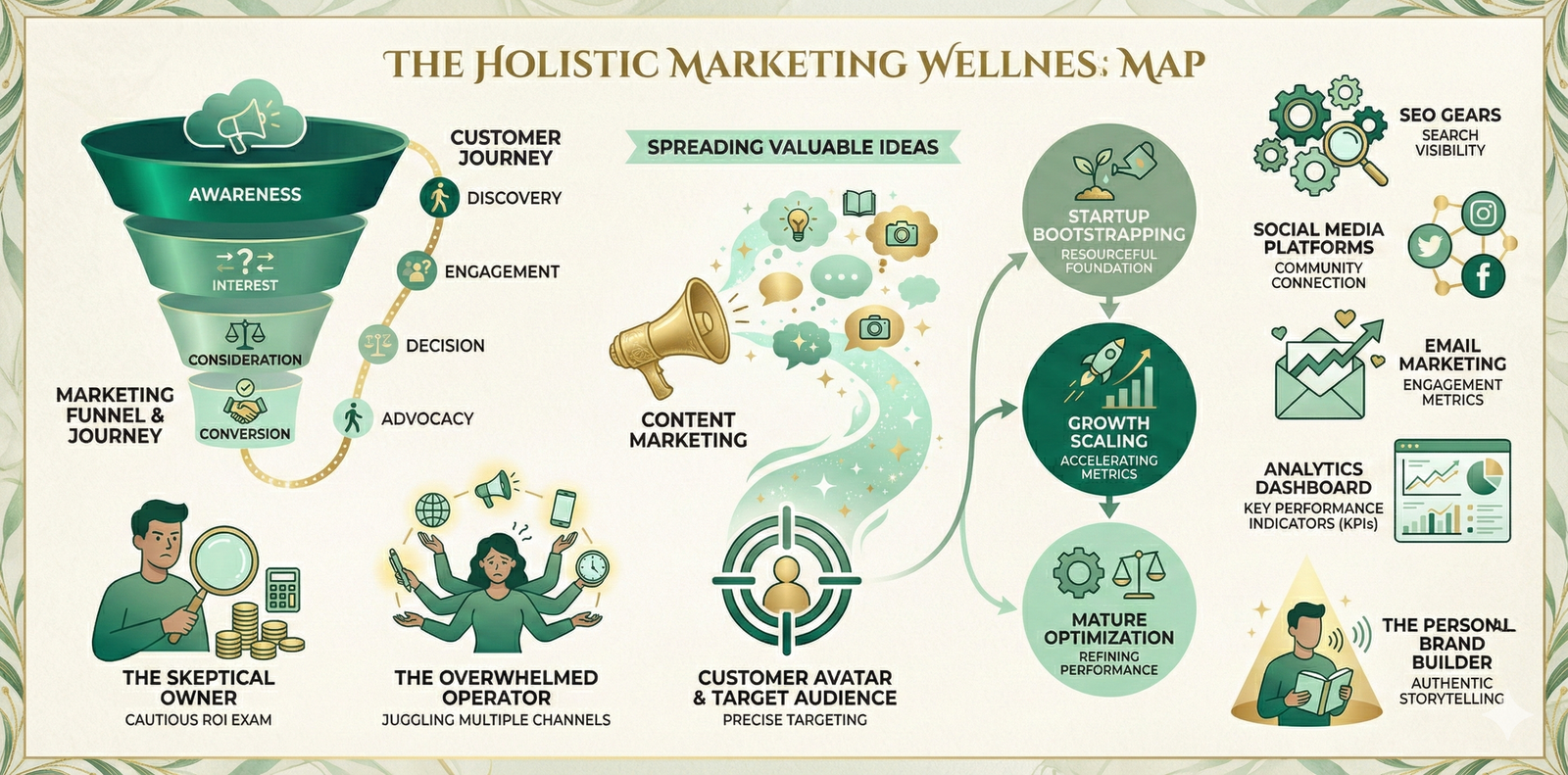
The most successful wealth builders recognize that marketing isn't a cost center; it's an investment in customer relationships that generate returns for years. By mastering strategic marketing, you transform the challenge of customer acquisition into a predictable, scalable system that drives consistent revenue growth.
Whether you're launching your first online business, scaling a service-based company, or building a personal brand, marketing knowledge gives you the competitive edge needed to thrive in an attention-saturated marketplace where standing out means securing your financial future.
¿Qué es el Marketing?
Marketing encompasses all activities your business uses to attract, engage, and convert potential customers into satisfied clients. This includes market research, product positioning, pricing strategy, content creation, advertising, public relations, customer experience design, and relationship management. Effective marketing starts by understanding what your target audience truly needs, not just what you want to sell. It involves crafting compelling messages that resonate emotionally while addressing practical problems, then delivering those messages through channels where your audience naturally spends their attention.
No es consejo médico.
In the context of wealth building, marketing becomes your system for acquiring customers who generate consistent revenue. The lifetime value of customers you successfully acquire through strategic marketing often exceeds your initial investment by 5-10 times. This multiplication effect—where smart marketing investments compound into years of customer relationships—is how businesses transform from survival mode into sustainable, scalable revenue machines that generate wealth even while you sleep.
Surprising Insight: Surprising Insight: According to 2024 research, content marketing costs 62% less than traditional methods yet generates 3 times as many leads, and email marketing delivers an average ROI of 4,200% (or 42 times your investment)—making strategic marketing one of the highest-ROI investments available.
The Customer Relationship Lifecycle
How marketing guides customers from awareness through advocacy, creating lifetime value
🔍 Click to enlarge
Why Marketing Matters in 2026
In today's hyper-connected marketplace, businesses without strategic marketing often fail silently—excellent products never reach their intended customers, and talented professionals struggle to gain visibility. Marketing closes this visibility gap. Companies that implement data-driven marketing strategies grow revenue 2-3 times faster than competitors relying on outdated tactics or hoping word-of-mouth alone will sustain them. In 2026, this gap is widening further as AI, personalization, and automation enable sophisticated marketers to create highly targeted campaigns that deliver exactly the right message to exactly the right person at exactly the right time.
For wealth builders specifically, marketing provides the scalable lever that transforms limited personal time into unlimited customer relationships. A consultant who relies only on personal referrals hits a ceiling—their individual capacity limits growth. But a consultant who masters marketing can create systems (content, email, advertising, partnerships) that work continuously, attracting dozens of clients monthly without requiring their personal attention for each acquisition. This is how marketing creates leverage, and leverage is how individual professionals become significant wealth generators.
The wealth-building opportunity in marketing is also expanding because consumer behavior continues evolving rapidly. By 2025, influencer marketing alone reached a projected $24.1 billion in value, and 76% of consumers now actively avoid brands they don't trust with their data. This creates both a challenge and an opportunity: businesses that master trust-based, personalized, authentic marketing will capture disproportionate market share from competitors still using interruptive, impersonal, outdated tactics.
The Science Behind Marketing
Marketing effectiveness relies on understanding how human psychology, neuroscience, and behavioral economics influence decision-making. Decades of research show that people don't make purchasing decisions based purely on rational analysis—emotions, social proof, authority figures, scarcity, and storytelling trigger decisions far more powerfully than features and specifications. Successful marketing leverages these psychological principles ethically to align customer desires with business offerings.
The science of marketing reveals why certain tactics work consistently: people trust recommendations from peers more than brand claims (social proof), they value what they might lose more than equivalent gains (loss aversion), they follow the lead of perceived authorities in their field (authority bias), and they remember stories more effectively than statistics. These aren't manipulative tricks—they're fundamental truths about how human brains process information and make decisions. Ethical marketing simply applies this understanding to create genuinely helpful messages that reach receptive audiences.
Psychological Triggers in Marketing
Key psychological principles that influence customer decision-making and purchasing behavior
🔍 Click to enlarge
Key Components of Marketing
Customer Research & Segmentation
Understanding your market deeply precedes all effective marketing. This involves researching who your ideal customers are (demographics, psychographics, behaviors), what problems they face, where they seek solutions, and why they choose competitors over alternatives. Customer segmentation divides your broader market into distinct groups with shared characteristics, allowing you to tailor messaging precisely rather than broadcasting generic content. Companies that invest in understanding their customers achieve marketing ROI that's often 10 times higher than competitors using demographic guesswork.
Positioning & Messaging
Positioning is how your business occupies a unique mental real estate in your customer's mind—it's the answer to 'Why should I choose you over alternatives?' Effective positioning identifies your competitive advantage and communicates it through compelling messaging that speaks directly to customer desires and pain points. Your messaging framework creates consistency across all customer touchpoints, from website copy to social media to sales conversations. Weak positioning makes customers perceive your business as interchangeable commodities; strong positioning makes customers perceive genuine differentiation worth premium pricing.
Channel Strategy & Media Mix
Modern marketing requires distributing your message across the channels where your audience actually spends attention. For some businesses, this means LinkedIn and email. For others, it's Instagram, TikTok, YouTube, and podcasts. The most successful marketing strategies match channel selection to audience preferences, then maintain consistent, high-quality presence across those channels. In 2025, omnichannel marketing—coordinating messaging and experience across all touchpoints—outperforms single-channel approaches by 30-40% in customer lifetime value and retention.
Data Analysis & Optimization
Modern marketing is inherently measurable. Every advertisement, email, social post, and website page generates data about how audiences respond. Sophisticated marketers constantly analyze this data to identify what's working, what's failing, and where to reallocate resources. A/B testing (comparing two variations to see which performs better) has become essential practice, enabling continuous improvement in conversion rates, engagement metrics, and customer acquisition costs. Businesses using data-driven optimization consistently outperform competitors relying on intuition.
| Marketing Channel | Average ROI | Best For |
|---|---|---|
| Email Marketing | 4,200% (42x) | Direct engagement with qualified leads |
| Content Marketing | 3x more leads at 62% lower cost | Building authority and organic traffic |
| SEO & Organic Search | Long-term sustained ROI | Capturing high-intent customers |
| Paid Social Media | 3-5x ROI | Targeted reach and brand awareness |
| Influencer Marketing | $5-6 revenue per $1 spent | Trust-building and audience expansion |
| Video Content | 80% higher engagement | Complex explanations and storytelling |
How to Apply Marketing: Step by Step
- Step 1: Identify Your Target Audience: Define exactly who you're trying to reach—their age, income, challenges, aspirations, media consumption habits, and decision-making style. The more specific, the better your targeting and messaging will be.
- Step 2: Research Their Needs & Pain Points: Use surveys, interviews, social media analysis, and industry research to understand what problems your audience faces and what outcomes they desire. This becomes the foundation for all messaging.
- Step 3: Develop Your Unique Positioning: Identify what makes your business genuinely different, better, or uniquely suited to solving your audience's problems. This differentiation becomes your competitive advantage and key messaging pillar.
- Step 4: Craft Your Core Messages: Translate your positioning into 3-5 core messages that resonate emotionally while addressing practical benefits. Each message should answer a specific customer question or concern.
- Step 5: Select Your Marketing Channels: Choose where your audience spends attention (email, social media, podcasts, in-person events, partnerships, etc.). Start with 2-3 channels you can dominate rather than spreading thin across many.
- Step 6: Create Your Content Strategy: Plan what content (blog posts, videos, podcasts, case studies, testimonials, webinars) you'll create monthly to attract, educate, and convert customers. Consistency matters more than perfection.
- Step 7: Set Up Measurement Systems: Define clear metrics for each marketing effort (email open rates, click-through rates, conversion rates, customer acquisition cost, lifetime value). Track everything systematically.
- Step 8: Launch Your Initial Campaigns: Execute your first marketing campaign using the messaging, channels, and content you've prepared. Don't aim for perfection—aim for learning and momentum.
- Step 9: Analyze Results & Iterate: Review performance data weekly, identifying what's generating interest and converting customers, and what's underperforming. Double down on winners and quickly kill underperformers.
- Step 10: Optimize & Scale: As you identify high-performing channels and messages, increase investment and frequency. Let data guide scaling decisions, always maintaining ROI focus while testing new tactics.
Marketing Across Life Stages
Adultez joven (18-35)
Young entrepreneurs typically face resource constraints but possess agility and comfort with digital channels. Marketing strategies should emphasize content creation over paid advertising (leveraging free platforms like social media, blogs, podcasts), personal brand building on LinkedIn and Twitter, community involvement and networking, and strategic partnerships with complementary businesses. This age group thrives on authentic storytelling, educational content, and building visible expertise that attracts opportunities and customers.
Edad media (35-55)
Established business owners and professionals often have deeper budgets and existing customer relationships. Marketing strategies should transition toward sophisticated segmentation and personalization, account-based marketing targeting high-value customers, thought leadership positioning, strategic partnerships with established organizations, and investing in paid channels where ROI is proven. This phase emphasizes retention of existing customers and leverage of authority built over years.
Adultez tardía (55+)
Entrepreneurs approaching transition or legacy phases should focus marketing on value demonstration, premium positioning reflecting expertise and track record, mentorship positioning that attracts next-generation partnerships, and building durable assets (content libraries, courses, advisory networks) that generate ongoing revenue independent of active marketing effort. This phase often emphasizes transition planning and wealth consolidation rather than pure growth.
Profiles: Your Marketing Approach
The Skeptical Owner
- Proof that marketing ROI justifies investment
- Clear connection between marketing activities and revenue
- Metrics and data demonstrating business impact
Common pitfall: Viewing marketing as expense rather than investment, abandoning strategies before they reach profitability
Best move: Start with one high-ROI channel (email or content), measure rigorously, then scale what works with confidence
The Overwhelmed Operator
- Simple, systematic approach to marketing
- Clear prioritization of what matters most
- Time-efficient tactics that don't require constant effort
Common pitfall: Trying to master every marketing tactic, feeling scattered and producing mediocre results across many channels
Best move: Choose one core channel and go deep with excellence; systematize processes using templates and automation
The Growth Enthusiast
- Advanced strategies for scaling marketing impact
- Experimentation with emerging platforms and tactics
- Leadership team and systems to execute sophisticated campaigns
Common pitfall: Chasing trends and new platforms instead of optimizing proven channels, fragmenting resources
Best move: Master fundamentals across all channels first, then selectively experiment with cutting-edge tactics in predictable ways
The Personal Brand Builder
- Authority positioning and visibility
- Content distribution across multiple platforms
- Strategic networking and partnership opportunities
Common pitfall: Creating content without strategic purpose, building audience but not converting to business results
Best move: Build content strategy around specific business objectives; connect visibility directly to offers and revenue
Common Marketing Mistakes
One of the most frequent mistakes is marketing before clearly understanding your customer. Businesses spend significant resources broadcasting messages without researching what their audience actually needs, resulting in excellent marketing that reaches the wrong people or sends the wrong message. The antidote is simple but powerful: spend time understanding your customer better than your competitors do, and let that understanding drive every message and channel choice.
Another widespread mistake is abandoning marketing tactics too early. Most marketing strategies require 3-6 months of consistent execution before reaching profitability. Businesses that give up after 4 weeks, declaring 'that strategy doesn't work,' never experience the compounding returns that make marketing such a powerful wealth-building tool. Effective marketing requires patience combined with data analysis to know when a strategy genuinely isn't working versus when it simply needs more time and refinement.
A third critical mistake is focusing exclusively on customer acquisition while neglecting retention. Acquiring new customers costs 5-25 times more than retaining existing ones, yet many businesses obsess over acquisition. The best wealth-building marketing strategies balance new customer acquisition with systematic retention of existing customers, recognizing that maximizing customer lifetime value through loyalty and repeat purchases generates far greater returns than constantly chasing new faces.
From Marketing Investment to Wealth
How consistent marketing effort compounds into sustainable business growth and wealth generation
🔍 Click to enlarge
Ciencia y estudios
Research consistently demonstrates that strategic marketing investment correlates strongly with business growth, profitability, and competitive advantage. Multiple longitudinal studies from universities and research firms show that businesses implementing data-driven marketing strategies grow revenue 2-3 times faster than competitors, and that marketing ROI compounds over time as brand awareness and customer relationships mature.
- HubSpot's 2024 Marketing Statistics: Content marketing costs 62% less than traditional marketing while generating 3 times more leads, making it one of the highest-ROI investments available to businesses seeking sustainable growth.
- Statista Digital Marketing Report 2024: Email marketing delivered an average ROI of 4,200% (42 times investment), making it consistently the highest-performing marketing channel across industries and business models.
- McKinsey Study: Companies implementing advanced marketing personalization techniques and omnichannel strategies achieved 30-40% higher customer lifetime value and retention compared to competitors using traditional approaches.
- Forrester Research 2024: 80% of marketers planned to significantly increase AI integration in 2025, indicating industry-wide shift toward data-driven, personalized marketing as competitive necessity.
- LinkedIn Economic Graph 2024: Companies with active personal brands and thought leadership positioning reported 40% faster revenue growth and 28% higher profit margins compared to industry peers lacking visibility.
Tu primer micro hábito
Comienza pequeño hoy
Today's action: Today, spend 30 minutes writing down the top 3 problems your ideal customers face, then write one social media post or email addressing one of those problems with genuinely helpful advice. No selling—just providing value. Post it immediately.
This micro habit connects you directly to marketing's core principle: serving customer needs. By starting with value creation rather than sales, you build the habit of customer-centric thinking that makes all future marketing efforts dramatically more effective. This single action compounds: each valuable piece of content builds authority, attracts attention, and creates touchpoints where customers learn to trust you.
Track your micro habits and get personalized AI coaching with our app.
Evaluación rápida
How would you describe your current approach to marketing your business or service?
Your answer reveals your starting point for marketing mastery. Those beginning with word-of-mouth often have the biggest breakthrough potential when they systematize their approach. Those struggling with measurement need to start here. Those already successful are ready to optimize and scale.
What's your biggest obstacle when it comes to marketing your business?
This identifies where you need to focus first. Audience research resolves obstacle one. Messaging strategy resolves obstacle two. Analytics and measurement resolve obstacle three. Creative resourcefulness and high-ROI tactics resolve obstacle four. Focus on your primary obstacle before expanding to others.
How much time are you currently investing in marketing weekly?
Time investment in marketing typically correlates with results. Those investing 15+ hours weekly often see significant growth within 3-6 months. If you're below that threshold, success depends heavily on channel selection and strategic focus rather than broad effort.
Take our full assessment to get personalized recommendations.
Descubre Tu Estilo →Preguntas frecuentes
Próximos pasos
Your next step is identifying which marketing channel aligns best with your strengths and your customer's preferences. Rather than trying to master every channel simultaneously, choose one—whether email, content marketing, social media, paid advertising, or networking—and commit to three months of focused execution with rigorous metric tracking. Within that timeframe, you'll have clear data showing what's working and what needs adjustment.
From there, the path becomes clearer: double down on high-performing channels, implement systematic optimization, and gradually expand to complementary channels as your foundation strengthens. Remember that marketing success compounds over time. The consistency you build today becomes the momentum that carries your business forward for years. Every piece of content, every email, every genuine customer connection becomes part of a growing ecosystem attracting customers, building loyalty, and generating sustainable revenue growth.
Get personalized guidance with AI coaching.
Comienza Tu Viaje →Research Sources
This article is based on peer-reviewed research and authoritative sources. Below are the key references we consulted:
Related Glossary Articles
Frequently Asked Questions
How much should I invest in marketing as a percentage of revenue?
Industry standards range from 3-15% of revenue depending on business model, competitive intensity, and growth stage. Early-stage businesses typically allocate 10-15%, established businesses 3-7%. Focus less on percentage and more on ROI—if marketing generates 3-5x returns, it's a worthy investment regardless of percentage.
How long before I see results from marketing efforts?
Most marketing strategies require 3-6 months of consistent execution before reaching profitability. Paid advertising can show results in weeks, while content marketing and organic strategies take longer to compound. The key is patience combined with data analysis—track metrics weekly but evaluate strategy success over 3-6 month timeframes.
Which marketing channels should I focus on first?
Choose channels where your target audience spends attention and where you have some competitive advantage. If you're naturally written communication, start with email and content. If you're comfortable on video, start with YouTube or TikTok. If you're a connector, start with LinkedIn and networking. Depth in one channel beats shallow presence in many.
How do I measure whether my marketing is actually working?
Establish clear metrics before launching: traffic sources, email open rates, conversion rates, customer acquisition cost, and customer lifetime value. Use unique tracking codes for different campaigns so you can attribute revenue to specific marketing efforts. Build a simple dashboard reviewing these metrics weekly.
Can marketing work for service businesses and solo practitioners, not just companies?
Absolutely. In fact, service businesses and solo practitioners often see higher marketing ROI than product companies because their barriers to entry are lower and their personal brand becomes a competitive advantage. The principles remain identical: know your customer, communicate clear value, be consistent, measure results.
Take the Next Step
Ready to improve your wellbeing? Take our free assessment to get personalized recommendations based on your unique situation.
- Discover your strengths and gaps
- Get personalized quick wins
- Track your progress over time
- Evidence-based strategies