Exercise
Exercise is planned, structured physical activity performed with the intention to improve or maintain fitness, health, and wellbeing. Whether you're walking, running, swimming, lifting weights, or practicing yoga, exercise fundamentally transforms how your body functions at every level—from your cardiovascular system to your brain chemistry. Regular physical activity reduces risk of over 250 diseases, enhances mental clarity, builds resilience, and adds years to your life. The science is clear: moving your body intentionally is one of the most powerful medicines available, accessible to almost everyone regardless of age or current fitness level.
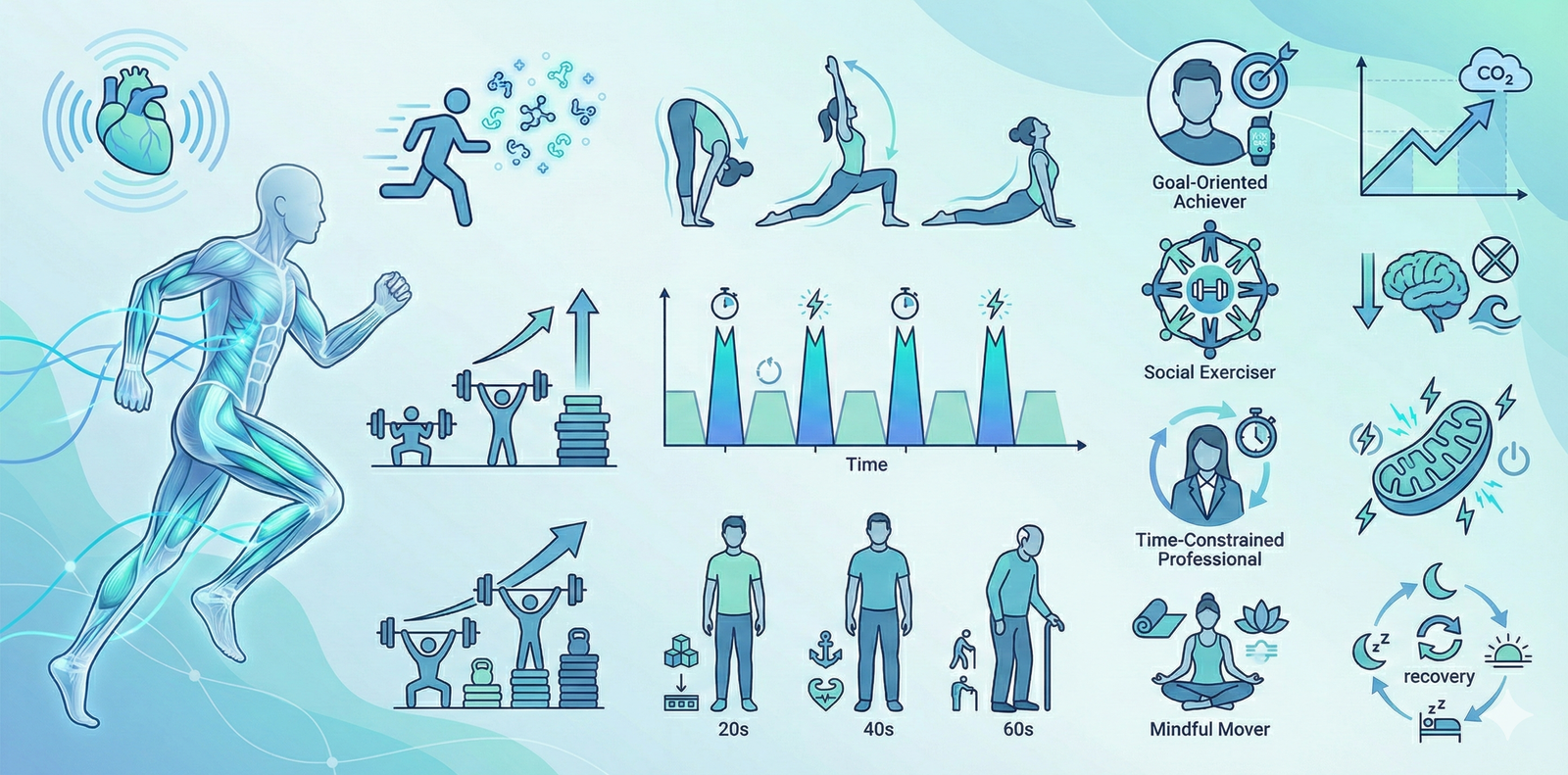
Every time you exercise, you trigger cascades of positive changes: blood vessels dilate, muscles strengthen, and your brain releases endorphins that elevate mood immediately and protect cognitive function long-term.
The benefits compound over time—consistent exercisers have healthier hearts, sharper minds, better sleep, and stronger immune systems than sedentary peers.
What Is Exercise?
Exercise is deliberate, structured physical activity designed to improve or maintain fitness. It differs from casual activity because it follows a plan, has specific intensity and duration, and targets particular fitness goals like strength, endurance, flexibility, or cardiovascular capacity. Exercise can be aerobic (walking, running, swimming), resistance-based (weight training, bodyweight exercises), flexibility-focused (yoga, stretching), or a combination. The key distinction is intentionality—you're purposefully moving your body in ways that stress your systems positively, prompting adaptation and improvement.
No es asesoramiento médico.
Modern research confirms that exercise isn't just about looking fit or losing weight. It's a systemic intervention that touches virtually every organ system. When you exercise, your muscles demand energy, pulling glucose from your bloodstream and improving insulin sensitivity. Your heart pumps harder, strengthening the cardiac muscle and improving circulation. Your brain releases BDNF (brain-derived neurotrophic factor), a protein critical for learning and memory. Your immune system gets boosted. Even your telomeres—the protective caps on your chromosomes—lengthen with consistent exercise, literally slowing cellular aging.
Surprising Insight: Perspectiva Sorprendente: People who exercise regularly reduce their risk of developing over 250 different diseases compared to sedentary individuals, with the largest reductions in cardiovascular disease, type 2 diabetes, and metabolic disorders.
How Exercise Transforms Your Body
The multi-system benefits of regular physical activity
🔍 Click to enlarge
Why Exercise importa en 2026
In 2026, sedentary lifestyles remain a leading cause of preventable disease and early death worldwide. With most people spending 8+ hours daily sitting at desks or in front of screens, the physical and mental health consequences are escalating. Exercise is the antidote—yet 31% of adults and 80% of adolescents don't meet minimal activity recommendations. This creates massive opportunity: those who prioritize exercise gain immediate advantages in energy, mood, cognitive performance, and long-term disease prevention.
Mental health crisis research from 2025 shows exercise rivals medication for treating depression and anxiety. Organizations like the CDC, American Heart Association, and WHO increasingly position exercise not as optional lifestyle enhancement but as essential preventive medicine. The time investment is small—150 minutes weekly yields measurable improvements in cardiovascular health, weight management, bone density, and mental resilience.
Personalization matters more in 2026 as research reveals different exercise responses between genders, ages, and genetic backgrounds. Women realize greater mortality reduction from regular exercise than men. Older adults see remarkable improvements in functional capacity and fall prevention. Young people who establish exercise habits now build protection against dozens of age-related diseases. Exercise isn't a one-size-fits-all intervention—it's a personalized health tool that meets you where you are and adapts as you evolve.
La Ciencia Detrás de Exercise
Exercise creates acute and chronic physiological adaptations. During a single workout session, your muscles contract, demanding oxygen and glucose. Your heart rate increases to deliver oxygen-rich blood. Your sympathetic nervous system activates, releasing adrenaline and cortisol. Metabolically, you burn calories and deplete muscle glycogen. Your core temperature rises, triggering sweat production. These acute changes are just the beginning.
With consistent exercise over weeks and months, your body makes permanent structural and functional changes. Your cardiovascular system becomes more efficient—your resting heart rate drops as your heart strengthens. Your mitochondria (the energy factories in your cells) multiply in number and improve in efficiency. Muscle fibers experience protein synthesis, building strength and size. Your metabolic rate increases. Your body becomes more insulin-sensitive, improving glucose control. At the neurological level, regular exercise increases BDNF, promotes neuroplasticity, and may even generate new neurons in the hippocampus. Your immune system strengthens, improving pathogen defense and reducing chronic inflammation.
Exercise Adaptations: Hours to Months
Timeline of physiological changes from acute to chronic exercise
🔍 Click to enlarge
Componentes Clave of Exercise
Aerobic Exercise
Aerobic exercise (cardio) involves continuous, rhythmic activity using large muscle groups while maintaining elevated heart rate. Examples include walking, running, cycling, swimming, dancing, and rowing. Aerobic exercise strengthens your cardiovascular system, improves oxygen transport, burns calories, and enhances endurance. Current guidelines recommend 150 minutes of moderate-intensity aerobic activity weekly (or 75 minutes of vigorous intensity). Moderate intensity means your heart beats faster, you breathe harder, but can still talk. Vigorous intensity elevates your breathing so much that talking becomes difficult. Aerobic exercise reduces risk of heart disease, stroke, hypertension, diabetes, and obesity.
Resistance Training
Resistance training uses external load (weights, bands, bodyweight) to challenge muscles, building strength and muscle mass. Examples include weight lifting, resistance bands, push-ups, and squats. Resistance training triggers muscle protein synthesis, increases metabolic rate, improves bone density, and enhances functional capacity. Guidelines recommend 2+ days weekly of muscle-strengthening activity. Resistance training is critical for all ages—young people build strength for future capacity, older adults prevent age-related muscle loss (sarcopenia) and maintain independence, and everyone benefits from improved metabolism and injury prevention through stronger support structures.
Flexibility and Mobility
Flexibility training includes stretching, yoga, Pilates, and tai chi—activities that enhance range of motion, joint mobility, and movement quality. These practices improve posture, reduce injury risk, enhance balance and proprioception, and provide stress relief. Many flexibility practices have meditative components, reducing anxiety and promoting mental calm. Flexibility work should be incorporated 2-3 times weekly or daily for optimal joint health and movement quality. As you age, flexibility becomes increasingly important for maintaining functional independence and preventing falls.
High-Intensity Interval Training (HIIT)
HIIT involves short bursts of maximum effort exercise alternated with recovery periods. For example, 30 seconds of sprinting followed by 90 seconds of walking, repeated for 15-20 minutes total. HIIT is time-efficient and produces exceptional cardiovascular and metabolic adaptations. Research shows HIIT improves aerobic capacity, burns more calories than steady-state cardio, enhances insulin sensitivity, and may improve cognitive function. HIIT is effective for individuals with limited time but requires proper progression to reduce injury risk.
| Exercise Type | Primary Benefits | Recommended Duration/Frequency |
|---|---|---|
| Aerobic Exercise | Cardiovascular health, endurance, calorie burn, disease prevention | 150 min/week moderate or 75 min/week vigorous |
| Resistance Training | Strength, muscle mass, metabolism, bone density, functional capacity | 2+ days/week, major muscle groups |
| Flexibility/Yoga | Range of motion, injury prevention, stress relief, balance | 2-3 times/week or daily |
| HIIT | Time-efficient cardio, metabolic boost, insulin sensitivity | 1-2 times/week, 15-30 minutes |
Cómo Aplicar Exercise: Paso a Paso
- Step 1: Start where you are: Choose an activity you enjoy (walking, dancing, swimming, cycling) rather than something you think you should do. Enjoyment predicts long-term adherence.
- Step 2: Begin conservatively: If sedentary, start with 10-20 minutes daily. If exercising already, gradually add intensity or duration. Your body adapts to progressive overload, not sudden extremes.
- Step 3: Establish aerobic baseline: Aim for 150 minutes of moderate-intensity activity weekly. This is the minimum threshold for significant health benefits.
- Step 4: Add resistance training: Include 2+ days weekly of muscle-strengthening exercises. Start bodyweight (push-ups, squats) or light weights, focusing on proper form.
- Step 5: Incorporate flexibility: Add 10-15 minutes daily of stretching or yoga to improve mobility and reduce injury risk. This is often neglected but crucial.
- Step 6: Monitor intensity: Use the 'talk test'—during moderate intensity, you should be able to talk but not sing. During vigorous intensity, speaking is difficult.
- Step 7: Track consistency: Mark your calendar or use an app to log workouts. Consistency matters more than intensity. Missing two days is a break; missing three becomes a new habit.
- Step 8: Rest and recover: Include 1-2 rest days weekly for recovery and injury prevention. Sleep is when adaptation occurs—prioritize 7-9 hours nightly.
- Step 9: Adjust based on results: After 4 weeks, assess how you feel. More energy? Better sleep? Less anxiety? These subjective improvements matter as much as physical changes.
- Step 10: Periodize your training: Every 4-6 weeks, change your routine to prevent adaptation plateau. Different exercises, intensities, or durations keep your body responding positively.
Exercise A lo Largo de las Etapas de la Vida
Adultez joven (18-35)
Young adults can build athletic capacity, strength, and cardiovascular base that protect health for decades. This stage is optimal for exploring diverse activities and establishing lifelong habits. Focus on building strength and aerobic capacity while establishing exercise identity. Young adults who exercise 150+ minutes weekly gain psychological benefits (improved mood, reduced anxiety, better focus) alongside physical improvements. Athletic investment now returns dividends throughout adulthood—every pound of muscle built now reduces age-related muscle loss later, and cardiovascular fitness established in youth persists even if fitness declines in middle age.
Edad media (35-55)
Middle-aged adults increasingly battle sedentary schedules and metabolic changes. Exercise becomes prevention medicine for the health challenges of aging—cardiovascular disease, diabetes, cognitive decline, joint degradation. Resistance training is critical now to combat natural muscle loss. Aerobic exercise helps manage weight despite metabolic slowdown. Flexibility work prevents injury and maintains functional capacity. Many middle-aged adults report that consistent exercise is the single factor separating their health trajectory from peers. Exercise also buffers against work stress and improves sleep quality—benefits that compound through demanding life phases.
Adultez tardía (55+)
Older adults gain remarkable benefits from exercise—improved balance and strength reduce fall risk and maintain independence, cognitive benefits of exercise slow mental aging, cardiovascular exercise reduces disease risk, and resistance training combats sarcopenia. Exercise-induced adaptations remain powerful at any age; older adults who exercise show significantly better health outcomes than sedentary peers. Social exercise (group classes, walking clubs) provides mental health benefits alongside physical gains. Starting exercise late is never too late—sedentary 65-year-olds who begin exercising see rapid improvements in strength, balance, and functional capacity within weeks.
Profiles: Your Exercise Approach
The Goal-Oriented Achiever
- Specific, measurable fitness targets (complete 5K, lift bodyweight, increase endurance)
- Structured programs with progression (couch-to-5K, periodized strength training)
- Progress tracking and visible metrics to maintain motivation
Common pitfall: Overtraining from enthusiasm, skipping recovery days, pursuing goals at expense of sustainability
Best move: Create 3-month goals with built-in recovery weeks; celebrate non-scale victories like improved energy and sleep
The Social Exerciser
- Group activities and community (group classes, team sports, walking clubs)
- Accountability through social commitment and shared goals
- Enjoyment and social connection alongside physical benefit
Common pitfall: Activity becomes dependent on others' schedules; motivation drops when group dissolves
Best move: Build core solo habit while using group activities for motivation boost; develop multiple activity options
The Time-Constrained Professional
- Efficient workouts (HIIT, combined strength-cardio sessions, 20-30 minute programs)
- Flexible scheduling that fits busy life (home workouts, lunchtime classes, early mornings)
- Minimal setup and maximum results to justify time investment
Common pitfall: Skipping 'short workouts' thinking they're not worth it; all-or-nothing mentality kills consistency
Best move: Embrace movement snacking—research shows shorter, frequent sessions build momentum; schedule workouts like meetings
The Mindful Mover
- Mind-body connection emphasis (yoga, tai chi, hiking, swimming with focus)
- Stress relief and mental clarity as primary goals alongside physical fitness
- Intrinsic motivation rather than external metrics or competition
Common pitfall: Underestimating strength and endurance benefits; missing cardiovascular training targets
Best move: Add 1-2 days weekly of intentional aerobic or resistance work to complement flexibility practice
Common Exercise Mistakes
The most common mistake is starting too hard and burning out. Many people launch intense exercise programs inspired by January resolutions, only to quit after 2-3 weeks when muscle soreness, fatigue, or injury intervenes. Starting conservatively—10-20 minutes, moderate intensity—ensures sustainability. Building slowly is faster than burning out and restarting repeatedly.
Another critical error is ignoring recovery. Many exercisers believe more is always better, training hard daily without rest days. This leads to overtraining syndrome—elevated resting heart rate, poor sleep, increased illness, and burnout. Your body adapts during recovery, not during exercise. Two rest days weekly and 7-9 hours nightly sleep are non-negotiable for results.
Finally, many people exercise without addressing foundational health—poor sleep, chronic stress, inadequate nutrition, and hydration undermine exercise benefits. You can't out-exercise a bad diet or sleep deficit. Exercise functions within the broader health system—prioritize sleep, nutrition, and stress management alongside training.
The Exercise Mistake Cascade
How common mistakes derail fitness progress
🔍 Click to enlarge
Ciencia y estudios
Recent research establishes exercise as foundational to health across the lifespan. September 2024 NIH findings show people who exercise reduce their risk of developing 250+ different diseases compared to sedentary individuals. The largest reductions were cardiovascular diseases, type 2 diabetes, metabolic syndrome, and obesity-related conditions. Women experience greater mortality reduction from exercise than men, and research on sex differences reveals how female physiology responds uniquely to training.
- National Institutes of Health (2024): Different exercise patterns bring measurable health benefits, with significant risk reductions for cardiovascular, metabolic, and chronic diseases
- WHO Physical Activity Guidelines: 150 minutes moderate-intensity or 75 minutes vigorous-intensity aerobic activity weekly, plus 2+ days resistance training, optimizes health outcomes
- PMC (2024): Regular physical activity improves mental health markers including depression, anxiety, cognitive function, and psychological well-being across all populations
- Stanford Medicine (2023): Exercise induces whole-body health benefits through systemic activation of cardiovascular, metabolic, neurological, and immune systems
- CDC Physical Activity Research (2025): Exercise snacks (short activity bouts throughout day) effectively improve body composition and metabolic health in sedentary individuals
Tu primer micro hábito
Comienza pequeño hoy
Today's action: Take a 10-minute walk today. Choose a route you enjoy—neighborhood, park, or even indoors. Notice how you feel before and after.
Walking is the most accessible exercise—no equipment, no skills required, proven benefits. A single 10-minute walk shifts your neurochemistry positively, improves circulation, and begins building habit. Micro habits feel manageable and create momentum. Succeeding at small commitments builds identity as 'someone who exercises,' making larger commitments natural.
Rastrea tus micro hábitos y obtén coaching personalizado con nuestra aplicación.
Evaluación rápida
How much exercise do you currently get weekly?
Your current baseline matters. Sedentary individuals gain the most dramatic health improvements from beginning any exercise. Those already active benefit most from intensity increase or adding neglected components (resistance, flexibility).
What exercise format appeals to you most?
Choosing activities you genuinely enjoy predicts long-term adherence more than any other factor. Exercise programs that match your preferences become sustainable; mismatched approaches fail despite good intentions. Your personality and preferences should guide format selection.
What's your biggest obstacle to consistent exercise?
Identifying your specific barrier is crucial. Time constraints require HIIT and home workouts. Physical limitations need modified movements. Low motivation needs identity-based habits and social support. Access issues need creativity (YouTube, bodyweight, outdoor spaces). Solutions exist for every barrier.
Completa nuestra evaluación para obtener recomendaciones personalizadas.
Descubre Tu Estilo →Preguntas frecuentes
Próximos pasos
Exercise is not optional self-care—it's foundational medicine. The science is overwhelming: regular physical activity prevents disease, enhances mental health, improves sleep, builds resilience, and extends lifespan. The question isn't whether you can find time for exercise; it's whether you can afford not to. Every day of inactivity compounds negative effects, while every day of movement builds positive adaptation.
Start where you are, with what you have, doing what you enjoy. A 10-minute walk today is better than planning a perfect 60-minute workout next week. Build consistency through small wins. Track how you feel—energy, sleep, mood, focus—not just physical changes. These subjective improvements often motivate better than scale numbers or metrics. Within weeks, exercise becomes identity, not obligation. You'll move not because you feel you should, but because you feel dramatically better when you do.
Obtén orientación personalizada con coaching de IA.
Comienza Tu Viaje →Research Sources
This article is based on peer-reviewed research and authoritative sources. Below are the key references we consulted:
Related Glossary Articles
Frequently Asked Questions
How much exercise do I really need?
Current guidelines recommend 150 minutes weekly of moderate-intensity aerobic activity (or 75 minutes vigorous) plus 2+ days of resistance training. That's about 30 minutes daily, 5 days per week. However, something is always better than nothing—even 30 minutes daily provides significant health benefits.
I've never exercised. Is it safe to start?
For most people, exercise is extremely safe. Start conservatively (10-20 minutes, moderate intensity) and build gradually. If you have pre-existing health conditions, discuss with your healthcare provider. Most sedentary people gain safety from exercise, not danger.
How long before I see results?
Mental benefits (improved mood, better sleep) appear within 2-3 weeks. Physical changes (visible muscle, significant weight loss) take 6-8 weeks with consistent effort. Cardiovascular improvements show within 4-6 weeks. Metabolic changes extend over months, but cellular adaptations begin immediately.
Should I exercise if I'm sore from a previous workout?
Light movement like walking or gentle stretching actually helps soreness. Skip intense training of sore muscles, but other muscle groups can be trained. Next-day soreness (DOMS) is normal with new exercise and decreases quickly as your body adapts.
Is it better to exercise at a specific time of day?
Morning and evening both have benefits. Morning exercise boosts mood and focus all day; evening exercise can improve sleep if not too close to bedtime. The best time is whenever you'll actually do it consistently. Habit formation requires consistency, not optimal timing.
Take the Next Step
Ready to improve your wellbeing? Take our free assessment to get personalized recommendations based on your unique situation.
- Discover your strengths and gaps
- Get personalized quick wins
- Track your progress over time
- Evidence-based strategies