Proprioception
Close your eyes and touch your nose with your finger. You probably did it without hesitation—maybe even wondering why we asked. That instant, effortless ability to know where your finger is in space, without looking, is proprioception at work. Your body possesses a sophisticated internal navigation system that constantly monitors position, movement, and force across every muscle and joint. This sensory superpower operates silently in the background, yet it's absolutely critical for everything from athletic performance to preventing falls as we age. Most people never think about proprioception until something goes wrong—a twisted ankle, poor balance, or that feeling of clumsiness. Understanding how this hidden sense works, and how to strengthen it, can transform your coordination, resilience, and confidence in movement.
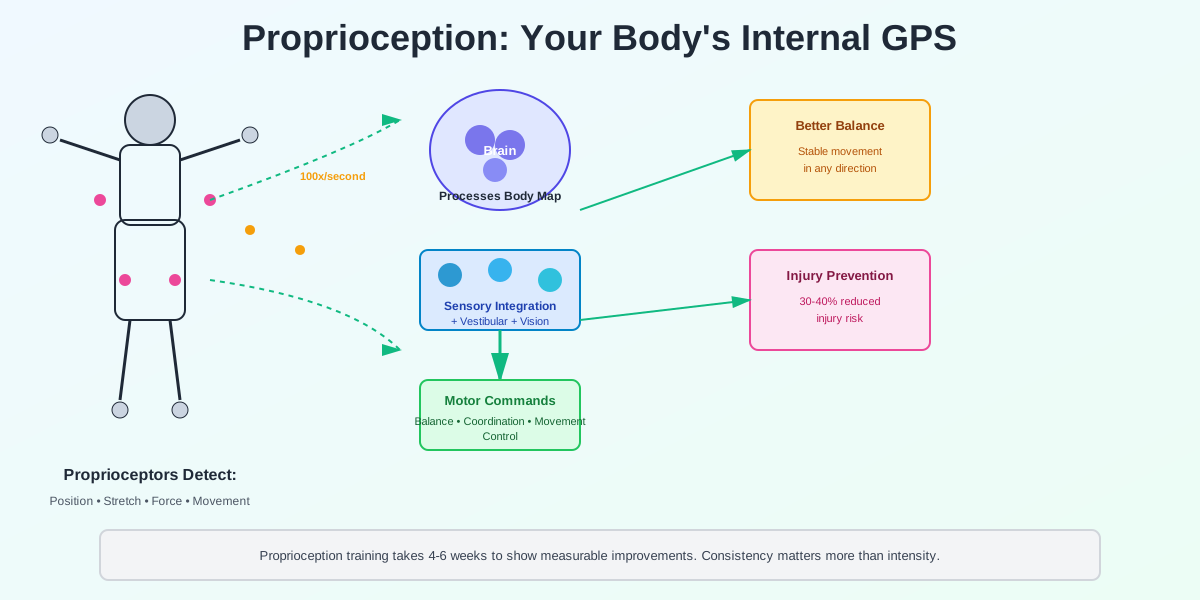
In this guide, we'll explore the science behind your body's internal GPS, discover why proprioception matters more now than ever, and learn practical exercises to enhance your spatial awareness and movement control.
By the end, you'll understand how professional athletes and rehabilitation specialists use proprioceptive training to prevent injury and boost performance—and how you can apply these insights to your own daily life.
What Is Proprioception?
Proprioception is your body's ability to sense its own position, movement, and the forces acting upon it—all without relying on vision. The term itself comes from Latin: 'proprius' meaning 'one's own' and 'capere' meaning 'to take or grasp.' Together, it literally means 'to grasp one's own' body in space. Often called your 'sixth sense,' proprioception works continuously, automatically, and usually invisibly, coordinating your muscles and joints to maintain balance, posture, and smooth movement.
Not medical advice.
Proprioception is fundamentally different from your other senses. While vision, hearing, taste, smell, and touch gather information about the external world, proprioception looks inward—monitoring the internal state of your body. It's the reason you can walk down stairs without staring at each step, why athletes can catch balls without conscious calculation, and why you maintain balance when the floor shifts unexpectedly.
Surprising Insight: Surprising Insight: Research from NIH neuroscientists reveals that proprioceptive neurons work so efficiently that your brain knows the exact position of every joint, the tension in every muscle, and the speed of every movement—all processed faster than conscious thought. This happens roughly 100 times per second.
The Proprioceptive System Architecture
This diagram shows how proprioceptors throughout the body send position and movement signals to the spinal cord and brain, creating a real-time map of body state.
🔍 Click to enlarge
Why Proprioception Matters in 2026
In an increasingly sedentary world where many of us spend hours sitting, our proprioceptive systems are declining. Research from the American Physiological Society shows that proprioceptive acuity naturally decreases with age—but inactivity accelerates this loss significantly. Young adults who spend most of their time on screens and in chairs show proprioceptive deficits previously seen only in older populations. This matters because weak proprioception directly increases fall risk, injury susceptibility, and poor posture.
At the same time, elite athletes, military special forces, and top rehabilitation programs have discovered that proprioceptive training delivers measurable improvements in performance and injury prevention. Studies published in the Journal of Sports Science and Medicine confirm that structured proprioceptive exercises reduce ankle injuries by up to 40%, enhance agility, and accelerate recovery from trauma.
Beyond athletics, proprioception is experiencing a renaissance in neuroscience research. NIH-funded studies now explore how proprioceptive training helps stroke survivors regain coordination, supports Parkinson's disease management, and even assists with certain cognitive challenges. As an individual, strengthening your proprioception is one of the highest-return-on-investment health interventions you can pursue—it requires minimal equipment, can be done anywhere, and benefits virtually every physical activity from walking to dancing to work.
The Science Behind Proprioception
Proprioception relies on specialized sensory receptors called proprioceptors distributed throughout your muscles, tendons, joints, and ligaments. These aren't eyes or ears—they're tiny neural sensors that detect mechanical changes: stretch, tension, pressure, and movement. When you move, these receptors fire signals that travel through peripheral nerves to your spinal cord and brain at incredible speed.
The main proprioceptors are muscle spindles (detecting muscle length and rate of stretch), Golgi tendon organs (detecting force and tension), and joint receptors (detecting joint angle and velocity). These three types work in concert like a sophisticated surveillance network, each specialized for different aspects of movement. Your brain integrates all these signals into a continuously updated 'body schema'—an internal map of where your body is and what it's doing. This happens so fast and so automatically that you experience it as simple, intuitive movement.
Proprioceptive Pathways: From Sensor to Movement
This pathway shows how proprioceptive information flows from sensors in muscles and joints through the nervous system to generate coordinated movement and postural control.
🔍 Click to enlarge
Key Components of Proprioception
Muscle Spindles: The Length Detectors
Muscle spindles are the most abundant proprioceptors, embedded directly within skeletal muscle fibers. They're exquisitely sensitive to changes in muscle length and the speed of that change. When you stretch a muscle, spindles immediately signal how much and how fast it's being stretched. This information is so critical that the spinal cord doesn't wait for brain approval to respond—it triggers an automatic stretch reflex that contracts the muscle to prevent overstretching. That's why when a doctor taps your knee tendon, your leg automatically kicks—the spindle detects sudden stretch and fires back before consciousness even registers.
Golgi Tendon Organs: The Force Sensors
Located where muscles attach to tendons, Golgi tendon organs (GTOs) sense tension and force. Unlike muscle spindles that detect length, GTOs monitor how hard the muscle is contracting. They're particularly sensitive to excessive force—if you're lifting something too heavy, GTOs signal the spinal cord to inhibit muscle contraction as a protective mechanism. This prevents injury from overloading. Athletes who engage in heavy resistance training actually improve GTO sensitivity through repeated exposure, which paradoxically helps them lift heavier weights safely. GTOs represent your body's built-in load monitoring system.
Joint Receptors: The Position Sensors
Your joints contain low-threshold mechanoreceptors embedded in joint capsules, ligaments, and surrounding tissues. These sensors detect joint angle, direction of motion, and velocity of movement. They're less sensitive than muscle spindles but crucial for detecting extreme joint positions and preventing you from moving into dangerous ranges. When you attempt an unnatural position, joint receptors signal 'stop'—that sensation of 'I can't twist my ankle that way' comes from these specialized sensors.
Integration in the Nervous System
What makes proprioception remarkable is how the nervous system integrates all these signals in real time. Information from muscle spindles, GTOs, and joint receptors converges in the spinal cord and brain, where it's combined with vestibular input (from your inner ear) and visual information to create a unified sense of body position and movement. This multi-sensory integration happens automatically, updating roughly 100 times per second. The cerebellum—your brain's coordination center—uses this constant stream of proprioceptive data to fine-tune movement and maintain balance.
| Proprioceptor Type | Location | What It Senses | Response Time |
|---|---|---|---|
| Muscle Spindles | Within muscle fibers | Muscle length and rate of stretch | Very fast (reflex-level) |
| Golgi Tendon Organs | Muscle-tendon junction | Tension and force production | Fast (protective) |
| Joint Receptors | Joint capsules and ligaments | Joint angle, direction, velocity | Moderate (protective) |
| Integrated Awareness | Central nervous system | Complete body position and movement | Continuous (100 times/second) |
How to Apply Proprioception: Step by Step
- Step 1: Assess your current proprioceptive baseline by performing the 'single-leg stance test'—stand on one leg with eyes open for 30 seconds, then repeat with eyes closed. Notice any difference in stability.
- Step 2: Begin with static balance exercises on stable ground. Stand on one leg for 10-15 seconds, focusing on feeling your foot's contact with the ground and micro-adjustments in your core and ankle.
- Step 3: Progress to dynamic balance by adding arm movements while standing on one leg—reach your opposite arm forward, sideways, and diagonally while maintaining balance.
- Step 4: Introduce unstable surfaces once basic exercises feel easy. Use a BOSU ball, balance board, or foam pad to challenge your proprioceptive system with a moving base.
- Step 5: Add cognitive load to make proprioceptive training functional. Perform balance exercises while reciting numbers backward or catching a soft ball.
- Step 6: Practice tandem stance (one foot directly in front of the other) for 20-30 seconds with eyes open, then closed. This challenges both proprioception and vestibular balance.
- Step 7: Integrate proprioceptive work into daily life. When brushing teeth or talking on the phone, practice standing on one leg. Make balance training unconscious and habitual.
- Step 8: Perform closed-eyes movements like the 'finger-nose test'—with eyes closed, touch your nose with your index finger, then touch the examiner's finger held at arm's length. Repeat 10 times.
- Step 9: Use 'proprioceptive agility drills' like lateral shuffle, figure-8 walks, or zigzag running to develop dynamic body awareness during complex, multi-directional movement.
- Step 10: Maintain consistency by doing proprioceptive exercises 3-4 times weekly. Allow 48 hours between sessions for nervous system adaptation. Most people see measurable improvements in 4-6 weeks.
Proprioception Across Life Stages
Young Adulthood (18-35)
During young adulthood, proprioceptive capacity is typically at its peak. Your nervous system is plastic and responsive, making this an ideal time to build proprioceptive skill and athletic capability. Young adults who engage in sports, dance, or deliberate balance training develop exceptional body awareness that pays dividends throughout life. Even non-athletes benefit enormously from proprioceptive work during this stage—it builds a neurological foundation for injury prevention and movement quality. The challenge at this stage is often motivation: proprioceptive training feels less glamorous than strength training or cardiovascular work, but the payoff in reduced injury risk and improved coordination is substantial.
Middle Adulthood (35-55)
Middle adulthood typically brings the first noticeable declines in proprioception, especially if physical activity has decreased. Desk work, reduced sports participation, and lifestyle factors all contribute to deteriorating body awareness during this phase. This is a critical intervention window: consistent proprioceptive training can halt or even reverse age-related decline. Middle adults who maintain or rebuild proprioceptive capacity through regular balance work, movement variety, and conscious body awareness demonstrate better posture, fewer injuries, and improved resilience. This is also the stage where the cost of proprioceptive neglect becomes apparent—chronic ankle instability, poor posture, and increased fall risk become more common in sedentary individuals.
Later Adulthood (55+)
Proprioceptive decline accelerates after age 60, primarily due to age-related loss of muscle mass, slower nerve conduction, and reduced sensory receptor density. However, research conclusively shows that proprioceptive training remains effective at any age. Older adults who engage in balance training reduce fall risk by 30-40%, improve confidence in movement, and maintain independence. The key difference is progression: older adults benefit from starting with more stable surfaces and progressing more gradually than younger populations. Proprioceptive training becomes increasingly important for quality of life, independence, and safety in later adulthood.
Profiles: Your Proprioception Approach
The Athlete or Active Person
- Proprioceptive training specifically designed to improve sport-specific movement patterns and injury prevention
- Progressive challenge through unstable surfaces, eyes-closed exercises, and multi-directional complexity
- Integration of proprioceptive work into existing training routines rather than separate sessions
Common pitfall: Assuming strength and cardiovascular fitness automatically confer good proprioception—many athletes are surprised to discover weak body awareness despite excellent conditioning
Best move: Add 10-15 minutes of proprioceptive training 2-3 times weekly to your regular routine, focusing on exercises that challenge your sport's specific demands
The Recovery or Rehabilitation Client
- Gentle, progressive proprioceptive retraining following injury to rebuild neuromuscular control
- Clear progression from stable to unstable surfaces with careful load management
- Professional guidance to ensure exercises support rather than aggravate healing tissues
Common pitfall: Rushing back to full activity before proprioceptive control has been re-established, leading to re-injury or chronic instability
Best move: Follow a structured rehabilitation protocol that includes proprioceptive phases—typically weeks 3-8 post-injury depending on severity—before returning to sport
The Aging or Fall-Conscious Adult
- Balance and proprioceptive training focused specifically on fall prevention and daily life safety
- Functional exercises that mimic real-world movement patterns like stepping over obstacles or reaching on unstable surfaces
- Gradual progression with close attention to safety and confidence-building
Common pitfall: Avoiding balance challenges due to fear of falling, which paradoxically accelerates proprioceptive decline and increases actual fall risk
Best move: Engage in consistent balance training in a safe environment 3-4 times weekly, starting with stable surfaces and progressively introducing controlled challenges
The Sedentary or Low-Activity Individual
- Simple, accessible proprioceptive exercises that don't require special equipment or gym access
- Motivation through experiencing quick wins and concrete improvements in daily movement quality
- Integration of proprioceptive awareness into regular daily activities like walking or household tasks
Common pitfall: Expecting instant results or feeling discouraged by initial clumsiness—proprioceptive training requires 4-6 weeks to show measurable benefits
Best move: Start with 5-minute daily proprioceptive practice in your home, focusing on single-leg balance and eyes-closed awareness, gradually expanding as capability improves
Common Proprioception Mistakes
The most common mistake is ignoring proprioception entirely until something goes wrong. Most people don't think about their sense of body position until they experience an injury, chronic instability, or poor balance. By then, the neural pathways have deteriorated and rebuilding takes longer. Starting proprioceptive training as a preventive measure is far more efficient than reactive rehabilitation.
Another widespread mistake is assuming that strength equals stability. A person can have very strong muscles but poor proprioceptive control—in fact, this mismatch is a common injury pattern. Muscle strength and proprioceptive awareness are separate neural systems that must be developed together. Athletes who build strength without proprioceptive training often experience increased injury rates despite their power.
A third critical error is advancing too quickly through proprioceptive progressions. Many people rush from stable surfaces to extreme instability without sufficient foundation. This can actually decrease proprioceptive development and increase injury risk. The nervous system learns best with gradual, progressive challenge—jumping too many difficulty levels bypasses learning and activates fear-based protective patterns instead.
Proprioceptive Training Progression Framework
This diagram illustrates the correct progression from stable to unstable surfaces, with examples at each level.
🔍 Click to enlarge
Science and Studies
Recent proprioception research reveals compelling evidence for both the importance of this sensory system and the effectiveness of targeted training. NIH-funded neuroscience studies using computational modeling have demonstrated that proprioceptive neurons in the brain encode body position with remarkable precision, with task-optimized neural networks accurately predicting limb position and velocity. Meanwhile, systematic reviews in sports science journals document that proprioceptive training reduces ankle injuries by 30-40%, particularly in athletes with prior ankle sprains. Clinical rehabilitation research shows that proprioceptive retraining following injury significantly accelerates return-to-sport timelines and reduces re-injury rates.
- NIH National Center for Biotechnology Information - 'Task-driven neural network models predict neural dynamics of proprioception' (2024): Demonstrates computational evidence for proprioceptive encoding in primate brain
- American Physiological Society - 'The Proprioceptive Senses: Their Roles in Signaling Body Shape, Body Position and Movement' (2012/2024 citations): Comprehensive review of proprioceptor types and their neurophysiological roles
- BMC Sports Science Medicine Rehabilitation - 'Effects of proprioceptive training on sports performance: A systematic review' (2024): Meta-analysis showing 30-40% injury reduction with proprioceptive training
- Experimental Physiology - 'Ageing changes the proprioceptive contribution to balance control' (2025): Recent evidence on age-related proprioceptive decline and training interventions
- Journal of NeuroEngineering and Rehabilitation - 'Electrical vestibular stimulation to improve balance in older adults' (2025): Emerging technologies for proprioceptive and vestibular enhancement in aging
Your First Micro Habit
Start Small Today
Today's action: Every morning when you brush your teeth, stand on one leg for the entire 2-3 minute duration. Alternate legs each day. This requires zero extra time, zero equipment, and becomes automatic within a week.
This micro habit uses an existing daily activity as an anchor, making it easy to remember and perform consistently. It activates your proprioceptive system within your current routine, and the 2-3 minute duration is long enough to drive neural adaptation without being intimidating. Most people see noticeably improved balance within 2 weeks of consistent practice.
Keep quitting habit apps after a missed day? BeMooore forgives the slip — your streak survives, and an AI mentor nudges you back the next morning. Free on iOS.
Quick Assessment
How would you describe your current balance and body awareness?
Your answer indicates your starting point for proprioceptive development. Those selecting 1-2 would benefit most from consistent balance training and may see rapid improvements. Those selecting 3-4 have reasonable baseline proprioception but can still enhance athletic performance or injury prevention.
What's your primary motivation for improving proprioception?
Your motivation will shape which exercises and progressions work best for you. Athletes need sport-specific challenges, rehabilitation clients need careful progression, and older adults need safety-focused training. Knowing your 'why' increases adherence.
How much time can you realistically commit to proprioceptive training weekly?
Proprioceptive benefits scale with consistency more than duration. Even 10-15 minutes of daily practice beats sporadic longer sessions. Realistically assess your commitment level and choose sustainable practices rather than ambitious routines you'll abandon.
Take our full assessment to get personalized recommendations.
Discover Your Style →Next Steps
Proprioception is your body's invisible superhero—working constantly to keep you balanced, coordinated, and safe. The remarkable news is that you have complete control over your proprioceptive capacity. Unlike some abilities that decline inevitably with age, proprioceptive function responds powerfully to training at any life stage. Whether you're an athlete chasing performance gains, someone recovering from injury, or an older adult prioritizing safety and independence, proprioceptive training offers concrete, measurable benefits.
Start today with one simple commitment: single-leg balance during your normal daily routine. No special equipment, no time addition, just mindful movement. Within weeks, you'll notice yourself standing more steadily, moving more confidently, and feeling more connected to your body. From there, the path forward is clear: progressive challenges, consistent practice, and gradual mastery of your physical world.
Get personalized guidance with AI coaching.
Start Your Journey →Research Sources
This article is based on peer-reviewed research and authoritative sources. Below are the key references we consulted:
Related Glossary Articles
Frequently Asked Questions
How quickly will I see improvements in proprioception?
Most people notice measurable improvements in balance and coordination within 4-6 weeks of consistent proprioceptive training. Some changes occur even faster—better body awareness can appear within 2-3 weeks. The nervous system responds remarkably well to this type of training, but consistency matters far more than intensity. Three 15-minute sessions weekly beats one 45-minute session, because the nervous system learns through repeated, spaced exposure.
Can proprioceptive training help with my chronic ankle instability?
Yes, substantially. Research shows that ankle instability is primarily a proprioceptive problem, not a strength problem. Even after ankle injuries heal structurally, residual proprioceptive deficits keep ankles unstable. Studies document that proprioceptive retraining reduces recurrent ankle sprains by 30-40%. Rehabilitation specialists now recognize proprioceptive training as essential—not optional—for ankle injury recovery.
Do I need special equipment or a gym to improve proprioception?
No. While balance boards, BOSU balls, and foam pads can be helpful, they're not necessary. You can build excellent proprioception using just your body weight and your home environment. Single-leg balance, tandem stance, eyes-closed walking, and basic agility movements deliver substantial benefits. Special equipment becomes valuable once you've mastered foundational exercises and want advanced challenge, but it's absolutely optional.
Is proprioceptive training beneficial for older adults, or is decline inevitable?
Proprioceptive training remains highly effective at any age. While age-related proprioceptive decline is real and begins around age 50, research conclusively shows that regular balance and proprioceptive training slows, halts, or even reverses this decline. Older adults who maintain proprioceptive training demonstrate significantly better balance, fewer falls, and greater confidence in movement compared to sedentary peers. Starting earlier is ideal, but it's never too late to improve.
Can I improve proprioception if I have a neurological condition?
Many neurological conditions—Parkinson's disease, stroke, multiple sclerosis—affect proprioceptive processing. While proprioceptive training can't cure these conditions, it can meaningfully improve function and safety. NIH research demonstrates that proprioceptive retraining helps stroke survivors regain coordination and helps Parkinson's patients maintain mobility. Work with your healthcare team to design appropriately adapted proprioceptive training for your specific condition.
Take the Next Step
Ready to improve your wellbeing? Take our free assessment to get personalized recommendations based on your unique situation.
- Discover your strengths and gaps
- Get personalized quick wins
- Track your progress over time
- Evidence-based strategies