Temptation Bundling
You know the feeling: the task is important, but your motivation is nowhere to be found. Temptation bundling is a simple yet powerful behavioral psychology technique that transforms this struggle. By pairing an activity you love with a task you've been avoiding, you rewire your brain's reward system. The result? Tasks that once felt like pulling teeth become something you actually want to do. In this guide, we'll show you exactly how to use this strategy to build lasting habits, increase productivity, and find joy in the things that matter most.
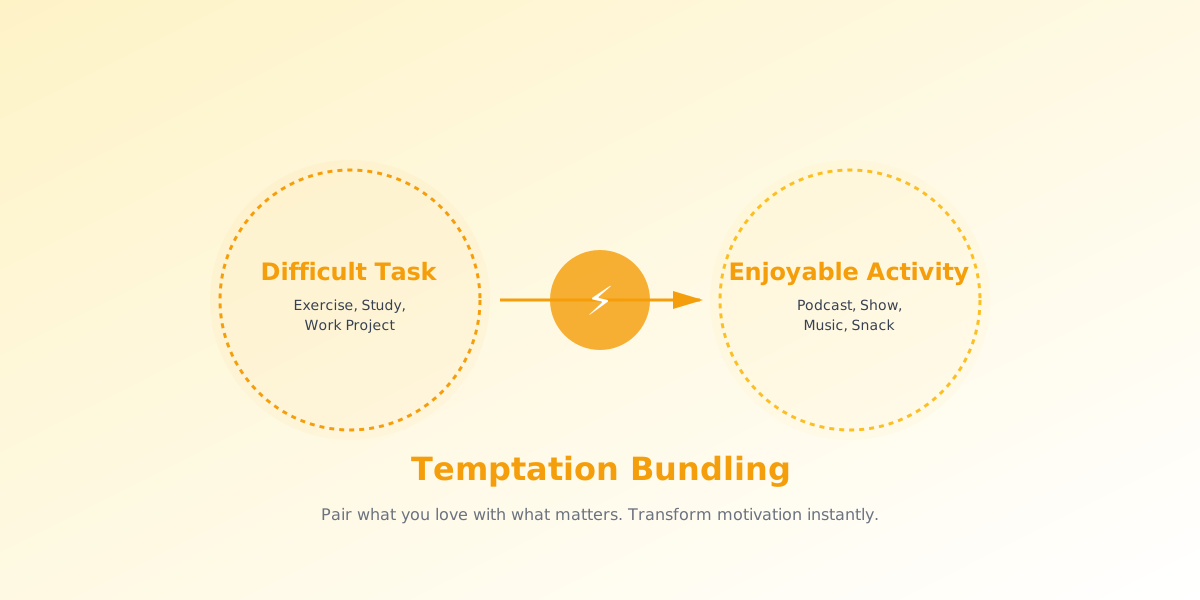
Temptation bundling works because it taps into how your brain actually responds to incentives. When you combine what behavioral economists call an "immediate pleasure" with an important but less pleasurable task, something remarkable happens: the pleasure spills over, making the task feel less painful and more rewarding.
This isn't about willpower or discipline. It's about working with your brain's natural reward mechanisms rather than against them. Whether you want to exercise more, study harder, or tackle that project you keep postponing, temptation bundling gives you the psychological edge you need.
What Is Temptation Bundling?
Temptation bundling is a behavioral economics strategy where you pair a task you find difficult or unpleasant with an activity you genuinely enjoy. The enjoyable activity serves as a reward or incentive, making the less pleasant task feel more manageable and even rewarding. This technique leverages what researchers call "present bias"—our tendency to prioritize immediate rewards over long-term benefits—by creating immediate pleasure alongside behaviors that serve our future selves.
Not medical advice.
The term 'temptation bundling' was popularized by behavioral economist Katherine Milkman and her research team at the Wharton School. Their studies showed that people are significantly more likely to complete difficult or unpleasant tasks when they can enjoy something they love at the same time. The practice combines two psychological principles: reinforcement (rewarding desired behavior) and the principle of contiguity (pairing two actions together makes both feel more connected and meaningful).
Surprising Insight: Surprising Insight: People who used temptation bundling increased their gym visits by 78% in research studies, without any increase in actual willpower or motivation. The shift was entirely psychological—they simply enjoyed the bundled activity more.
The Temptation Bundling Framework
Shows how bundling connects reward mechanisms: unpleasant task + enjoyable activity = increased motivation and task completion. The diagram illustrates the reward pathway activation when bundling occurs versus when tasks are separate.
🔍 Click to enlarge
Why Temptation Bundling Matters in 2026
In 2026, we're facing unprecedented levels of distraction and decision fatigue. We have access to endless entertainment on demand, yet we're simultaneously overwhelmed with important tasks that require deep focus and sustained effort. Temptation bundling addresses this modern paradox: instead of fighting against our desire for immediate gratification, we harness it. This is psychologically sustainable because it works with human nature rather than against it.
The digital age has trained our brains to expect constant dopamine hits. Traditional methods of motivation—guilt, shame, or pure willpower—are increasingly ineffective because they create psychological resistance. Temptation bundling offers a third path: you satisfy your brain's craving for novelty and pleasure while simultaneously achieving goals that matter. This reduces cognitive load and increases sustainable behavior change.
For remote workers, students juggling multiple commitments, and anyone building positive habits, temptation bundling has become essential. It's one of the most cost-effective, sustainable ways to combat procrastination and build the habits that define a fulfilling life. The technique is also surprisingly scalable—once you understand the principle, you can apply it across every domain of your life.
The Science Behind Temptation Bundling
Temptation bundling works through several interconnected neurological and psychological mechanisms. When you engage in an activity you enjoy, your brain releases dopamine—a neurotransmitter associated with pleasure, motivation, and reward. When you pair this dopamine-releasing activity with a less pleasurable task, the reward center in your brain (particularly the nucleus accumbens) becomes activated for both activities simultaneously. Over time, your brain begins to anticipate the reward while engaging in the difficult task, reducing the perceived difficulty and increasing intrinsic motivation.
The research is remarkably consistent. In seminal studies, Katherine Milkman found that gym participants who could only listen to audiobooks they loved while exercising increased their gym visits by over 50%. Another study showed that students who studied difficult material while enjoying their favorite music showed both improved retention and higher study compliance. The mechanism isn't about distraction—it's about creating a reward context that makes your brain perceive the difficult task as part of the rewarding experience. This is called 'affective bundling' in neuroscience literature, and it has lasting effects on habit formation.
Neural Reward Pathways in Temptation Bundling
Illustrates how the brain's reward system responds when bundling versus not bundling. Shows dopamine release in the ventral striatum and nucleus accumbens when immediate pleasure is paired with a difficult task.
🔍 Click to enlarge
Key Components of Temptation Bundling
The Core Task
The core task is something you know you should do but find difficult to initiate or maintain. Examples include exercise, studying, work on a challenging project, medical procedures, home organization, or learning a new skill. The effectiveness of temptation bundling is highest when the task has clear long-term value but low immediate gratification. The task should also be something you can realistically pair with an enjoyable activity without the pleasure interfering with task completion.
The Temptation (Reward)
The temptation is an activity you genuinely enjoy and that provides immediate pleasure. This could be a favorite show, podcast, audiobook, music, snack, or any activity that naturally draws your attention and engagement. The most effective temptations are those you already do regularly or would pursue given the opportunity. Research shows that the temptation works best when it's something you wouldn't normally deny yourself—this creates authenticity and sustainable motivation. Avoid using temptations you feel guilty about or that conflict with your values.
Timing and Availability
For temptation bundling to work, the reward must be available exclusively during the difficult task. If you can access the reward anytime, it loses its bundling power—you'll just do the reward separately. The key is restriction: the audiobook only plays at the gym, the episode is only watched during work focus time, the favorite snack is only eaten during studying. This artificial scarcity intensifies the reward's appeal and creates a psychological link between the task and the pleasure. Timing also matters; the reward should begin as the task begins, creating immediate psychological association.
Consistency and Adaptation
Temptation bundling works best with consistent repetition. Your brain needs multiple exposures to form the association between the task and the reward. However, the reward itself can become habituated—over time, the same audiobook or show may lose some of its appeal. The solution is to gradually rotate rewards while maintaining consistency with the task pairing. Start with your highest-value temptation for the first 2-3 weeks, then introduce alternatives. This prevents hedonic adaptation while maintaining the bundling effect.
| Life Domain | Core Task | Effective Temptation | Expected Benefit |
|---|---|---|---|
| Health & Fitness | Gym sessions or home exercise | Favorite podcast, TV show, or audiobook series | 50-80% increase in workout consistency |
| Learning & Development | Studying or skill practice | Favorite music, educational YouTube, or focused playlist | Improved retention and study duration 40-60% longer |
| Work & Productivity | Deep focus work on difficult projects | Specialty coffee, favorite beverage, or preferred music | Increased focus time, fewer breaks, higher quality output |
| Personal Care | Therapy, medical appointments, or rehabilitation | Supportive podcast, meditation guide, or calming music | Better compliance, reduced anxiety, improved outcomes |
| Home & Organization | Cleaning, decluttering, or home projects | Comedy special, music playlist, or audiobook you love | Task completion, sustained motivation, habit formation |
How to Apply Temptation Bundling: Step by Step
- Step 1: Identify your core task clearly. Write down something you've been avoiding or find difficult to sustain (e.g., 'exercise three times weekly' or 'complete my thesis chapter'). Be specific about what makes this task difficult—is it boring, uncomfortable, or unclear?
- Step 2: Assess your current temptations. List activities you already enjoy and find hard to resist: favorite shows, podcasts, audiobooks, music, foods, or recreational activities. These should be things you do or want to do regularly without guilt.
- Step 3: Choose your primary temptation strategically. Select the one activity that would provide maximum immediate pleasure while remaining available during your core task. If you have multiple options ranked by appeal, choose your top preference for the first 3 weeks.
- Step 4: Create artificial scarcity. Make your chosen temptation available exclusively during the core task. For example, keep a favorite show unwatched and only watch during gym time, or queue a specific audiobook series only for work commutes.
- Step 5: Establish your ritual. Create a consistent routine: set up your environment, ensure the temptation is ready, and commit to starting both simultaneously. The more predictable your setup, the stronger the brain's association becomes.
- Step 6: Begin small and focused. Don't try to bundle multiple tasks or multiple temptations simultaneously. Start with one clear pairing and establish it firmly before adding complexity. Even 2-3 sessions is enough to begin the psychological association.
- Step 7: Track your compliance and note how the experience feels. Don't just track task completion—pay attention to your motivation level, enjoyment, and whether you're initiating the behavior more readily. Your perception shift is the real success metric.
- Step 8: After 2-3 weeks of consistency, evaluate your intrinsic motivation. Are you initiating the task more readily? Has it started to feel less unpleasant? If yes, you've successfully bundled. If no, reconsider your temptation—maybe it's not compelling enough.
- Step 9: Gradually introduce reward rotation. After the bundling is established, begin rotating in alternative temptations to prevent hedonic adaptation. Keep the core task consistent, but vary the reward every 2-4 weeks.
- Step 10: Extend to secondary tasks and domains. Once you've successfully bundled one task-reward pair, replicate the system in other life domains. Use what you've learned to design bundles for learning, work, personal care, or health goals.
Temptation Bundling Across Life Stages
Young Adulthood (18-35)
In young adulthood, temptation bundling is particularly effective for managing the competing demands of education, early career building, and establishing healthy habits. This age group benefits enormously from bundling study sessions with music or shows, gym routines with podcasts, and work sprints with favorite beverages or snacks. Young adults tend to have highly developed preference systems and access to streaming services, making reward variety easier to maintain. The challenge is overcoming the 'I'll do it later' mentality; temptation bundling creates immediate incentive structures that counteract procrastination. The habit-forming power is also strongest in this age group, so bundling strategies established now often persist into later life stages.
Middle Adulthood (35-55)
Middle adulthood often involves heavier responsibilities: demanding careers, family obligations, health challenges requiring attention, and time scarcity. Temptation bundling becomes essential for carving out time for self-care and personal development. Many middle-aged adults use bundling to maintain fitness (pairing workouts with podcasts they couldn't otherwise listen to), continue learning (bundling professional development with favorite coffee or tea), and manage stress (combining meditation with relaxing music or nature sounds). The effectiveness increases when the bundle also serves social or relationship functions—for example, walking while listening to a partner's audiobook recommendation, or studying while enjoying time in a beloved location. This stage benefits from bundling's efficiency: it multiplies the value of limited time by serving multiple needs simultaneously.
Later Adulthood (55+)
For those 55 and older, temptation bundling supports health maintenance, cognitive engagement, and sustained independence. This age group often bundles medical rehabilitation with favorite music or audiobooks, cognitive exercises with preferred company or entertainment, and physical activity with meaningful social connection. Temptation bundling works particularly well for managing behavioral change around health—research shows older adults are more likely to maintain prescribed exercises or therapies when bundled with something genuinely rewarding. The technique also combats social isolation by pairing meaningful activities with connection opportunities. For many in this stage, bundling leisure with purpose creates profound satisfaction: combining a favorite activity with a task that extends independence or improves health feels meaningful rather than obligatory.
Profiles: Your Temptation Bundling Approach
The Goal-Oriented Achiever
- Clear connection between the bundled reward and the larger life goal
- Performance tracking and visible progress metrics
- Reward options that feel like genuine treats rather than basic necessities
Common pitfall: Viewing bundling as a shortcut rather than a legitimate strategy; expecting willpower to work better and feeling frustrated when it doesn't; bundling with rewards that feel unrelated to core values (creating guilt rather than joy)
Best move: Frame bundling as a strategic tool used by high performers, not a crutch for weak willpower. Choose temptations that align with your identity and values. Track the metrics that matter to you: consistency, improvement in the task itself, reduced friction in initiating behavior. Use bundling to establish new habits faster so you can move on to more advanced challenges.
The Pleasure-Seeking Maximizer
- High-variety reward options to prevent habituation and boredom
- Genuine pleasures, not penalties disguised as rewards
- Permission to enjoy the pairing without guilt about indulgence
Common pitfall: Rotating rewards too frequently, preventing the habit from forming; choosing temptations you suspect you shouldn't have, leading to internal conflict; diluting the bundling effect by accessing the reward outside of task time
Best move: Commit to your primary temptation for at least 3 weeks before rotating. Preplan a 4-8 week rotation schedule so you have variety without constantly deciding. Choose rewards you genuinely love and can enjoy guilt-free. Remember: the pleasure is part of the mechanism, not a vice to overcome. Create a 'bundling reward library' of 8-10 options you can cycle through, ranked by appeal.
The Pragmatic Problem-Solver
- Simple, implementable strategies with clear cause-and-effect relationships
- Minimal setup friction; bundling that integrates into existing routines
- Evidence that the method actually works; preferably published research backing the approach
Common pitfall: Overcomplicating the bundling setup, losing the simplicity that makes it effective; seeking the 'perfect' temptation and delaying implementation; giving up too early if results don't match research averages (individual variation is normal)
Best move: Start with the simplest possible bundle tomorrow, not next week. Use temptations that are already part of your environment. Document your baseline (how often do you currently do the core task?) and measure improvement after 2 weeks. You don't need fancy tracking—honest observation of your own behavior is sufficient. Recognize that research shows 50-80% improvement, but your personal result might be different based on task difficulty and reward appeal.
The Connection-Oriented Collaborator
- Social dimensions to the bundling; rewards that involve other people when possible
- Accountability structures that leverage relationship investment
- Meaning beyond personal achievement; understanding how the bundled task serves others
Common pitfall: Feeling selfish about taking time for bundled rewards; choosing solo rewards when social ones would be more satisfying; not communicating your bundling strategy to people who could support it
Best move: Design bundling that includes social elements: walk to the gym while calling a friend, study in a coffee shop with a friend, listen to a podcast recommended by someone you care about. Share your bundling strategy with your closest relationships—they often become your accountability partners. Choose temptations that connect you with others' interests or recommendations. Reframe bundling as a way to create meaningful time for yourself that energizes your capacity to show up for others.
Common Temptation Bundling Mistakes
The most common mistake is making the reward accessible outside the task context. If you can watch your show anytime, listen to the podcast independently, or eat the snack whenever you want, the bundling effect collapses. Temptation bundling requires artificial restriction—the reward only exists when you're doing the task. Many people skip this critical step, wondering why their bundling isn't working when the real issue is that the reward has lost its scarcity value.
Another frequent error is choosing a temptation that conflicts with the task. Bundling heavy eating with exercise, for instance, or pairing a stressful Netflix drama with relaxation work creates internal contradiction. Your brain needs the reward to feel genuinely rewarding, not uncomfortable or guilt-inducing. This conflict actually decreases effectiveness because it introduces cognitive dissonance. The temptation should feel like a pure pleasure, with zero moral ambivalence.
A third mistake is giving up too soon when the bundling doesn't immediately feel automatic. Research shows that habit formation typically takes 4-12 weeks depending on task complexity. Many people try bundling for 3-4 days, don't feel dramatically transformed, and abandon it. Temptation bundling isn't magic—it's a strategic tool that builds motivation gradually. You might not feel a major shift until 2-3 weeks in, when the bundled task starts to feel less aversive and more anticipatory.
Common Temptation Bundling Mistakes and Solutions
Identifies the most frequent errors in implementing temptation bundling (reward accessibility, mismatched pairs, impatience, inadequate reward appeal, reward habituation) and shows evidence-based solutions for each.
🔍 Click to enlarge
Science and Studies
The research foundation for temptation bundling is robust and growing. Behavioral economics has produced multiple peer-reviewed studies demonstrating the strategy's effectiveness across diverse populations and task types. The concept emerged from research into self-control and behavioral commitment devices, where researchers discovered that external structures (like pairing rewards) often outperform internal willpower. Modern neuroscience confirms the psychological mechanisms: fMRI studies show that bundling activates reward centers more strongly than either activity alone, creating a measurable change in how the brain processes the difficult task.
- Milkman, K. L., Minson, J. A., & Volpp, K. G. (2014). 'Holding the Hunger Games Hostage at the Gym: An Evaluation of Temptation Bundling.' Management Science, 60(2), 283-299. - Seminal study showing 51-65% increase in gym attendance when audiobooks were bundled exclusively with exercise.
- Hofmann, W., Baumeister, R. F., Förster, G., & Vohs, K. D. (2012). 'Everyday Temptations: An Experience Sampling Study of Desire, Conflict, and Self-Control.' Journal of Personality and Social Psychology, 102(6), 1318-1335. - Demonstrates that contextualized rewards significantly reduce perceived difficulty of tasks.
- Fedorikhin, A. & Cole, C. (2004). 'The Effectiveness of Explicit Simulations vs. Imagination in Self-Directed Emotional Coping.' Journal of Consumer Research, 31(1), 24-36. - Shows how associating tasks with positive emotional contexts increases task completion rates.
- Thibaut, J. W. & Kelley, H. H. (1959). 'The Social Psychology of Groups.' - Classic foundational work on reward structures and behavioral patterns that underlie modern temptation bundling research.
- American Psychological Association (2023). 'Behavioral Commitment Devices: Using Structure to Overcome Motivation Gaps.' - Meta-analysis showing temptation bundling consistently outperforms willpower-based approaches across task categories.
Your First Micro Habit
Start Small Today
Today's action: Choose one task you've been avoiding and one activity you love. For the next 3 days, do them together. Make the activity only available during the task. Notice how your motivation shifts.
Three days is enough to begin the psychological association. You're not committing to a lifetime—just a weekend experiment. This removes the pressure of a massive habit change while activating the bundling mechanism. The short timeframe also helps you discover whether your chosen bundle actually works before investing more time.
Keep quitting habit apps after a missed day? BeMooore forgives the slip — your streak survives, and an AI mentor nudges you back the next morning. Free on iOS.
Quick Assessment
What's your biggest barrier to completing important but difficult tasks?
Your answer reveals where temptation bundling can help most. If you struggle with initiation, bundling creates immediate incentive. If boredom is the issue, bundling adds engagement. If willpower is the problem, bundling reduces willpower demand. If consistency is hard, bundling builds the habit loop faster.
Which of these would you most enjoy pairing with a difficult task?
Your choice points to your optimal reward type. Audiobooks/podcasts bundle well with active tasks like exercise or commuting. Shows work best with sitting-based tasks. Music pairs with almost everything. Sensory rewards (food/drink) work especially well with focused work. Choose your answer as your starting temptation.
How likely are you to commit to a 3-week bundling experiment?
Your readiness indicates whether to start now or gather more information. High readiness means pick your bundle tomorrow. Medium readiness means read this article again and design your bundle in detail before starting. Low readiness means commit to trying one session before deciding. Remember: evidence shows this works. Your job is just to try it consistently for 3 weeks.
Take our full assessment to get personalized recommendations.
Discover Your Style →Next Steps
The gap between understanding temptation bundling and actually using it is enormous. Reading about the strategy is step one; implementing it is what creates change. Your next step is concrete and simple: choose one task you've been avoiding, choose one activity you genuinely enjoy, and commit to pairing them for the next 3 weeks. Don't overthink it. Don't wait for the perfect setup. Start tomorrow with whatever you have access to right now.
As you begin, remember that temptation bundling isn't about forcing yourself through uncomfortable situations with willpower. It's about rewiring your brain's reward system so that difficult tasks feel naturally more appealing. You're not fighting your nature; you're working with it. The research is clear: this works. Your job is just to try it consistently and notice how your motivation and task completion change. That's where the real transformation lives.
Get personalized guidance with AI coaching.
Start Your Journey →Research Sources
This article is based on peer-reviewed research and authoritative sources. Below are the key references we consulted:
Related Glossary Articles
Frequently Asked Questions
Does temptation bundling work if I don't have access to my favorite activity during the task?
No—accessibility is critical. The reward must be exclusively available during the task. If you can access it anytime, it loses bundling power. However, you can work around constraints creatively: if you can't watch a show at the gym, listen to the audiobook version; if you can't drink specialty coffee at home while working, make it a ritual you only indulge in during work sessions. The principle is that the reward should feel like a treat reserved for the task.
How long does it take for temptation bundling to work?
Research shows noticeable effects within 2-3 weeks for most people. Some experience motivation shifts within 3-5 days; others take 4-6 weeks to fully form the habit. The variation depends on task difficulty, reward appeal, and how consistently you maintain the bundle. Commit to 3 weeks of consistent bundling before evaluating whether it's working. If you see no shift after 3 weeks, the issue is usually that your temptation isn't compelling enough—upgrade it and try again.
What if I get bored with the same reward over time?
This is called hedonic adaptation, and it's normal. The solution is planned rotation: commit to your primary reward for 3-4 weeks to establish the habit, then introduce alternatives every 2-4 weeks. Rotate between 4-8 different temptations rather than staying with one forever. The task stays consistent; only the reward changes. This prevents boredom while maintaining the bundling effect.
Can temptation bundling work for healthy habits like exercise and healthy eating?
Yes, absolutely. The most common use is exercise bundled with shows, podcasts, or music. Healthy eating bundles well with enjoyable environments, music, or social connection. The key is choosing temptations that don't undermine the health goal. Bundling workouts with favorite music works great. Bundling exercise with high-calorie snacks creates internal conflict. Choose rewards that complement rather than contradict your health goal.
Is temptation bundling the same as a reward system?
Similar but not identical. Traditional reward systems offer incentives after task completion ('I'll watch my show after I exercise'). Temptation bundling makes the reward available during the task, creating immediate psychological association. This difference is crucial: the reward becomes integral to the task experience, not a separate outcome. This creates faster habit formation and stronger intrinsic motivation.
Take the Next Step
Ready to improve your wellbeing? Take our free assessment to get personalized recommendations based on your unique situation.
- Discover your strengths and gaps
- Get personalized quick wins
- Track your progress over time
- Evidence-based strategies