Dopamine Detox
You wake up, reach for your phone, and thirty minutes vanish before your feet touch the floor. The scrolling feels automatic, the notifications feel urgent, and the idea of sitting quietly with your own thoughts feels almost painful. If this sounds familiar, you are not alone. Millions of people feel trapped by digital wellness challenges that hijack their attention and leave them feeling drained before the day even begins. The concept of a dopamine detox promises a way out, but the science behind it is far more nuanced than most viral videos suggest.
In the next few minutes, you will discover what dopamine actually does in your brain, why the popular version of a dopamine detox gets the science wrong, and what evidence-based strategies genuinely help you regain <a href='/g/focus.html'>focus</a> and <a href='/g/motivation.html'>motivation</a>.
Whether you struggle with constant concentration issues, feel addicted to your phone, or simply want sharper cognitive function, this guide walks you through the real science and practical steps that work.
What Is a Dopamine Detox?
A dopamine detox is a practice where you temporarily reduce or eliminate activities that provide quick, easy pleasure, such as social media, video games, junk food, and streaming entertainment. The goal is to reset your relationship with these stimuli so that you can find satisfaction in more meaningful, effortful activities. The term was popularized by Dr. Cameron Sepah, a Harvard-trained psychiatrist who introduced Dopamine Fasting 2.0 as an evidence-based technique grounded in behavior change principles from cognitive behavioral therapy.
Not medical advice.
Despite the name, a dopamine detox does not actually lower your dopamine levels. Dopamine is a neurotransmitter essential for brain function, learning, movement, and motivation. You cannot fast from dopamine itself. What you can do is reduce your exposure to supernormal stimuli, the artificially intense rewards that modern technology and processed foods deliver to your brain health system. This distinction matters enormously because misunderstanding the mechanism leads people toward extreme, ineffective, and sometimes harmful protocols.
Surprising Insight: Surprising Insight: Research shows that dopamine neurons are far more diverse than previously thought. Some dopamine pathways actually respond to aversive experiences, not just rewards, making the idea of simply lowering dopamine levels essentially meaningless from a neuroscience perspective.
Dopamine Detox: Myth vs. Reality
A comparison of popular misconceptions about dopamine detox versus the evidence-based understanding.
🔍 Click to enlarge
Why Dopamine Detox Matters in 2026
The average person now spends over seven hours per day on screens outside of work. Social media platforms, streaming services, and mobile games are engineered to deliver rapid dopamine hits that keep you scrolling, watching, and tapping. This constant stimulation reshapes your reward circuitry over time, making it harder to find satisfaction in activities like reading, exercising, or having a face-to-face conversation. Understanding brain optimization through intentional stimulus management has never been more relevant.
The rise of AI-generated content, short-form video, and infinite feeds means that the intensity and volume of digital stimulation will only increase. People who develop self-control strategies and digital minimalism habits now will have a significant advantage in preserving their cognitive health and mental health over the coming decade.
Beyond individual wellbeing, the inability to sustain deep work affects career trajectories, academic outcomes, and creative output. A well-designed approach to managing your dopamine system is not about deprivation but about building psychological flexibility so you can direct your attention where it matters most.
The Science Behind Dopamine Detox
Dopamine is often called the pleasure molecule, but neuroscientists describe it more accurately as the molecule of wanting and anticipation. When you anticipate a reward, dopamine surges. Once you receive the reward, dopamine drops. This cycle drives habit formation and is central to understanding why certain behaviors become compulsive. Andrew Huberman, a Stanford neuroscientist, explains that dopamine is about craving and motivation rather than enjoyment. The pleasure you feel from an activity is largely mediated by other neurotransmitters like endorphins and serotonin.
When you repeatedly expose yourself to high-dopamine activities like rapid social media scrolling, video game rewards, or processed sugar, your brain adjusts by reducing dopamine receptor sensitivity. This process, called downregulation, means you need more intense stimulation to feel the same level of satisfaction. Over time, everyday pleasures like a walk in nature, a good meal, or a meaningful conversation feel flat by comparison. This is where the principles behind a dopamine detox become genuinely useful. By temporarily reducing high-intensity stimuli, you allow your receptor sensitivity to normalize, restoring your capacity to enjoy daily routines and mindfulness practices.
Research published in the journal Lifestyle Medicine examined dopamine fasting as a potential intervention for behavioral addiction. The study concluded that while the popular framing is scientifically inaccurate, the underlying behavioral strategy, which involves stimulus control and cognitive restructuring, has solid support in the behavioral change literature. Harvard Medical School researchers similarly noted that the benefits people experience from a dopamine detox likely come from intentional living and reduced distraction rather than any chemical reset.
Dopamine Regulation Cycle
How dopamine levels fluctuate in response to stimulation and how detox periods help restore baseline sensitivity.
🔍 Click to enlarge
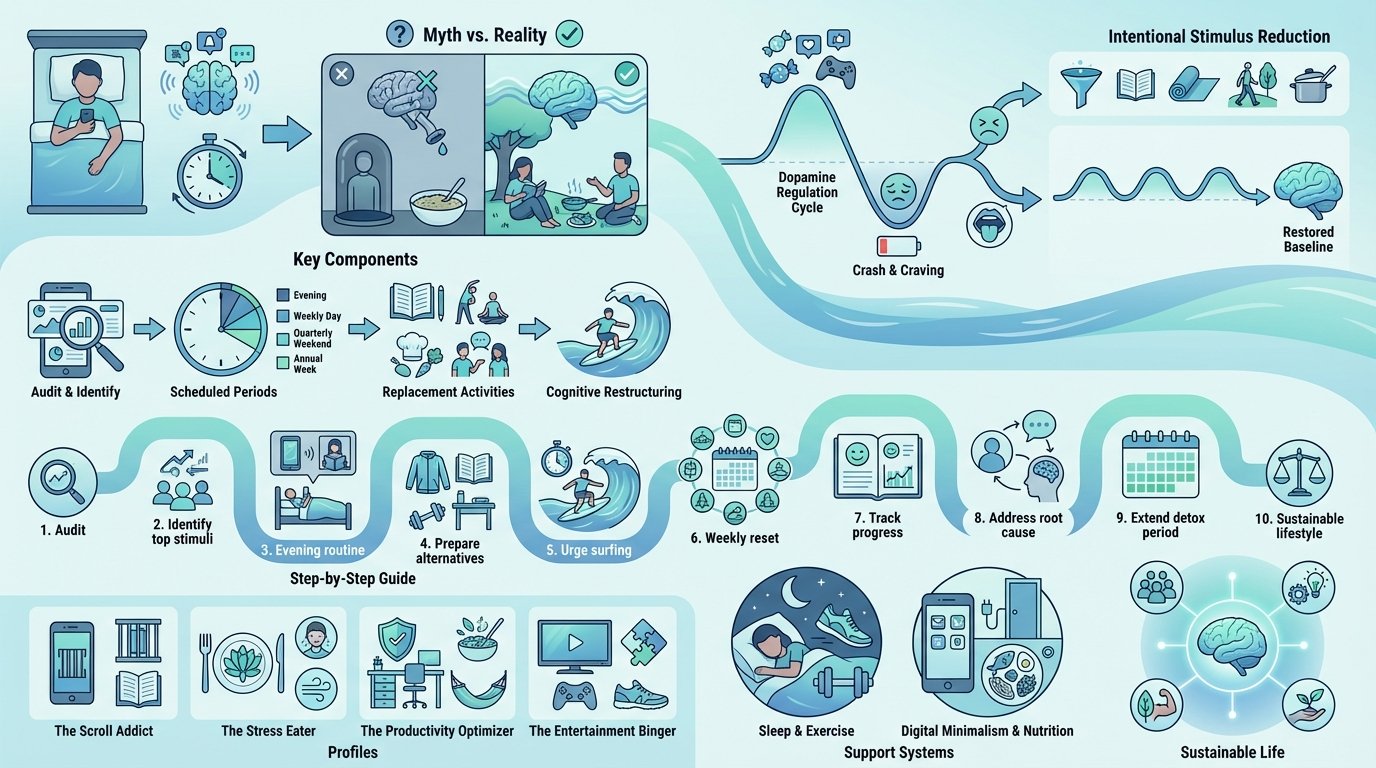
Key Components of a Dopamine Detox
Stimulus Identification
The first step is identifying which activities in your life deliver supernormal stimulation. Dr. Sepah outlined six categories most prone to compulsive use: excessive internet and gaming, emotional eating, gambling or shopping, pornography, thrill-seeking behaviors, and recreational drug use. However, for most people, the primary culprits are social media scrolling, binge-watching, and processed food consumption. Honest self-assessment is essential. Track your daily routines for one week, noting how much time you spend on each high-stimulus activity and how you feel afterward. This audit forms the foundation of a personalized detox plan aligned with your goal setting priorities.
Scheduled Fasting Periods
Rather than extreme all-or-nothing abstinence, Sepah recommends a graduated schedule: one to four hours at the end of each day, one full weekend day per week, one weekend per quarter, and one full week per year. This progressive structure mirrors how meditation retreats and breaking bad habits programs work: you gradually build your capacity for low-stimulation environments. The key insight is that the goal is not suffering but building resilience and comfort with boredom, which is where creativity and deep work thrive.
Replacement Activities
A dopamine detox is not about sitting in an empty room. It is about replacing high-stimulus activities with meaningful, moderately rewarding alternatives. These include exercise, journaling, reading, nature walks, breathing techniques, cooking from scratch, meaningful conversations, and creative projects. These activities still produce dopamine but at natural, sustainable levels that strengthen rather than exhaust your reward circuitry. The shift supports long-term brain performance and emotional regulation.
Cognitive Restructuring
The original dopamine fasting protocol is rooted in cognitive behavioral therapy. This means changing how you think about urges, not just white-knuckling through them. When a craving for your phone or a snack arises, you notice the thought, label it as a craving rather than a need, and choose a response aligned with your values. Over time, this builds emotional awareness and weakens the automatic connection between stimulus and response. This approach strengthens your decision-making capacity and supports lasting behavior change.
| Timeframe | Duration | What to Avoid |
|---|---|---|
| Daily Evening | 1-4 hours before bed | Screens, social media, news, junk food |
| Weekly Reset | One full day per week | All high-stimulus digital activities |
| Quarterly Deep Reset | One weekend per quarter | All digital devices, processed food |
| Annual Retreat | One full week per year | Extended break from all compulsive behaviors |
How to Apply Dopamine Detox: Step by Step
- Step 1: Audit your current habits. Spend one week tracking every high-stimulus activity, including social media time, gaming, streaming, snacking, and online shopping. Use screen time reports on your phone as a starting point for understanding your <a href='/g/energy-management.html'>energy management</a> patterns.
- Step 2: Identify your top three triggers. From your audit, pinpoint the three activities that consume the most time and leave you feeling least satisfied. These are your primary detox targets. Consider how they affect your <a href='/g/sleep-quality.html'>sleep quality</a> and <a href='/g/stress-management.html'>stress management</a>.
- Step 3: Set your detox schedule. Start with the daily evening window: commit to one screen-free hour before bed. Use this time for reading, stretching, or conversation. Build toward a full <a href='/g/evening-routines.html'>evening routine</a> that supports your <a href='/g/circadian-rhythm.html'>circadian rhythm</a>.
- Step 4: Prepare replacement activities. Stock your environment with low-stimulus, high-meaning alternatives. Place a book on your nightstand, set out exercise clothes, prepare ingredients for cooking. Environmental design is more reliable than <a href='/g/self-control.html'>self-control</a> alone.
- Step 5: Practice urge surfing. When a craving hits, set a timer for ten minutes and observe the urge without acting on it. Notice where you feel it in your body. Most cravings peak and fade within this window, building your <a href='/g/mental-toughness.html'>mental toughness</a>.
- Step 6: Add a weekly reset day. Choose one day per week where you significantly reduce digital consumption. Spend this day outdoors, with family, or on a hobby that requires <a href='/g/flow-state.html'>flow state</a> engagement like painting, woodworking, or playing music.
- Step 7: Track your progress. Keep a simple journal noting your mood, energy, and <a href='/g/productivity.html'>productivity</a> levels on detox days versus regular days. This data helps you see the benefits clearly and stay motivated.
- Step 8: Address underlying needs. If you use social media to cope with loneliness, address the root cause by building real <a href='/g/connection.html'>connection</a>. If you binge-watch to manage <a href='/g/anxiety-management.html'>anxiety</a>, explore proper <a href='/g/coping-strategies.html'>coping strategies</a> instead.
- Step 9: Gradually extend your detox periods. Once daily evening detox feels natural, add the weekly reset. Then try a quarterly weekend. Each expansion builds your capacity for sustained <a href='/g/focus.html'>focus</a> and <a href='/g/self-control.html'>discipline</a>.
- Step 10: Build a sustainable lifestyle. The end goal is not periodic fasting from pleasure but a daily life where high-quality activities, meaningful work, physical movement, and real relationships provide most of your satisfaction. This is <a href='/g/holistic-health.html'>holistic health</a> in practice.
Dopamine Detox Across Life Stages
Young Adulthood (18-35)
Young adults face the highest exposure to digital superstimuli. Social media comparison, dating apps, gaming, and constant connectivity create an environment where dopamine circuits are under relentless pressure. A dopamine detox at this stage often focuses on reducing social media time, establishing morning routines that do not start with a phone, and building habit formation skills that support academic and career goal achievement. Young adults who develop strong cognitive enhancement practices early gain compounding benefits throughout life.
Middle Adulthood (35-55)
In middle adulthood, the challenge shifts toward managing work-related digital overload, stress eating, and the subtle creep of passive entertainment replacing active engagement. Parents in this stage often model high-screen-time behavior for their children. A dopamine detox at this stage focuses on burnout prevention, creating technology-free family time, and rediscovering hobbies that were abandoned during the busy career-building years. Strengthening emotional resilience and energy vitality becomes particularly important.
Later Adulthood (55+)
Older adults are increasingly affected by screen dependency, with television and news consumption often filling the void left by retirement. A dopamine detox in later life centers on maintaining cognitive health through stimulating but non-passive activities: learning new skills, volunteering, gardening, and maintaining social connections. The focus is on preserving brain health and preventing the cognitive decline associated with passive consumption patterns. Regular exercise and gut health support remain foundational.
Profiles: Your Dopamine Detox Approach
The Scroll Addict
- Phone-free zones in the home (bedroom, dining table)
- App timers and grayscale mode to reduce visual pull
- One offline hobby practiced at least three times per week
Common pitfall: Replacing one screen with another (e.g., swapping Instagram for YouTube)
Best move: Delete your most-used social app for 30 days and track how your mood, sleep, and focus change.
The Stress Eater
- Identifying emotional triggers that lead to snacking
- Stocking the kitchen with whole foods that require preparation
- A five-minute breathing protocol before opening the fridge
Common pitfall: Going too restrictive, which triggers binge cycles
Best move: Practice one mindful meal per day where you eat without screens and focus on taste and texture.
The Productivity Optimizer
- Scheduled deep work blocks with all notifications disabled
- Clear boundaries between work and recovery time
- Acceptance that boredom is part of the creative process
Common pitfall: Turning the detox itself into another optimization project that creates more stress
Best move: Commit to two unstructured hours each weekend with no plan, no phone, and no productivity goal.
The Entertainment Binger
- A one-show rule: choose one series and watch it intentionally
- No autoplay, removing the path of least resistance
- Active alternatives ready for evenings (board games, walks, cooking)
Common pitfall: Labeling all entertainment as harmful rather than building a healthy relationship with leisure
Best move: Replace one streaming hour per day with a physical activity or social engagement for two weeks.
Common Dopamine Detox Mistakes
The most damaging mistake is treating a dopamine detox as extreme isolation. Some versions of the trend encourage sitting in a dark room, avoiding all conversation, and eating nothing but bland food. This approach has no scientific support and can actually worsen depression and anxiety. The goal is reducing supernormal stimuli, not all stimuli. Meaningful social interaction, nature exposure, and nourishing food are essential throughout any detox period.
Another common error is the all-or-nothing mindset. People attempt a dramatic 24 or 48-hour complete digital fast, fail, and then conclude the entire concept does not work. Effective behavioral change is gradual. Start with the daily evening window and build from there. Consistency over weeks matters far more than intensity over a single day. This mirrors how micro habits and habit stacking produce lasting results.
A third mistake is ignoring the replacement side of the equation. Simply removing high-dopamine activities without adding meaningful alternatives creates a vacuum that willpower alone cannot sustain. You need a clear plan for what you will do during detox periods. The best alternatives are activities that produce flow state engagement: challenges that match your skill level, provide clear feedback, and absorb your full attention, strengthening cognitive performance naturally.
Dopamine Detox Decision Framework
A practical guide for deciding when and how to implement detox strategies based on your current situation.
🔍 Click to enlarge
The Role of Sleep and Exercise
Two factors dramatically influence your dopamine system independent of any detox protocol: deep sleep and physical exercise. During deep sleep, your brain replenishes dopamine reserves and restores receptor sensitivity. People who are sleep-deprived experience lower baseline dopamine levels and are more vulnerable to impulsive, high-stimulus seeking behavior. Prioritizing sleep quality through consistent bed times, cool room temperature, and screen elimination before sleep is the single most impactful change you can make for brain performance.
Exercise produces a sustained, moderate increase in dopamine that lasts for hours after the activity ends. Unlike the sharp spike and crash from social media scrolling, the dopamine release from a run, swim, or strength training session follows a healthy pattern that strengthens your reward circuitry. Research consistently links regular physical activity with improved cognitive function, better mood regulation, and greater emotional regulation. Cold exposure, such as cold showers, has also been shown to produce long-lasting dopamine increases of up to 250 percent above baseline, according to research cited by Huberman Lab.
Dopamine Detox and Digital Minimalism
Cal Newport's concept of digital minimalism aligns closely with the principles behind a dopamine detox. Rather than using technology mindlessly, digital minimalism encourages you to choose only the tools and platforms that genuinely serve your values and to use them intentionally. This is not anti-technology; it is pro-autonomy. When you decide in advance how and when you will use social media, news apps, and entertainment platforms, you remove the impulsive, reward-driven usage that erodes your focus and energy management.
Practical digital wellness strategies include turning off all non-essential notifications, using website blockers during work hours, charging your phone outside the bedroom, and designating specific times for checking email and social media. These structural changes are more effective than relying on self-control because they reduce the number of decisions you need to make throughout the day. Combined with mindfulness practices, these habits create an environment where deep work and sustained concentration become the default rather than the exception.
Nutrition and Gut-Brain Connection
Your dopamine system does not operate in isolation from the rest of your body. Dopamine is synthesized from the amino acid tyrosine, found in protein-rich foods like eggs, fish, poultry, and legumes. A diet lacking in these building blocks impairs your ability to produce dopamine naturally. Additionally, emerging research on the gut-brain connection reveals that gut bacteria produce precursors to dopamine and influence neurotransmitter balance. Supporting your microbiome through fermented foods, fiber, and supplements like probiotics contributes to healthier dopamine regulation.
Processed foods, refined sugar, and artificial sweeteners create the same supernormal stimulation pattern in the reward system that digital media does. Reducing these foods as part of your dopamine detox supports body wellness while simultaneously reducing the biochemical drivers of craving. The combination of healthy eating and stimulus management creates a powerful synergy for restoring natural energy levels and stable mood throughout the day.
Science and Studies
The scientific literature on dopamine detox is still developing, but several key studies and reviews provide a solid foundation for evidence-based practice. The original Dopamine Fasting 2.0 protocol by Dr. Cameron Sepah draws on established CBT techniques for managing behavioral addictions. Peer-reviewed research on cognitive enhancement through stimulus management continues to grow, and neuroscience research on dopamine receptor sensitivity supports the general principle that reducing overstimulation helps restore baseline function.
- Fei, Y.J. et al. (2022). Maladaptive or misunderstood? Dopamine fasting as a potential intervention for behavioral addiction. Lifestyle Medicine, Wiley. This review found that while the popular framing is inaccurate, the behavioral strategies have legitimate therapeutic value.
- Radwan, B. et al. (2024). A Literature Review on Holistic Well-Being and Dopamine Fasting: An Integrated Approach. PMC/NIH. Examined the intersection of dopamine fasting with overall wellness and concluded that integrated approaches yield the best outcomes.
- Lembke, A. (2021). Dopamine Nation: Finding Balance in the Age of Indulgence. Dutton. Stanford psychiatrist's exploration of how modern pleasure overload affects the brain's balance between pain and pleasure.
- Huberman, A. (2021). Controlling Your Dopamine For Motivation, Focus and Satisfaction. Huberman Lab Podcast. Detailed neuroscience-based tools for managing dopamine including cold exposure, sleep, and effort-reward pairing.
- Harvard Health Publishing (2020). Dopamine fasting: Misunderstanding science spawns a maladaptive fad. Harvard Medical School. Clarified that benefits come from intentional living rather than chemical resets.
Your First Micro Habit
Start Small Today
Today's action: Tonight, place your phone in another room one hour before bed and spend the time reading a physical book or having a conversation.
Removing the phone eliminates the strongest trigger for impulsive scrolling, while the replacement activity provides moderate, healthy dopamine stimulation. This single change improves sleep quality and starts rewiring your evening reward patterns.
Keep quitting habit apps after a missed day? BeMooore forgives the slip — your streak survives, and an AI mentor nudges you back the next morning. Free on iOS.
Quick Assessment
How often do you reach for your phone within the first five minutes of waking up?
Your morning phone habit reveals how strongly your dopamine system is tied to digital stimulation. Those who reach for their phone immediately may benefit most from starting their detox with a screen-free first hour.
When you have 15 minutes of free time with nothing planned, what do you typically do?
Your default response to unstructured time indicates your current relationship with boredom. The ability to sit without stimulation is a key indicator of dopamine system health and a skill that a detox helps develop.
After a day of heavy screen use, how do you typically feel by evening?
Post-screen fatigue is a sign of dopamine system strain. If you feel wired but tired, your brain is caught in a cycle of overstimulation and depletion, exactly the pattern a dopamine detox addresses.
Take our full assessment to get personalized recommendations.
Discover Your Style →Next Steps
The path to a healthier relationship with stimulation does not require dramatic sacrifice. It starts with awareness: understanding which activities drain your energy without replenishing it, and which ones leave you feeling genuinely satisfied. Use the step-by-step protocol in this guide to begin with small, sustainable changes. Explore related topics like biohacking, longevity, general health, and health tips to build a comprehensive approach to body wellness and cognitive optimization.
Remember that the goal is not to eliminate pleasure from your life. It is to build a life where your deepest sources of satisfaction come from meaningful work, real relationships, physical vitality, and personal growth. When your brain is no longer overstimulated by artificial rewards, ordinary life becomes extraordinary. Start tonight with your first phone-free hour and experience the difference for yourself.
Get personalized guidance with AI coaching.
Start Your Journey →Research Sources
This article is based on peer-reviewed research and authoritative sources. Below are the key references we consulted:
Related Glossary Articles
Frequently Asked Questions
How long does a dopamine detox take to work?
Most people notice improved focus and reduced cravings within one to two weeks of consistent evening detox practice. Dr. Anna Lembke and Andrew Huberman suggest that a 30-day period of abstinence from specific compulsive behaviors may be needed for significant receptor resensitization. However, benefits are cumulative, and even small reductions in high-stimulus activity produce measurable improvements in mood and concentration.
Can a dopamine detox be harmful?
Extreme versions involving total social isolation, severe food restriction, or sensory deprivation can worsen anxiety and depression. The evidence-based approach uses gradual stimulus reduction while maintaining meaningful social contact, proper nutrition, and physical activity. If you have a diagnosed mental health condition, consult a healthcare professional before starting any detox protocol.
Do I need to give up all technology for a dopamine detox?
No. The goal is not to eliminate technology but to use it intentionally. Identify which digital activities are compulsive versus purposeful. Keep tools that serve your work and relationships while reducing or eliminating those that primarily deliver empty dopamine hits like infinite scrolling and autoplay video.
Is dopamine detox scientifically proven?
The specific term dopamine detox is a misnomer because you cannot actually detox from dopamine. However, the underlying behavioral strategies, drawn from cognitive behavioral therapy, stimulus control, and habit reversal, are well supported by decades of psychological research. The benefits come from intentional behavior change, not a chemical reset.
What should I do during a dopamine detox?
Focus on activities that provide moderate, natural reward: physical exercise, nature walks, reading, cooking, journaling, meaningful conversation, creative projects, and meditation. These activities produce healthy dopamine patterns that strengthen your reward circuitry rather than depleting it.
Can cold showers really help with dopamine?
Research cited by Huberman Lab shows that cold water exposure can increase dopamine levels by up to 250 percent above baseline, with effects lasting several hours. Unlike the spike-and-crash pattern from digital stimulation, cold exposure produces a gradual, sustained elevation that supports motivation and mood throughout the day.
How is dopamine detox different from a digital detox?
A digital detox focuses specifically on reducing screen time and technology use. A dopamine detox is broader, addressing any behavior that provides supernormal stimulation, including processed food, gambling, compulsive shopping, and thrill-seeking. Digital reduction is often a major component, but the dopamine detox framework addresses the full spectrum of modern overstimulation.
Take the Next Step
Ready to improve your wellbeing? Take our free assessment to get personalized recommendations based on your unique situation.
- Discover your strengths and gaps
- Get personalized quick wins
- Track your progress over time
- Evidence-based strategies