Shadow Work
Deep inside, you reject certain parts of yourself—anger you think is 'bad,' vulnerability you label 'weak,' or ambition you've been taught to hide. Shadow work asks: What if those rejected traits actually hold power? Shadow work is the psychological practice of acknowledging, exploring, and integrating the aspects of your personality and past that you've pushed away. By bringing these hidden parts into conscious awareness, you reclaim wholeness, reduce anxiety, and unlock authentic confidence. This isn't therapy—it's deliberate self-discovery that transforms how you relate to yourself and others.
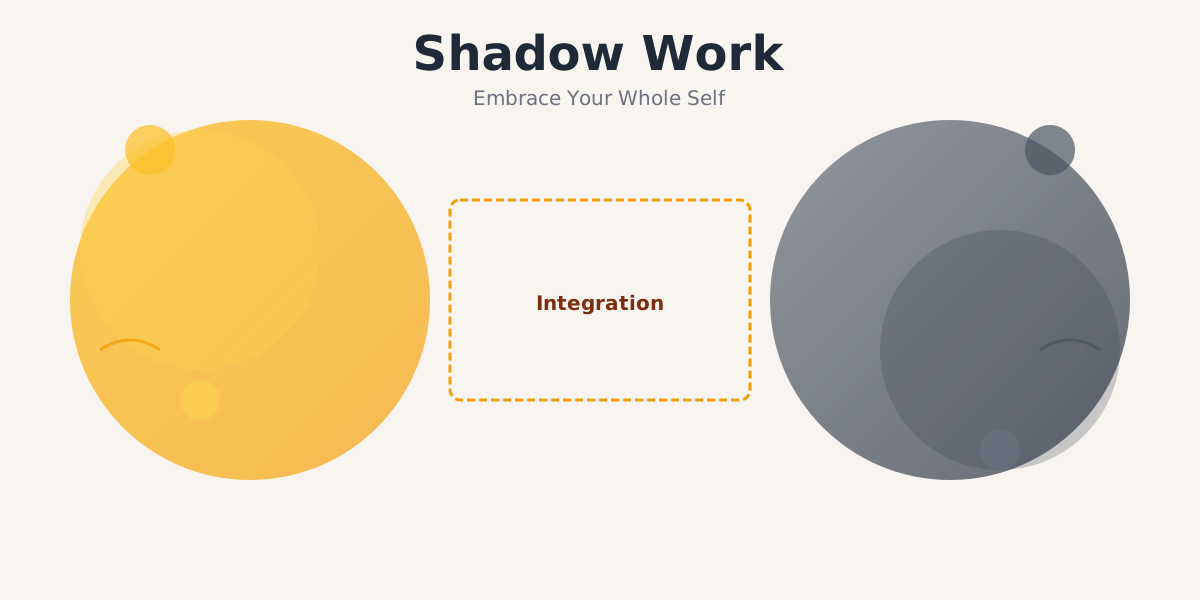
Your shadow isn't an enemy. It's the reservoir of suppressed emotions, desires, and traits that make you human.
Shadow work is the gateway to becoming the person you're truly capable of being—not despite your flaws, but because of how you consciously choose to integrate them.
What Is Shadow Work?
Shadow work is a psychological practice rooted in Jungian depth psychology, founded by Carl Jung in the early 1900s. Jung introduced the concept of the 'shadow self'—the unconscious portion of the personality that doesn't align with your ego ideal. The shadow contains everything you reject about yourself: negative emotions (rage, jealousy, fear), socially unacceptable desires (ambition, sexual attraction, greed), and suppressed talents or strengths you learned to hide. Shadow work involves bringing these rejected aspects into conscious awareness and integrating them into your whole personality. It's not about becoming 'dark' or 'bad'—it's about wholeness.
Not medical advice.
From childhood, you internalize messages about which parts of yourself are acceptable. A child taught 'anger is shameful' suppresses rage; one taught 'showing need is weakness' hides vulnerability. Over decades, these suppressed traits don't disappear—they live in your unconscious shadow, influencing your choices, relationships, and well-being without your awareness. Shadow work reverses this process: you consciously recover these rejected parts, understand why you rejected them, and choose how to use that energy authentically.
Surprising Insight: Surprising Insight: Your strongest judgments about others often reveal your shadow. When someone triggers intense anger or contempt in you, they're usually mirroring a rejected part of yourself. This phenomenon is called 'projection'—and noticing it is the beginning of shadow work.
The Shadow Work Process
A flowchart showing how unconscious traits become conscious through awareness, acceptance, and integration.
🔍 Click to enlarge
Why Shadow Work Matters in 2026
In 2026, perfectionism culture and social media highlight only your 'best self'—the curated, polished version you present online. This constant self-editing deepens your shadow. People suppress anger to stay 'nice,' hide ambition to avoid judgment, deny fear to seem strong, and reject sexuality to stay respectable. The cost is high: anxiety disorders, depression, relationship conflict, and chronic self-doubt all connect to shadow repression. Shadow work is increasingly recognized as essential for mental health because it addresses the root cause—the energy cost of maintaining an artificial persona.
Additionally, shadow work prevents unconscious behavior patterns. When you deny your anger, it leaks out as passive aggression toward loved ones. When you suppress ambition, you sabotage your own success. When you reject sexuality, intimacy suffers. By integrating these shadow aspects consciously, you gain control over your behavior instead of being controlled by your unconscious.
Finally, shadow work builds resilience. People who've done shadow work are less reactive to others' behavior because they're no longer triggered by their own projected shadows. They feel more authentic, less anxious, and more capable of genuine connection—all core drivers of happiness in 2026.
The Science Behind Shadow Work
Modern neuroscience validates Jung's shadow concept. Research on implicit memory shows that experiences and emotions processed outside conscious awareness (the unconscious) still influence behavior, decisions, and emotional responses. fMRI studies demonstrate that suppressed emotions activate the amygdala (fear/emotion center) even without conscious awareness, creating chronic low-level anxiety. When you do shadow work—bringing suppressed material into conscious awareness—the prefrontal cortex (rational center) can process and regulate it, reducing amygdala activation and anxiety.
Psychologist Carl Rogers found that the gap between your 'real self' and your 'ideal self' predicts anxiety and depression. Shadow work directly narrows this gap by accepting more of your real self. Additionally, research on psychological flexibility—the ability to accept difficult thoughts and feelings—shows it's one of the strongest predictors of life satisfaction. Shadow work is essentially the practice of developing psychological flexibility toward the parts of yourself you've been rejecting.
Brain Systems in Shadow Work
Shows how suppression activates the amygdala, while integration engages the prefrontal cortex for regulation.
🔍 Click to enlarge
Key Components of Shadow Work
Projection Recognition
Projection is the unconscious tendency to attribute your own rejected traits to others. You judge someone for being 'selfish,' but that judgment likely means you've rejected your own healthy self-interest. You feel disgusted by someone's 'neediness,' but that disgust reveals you've suppressed your own need for support. Shadow work begins by noticing your strongest negative judgments—these are maps to your shadow. When you observe what consistently triggers you, you've found a doorway to your shadow work.
Emotional Excavation
Emotional excavation involves deliberately exploring the emotions you habitually suppress. If you were raised to 'not be angry,' anger becomes part of your shadow. Shadow work asks: What situations make you want to rage? What would you do if anger were acceptable? What need is underneath the anger? By journaling, speaking with a therapist, or meditating on these suppressed emotions, you bring them into conscious awareness where you can understand and integrate them.
Narrative Revision
The stories you tell yourself about why you rejected certain traits often need revision. You might believe 'showing anger makes me a bad person' because a parent shamed your anger. Shadow work involves questioning this narrative: Is anger inherently bad? What would happen if you expressed anger appropriately? What positive function could this trait serve? By revising the narrative from 'this trait is shameful' to 'this trait is part of being human and can be used wisely,' you integrate the shadow.
Behavioral Integration
The final step is choosing how to use your integrated traits. Shadow work isn't about acting on every impulse—it's about conscious choice. You might integrate your anger by standing up for yourself, setting boundaries, or channeling it into advocacy. You might integrate your ambition by pursuing meaningful goals. Integration means the trait no longer controls you through unconscious behavior; instead, you consciously decide when and how to express it.
| Suppressed Trait | Why Suppressed | Integration Benefit |
|---|---|---|
| Anger | Taught it's 'bad' or unsafe to express | Healthy boundaries, assertiveness, healthy aggression |
| Vulnerability | Labeled 'weakness' in family culture | Genuine connection, intimacy, asking for help |
| Ambition | Religious or family message to 'stay humble' | Goal achievement, self-respect, meaningful contribution |
| Sexuality | Shame messages from family or religion | Authentic intimacy, body confidence, pleasure |
| Self-interest | Socialized to prioritize others' needs | Healthy boundaries, self-care, preventing burnout |
How to Apply Shadow Work: Step by Step
- Step 1: Notice your strongest emotional reactions: When do you feel intense anger, disgust, contempt, or shame about someone's behavior? Write down three recent moments.
- Step 2: Ask the projection question: What trait are they displaying that triggers me? Now ask: Do I have this trait? Where do I suppress it?
- Step 3: Identify the childhood source: When did you first learn to reject this trait? Who taught you it was unacceptable? What message did you internalize?
- Step 4: Journal on the suppressed emotion: Write about a time you felt this trait strongly but suppressed it. What would have happened if you'd expressed it? What did you fear?
- Step 5: Explore the functional purpose: What positive function could this trait serve? How might it help you if integrated consciously?
- Step 6: Revise the story: Replace 'This trait is bad/shameful' with 'This trait is human and can be used wisely.' Write this new story as if it's true.
- Step 7: Start small: Practice expressing the integrated trait in a safe, low-stakes situation. If integrating anger, try saying 'no' to a small request.
- Step 8: Notice the activation: Your nervous system might activate when you first integrate a suppressed trait. This is normal. Breathe through it. Your system is learning it's safe.
- Step 9: Reflect and adjust: After integrating the trait in a situation, journal about what happened. Did the feared outcome occur? What did you learn?
- Step 10: Continue intentionally: Shadow work is ongoing. As you integrate one trait, deeper shadows emerge. Return to step 1 regularly for lifelong growth.
Shadow Work Across Life Stages
Young Adulthood (18-35)
In young adulthood, shadow work often focuses on family-of-origin messages and early identity formation. You're discovering which traits your family/culture rejected and beginning to question whether you agree. Common shadow traits include anger (if parents modeled 'nice' responses), sexuality (if raised with shame), and authentic desires (if taught to prioritize others' expectations). Shadow work here involves distinguishing between inherited beliefs and your own values, which is essential for building authentic adult identity.
Middle Adulthood (35-55)
In middle adulthood, shadow work often reveals costs of long-suppression. You might realize that decades of rejecting anger have led to passive aggression in relationships, or suppressing vulnerability has created loneliness. Shadow work in this phase is often more urgent because people recognize that ignoring their shadow won't work anymore. It involves grieving lost time and consciously choosing integration before the final decades of life. Relationships often improve dramatically as people do this work.
Later Adulthood (55+)
In later adulthood, shadow work becomes a practice of integration and wholeness before death. Rather than fearing your rejected traits, you accept them as part of your full humanity. This often brings peace—you stop trying to be 'good enough' and accept yourself fully. Shadow work here frequently involves forgiveness (of yourself and others who taught you the shame) and legacy—how you want to be remembered and what wisdom you want to pass on.
Profiles: Your Shadow Work Approach
The Perfectionist
- Permission to be 'imperfect' and human
- Integration of the part that's 'lazy' or 'irresponsible'
- Understanding that rest is not laziness
Common pitfall: Believing shadow work means abandoning standards; actually it means high standards chosen consciously rather than driven by shame
Best move: Journal on: 'What would happen if I made one mistake and didn't fix it immediately?' Notice the anxiety. That's your shadow asking for integration.
The Caregiver
- Permission to prioritize their own needs
- Integration of healthy selfishness and boundary-setting
- Understanding that caring for yourself enables better care for others
Common pitfall: Believing shadow work means becoming 'selfish'; actually it means healthy self-interest that prevents burnout
Best move: Notice who triggers you with their 'selfishness.' That person is likely mirroring your suppressed self-interest. Start saying 'no' to one request per week.
The Achiever
- Integration of vulnerability and 'failure'
- Permission to rest without achievement
- Understanding that human worth isn't achievement-dependent
Common pitfall: Using shadow work to achieve more efficiently; actually it's about valuing yourself beyond productivity
Best move: Schedule one week where you don't achieve anything measurable. Sit with the discomfort. Journal on what arises.
The Conflict-Avoider
- Integration of anger and healthy assertion
- Permission to have needs and express them
- Understanding that conflict is sometimes necessary for healthy relationships
Common pitfall: Believing shadow work means confrontation; actually it means honest communication about needs
Best move: Identify one relationship where you've been avoiding expressing a need. Write what you need to say. Practice it first, then share.
Common Shadow Work Mistakes
The most common mistake is confusing shadow work with therapy. While shadow work is psychological, it's self-directed exploration, not clinical treatment. If you have diagnosed mental health conditions, shadow work should supplement therapy, not replace it. A skilled therapist can help you navigate shadow material safely, especially if you've experienced trauma.
A second mistake is using shadow integration as permission to act on impulses without responsibility. 'I'm integrating my anger' doesn't mean you yell at loved ones; it means you acknowledge the anger and choose how to express it. Integration requires conscious discernment, not acting out.
A third mistake is expecting shadow work to be linear. You integrate a trait (say, anger), feel relieved, then bump into a deeper layer of the same trait months later. This isn't failure—it's normal. Shadow work is ongoing, and each layer offers deeper integration.
Shadow Work Pitfalls and Solutions
Common mistakes in shadow work and how to navigate them.
🔍 Click to enlarge
Science and Studies
Shadow work is supported by decades of depth psychology and modern neuroscience research. Key studies show that integration of suppressed emotions reduces anxiety and improves relationship quality. The research base includes Jungian psychology, humanistic psychology, and increasingly, neuroscience validating the mechanisms Jung described over a century ago.
- Jung, C.G. (1959). 'Psychology and Religion: West and East.' Collected Works Vol. 11. The foundational text on shadow psychology and integration.
- Rogers, C.R. (1961). 'On Becoming a Person.' Research showing the mental health costs of the gap between real and ideal self.
- Assagioli, R. (1971). 'Psychosynthesis.' Framework for conscious integration of shadow and unconscious material.
- Tangney, J.P., Stuewig, J. & Mashek, D.J. (2007). 'Moral Emotions and Moral Behavior' in Annual Review of Psychology. How shame (related to shadow suppression) impacts behavior and relationships.
- Linehan, M.M. (2015). 'DBT Skills Training Manual, Second Edition.' Clinical validation of psychological flexibility (accepting rather than fighting shadow material) as treatment for emotional dysregulation.
Your First Micro Habit
Start Small Today
Today's action: For the next 3 days, notice one strong negative judgment you have about someone and ask: 'Do I have this trait? Where do I suppress it?' Write down one observation. That's your shadow map beginning.
Shadow work begins with awareness. By noticing projections (your judgments of others), you start mapping your shadow without feeling overwhelmed. This micro habit builds the observational muscle you need for deeper shadow work.
Track your shadow work observations and get personalized AI coaching with our app.
Quick Assessment
How often do you notice you judge others harshly for traits they have?
If you're 'often' or 'very often,' you likely have active shadow material. Those harsh judgments are projections revealing what you've rejected in yourself. This is actually valuable information for shadow work.
Which emotion do you find most difficult to express, even when you feel it strongly?
The emotion you selected is likely a primary shadow trait for you. Shadow work starts by acknowledging: 'I suppress this emotion. Now let me understand why and choose to integrate it.'
When you imagine expressing a suppressed emotion (your answer to question 2), what's your biggest fear?
Your answer reveals the core belief maintaining your shadow. Shadow work involves examining whether this fear is realistic or inherited from childhood messages that no longer serve you.
Take our full assessment to get personalized recommendations.
Discover Your Style →Next Steps
Shadow work begins with curiosity, not judgment. Your next step is to notice: What traits do I judge most harshly in others? What emotions do I habitually suppress? These are your shadows calling for integration. Start with the micro habit above—three days of projection awareness. That's enough to begin mapping your shadow.
After the micro habit, consider journaling on one specific shadow trait. Use prompts like: 'What would happen if I expressed this emotion?' or 'When did I first learn to suppress this?' Writing bypasses your rational mind and accesses the unconscious material shadow work requires. You'll be amazed what emerges.
Get personalized guidance with AI coaching.
Start Your Journey →Research Sources
This article is based on peer-reviewed research and authoritative sources. Below are the key references we consulted:
Related Glossary Articles
Frequently Asked Questions
Is shadow work the same as therapy?
Not exactly. Shadow work is self-directed psychological exploration, while therapy is professional treatment for mental health conditions. Shadow work is self-help; therapy is clinical care. However, they complement each other beautifully. If you're dealing with trauma or diagnosed mental health conditions, therapy should come first or accompany shadow work. Shadow work alone cannot treat clinical depression, anxiety disorders, or trauma.
How long does shadow work take?
Shadow work is ongoing. You might notice shifts in 2-4 weeks of consistent practice, but integration is a lifelong process. Each layer of your shadow takes time to surface, understand, and integrate. Some people do intensive shadow work for 6-12 months and then maintain with regular practice. Think of it like physical fitness—you don't do a bicep curl and stop exercising forever.
Can shadow work make me worse before better?
Yes, temporarily. When you start bringing suppressed material into awareness, you might feel increased anxiety, irritability, or sadness for a few days or weeks. This is called 'activation' and it's normal. Your nervous system is learning that it's safe to feel these emotions consciously rather than have them leak out unconsciously. If activation becomes overwhelming, slow down or work with a therapist.
What if I discover I've hurt people because of my unconscious shadow?
This is common and actually a sign of genuine growth. When you realize you've unconsciously harmed someone, shadow work guides you to repair if possible. Apologize authentically, take responsibility without excusing yourself, and commit to integrated behavior going forward. This is how shadow work creates ripples of healing through relationships.
Does shadow work mean I'll become 'dark' or 'negative'?
No. Shadow work actually reduces darkness by bringing suppressed material into conscious light. When anger, jealousy, or desire lives in your unconscious, it leaks out as subtle harm, passive aggression, or self-sabotage. When you consciously integrate these traits, you use them intentionally and responsibly. An integrated person is more emotionally stable, not less.
Take the Next Step
Ready to improve your wellbeing? Take our free assessment to get personalized recommendations based on your unique situation.
- Discover your strengths and gaps
- Get personalized quick wins
- Track your progress over time
- Evidence-based strategies