Roth IRA
A Roth IRA is one of the most powerful wealth-building tools available to individuals seeking financial independence. Unlike traditional retirement accounts where you get an immediate tax break but pay taxes later, a Roth IRA flips the equation: you pay taxes now on your contributions, but then enjoy tax-free growth and completely tax-free withdrawals in retirement. This simple shift in timing creates extraordinary long-term wealth potential. Imagine contributing $7,500 annually for 30 years and watching your entire portfolio—contributions and gains alike—grow completely tax-free. That's the transformative power of understanding and utilizing a Roth IRA strategically.
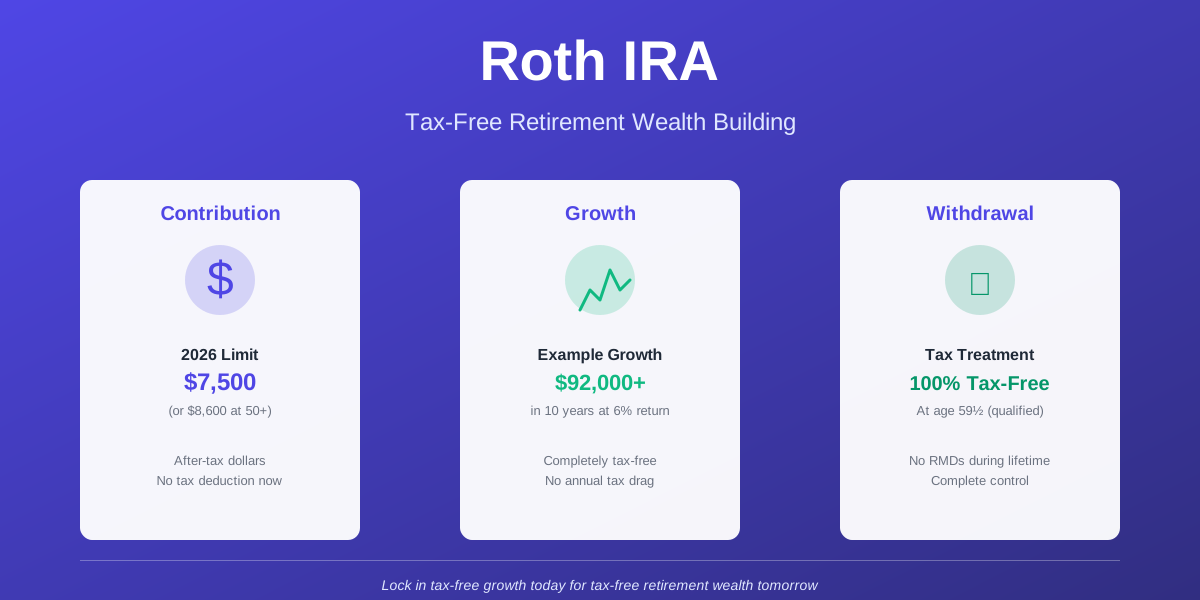
The Roth IRA has become essential in 2026 because tax rates remain historically uncertain, and the ability to lock in tax-free growth now protects you against potentially higher tax brackets in the future.
For high earners seeking to bypass income limitations on direct contributions, understanding conversion strategies and backdoor Roth mechanics opens entirely new wealth-building pathways.
What Is Roth IRA?
A Roth IRA is an Individual Retirement Account where you contribute after-tax dollars (money you've already paid income tax on) with the understanding that all investment growth and withdrawals will be completely tax-free, provided you follow IRS rules. The key distinction: with a traditional IRA, you get a tax deduction when you contribute but pay ordinary income taxes on withdrawals. With a Roth IRA, there's no upfront tax deduction, but your withdrawals are 100% tax-free.
This is not investment advice.
Created by the Taxpayer Relief Act of 1997, the Roth IRA has fundamentally changed how Americans approach retirement planning. It removed the income limits on conversions in 2010, making it accessible to virtually anyone willing to explore conversion strategies. Today, the Roth IRA represents a tax-advantaged retirement vehicle that rewards long-term thinking and disciplined saving.
Surprising Insight: Surprising Insight: A Roth IRA has NO required minimum distributions (RMDs) during your lifetime, meaning your money can continue compounding tax-free for as long as you live. This makes it an exceptional wealth transfer tool for leaving tax-free accounts to heirs.
Roth IRA vs Traditional IRA: Tax Timeline
Shows the contrasting tax treatment of Roth and Traditional IRAs across contribution, growth, and withdrawal phases.
🔍 Click to enlarge
Why Roth IRA Matters in 2026
In 2026, the Roth IRA matters more than ever because the tax landscape is uncertain. Current tax rates are scheduled to change, and building a Roth IRA today locks in today's tax rates forever. You're essentially trading certainty now for absolute certainty later.
Second, contribution limits increased to $7,500 for those under 50 (and $8,600 for those 50 and older), giving individuals greater opportunity to build tax-free wealth. High earners who cannot contribute directly can utilize backdoor Roth conversions, turning this limitation into an advantage.
Third, with no RMDs during your lifetime and the ability to withdraw contributions penalty-free at any time, a Roth IRA provides unparalleled flexibility for emergencies while maximizing long-term wealth. This combination of safety and growth potential makes the Roth IRA the centerpiece of modern retirement planning.
The Science Behind Roth IRA
The power of a Roth IRA lies in tax-free compounding. When you invest $7,500 annually for 10 years with an average 6% return, you accumulate approximately $92,000—about $22,000 more than your actual contributions. The difference is investment growth, and crucially, none of that growth is taxed annually. In a taxable brokerage account, you'd pay taxes on dividends, interest, and capital gains every year, significantly reducing your compounding returns.
Behavioral research confirms that having a dedicated retirement account—separate from everyday spending money—increases savings discipline and long-term wealth accumulation. The psychological commitment to an IRA combined with the tax incentive creates a powerful behavioral lever for building wealth.
Growth Comparison: Roth IRA vs Taxable Account
30-year wealth accumulation showing how tax-free compounding in a Roth IRA dramatically outpaces a taxable investment account with annual tax drag.
🔍 Click to enlarge
Key Components of Roth IRA
Contribution Limits (2026)
For 2026, the IRA contribution limit is $7,500 for individuals under age 50. If you're 50 or older, you're eligible for a catch-up contribution of an additional $1,100, bringing your total to $8,600. These limits apply per individual per calendar year and apply to combined Traditional and Roth IRA contributions—you cannot contribute $7,500 to both.
Income Phase-Out Ranges
While Roth conversions have no income limits, direct Roth IRA contributions do phase out. For single filers in 2026, the phase-out range is $153,000 to $168,000 of Modified Adjusted Gross Income (MAGI). For married filing jointly, it's $242,000 to $252,000. This limitation is precisely why backdoor Roth conversions exist—for those exceeding the income limits.
The Five-Year Rule
Every Roth IRA is subject to a 5-year holding period that begins on January 1 of the tax year for which you made your first Roth contribution or conversion. You must satisfy this rule once per account. While you can withdraw contributions at any time penalty-free, earnings cannot be withdrawn before age 59½ without the 5-year rule being satisfied, or you'll owe a 10% early withdrawal penalty plus income taxes on the earnings.
No Required Minimum Distributions
Unlike traditional IRAs, which require withdrawals starting at age 73, Roth IRAs have zero RMD requirements during your lifetime. This means your money continues compounding tax-free indefinitely, and you maintain complete control over when and how much you withdraw. Your heirs inherit tax-free accounts, creating a powerful wealth transfer mechanism.
| Feature | Roth IRA | Traditional IRA |
|---|---|---|
| Contribution Tax Treatment | After-tax (no deduction) | Pre-tax (tax deductible) |
| Growth | Tax-free | Tax-deferred |
| Withdrawals in Retirement | Tax-free (if qualified) | Fully taxable |
| Required Minimum Distributions | None during lifetime | Required at age 73 |
| Early Withdrawal of Earnings | 10% penalty + tax before 59½ | 10% penalty + tax before 59½ |
| 2026 Contribution Limit (under 50) | $7,500 | $7,500 |
| Income Limits on Direct Contributions | Yes ($153K-$168K single) | No income limits |
| Conversion Income Limits | None (anyone can convert) | N/A |
How to Apply Roth IRA: Step by Step
- Step 1: Evaluate your income against 2026 Roth IRA contribution limits ($153K-$168K for single filers) to determine if you're eligible for direct contributions.
- Step 2: Choose a financial institution (Fidelity, Vanguard, Charles Schwab, etc.) to open your account—compare fees, minimum investments, and available investment options.
- Step 3: Complete the account opening process online in minutes, providing personal information, employment details, and banking information for electronic transfers.
- Step 4: Make your 2026 contribution: transfer funds from your bank account to your Roth IRA (deadline is April 15, 2027 for 2026 contributions).
- Step 5: Select your investments from available options: index funds, ETFs, individual stocks, bonds, or mutual funds aligned with your risk tolerance.
- Step 6: If income-limited, explore the backdoor Roth strategy: contribute to a Traditional IRA, then immediately convert it to a Roth IRA (consult a tax professional).
- Step 7: Set up automatic monthly contributions if possible—even $625/month reaches the $7,500 annual limit and enforces savings discipline.
- Step 8: Review your Roth IRA annually: ensure your asset allocation matches your age and risk tolerance (more aggressive when younger, more conservative as retirement approaches).
- Step 9: Avoid common mistakes: don't touch earnings before age 59½ (unless qualifying exceptions apply), don't withdraw more than your contribution basis, and don't miss the annual deadline.
- Step 10: Consider increasing contributions at age 50 to maximize the $8,600 catch-up limit, accelerating your path to retirement security.
Roth IRA Across Life Stages
Young Adulthood (18-35)
During young adulthood, the Roth IRA becomes your most powerful wealth-building tool. You have 30-40+ years until retirement, meaning compound growth has maximum time to work. Even small contributions—$7,500 annually—grow to hundreds of thousands of dollars. Young adults in lower tax brackets benefit maximally from paying taxes now at lower rates while locking in tax-free growth. The psychological shift of starting retirement savings early creates lifelong financial discipline.
Middle Adulthood (35-55)
During middle adulthood, your focus shifts to maximization and strategic conversions. If you haven't maximized your Roth IRA, increase contributions from $7,500 to $8,600 at age 50. This is also the ideal phase for backdoor Roth conversions if your income exceeds limits. You have 10-20 years of remaining compound growth, so every dollar converted becomes tax-free forever. Mid-career professionals often have increased income and should consider whether a conversion strategy makes sense.
Later Adulthood (55+)
After age 55, the Roth IRA remains your most valuable retirement asset. You're maximizing the $8,600 catch-up contribution if possible. Critically, you're NOT forced to withdraw—no RMDs means your money continues compounding. Use your Roth strategically in early retirement (before age 73) to avoid Required Minimum Distributions from traditional accounts. Because Roth withdrawals are tax-free, they don't increase your taxable income, preserving Medicare subsidies and Social Security taxation advantages.
Profiles: Your Roth IRA Approach
The Young Professional
- Maximize annual contributions immediately to benefit from 30+ years of compound growth
- Invest in growth-oriented index funds or ETFs to capture market returns
- Understand that current taxes are lower than likely future retirement taxes
Common pitfall: Delaying contributions due to other financial priorities, missing decades of compound growth.
Best move: Prioritize Roth IRA contributions as non-negotiable monthly expense, treat it like rent you must pay yourself.
The High Earner
- Navigate income limits that prevent direct contributions but allow conversions
- Execute backdoor Roth strategies to access tax-free growth despite high income
- Coordinate Roth with other retirement accounts (401k, traditional IRA) for optimal tax efficiency
Common pitfall: Assuming high income excludes Roth participation entirely, missing conversion opportunities.
Best move: Work with a tax professional to execute annual backdoor Roth conversions—no income limits apply.
The Mid-Career Maximizer
- Accelerate contributions at age 50 using the $8,600 limit with catch-up contributions
- Evaluate whether conversion strategies make sense with 15-20 years until retirement
- Balance Roth contributions with other retirement goals like maximizing 401k
Common pitfall: Not increasing contributions at 50, leaving catch-up contribution potential unused.
Best move: Increase to $8,600 annually at 50, and ensure catch-up contributions are funded before other retirement savings.
The Flexible Retiree
- Access tax-free withdrawals to manage retirement income without increasing tax bracket
- Use Roth strategically before required distributions from traditional accounts begin
- Plan tax-efficient withdrawal sequences across Traditional and Roth accounts
Common pitfall: Over-withdrawing from traditional accounts, increasing taxable income unnecessarily.
Best move: Withdraw from Roth before traditional accounts when possible to minimize taxable income in early retirement.
Common Roth IRA Mistakes
The most critical mistake is withdrawing earnings before satisfying both age 59½ and the 5-year rule. Many people believe they can withdraw earnings at any time, but this triggers a 10% penalty plus income taxes. You can withdraw contributions anytime without penalty, but earnings are different. Understand this distinction thoroughly.
Second, high earners often assume they cannot use Roth IRAs due to income limits. This is false. Backdoor Roth conversions have no income limits—anyone can convert a Traditional IRA to a Roth IRA, regardless of income. This strategy is specifically designed for those exceeding direct contribution limits.
Third, neglecting to rebalance your portfolio or letting cash sit idle in your Roth IRA means missing years of compound growth. Your Roth should always be fully invested in aligned assets—not sitting as cash. Once annually, rebalance to maintain your target asset allocation.
Roth IRA Withdrawal Rules Decision Tree
Flowchart showing which Roth IRA withdrawals are tax-free, taxable, or penalized based on age and holding period.
🔍 Click to enlarge
Science and Studies
Financial research consistently demonstrates that tax-free compounding creates extraordinary wealth advantages over time. Studies from Vanguard, Fidelity, and academic researchers show that retiring with a Roth IRA reduces lifetime tax burden significantly compared to all-traditional retirement accounts. The IRS acknowledges this through its tax code, making Roth IRAs a legitimized strategy for tax reduction.
- IRS Publication 590-B (Distributions from Individual Retirement Arrangements): Comprehensive official guidance on Roth IRA rules, withdrawal exceptions, and tax treatment.
- Vanguard Research (2024): Long-term study showing tax-free accounts reduce lifetime tax burden by 15-25% compared to all-taxable accounts.
- Fidelity Learning Center: Analysis demonstrating $7,500 annual contributions for 30 years at 6% average returns grow to $435,000+ with zero tax on withdrawals.
- Khan Academy Finance: Educational framework explaining Roth IRAs, Traditional IRAs, and tax-deferred compound growth mechanisms.
- IRS Newsroom (2025): Official announcement that 2026 IRA contribution limit increased to $7,500 and catch-up contribution increased to $1,100 for age 50+.
Your First Micro Habit
Start Small Today
Today's action: Open a Roth IRA account this week with your chosen provider (Fidelity, Vanguard, or Charles Schwab) and make your first contribution of at least $500—even if you cannot contribute the full $7,500 today.
Opening the account removes the activation energy barrier. Your first contribution—no matter the size—initiates the compound growth timeline. Every day your money sits in a Roth IRA growing tax-free is a day you're not paying taxes on returns. Small actions create momentum toward financial independence.
Keep quitting habit apps after a missed day? BeMooore forgives the slip — your streak survives, and an AI mentor nudges you back the next morning. Free on iOS.
Quick Assessment
How clear is your current understanding of Roth IRA mechanics and tax advantages?
Your clarity level determines whether to focus on basic setup (options 3-4) or advanced strategies like backdoor conversions (options 1-2).
What is your primary goal with a Roth IRA?
Different goals suggest different strategies: younger investors prioritize compound growth, while near-retirees focus on withdrawal optimization.
What is your annual income relative to 2026 Roth IRA limits ($153K-$168K single, $242K-$252K married)?
Income level determines strategy: direct contributors use simple contributions, while high earners leverage backdoor conversions with no income limits.
Take our full assessment to get personalized recommendations.
Discover Your Style →Next Steps
Your next step is concrete action. Open a Roth IRA account with Fidelity, Vanguard, Charles Schwab, or your chosen provider this week. Identify your income situation—if below the phase-out limit, contribute directly; if above, research backdoor Roth conversions with a tax professional. Choose low-cost index funds aligned with your age and risk tolerance, and set up automatic monthly contributions.
Commit to annual reviews: each year, increase your contribution if possible (especially at age 50 when catch-up contributions begin), rebalance your portfolio, and adjust your asset allocation as you age. The Roth IRA is not a set-it-and-forget-it account—it requires ongoing attention and strategic decision-making to maximize its wealth-building potential.
Get personalized guidance with AI coaching.
Start Your Journey →Research Sources
This article is based on peer-reviewed research and authoritative sources. Below are the key references we consulted:
Related Glossary Articles
Frequently Asked Questions
Can I withdraw my Roth IRA contributions at any time without penalty?
Yes. You can withdraw your contributions (the money you put in) at any time, for any reason, without taxes or penalties. However, earnings (investment gains) have restrictions—you must be age 59½ and satisfy the 5-year rule, or you'll owe a 10% penalty plus income taxes on the earnings. Always verify with your provider before withdrawing to ensure you understand your specific balance breakdown.
What is the backdoor Roth strategy and who should use it?
A backdoor Roth is a strategy for high-income earners who exceed direct Roth IRA contribution limits. You contribute to a Traditional IRA (non-deductible), then immediately convert it to a Roth IRA. This works because conversions have NO income limits—anyone can convert regardless of income. Consult a tax professional before executing this strategy, as the pro-rata rule may apply if you have existing Traditional IRA balances.
Do I have to withdraw money from my Roth IRA in retirement?
No. Unlike Traditional IRAs, Roth IRAs have no required minimum distributions (RMDs) during your lifetime. Your money can continue compounding tax-free indefinitely, and you maintain complete discretion over when and how much to withdraw. This makes Roth IRAs powerful wealth transfer tools—your heirs inherit tax-free accounts.
Can I have both a Traditional IRA and a Roth IRA?
Yes, you can have both accounts simultaneously. However, your combined contributions to all IRAs (Traditional and Roth combined) cannot exceed $7,500 annually ($8,600 if age 50+). If you contribute $4,000 to a Traditional IRA, you can only contribute $3,500 to a Roth that year. Choose strategically based on your tax situation and retirement timeline.
What happens to my Roth IRA when I die?
Your designated beneficiaries inherit your Roth IRA as a tax-free inherited IRA. They can withdraw contributions anytime tax-free, and earnings remain tax-free if distributed properly. This makes Roth IRAs exceptional estate planning tools. Non-spouse beneficiaries must withdraw the inherited IRA within 10 years under current SECURE 2.0 Act rules, but the withdrawals remain tax-free, unlike Traditional IRA inheritance.
Take the Next Step
Ready to improve your wellbeing? Take our free assessment to get personalized recommendations based on your unique situation.
- Discover your strengths and gaps
- Get personalized quick wins
- Track your progress over time
- Evidence-based strategies