Radical Acceptance
You're fighting reality. Your mind keeps replaying what should have happened instead of what actually did. Your body tenses. Your emotions spiral. But what if the exhaustion you feel comes not from the difficult event itself, but from your resistance to accepting it? Radical acceptance is a transformative mental wellness skill that invites you to stop this internal battle—not through surrender or approval, but through clear-eyed acknowledgment of what is. In this guide, we'll explore how completely accepting reality as it is can paradoxically free you from suffering and enable genuine change.
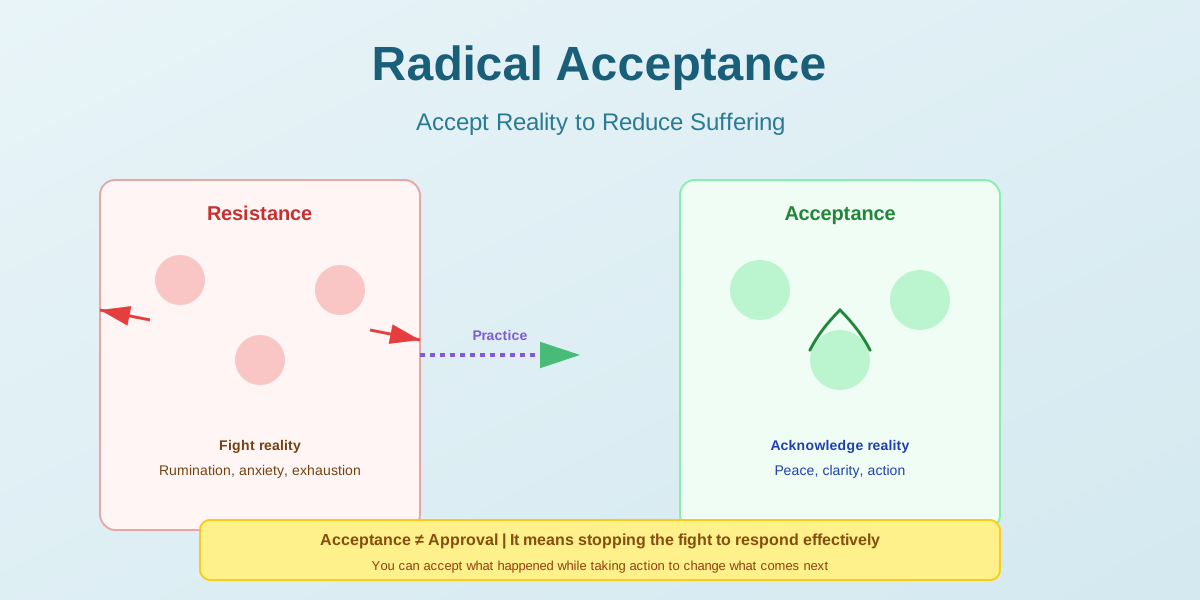
Radical acceptance doesn't mean passive resignation or defeat. It means recognizing the facts of your situation without the distorted lens of judgment, shame, or resistance. This single shift in perspective can reduce anxiety, depression, and emotional overwhelm while improving your ability to respond effectively to life's challenges.
Whether you're facing grief, loss, chronic illness, relationship conflict, or simply the accumulated stress of modern life, radical acceptance offers a pathway from suffering to peace. And you can start practicing it today—in the next ten minutes.
What Is Radical Acceptance?
Radical acceptance is a core skill in Dialectical Behavior Therapy (DBT), developed by psychologist Marsha M. Linehan in the late 1980s. At its essence, radical acceptance means fully and completely acknowledging reality as it is in this present moment, without judgment, resistance, or attempts to change what cannot be changed. The word 'radical' comes from the Latin 'radix,' meaning root—it refers to a complete, all-the-way-down acceptance, not a half-hearted or partial one.
Not medical advice.
Radical acceptance operates on three interconnected levels: first, accepting the facts of a situation (what happened is what happened); second, accepting that the event or situation has causes—it didn't occur in a vacuum; and third, accepting that life can still be worth living even with painful events. This three-part approach prevents you from adding psychological suffering on top of unavoidable pain. When you break your leg, the break is real. Radical acceptance means stopping the internal narrative that says 'this shouldn't have happened' or 'my life is ruined,' and instead saying 'this happened, I'm healing, I can adapt.'
Surprising Insight: Surprising Insight: Research shows that practicing radical acceptance for just 15 minutes can reduce emotional intensity more effectively than cognitive reappraisal alone—and the benefits extend to improve your ability to use other coping strategies afterward.
The Three Levels of Radical Acceptance
Understanding how radical acceptance operates at factual, causal, and existential levels
🔍 Click to enlarge
Why Radical Acceptance Matters in 2026
In 2026, we face unprecedented levels of uncertainty and change. Economic instability, climate anxiety, rapid technological disruption, and social fragmentation create constant low-level stress. Many of us live in a perpetual state of resistance—wishing things were different than they are, fighting against circumstances we cannot control, and experiencing the exhaustion that comes from this internal war. Radical acceptance offers a counterintuitive pathway: by stopping the fight against reality, we recover enormous emotional energy for focusing on what we can actually influence.
Mental health professionals now recognize that anxiety and depression often stem not just from difficult circumstances, but from our resistance to those circumstances. We add a second arrow of suffering—the emotional reaction to the pain. Radical acceptance addresses this at its root. By teaching yourself to accept what is, you can dramatically reduce the emotional load you carry. This creates space for resilience, creativity, and genuine problem-solving.
For those with chronic illness, trauma histories, grief, or ongoing life challenges, radical acceptance is not a one-time achievement but an ongoing practice. Studies show that people who cultivate acceptance-based mindset show lower rates of depression, reduced anxiety symptoms, and improved quality of life even when external circumstances don't change. This skill directly impacts your wellbeing regardless of what happens around you.
The Science Behind Radical Acceptance
The neurobiological foundation of radical acceptance lies in how your brain processes threat and stress. When you resist reality—when you insist 'this shouldn't be happening'—your nervous system interprets this as an unresolved threat. Your amygdala remains activated, cortisol stays elevated, and your prefrontal cortex (the part responsible for clear thinking and decision-making) becomes less available. This is the neurological basis of anxiety and emotional overwhelm. Acceptance literally changes this neural pathway. When you practice radical acceptance, you signal to your nervous system that the threat is manageable or unchangeable, allowing activation to decrease and executive function to return.
A 2025 study published in Current Psychology found that radical acceptance as a standalone emotion regulation strategy produced greater reductions in emotional intensity compared to cognitive reappraisal alone. The mechanism appears to be that acceptance removes the energy cost of internal resistance, allowing your nervous system to stabilize. Research from the University of Rochester and other institutions demonstrates that acceptance-based interventions significantly reduce symptoms of anxiety and depression, with effects comparable to or exceeding other therapeutic approaches. For people with PTSD following trauma, combining acceptance with other trauma therapies accelerates recovery—shame, guilt, and fear all decrease while acceptance increases throughout treatment.
How Radical Acceptance Affects Your Nervous System
The neurobiological shift from resistance to acceptance
🔍 Click to enlarge
Key Components of Radical Acceptance
Factual Clarity
The foundation of radical acceptance is seeing reality as it actually is, not as your emotional mind insists it should be. This means distinguishing between what happened (the facts) and the story you tell about what it means. Did your partner leave the relationship? That's a fact. Does it mean you're unlovable? That's an interpretation layered on top of the fact. Factual clarity helps you work with reality rather than with your distorted perception of it.
Release of Judgment
Radical acceptance explicitly includes releasing judgment about whether the situation is fair, deserved, or acceptable by your standards. This doesn't mean approving of harmful behavior or being passive. It means recognizing that regardless of whether something 'should' have happened, it did happen, and now you're living with the reality that it occurred. The should is no longer relevant. What's relevant is what's true and what you can do from here.
Emotional Tolerance
Acceptance includes developing the capacity to feel difficult emotions without either acting on them or trying to escape them. Sadness, grief, anger, and fear are natural responses to loss and challenge. Radical acceptance means allowing these emotions to move through you rather than resisting them or turning them into permanent identity. You practice saying 'I feel grief right now, and I can tolerate this' rather than 'I feel grief therefore something is wrong with me.'
Mindful Attention
Radical acceptance requires present-moment awareness—noticing what's actually happening right now rather than what you feared would happen or what you wish had happened. This is where mindfulness practice supports acceptance. By training your attention to rest in the present moment, you naturally reduce the mental energy devoted to ruminating about the past or catastrophizing about the future. Both rumination and catastrophizing reinforce resistance to reality.
| Situation | Resistance Response | Acceptance Response |
|---|---|---|
| Job loss | 'This shouldn't have happened to me' → Rumination → Depression | 'This happened. I'm grieving. Now I'll explore next steps' → Action |
| Chronic illness | 'My life is ruined' → Fighting the diagnosis → Emotional exhaustion | 'I have this condition. I'll adapt and manage' → Resilience building |
| Relationship ended | 'They were wrong to leave me' → Resentment → Stuck in past | 'The relationship ended. I'm sad and I can learn from this' → Growth |
| Social anxiety | 'I shouldn't feel nervous around people' → Avoiding social situations | 'I feel nervous and I can do this anyway' → Gradual confidence building |
How to Apply Radical Acceptance: Step by Step
- Step 1: Identify the situation: Name clearly what has happened or what is currently true. Be specific and factual, avoiding interpretation. Write it down if helpful: 'I lost my job today.' 'My parent is ill.' 'I made a mistake.'
- Step 2: Notice your resistance: Observe what your mind is saying about this situation. What 'shoulds' appear? 'This shouldn't have happened.' 'I should have seen this coming.' 'My life should be different.' Simply notice these thoughts without arguing with them.
- Step 3: Pause and breathe: Take three deep breaths. Bring awareness to your body. Where do you feel tension or tightness? Breathe into those spaces. This pause creates space between the event and your response.
- Step 4: Say it aloud: Articulate your acceptance clearly. 'This happened. The facts are what they are. I cannot change what already occurred.' Saying it aloud engages additional neural pathways and strengthens the practice.
- Step 5: Release the fight: Consciously let go of resistance. Imagine putting down a weight you've been carrying. Visualize your resistance dissolving like mist. Notice what happens in your body when you do this.
- Step 6: Feel your emotions: Let whatever emotions are present arise without trying to change them. Sadness, anger, fear, grief—these are appropriate responses to real challenges. Allow yourself to feel them fully.
- Step 7: Acknowledge the impact: Acceptance doesn't deny that this situation has consequences. Recognize how this impacts you: 'This is difficult. It will take time to adjust. I will need to take specific actions.'
- Step 8: Identify what you can control: Even while accepting what happened, identify what remains within your sphere of influence. What steps can you take? What support do you need? This shifts energy from resistance to agency.
- Step 9: Practice self-compassion: Extend compassion to yourself for being in this difficult situation. The situation is challenging enough without adding self-criticism. Speak to yourself as you would a good friend in this circumstance.
- Step 10: Repeat daily: Radical acceptance is a skill that strengthens with practice. Spend 3-5 minutes each day practicing acceptance of small challenges—a frustrating email, unexpected change in plans, minor disappointment—to build capacity for larger difficulties.
Radical Acceptance Across Life Stages
Young Adulthood (18-35)
Young adults often struggle with accepting that reality doesn't match their imagined future. The pressure to be successful, attractive, and perfect runs high. In this stage, radical acceptance focuses on embracing your actual strengths rather than mourning imagined ones, accepting that your path differs from your peers' paths, and acknowledging that mistakes are part of growth rather than proof of failure. Learning to accept uncertainty about career and relationships during this stage builds tremendous resilience for future challenges.
Middle Adulthood (35-55)
Middle adulthood often brings the confrontation between teenage dreams and adult reality. The career didn't launch as imagined. The relationship isn't what was hoped. The body changed. Responsibilities multiplied. Radical acceptance in this phase means grieving unexpressed potential while engaging fully with what is actually happening now. It means accepting aging, accepting that some life paths remain closed, and paradoxically finding deeper satisfaction in what was actually built rather than what was imagined.
Later Adulthood (55+)
Later adulthood brings inevitable losses—health changes, the death of loved ones, shifting social roles, the awareness of limited time. Radical acceptance becomes critical for maintaining well-being and meaning. It involves accepting physical changes without catastrophizing, accepting that death is part of life, and accepting that your life has been what it was rather than holding endless regret. Research shows that acceptance-based approaches are particularly effective for people managing chronic illness and existential concerns common in later life.
Profiles: Your Radical Acceptance Approach
The Perfectionist Controller
- Learning that you can't control everything and survive it
- Practicing acceptance of imperfection without shame
- Recognizing that micromanaging comes from anxiety, not strength
Common pitfall: Believing that if you just think hard enough, you can fix anything; becoming exhausted and resentful when reality resists your will
Best move: Start small: accept one thing today that isn't perfect. Notice that you survive it. Build from there.
The Ruminator/Analyzer
- Moving from endless analysis to acceptance and action
- Breaking the cycle where thinking about the problem feels like doing something
- Learning to tolerate uncertainty without needing perfect understanding
Common pitfall: Spending enormous mental energy reviewing past mistakes or analyzing what-if scenarios; never reaching peace or moving forward
Best move: When you catch yourself ruminating, gently redirect: 'This happened. I can't change it. What can I do now?' Repeat this redirect practice.
The Avoider
- Building capacity to feel difficult emotions without immediately escaping
- Understanding that avoidance temporarily reduces discomfort but increases anxiety long-term
- Developing the skill of sitting with discomfort for brief periods
Common pitfall: Using distraction, substance use, or activity to sidestep difficult emotions; the underlying issue grows larger in the background
Best move: Practice the 'five-minute challenge': sit with one difficult emotion or situation for just five minutes without escaping. You can handle five minutes.
The Warrior/Striver
- Learning that accepting difficult circumstances is strength, not weakness
- Channeling competitive drive toward building resilience and adaptability
- Recognizing that fighting reality drains energy needed for actual problem-solving
Common pitfall: Exhaustion from constant fighting against circumstances; injury from refusing to adapt or rest when needed
Best move: Reframe acceptance as a high-level strategic skill: elite athletes accept conditions they can't change and optimize what they can control.
Common Radical Acceptance Mistakes
Mistake 1: Confusing acceptance with approval or passivity. People often resist radical acceptance believing it means approving of harmful behavior or becoming passive and unmotivated. In reality, acceptance is the prerequisite for effective action. You can fully accept that you have anxiety (the fact) while simultaneously taking steps to manage it (the action). Acceptance and assertive action are not opposites—acceptance provides the clear foundation from which effective action emerges.
Mistake 2: Using acceptance as spiritual bypassing. Some people use 'acceptance' language to avoid legitimate emotions or necessary action. 'I accept my unhealthy relationship' without setting boundaries or leaving is not radical acceptance—it's avoidance dressed in acceptance language. True radical acceptance of an unhealthy relationship includes accepting your own needs and taking action to meet them, possibly by leaving.
Mistake 3: Expecting one-time acceptance to stick forever. Acceptance is not a destination you reach once. It's an ongoing practice, especially with larger losses and challenges. You may genuinely accept a diagnosis one day, then find yourself in resistance the next day when symptoms worsen. This is normal. Radical acceptance is something you return to repeatedly, not something you achieve once and keep forever.
Acceptance vs. Common Misunderstandings
Clarifying what radical acceptance actually is and is not
🔍 Click to enlarge
Science and Studies
The research foundation for radical acceptance continues to expand. Multiple peer-reviewed studies have documented its effectiveness across diverse populations and conditions. The evidence base demonstrates that acceptance-based interventions produce meaningful improvements in psychological wellbeing, with effects that often match or exceed other therapeutic approaches.
- Or, A., Bronshtein, K., & Weinbach, N. (2025). The benefits of radical acceptance of reality as a standalone strategy for emotion regulation. Current Psychology & Psychology and Psychotherapy: Theory, Research and Practice—Showed that a single 15-minute radical acceptance practice reduced emotional intensity more effectively than cognitive reappraisal alone.
- Acceptance and Commitment Therapy meta-analysis (2021): ACT-based treatments (which heavily utilize acceptance) produced more positive impacts on depression symptoms than no treatment or treatment-as-usual, with moderate to large effect sizes.
- DBT for PTSD (Trauma and Mental Health Report, 2017): In treating PTSD following childhood sexual abuse, participants showed significant decreases in shame, guilt, disgust, distress, and fear while radical acceptance increased throughout the treatment course.
- Clinical Psychology Review (2014) meta-analysis: DBT interventions significantly decreased symptoms of depression and anxiety across multiple studies, with radical acceptance identified as a key active ingredient.
- University of Rochester research (2025): Acceptance-based mindfulness practices demonstrated improvements in stress tolerance, sleep quality, and nervous system regulation—even when external life circumstances remained unchanged.
Your First Micro Habit
Start Small Today
Today's action: When something frustrates you today—a slow internet connection, an email you didn't want, traffic, a mistake—pause and practice 30 seconds of radical acceptance. Say: 'This is what's happening right now. I don't like it, and it's here. I can handle this.'
Small daily practice builds neural pathways and emotional capacity. You're training your brain to reflexively accept instead of reflexively resist. These micro-moments accumulate into genuine skill development over weeks.
Keep quitting habit apps after a missed day? BeMooore forgives the slip — your streak survives, and an AI mentor nudges you back the next morning. Free on iOS.
Quick Assessment
Which statement best describes how you typically respond to difficult situations?
Your response style shapes your emotional wellbeing. Acceptance-focused responses create more resilience and peace than resistance-focused ones. Your style can change with practice.
When you face something you can't control, what's your typical struggle?
The struggle itself is optional. Radical acceptance helps you stop the internal battle and redirect that energy toward what actually matters and what you can actually influence.
How would your life change if you could fully accept things you cannot change?
Acceptance doesn't create passivity—it enables effective action by freeing the enormous mental energy spent on resistance. This energy redirects toward genuine problem-solving and wellbeing.
Take our full assessment to get personalized recommendations.
Discover Your Style →Next Steps
Radical acceptance is immediately practical. You can begin this very moment with the next frustration you encounter. Notice what you cannot control. Practice saying 'this is what's true' instead of 'this shouldn't be true.' Feel the difference in your nervous system when you release resistance. Start with tiny challenges—a slow Wi-Fi connection, a typo in an important email, a moment of social awkwardness. Build your acceptance muscle on small things, and it becomes available for larger challenges when you need it.
Consider combining radical acceptance with related practices: mindfulness meditation to strengthen present-moment awareness, self-compassion practices to support yourself through difficulty, and journaling to process emotions and track your relationship with acceptance over time. The more you practice, the more acceptance becomes your automatic response to life's inevitable challenges.
Get personalized guidance with AI coaching.
Start Your Journey →Research Sources
This article is based on peer-reviewed research and authoritative sources. Below are the key references we consulted:
Related Glossary Articles
Frequently Asked Questions
Isn't radical acceptance just giving up?
No. Acceptance is not about giving up—it's about stopping the internal fight against what's already happened so you can effectively respond. You can fully accept a diagnosis while actively pursuing treatment. You can accept a relationship ended while grieving and eventually moving forward. Acceptance is the foundation for wise action, not the opposite of it.
How is radical acceptance different from just thinking positive thoughts?
Radical acceptance is quite different from toxic positivity or forced positive thinking. Acceptance means seeing reality clearly, including difficult truths, without adding judgment. You're not pretending things are fine—you're acknowledging they're hard while also refusing to add unnecessary suffering through resistance. This leads to genuine peace, not forced cheer.
Can I practice radical acceptance while still being angry about injustice?
Absolutely. Accepting that an injustice occurred is entirely compatible with anger about that injustice and with taking action to address it. You can fully accept what happened while also working to change systems or prevent future harm. Acceptance and advocacy are not opposites.
How long does it take to get good at radical acceptance?
You can experience some benefits from a single practice session. However, radical acceptance is a skill that deepens with regular practice. Most people begin noticing significant shifts in 2-4 weeks of daily practice with small challenges. Larger challenges may require more ongoing practice. The good news: the practice itself feels increasingly peaceful over time.
What do I do if I practice acceptance and still feel upset?
Feeling upset is completely normal and doesn't mean you're doing it wrong. Acceptance doesn't eliminate painful emotions—it stops adding suffering on top of legitimate pain. You can feel grief while accepting a loss. You can feel anger while accepting an injustice. Acceptance creates space to feel these emotions fully rather than fighting them. Over time, this actually helps emotions process and eventually resolve.
Take the Next Step
Ready to improve your wellbeing? Take our free assessment to get personalized recommendations based on your unique situation.
- Discover your strengths and gaps
- Get personalized quick wins
- Track your progress over time
- Evidence-based strategies