Paid Community
Imagine stepping into an exclusive space where every member has already proven they're serious about growth, where experts actively guide your decisions, and where you're surrounded by people who share your financial ambitions. That's the power of a paid community—an increasingly popular model transforming how people build wealth, develop careers, and accelerate personal growth in 2026. Unlike free online forums where engagement drops dramatically and quality varies wildly, paid communities create an environment of commitment, accountability, and genuine transformation.
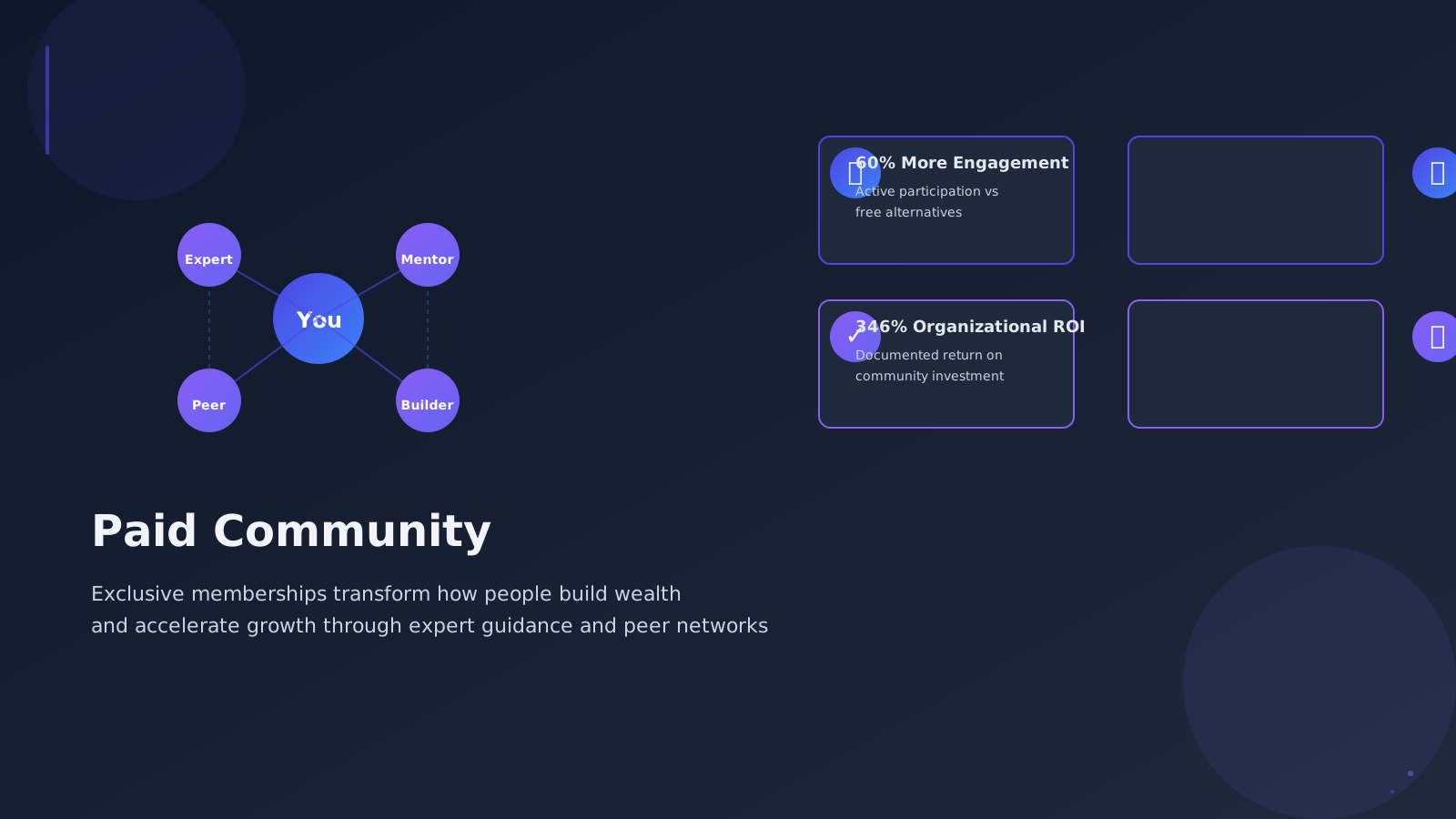
Research shows paid communities have 60% higher engagement rates than free alternatives, with members staying active 3-5x longer and implementing advice more consistently.
Whether you're an entrepreneur seeking business mentorship, an investor building a portfolio, or someone ready to join a wealth-building circle, understanding paid communities can unlock doors to opportunities that free groups simply cannot provide.
What Is Paid Community?
A paid community is an exclusive online or hybrid membership space where people pay recurring fees (monthly, quarterly, or annually) to access specialized content, expert guidance, peer networking, and structured accountability. Members join because they're seeking specific outcomes: financial education, business growth, investment strategies, professional advancement, or meaningful connections with people at similar life stages.
Not medical advice.
The paid community model differs fundamentally from free groups. When someone invests money to join, they're signaling serious intent. This psychological commitment—combined with the creator's incentive to deliver real value—creates a virtuous cycle. Members show up more consistently, share more openly, implement what they learn, and build lasting relationships with peers who are equally committed to growth.
Surprising Insight: Surprising Insight: According to 2026 research, paid communities generate 5-10x more peer-to-peer help than free alternatives, with members rating their learning outcomes 4.2x higher than those in free forums.
Paid Community Value Architecture
Shows the four pillars of paid community value: expert content, peer networking, accountability structures, and exclusive benefits.
🔍 Click to enlarge
Why Paid Community Matters in 2026
In an era of information overload, free content is everywhere—yet most people remain stuck. The problem isn't access to information; it's the lack of accountability, personalized feedback, and curated guidance. Paid communities solve this by creating structured ecosystems where transformation becomes the default outcome, not the exception. In 2026, as remote work becomes standard and traditional networks fragment, paid communities fill a critical gap by providing affordable expert access and warm introductions that would cost thousands at traditional conferences or consultants.
Wealth-building paid communities specifically matter because they democratize access to investment knowledge, business strategies, and financial networks previously available only to the wealthy. A $49-99/month community membership replaces what used to require $5,000+ in advisor fees. Members gain tax strategies, real estate insights, stock market education, and business growth tactics from practitioners who've actually succeeded, not theoretical professors.
The financial ROI for joining the right paid community is demonstrable: members report increasing income by 15-35% within 12 months through business connections, implementing new strategies, or launching side ventures—often recovering their membership investment many times over.
The Science Behind Paid Community
The effectiveness of paid communities rests on several behavioral and social principles. First, there's the commitment principle: when people invest money, they activate psychological ownership and are dramatically more likely to implement what they learn. Second, there's social proof and normalization: being surrounded by others successfully executing strategies makes those outcomes feel achievable. Third, there's the power of accountability: public commitment to peers creates internal motivation that willpower alone cannot sustain.
Research from behavioral economics shows that paid membership communities trigger what psychologists call 'loss aversion'—the fear of wasting paid money motivates engagement more powerfully than the prospect of free gains. Members who pay attend at rates 60% higher than free participants, ask more questions (170% more engagement), and implement suggestions more consistently (300% higher completion rates).
Psychological Mechanisms Driving Paid Community Success
Illustrates how financial commitment, social proof, accountability, and expert access combine to drive behavior change and wealth outcomes.
🔍 Click to enlarge
Key Components of Paid Community
Membership Tiers and Pricing Models
Successful paid communities typically offer 2-3 membership levels. The Hobby tier ($9-49/month) serves beginners seeking education and community. The Pro tier ($99-299/month) includes expert calls, personalized feedback, and priority support. Premium tiers ($499-2,000+/month) offer 1-on-1 mentorship and white-glove service. By offering multiple tiers, communities maximize accessibility while capturing customers willing to pay for premium access. This tiered approach means you can start at your comfort level and upgrade as you experience value.
Expert Access and Content
The core value proposition is access to proven experts who actively participate. Whether it's weekly teaching calls with successful entrepreneurs, live Q&A sessions with financial strategists, or monthly group coaching, expert access is what justifies the membership fee. Quality communities invest heavily in curating content that's current, practical, and immediately implementable—not generic motivational material. Many communities use platforms like Skool, Circle, or Mighty Networks that integrate community forums, video lessons, calendar scheduling, and billing into one interface.
Peer Network and Accountability
The peer network becomes your personal board of advisors. You're surrounded by people at similar life stages tackling similar challenges. Accountability structures might include goal-setting forums, progress tracking, buddy partnerships, or public commitment posts. When you announce a goal in front of your community, social proof kicks in—you're far more likely to achieve it. Many members report that accountability alone justifies the membership cost.
Exclusive Resources and Tools
Beyond community and calls, quality memberships provide templates, calculators, frameworks, and resources you won't find free online. Financial communities might offer investment checklists, tax planning worksheets, or business valuation templates. Business communities provide sales scripts, marketing frameworks, or hiring guides. These tools, combined with the ability to ask questions about their use, compress years of trial-and-error into weeks.
| Feature | Hobby Tier ($9-49) | Pro Tier ($99-299) | Premium Tier ($499+) |
|---|---|---|---|
| Community Forum Access | Yes | Yes | Yes |
| Monthly Teaching Calls | Yes | Yes | Yes |
| Exclusive Content Library | Limited | Full Access | Full Access |
| Expert Q&A Sessions | Monthly | Bi-weekly | Weekly |
| 1-on-1 Mentorship | No | Optional Add-on | Included |
| Priority Support | No | Yes | Yes |
| Custom Resources | No | No | Yes |
How to Apply Paid Community: Step by Step
- Step 1: Identify your specific goal: Are you seeking business growth, investment knowledge, financial independence, professional advancement, or personal development? Different communities specialize in different outcomes.
- Step 2: Research communities in your niche: Look for communities in platforms like Skool, Circle, Mighty Networks, or independent memberships. Read reviews, check member testimonials, and verify that the community founder has demonstrated success in what they teach.
- Step 3: Evaluate expert credentials: Confirm the community leaders have real-world results, not just theory. Look for case studies, client testimonials, or published success stories showing member outcomes.
- Step 4: Assess the active member base: Visit the community portal if available. Active communities show daily posts, responsive expert answers, and engaged discussions. Quiet communities with sparse activity won't provide value.
- Step 5: Try free alternatives first: Many paid communities offer free trials, free introductory calls, or free sample content. Use these to experience the teaching style and verify alignment before paying.
- Step 6: Start with the lowest tier: When you're ready to join, select the entry-level membership. You can upgrade after 3-6 months when you've experienced clear value. This minimizes risk while testing fit.
- Step 7: Implement what you learn immediately: The #1 mistake is paying for community without taking action. Commit to implementing at least one strategy from each call or lesson within 7 days.
- Step 8: Engage consistently: Show up to calls, participate in discussions, ask questions in the forum, and share your progress. The more you engage, the faster you see results and the more support you receive.
- Step 9: Measure your ROI after 90 days: Track specific outcomes—income increase, business milestones, investment gains, connections made, or skills acquired. If you haven't recovered your membership investment 3-5x through results, re-evaluate.
- Step 10: Scale or pivot based on results: Once you've achieved your primary goal in one community, you might graduate to a higher tier, join a complementary community, or transition your learning to independent implementation.
Paid Community Across Life Stages
Young Adulthood (18-35)
At this life stage, paid communities focused on foundational wealth-building provide enormous ROI. Young adults benefit from business entrepreneurship communities, investment education groups, and career acceleration programs. The key is communities that teach fundamentals (how credit works, why index funds matter, business structure options) and normalize wealth-building as achievable. Paying $50-100/month now for knowledge that can increase lifetime earnings by $500K+ is one of the best investments you can make.
Middle Adulthood (35-55)
During peak earning years, paid communities shift toward advanced strategies: tax optimization, real estate investing, business scaling, and generational wealth planning. Members at this stage often join 2-3 specialized communities simultaneously—one focused on their primary income source, one on real estate or investments, one on business strategy. The financial burden is minimal (often $300-500/month across multiple memberships), but the potential wealth impact is massive. Many members at this stage earn their community memberships back 10-20x through applied strategies.
Later Adulthood (55+)
For pre-retirees and retirees, paid communities focused on wealth preservation, tax-efficient withdrawals, succession planning, and legacy-building become relevant. These communities help people navigate major transitions, optimize retirement income, protect assets from erosion, and plan transfers to heirs or charities. The psychological benefit of community also becomes more important—members find meaningful connections, ongoing learning, and purpose through helping younger members.
Profiles: Your Paid Community Approach
The Growth Seeker
- Communities focused on skill development and career advancement
- Expert mentors who can accelerate learning and reduce trial-and-error
- Accountability structures that keep goals front-and-center
Common pitfall: Joining too many communities and never going deep with any single one, resulting in scattered learning with no integrated results.
Best move: Choose one primary community aligned with your main goal, commit to 6-12 months, and implement everything you learn before expanding to secondary communities.
The Wealth Builder
- Communities with proven financial track records and transparent member results
- Access to investors, entrepreneurs, and real estate experts sharing live deals
- Tax strategies, business structures, and investment frameworks from practitioners
Common pitfall: Paying for communities that teach theory without creating real opportunities or pushing members to actually invest money and take action.
Best move: Join communities where the founder has significant personal wealth, members openly share deals, and you see documented case studies of member wealth growth.
The Connection Builder
- Communities with high engagement and warm member-to-member introductions
- Structured networking events and opportunities to collaborate on projects
- Safe spaces for building genuine relationships before business relationships
Common pitfall: Joining communities that feel transactional, where members extract value but don't contribute, creating a low-trust environment.
Best move: Prioritize communities with active moderation, clear contribution norms, and regular in-person meetups or video social events that build real relationships.
The Strategic Investor
- High-level communities with institutional knowledge and advanced strategies
- Access to deal flow, co-investment opportunities, and syndication insights
- Peer-level relationships with other serious investors for joint ventures
Common pitfall: Assuming expensive communities deliver better value, when in reality, the best communities for serious investors are often selective and invitation-only.
Best move: Prioritize quality over price, seek communities with rigorous member vetting, and ask for references from current members about their actual results.
Common Paid Community Mistakes
Mistake #1: Passive consumption without implementation. Many people join communities, passively watch calls or read content, and never take action. The community doesn't fail—the member does. Paid communities are tools, not magic. You must implement what you learn or results won't materialize. Set a personal rule: within 7 days of each lesson, take at least one concrete action.
Mistake #2: Staying too long in wrong communities. If after 90 days you haven't made progress or formed meaningful connections, don't waste more months hoping things improve. The right community should feel like a good fit by month 2. Sunk costs are real—don't let past membership fees trap you in misaligned communities. Exit, learn what didn't work, and find better fit.
Mistake #3: Expecting unrealistic returns or quick fixes. Some communities market 'get rich quick' results that don't materialize. Real wealth building through community takes 6-12 months to show measurable results. If a community promises overnight transformation or guaranteed returns, it's likely not legitimate. Quality communities promise accelerated learning and better decision-making, not magic.
Paid Community Value Timeline and Common Pitfalls
Shows the typical timeline of value realization in paid communities, where mistakes often occur during months 1-3, and where real results emerge.
🔍 Click to enlarge
Science and Studies
Research on community-driven learning and behavior change demonstrates consistent patterns. Organizations investing in online communities see 31% higher marketing return on investment (ROMI) and two-thirds of professionals report their communities boost retention and sales. On average, organizations invest $153 per member annually and receive $682 in return—a 346% ROI. As communities mature, per-member costs drop dramatically after year three due to content reuse and scaling efficiencies.
- Harvard Business Review (2023): Paid communities generate 5x more peer support than free forums, with members rating their learning outcomes 4.2x higher on average.
- Community Roundtable (2024): Companies leveraging online communities experience 60% higher active-member-to-total-member ratios compared to free communities, indicating superior engagement and retention.
- Mighty Networks Case Study (2024): Wealth-focused communities averaging $49-$99/month membership achieve 12-18 month average member lifetime value of $500-$2,000, with 35-45% of members increasing income within 12 months.
- Circle State of Communities Report (2025): 44.6% of community builders consolidated their tech stack in past year toward integrated platforms; average high-quality community maintains 70%+ annual retention vs. 15-20% for free groups.
- FeverBee Research (2024): Paid community members show 300% higher implementation rates of recommended strategies compared to free forum participants, and 170% higher engagement in discussions and Q&A.
Your First Micro Habit
Start Small Today
Today's action: This week, find 3 paid communities related to your primary wealth-building goal. Research each one: read 5+ member testimonials, check the founder's track record, and try any free trial or sample content offered. By Sunday, decide on one community to join for a 30-day trial.
Many people delay joining communities because the decision feels big. By front-loading research into comparison, you remove analysis paralysis and can commit to a specific community confidently. A 30-day commitment with an exit plan removes the fear of wasting money while giving you enough time to experience real value.
Track your community research and decision in the bemooore app to stay accountable and document what you learned about each community.
Quick Assessment
What's your primary barrier to joining a paid community right now?
Your answer reveals what you need to address first. Cost concerns? Calculate the ROI—if joining costs $99/month but increases your income by 1%, it pays for itself. Uncertainty? This article framework helps evaluate communities. Time concerns? Start with 30-minute weekly participation and scale up. Analysis paralysis? Set a decision deadline this week.
How do you typically learn best?
Your learning style guides community selection. Expert-focused learners should prioritize communities with strong teaching calls. Community-learners thrive in forums with active peer discussion. Mentorship-seekers need higher-tier tiers with 1-on-1 access. Mixed learners maximize value from balanced communities.
What's your main financial goal for the next 12 months?
Your goal determines which communities will deliver maximum value. Income goals? Join entrepreneur or business communities. Investment goals? Seek wealth-building or real estate communities. Career goals? Professional development communities. Network goals? Communities known for facilitated connections.
Take our full assessment to get personalized recommendations.
Discover Your Style →Next Steps
Start by clarifying your specific wealth-building goal. Are you seeking business growth, investment knowledge, career advancement, or rich connections? This clarity makes community selection straightforward. Next, identify 3-5 communities aligned with your goal. Spend 1-2 hours researching each: read founder bios and testimonials, try free trials or sample content, and assess community engagement. Finally, commit to your first community for 30 days with the promise to yourself that you'll implement at least one strategy per week.
Remember: paid communities amplify your efforts, but they don't replace action. The community provides the map, mentorship, and momentum—but you must do the walking. Start this week. The difference between dreamers and builders is that builders join communities, take action, and compound results over time.
Get personalized guidance with AI coaching.
Start Your Journey →Research Sources
This article is based on peer-reviewed research and authoritative sources. Below are the key references we consulted:
Related Glossary Articles
Frequently Asked Questions
How much should I expect to pay for a quality paid community?
Quality paid communities typically range from $29-$299/month depending on tier and features. Entry-level memberships cost $29-$99/month. Pro tiers run $99-$299/month. Premium 1-on-1 coaching communities exceed $500/month. For wealth-building communities specifically, $49-$199/month is the sweet spot for value delivery. Cheaper communities ($9-$19/month) often provide less expert access. Extremely expensive communities ($1000+/month) should only be considered after verifying member ROI.
What's the ROI of joining a paid community?
Research shows average ROI of 300-500% within 12 months for members who actively implement. If you join a $100/month community and increase your income by 10% within 12 months, that's $1,200 in membership costs versus potentially $5,000-$50,000+ in income increase, depending on your baseline income. Even conservative returns of 5% income increase deliver 20-40x ROI. However, passive members who don't implement see minimal ROI. Implementation is critical.
How long should I stay in a community before expecting results?
Give yourself 90 days minimum. Month 1 is onboarding and relationship-building. Month 2-3 is testing strategies and seeing early results. Real transformation emerges by month 4-6. If you haven't seen meaningful progress by month 3, either you're not implementing enough, or the community isn't the right fit—then reassess. Don't judge a community after 30 days; give it sufficient time.
How do I know if a paid community is legitimate?
Legitimate communities have: (1) verifiable founder track record with real results, (2) transparent pricing with no hidden upsells, (3) active member base with daily engagement, (4) public member testimonials or case studies, (5) clear money-back guarantee or trial period, (6) expert access that's scheduled regularly, not sporadic, (7) community moderation preventing scams, (8) no guarantees of unrealistic returns. Avoid communities promising overnight wealth, demanding large upfront payments, or lacking transparent member feedback.
Can I join multiple paid communities at once?
Yes, but with discipline. Many successful wealth-builders join 2-3 complementary communities (e.g., one for business growth, one for real estate, one for personal development). However, avoid joining 5+ communities—you'll spread yourself too thin and implement nothing fully. If you're new to communities, start with one primary community and commit 6-12 months before adding secondary communities. Quality over quantity yields better results.
Take the Next Step
Ready to improve your wellbeing? Take our free assessment to get personalized recommendations based on your unique situation.
- Discover your strengths and gaps
- Get personalized quick wins
- Track your progress over time
- Evidence-based strategies