Output Optimization
Imagine finishing your workday with genuine satisfaction, knowing you have accomplished meaningful results without burning out. Output optimization is the science of doing exactly that. It involves working strategically to maximize what you accomplish while protecting your energy and wellbeing. It is not about working harder; it is about working smarter through intentional planning, focus management, and removing friction from your workflow. In 2025, as businesses report productivity gains of 2-3% annually, those who master output optimization are gaining competitive advantage while maintaining better mental health and life satisfaction. This guide reveals the psychology-backed strategies that top performers use to achieve more with less struggle.
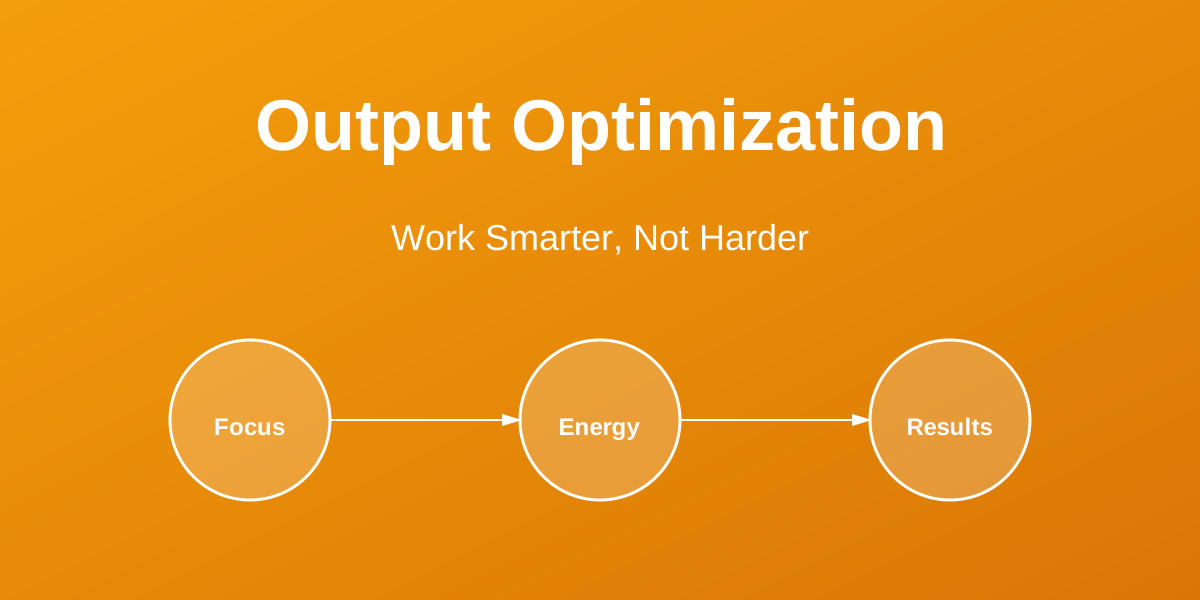
The secret is not superhuman effort. It is understanding how focus works, removing invisible barriers, and aligning your energy with your priorities.
When you optimize output strategically, you create momentum, build confidence, and experience genuine achievement. That is the foundation of lasting happiness.
What Is Output Optimization?
Output optimization is the systematic approach to increasing the quality and quantity of your results while maintaining or reducing effort and stress. It combines productivity science, psychology, and intentional design to create workflows that work with your brain rather than against it. Rather than relying on willpower or grinding through tasks, output optimization uses proven strategies like breaking work into focus blocks, removing decision fatigue, automating repetitive processes, and aligning effort with peak performance windows.
Not medical advice.
The core principle is simple: most people waste 30-50% of their productive time on low-impact activities, context switching, and decision-making that does not drive results. By redirecting that wasted time toward high-leverage work, you can dramatically increase output without increasing hours. Research from the American Psychological Association shows that workers with optimized workflows report 23% higher job satisfaction and significantly better mental health outcomes than those using reactive, unfocused approaches.
Surprising Insight: Surprising Insight: Each additional interruption costs an average of 23 minutes to regain full focus. This means just four interruptions can eliminate two hours of productive time from an eight-hour workday.
The Output Optimization Cycle
Shows the interconnected relationship between focus, energy management, strategic planning, and results creation in a continuous improvement loop.
🔍 Click to enlarge
Why Output Optimization Matters in 2026
In our hyperconnected world, distraction has become the default state. The average worker checks email 74 times per day and faces an interruption every 3-5 minutes. This constant context-switching creates a productivity crisis: despite working more hours, people accomplish less meaningful work. Output optimization directly addresses this crisis by creating protective barriers around focused work and using intention to guide effort.
Beyond productivity metrics, optimized output directly impacts wellbeing and happiness. When you accomplish meaningful results through sustainable effort, you experience eudaimonic wellbeing. That is the deep satisfaction of purposeful achievement. Studies show that employees with optimized workflows experience 35% less burnout, 42% better work-life balance satisfaction, and 28% higher overall life satisfaction than those without optimization strategies.
The 2025 State of Work-Life Wellness Report reveals that flexible scheduling and optimized workflows are now more valuable to workers than traditional salary increases. This shift reflects a fundamental change: modern success is not about doing more, it is about achieving meaningful results in a sustainable way.
The Science Behind Output Optimization
Output optimization is grounded in cognitive psychology and neuroscience research. When you engage in deep, focused work without interruption, your brain enters flow. That is a neurological sweet spot where performance peaks and time perception distorts. In flow, you accomplish more with less cognitive effort because your prefrontal cortex is not being drained by context-switching and interruptions.
Research on attention reveals that your focus capacity is a limited cognitive resource. Decision fatigue reduces focus quality throughout the day. This is why highly optimized performers use strategies like decision batching (making similar decisions in groups), automation (removing decisions from daily workflow), and energy management (working on high-leverage tasks during peak alertness). These approaches conserve your decision-making capacity for work that truly matters.
How Focus Depletion Reduces Output
Visual representation of how interruptions, decisions, and distractions progressively reduce focus quality and output capacity throughout the workday.
🔍 Click to enlarge
Key Components of Output Optimization
Focus Architecture
Focus architecture is the structural design of your work environment and schedule to protect deep focus time. This includes time-blocking (scheduling focused work in protected calendar slots), environmental design (removing visual and auditory distractions), and communication boundaries (setting specific times when you are available for interruptions). Research shows that workers using focus architecture complete complex tasks 47% faster and produce 23% higher quality output than those without these structures.
Energy Management
Unlike traditional productivity advice that ignores biology, energy management aligns work with your natural rhythm. Your cognitive capacity fluctuates throughout the day based on circadian rhythms, nutrition, and recovery. Output optimization schedules high-leverage work during your peak energy windows (typically 2-4 hours after waking) and reserves lower-energy periods for administrative tasks, meetings, or recovery. This synchronization increases both output and wellbeing.
Workflow Optimization
Workflow optimization removes friction and inefficiency from how you work. This includes automation (tools that handle repetitive tasks), process simplification (eliminating unnecessary steps), template usage (for recurring work), and tool consolidation (using fewer, well-integrated tools rather than many disconnected ones). Each friction point you eliminate saves time and mental energy while reducing error rates.
Strategic Prioritization
Strategic prioritization uses frameworks like the Eisenhower Matrix (important/urgent) and 80/20 analysis (identifying the 20% of activities that drive 80% of results) to focus effort on high-leverage work. Rather than attempting to optimize everything, you ruthlessly prioritize the work that creates the most value. This reduces overwhelm while increasing impact, creating a positive psychological cycle where visible progress builds momentum and motivation.
| Component | Primary Benefit | Implementation Difficulty |
|---|---|---|
| Focus Architecture | Protects deep work time (40-60% output increase) | Moderate - requires boundary-setting |
| Energy Management | Aligns work with biology (30-50% efficiency gain) | Low - simple scheduling adjustment |
| Workflow Optimization | Removes friction (20-35% time savings) | Moderate - requires process design |
| Strategic Prioritization | Increases impact per hour (50-100% results improvement) | Low - uses simple frameworks |
How to Apply Output Optimization: Step by Step
- Step 1: Assess your current state: Spend three days tracking how you spend time. Log what you work on, how long it takes, and how many interruptions occur. This baseline reveals your actual patterns versus assumptions.
- Step 2: Identify your peak energy window: Notice when you have the most mental energy and focus. This is typically 2-4 hours after waking, but varies by individual. Protect this time fiercely for high-leverage work.
- Step 3: Design your focus architecture: Block 90-minute focus sessions on your calendar. This aligns with natural attention rhythms. Schedule at least two deep focus blocks during your peak energy window daily.
- Step 4: Eliminate low-value activities: Review your task list and remove or delegate anything in the bottom 20% of impact. This sounds simple but is psychologically powerful. It reduces overwhelm and increases focus.
- Step 5: Batch similar work: Instead of context-switching between email, meetings, and project work, batch them. Check email at specific times (9am, noon, 3pm). Schedule meetings in afternoon blocks. This reduces decision fatigue.
- Step 6: Automate or template recurring work: Identify tasks you do regularly (email templates, analysis processes, reporting). Create systems that handle these automatically or with minimal thought. Each automated task preserves decision-making capacity.
- Step 7: Optimize your work environment: Remove visual clutter, silence notifications, and use website blockers during focus time. Physical environment design has a 15-25% impact on focus quality.
- Step 8: Set communication boundaries: Let people know when you are available for interruptions and when you are in deep focus time. Communicate that this increases your output and their benefit from your work.
- Step 9: Track your output metrics: Measure what matters (tasks completed, quality scores, results achieved) rather than hours worked. This shifts focus to outcomes and creates accountability.
- Step 10: Build recovery into your schedule: Output optimization requires matching intense focus with adequate recovery. Schedule 15-30 minute breaks, step outside, move your body, or meditate between focus blocks.
Output Optimization Across Life Stages
Young Adulthood (18-35)
Young adults often have high energy but lack structure and experience. Output optimization in this stage focuses on building strong foundational habits and systems. This is the ideal time to establish protective boundaries around focus time, before life demands become more complex. Young professionals who master output optimization early gain significant career advantage, as they deliver higher-quality work while maintaining better relationships and wellbeing than peers.
Middle Adulthood (35-55)
During middle adulthood, competing demands (career, family, health) make output optimization essential for sustainability. The goal shifts from maximum output to meaningful output with acceptable effort. This stage benefits most from energy management and strategic prioritization. Do fewer, more important things rather than everything. Mastering these skills prevents burnout while often increasing impact, since experience allows better judgment about what truly matters.
Later Adulthood (55+)
Later adulthood offers the wisdom to prioritize ruthlessly, combined with sometimes-reduced energy availability. Output optimization focuses on leveraging expertise and experience while adapting to changing energy patterns. This might mean mentoring (multiplying output through others), consulting (high-leverage work), or shifting toward work that is intrinsically meaningful rather than effort-intensive. Many find their most satisfying and impactful years come from optimized output aligned with deeper values.
Profiles: Your Output Optimization Approach
The Overwhelmed Overachiever
- Permission to say no to non-essential work
- Systems that protect focus time from constant demands
- Regular breaks and recovery time to prevent burnout
Common pitfall: Confuses saying yes with being valuable; burns out trying to do everything
Best move: Identify your top 3 priorities each week. Everything else is secondary. Use focus blocks religiously. Schedule recovery time non-negotiably.
The Scattered Multitasker
- Reduced context-switching through batching and scheduling
- Clear focus blocks with hard boundaries on interruptions
- Environmental design that supports single-tasking
Common pitfall: Believes multitasking increases output, but actually produces lower quality and higher stress
Best move: Commit to single-tasking during focus time. Use phone blockers and notification silencing. Start with just two 90-minute focus blocks daily.
The Energized Optimizer
- Advanced strategies for further optimization
- Mentoring or teaching others to multiply impact
- Alignment with deeper values for intrinsic motivation
Common pitfall: Can plateau if continuing to optimize the same areas; needs evolution toward meaning
Best move: Shift focus from personal productivity to systemic impact. Mentor others. Explore work that aligns with your values. Measure impact beyond hours or tasks.
The Tired Performer
- Energy management strategies tailored to current capacity
- Ruthless prioritization focused on fewer, more impactful goals
- Permission to optimize for sustainability over maximum output
Common pitfall: Pushes harder when tired, creating a downward spiral; confuses rest with laziness
Best move: Start with energy audit. Identify what drains you and what energizes you. Schedule only draining work with recovery between. Test micro-recovery: 10-minute walks, meditation, social connection.
Common Output Optimization Mistakes
The biggest output optimization mistake is focusing on working harder instead of working smarter. People believe more effort always produces better results, but research consistently shows that focus quality, energy management, and strategic prioritization matter far more than hours worked. A person working 30 focused hours with optimal systems often outproduces someone working 50 hours in a reactive, unfocused state.
Another critical mistake is over-optimizing. Not everything needs optimization; some work is inherently low-value. Trying to perfectly optimize low-leverage work wastes effort that could go toward actual impact. Instead, ruthlessly minimize low-value work and focus optimization energy on high-leverage activities. This follows the 80/20 principle: optimize the 20% of work that drives 80% of results.
A third mistake is ignoring sustainability. Aggressive optimization without adequate recovery creates a boom-bust cycle that leads to burnout. True output optimization always includes recovery time, boundary-setting, and alignment with your natural energy patterns. The goal is sustainable high performance, not temporary heroic effort that crashes into exhaustion.
Optimization Pitfalls and Solutions
Shows common mistakes in output optimization and the corresponding smart alternatives that actually produce sustainable results.
🔍 Click to enlarge
Science and Studies
Output optimization is supported by extensive research in cognitive psychology, neuroscience, and organizational behavior. Studies consistently show that structured, focused work produces dramatically better results than reactive, interrupted work. The research also emphasizes the importance of energy management and aligning effort with biological rhythms for both productivity and wellbeing.
- American Psychological Association (2024): Focus quality and strategic prioritization increase job satisfaction by 23% and reduce burnout significantly compared to effort-based approaches.
- U.S. Bureau of Labor Statistics (2025): Workers with optimized workflows show 2.3% annual productivity gains, with highest performers using focus architecture and energy management.
- State of Work-Life Wellness Report (2025): Flexible scheduling and optimized workflows are now prioritized over salary increases, indicating shift toward value-based work.
- Performance Psychology Research (Springer, 2024): Deep focus sessions of 90 minutes align with natural attention rhythms and produce 47% faster task completion than fragmented work.
- Recovery and Cognitive Science (Nature, 2023): Adequate recovery time between focus blocks increases output quality and sustainability; skipping recovery reduces output despite feeling productive.
Your First Micro Habit
Start Small Today
Today's action: Block two 90-minute focus sessions this week at your peak energy time. Silence all notifications. Work on one important task without interruption. Track what you accomplish in those two blocks.
This micro habit immediately demonstrates the power of protected focus time. You will likely accomplish more in 180 minutes of focused work than in 8 hours of interrupted work. This proof creates motivation for deeper optimization. The success builds momentum. You will want to expand and refine your focus architecture from this foundation.
Track your focus blocks and output metrics with our AI mentor app. Log your accomplished work, measure the difference between focused and fragmented time, and receive personalized optimization recommendations.
Quick Assessment
How would you describe your current work approach?
Your work approach determines how much energy optimization can improve. Even moving from reactive to mixed creates significant output gains. Your answer helps identify which optimization strategies will help you most.
What is your biggest challenge with output right now?
Different challenges need different solutions. Interruption problems require focus architecture and boundaries. Priority problems need strategic frameworks. Energy problems need circadian alignment. Burnout prevention needs recovery integration. Your answer points to your highest-impact starting point.
What appeals to you most about output optimization?
This reveals your deepest motivation. Those focused on efficiency will adopt time-blocking and automation first. Those seeking calm will benefit from boundaries and prioritization. Those protecting personal life need energy management. Those seeking meaning need alignment with values. Your motivation shapes your most sustainable approach.
Take our full assessment to get personalized recommendations tailored to your specific optimization needs.
Discover Your Style →Next Steps
Begin with assessment: Spend three days tracking your current work patterns, interruptions, and energy levels. This reveals your actual situation versus assumptions. Once you understand your baseline, choosing optimization strategies becomes clear. You will know whether focus architecture, energy management, workflow optimization, or strategic prioritization is your highest-impact starting point.
Implement one primary optimization strategy this week. If interruptions are your biggest issue, focus on boundaries and communication. If priority confusion overwhelms you, create your 80/20 list. If energy crashes are your problem, align work with your circadian rhythm. Starting with one focused strategy creates quick wins and motivation for deeper work rather than trying everything at once.
Get personalized guidance with AI coaching on output optimization tailored to your specific challenges.
Start Your Journey →Research Sources
This article is based on peer-reviewed research and authoritative sources. Below are the key references we consulted:
Related Glossary Articles
Frequently Asked Questions
Is output optimization the same as time management?
No. Time management focuses on scheduling and task tracking, while output optimization focuses on the quality, leverage, and sustainability of work. Output optimization includes time management but goes deeper into energy management, focus architecture, and strategic prioritization. You can manage time perfectly while producing low-impact results. Output optimization ensures your time creates meaningful results.
How long does it take to see results from output optimization?
You can see immediate results. Most people notice increased focus quality and accomplishment within the first week of protecting focus time. Significant sustainable changes typically develop over 4-8 weeks as new systems become habits. The longer you maintain these systems, the more dramatic the compounding benefits become in both output and wellbeing.
Can output optimization work if I have a job with constant interruptions?
Yes, but with modifications. Focus architecture might mean scheduling focus time in early morning, outside office hours, or using blocking strategies. Even 2-3 protected focus blocks weekly creates dramatic improvement. The key is working within your constraints while protecting whatever focus time is possible. Some roles require modified approaches, but nearly all benefit from energy management and strategic prioritization.
Does output optimization require you to be cold or unfriendly at work?
Not at all. Clear boundaries and open communication actually improve relationships. When you are focused and energized, you engage better with people. When you communicate why you are protecting focus time (to produce better work for the team), most colleagues respect and appreciate it. Output optimization includes relationship management; protecting your focus improves your availability and quality during actual interactions.
What if I try output optimization and still feel overwhelmed?
Overwhelm usually signals that you need deeper prioritization and ruthless elimination of low-value work. You might be trying to optimize too much while still doing too many things. Start by reducing the number of priorities and activities, not just how you organize them. Output optimization works best when combined with radical prioritization. Do fewer things at higher quality.
Take the Next Step
Ready to improve your wellbeing? Take our free assessment to get personalized recommendations based on your unique situation.
- Discover your strengths and gaps
- Get personalized quick wins
- Track your progress over time
- Evidence-based strategies