Personal Growth
Personal growth is the continuous process of improving yourself across all dimensions of life—mentally, emotionally, physically, and spiritually. It's not about becoming someone else; it's about evolving into a more authentic, capable, and resilient version of yourself. Whether you're developing new skills, healing old patterns, or pursuing bigger goals, growth happens when you step beyond your comfort zone and commit to meaningful change. Research shows that people who embrace personal growth experience greater life satisfaction, improved relationships, better career prospects, and enhanced psychological resilience. Unlike talent, which is relatively fixed, your capacity for growth is essentially unlimited when you adopt the right mindset and strategies.
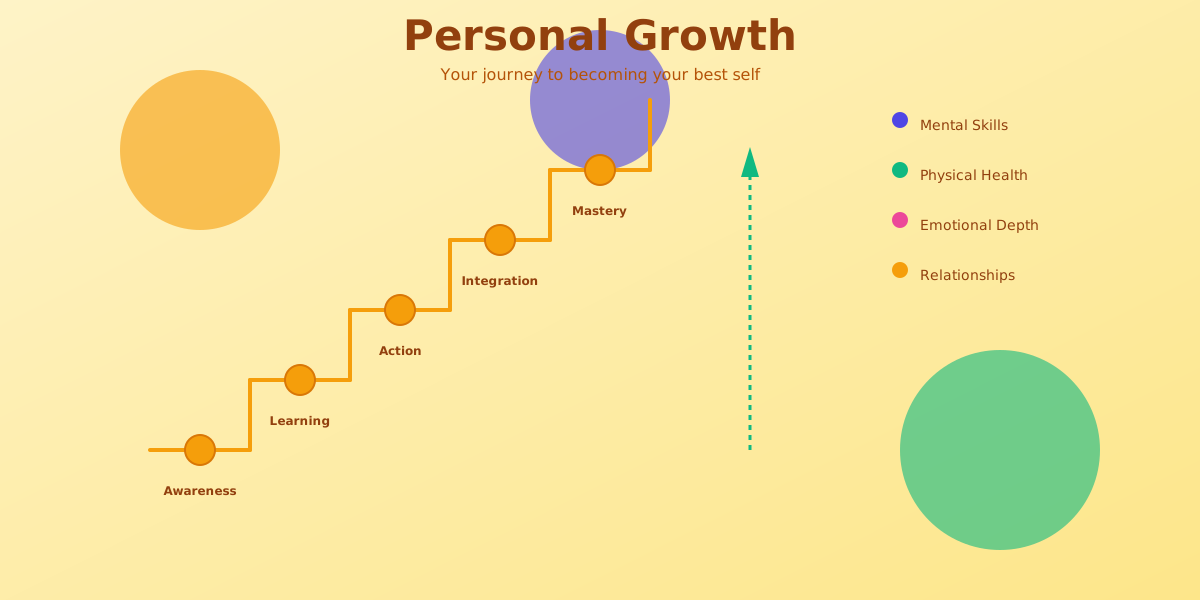
Here's what makes growth transformational: it's not a destination but a daily practice. Small, consistent improvements compound over months and years into remarkable life changes.
The science of growth reveals that your brain is neuroplastic—capable of rewiring itself throughout your entire life. This means you're never too old to learn, change, or improve.
What Is Personal Growth?
Personal growth encompasses the intentional development of your capabilities, character, and consciousness. It includes expanding your knowledge, refining your skills, healing emotional wounds, building resilience, strengthening relationships, and clarifying your values and purpose. Growth isn't linear—it happens in cycles of challenge, struggle, breakthrough, and integration. Psychologist Carl Rogers described growth as the process of becoming more fully yourself, while modern researchers emphasize growth as both the process and the outcome of intentional development.
Not medical advice.
Growth is fundamentally about expanding your identity and capabilities. When you grow, you're literally rewiring your brain, building new neural pathways, and establishing new behavioral patterns. This explains why growth often feels uncomfortable at first—you're operating in unfamiliar territory. But as neuroscientists have demonstrated, repeated practice strengthens new pathways until they become automatic, allowing you to operate at higher levels of functioning.
Surprising Insight: Surprising Insight: 65% of people who actively pursue personal growth report significant improvements in life satisfaction within 12 months, yet only 8% of people maintain consistent growth practices beyond 90 days.
The Growth Cycle
Illustration of the iterative cycle of personal growth including awareness, intention, action, feedback, and integration phases.
🔍 Click to enlarge
Why Personal Growth Matters in 2026
In 2026, the pace of change is accelerating in every domain—technology, work, relationships, health. People who stop learning and evolving find themselves increasingly irrelevant and stressed. Conversely, those committed to continuous growth navigate change with adaptability and confidence. Personal growth directly impacts your earning potential (those with strong learning agility earn 30-50% more over their careers), relationship quality, and long-term health and happiness.
Growth also builds psychological resilience—the ability to bounce back from setbacks. As global uncertainty increases, resilience becomes a critical life skill. People who actively develop themselves report higher levels of hope, agency, and optimism even when facing genuine challenges.
Beyond individual benefits, personal growth creates positive ripple effects. As you improve, you model possibility for others. Parents who grow inspire their children to grow. Colleagues who develop themselves elevate team performance. Your growth becomes a gift to those around you.
The Science Behind Personal Growth
Neuroplasticity is the foundation of personal growth. Your brain continuously forms new neural connections in response to learning and experience. Every time you practice a skill, study a concept, or work through an emotional challenge, you're literally reshaping your brain. The prefrontal cortex—responsible for goal-setting, impulse control, and long-term thinking—can be strengthened through deliberate practice. The amygdala—your threat-detection system—can be recalibrated through gradual exposure and emotional processing. This means your patterns aren't fixed; they're learned behaviors that can be unlearned and replaced.
Carol Dweck's research on growth mindset demonstrates that believing your abilities can be developed (as opposed to being fixed) is a powerful predictor of achievement and resilience. Students with growth mindset embrace challenges, persist through difficulty, learn from criticism, and achieve higher academic results. This mindset advantage carries into adulthood, affecting career success, relationship quality, and overall wellbeing.
Growth Mindset vs. Fixed Mindset
Comparison table showing how growth and fixed mindsets respond differently to challenges, feedback, and effort.
🔍 Click to enlarge
Key Components of Personal Growth
Self-Awareness
Growth begins with honest self-assessment. You must understand your current strengths, limitations, patterns, and beliefs. Self-awareness practices include journaling, meditation, personality assessments, therapy, and honest feedback from trusted people. Research shows that people who regularly reflect on their experiences learn and grow faster than those who simply have experiences without processing them. The simple practice of examining "What did I learn from that?" dramatically accelerates growth.
Intentional Learning
Growth requires deliberately acquiring new knowledge and skills. This might mean formal education, reading, online courses, workshops, or apprenticeship. But intentional learning goes beyond passive consumption—it means actively applying what you learn, teaching it to others, and integrating it into your life. The most powerful learners adopt a systems approach: they read widely, experiment regularly, document insights, and iterate based on results.
Behavioral Change
New knowledge alone doesn't create growth. You must actually change your behavior. Habit formation research shows this requires consistent repetition (typically 66 days for a new behavior to feel automatic), environmental design to support the new behavior, and managing the identity shift that comes with change. The most successful behavior change happens when you evolve your self-image: instead of "I'm trying to be more confident," you become "I'm a confident person."
Emotional Integration
Personal growth always involves emotional dimensions. As you develop, you may need to process past hurts, grieve old identities, manage anxiety about change, or work through self-doubt. Emotional intelligence—the ability to recognize, understand, and skillfully work with emotions—is a core growth competency. Without emotional integration, you may develop new skills while remaining emotionally stuck.
| Framework | Primary Focus | Key Outcome |
|---|---|---|
| Growth Mindset (Dweck) | Belief system about ability | Resilience through challenge |
| Self-Determination Theory | Autonomy, competence, relatedness | Intrinsic motivation for growth |
| Positive Psychology | Strengths and wellbeing, not deficits | Thriving rather than just coping |
| Integral Development | All dimensions simultaneously | Holistic evolution |
How to Apply Personal Growth: Step by Step
- Step 1: Clarify your why: Identify specifically what dimensions of your life you want to develop and why it matters to you. Generic growth goals fail; personal, meaningful ones succeed.
- Step 2: Assess your starting point: Honestly evaluate your current capabilities, patterns, and beliefs. Use personality assessments, journaling, or feedback from others to see yourself clearly.
- Step 3: Define success: Create specific, observable markers of growth. Instead of 'be more confident,' aim for 'have one meaningful conversation with a stranger weekly' or 'share an idea in meetings twice weekly.'
- Step 4: Design your environment: Make growth easy by surrounding yourself with growth-oriented people, resources, and systems. Environment shapes behavior more than willpower.
- Step 5: Start small and build: Don't attempt massive life overhauls. Instead, identify one small practice and build it consistently. Consistency beats intensity.
- Step 6: Establish feedback loops: Regularly assess your progress. Did the behavior change? Did you learn? Where are you struggling? Adjust based on real results.
- Step 7: Process emotions as they arise: Growth triggers emotions—fear about change, grief about old identities, frustration with slow progress. Feel them fully rather than suppressing them.
- Step 8: Find community support: Share your growth journey with others pursuing similar development. Community dramatically increases consistency and success rates.
- Step 9: Celebrate progress: Notice and acknowledge your growth. Your brain needs positive reinforcement to sustain new behaviors. Celebrate not just outcomes but effort and learning.
- Step 10: Integrate and repeat: Once a behavior feels automatic, it becomes part of your new baseline. Then you're ready to grow in a new direction. Growth is never finished; it's the lifelong practice of becoming.
Personal Growth Across Life Stages
Young Adulthood (18-35)
Young adulthood is a critical growth window. Your identity is still forming; your neural plasticity is optimal. This is the ideal time to experiment widely, build foundational skills, and establish growth as a core value. Young adults benefit from exploring different careers, relationships, beliefs, and identities to understand what resonates. However, the pressure to 'figure it out' early can create anxiety. Growth in this phase is about exploration and experimentation rather than certainty.
Middle Adulthood (35-55)
Middle adulthood brings the opportunity for depth. Rather than broad exploration, growth often focuses on mastery, purpose, and contribution. This might mean developing expertise in your field, deepening relationships, addressing patterns that emerged in young adulthood, or pivoting to more meaningful work. Middle adults often experience a 'second adolescence' where old identities no longer fit and new ones must be integrated. Growth here is about integration and purpose.
Later Adulthood (55+)
Contrary to cultural stereotypes, later adulthood remains a powerful growth period. Cognitive domains like pattern recognition and wisdom actually improve with age. Later adults often pursue growth through mentoring, legacy building, creative expression, spiritual development, and relationship deepening. Physical health and cognitive engagement require intentional focus, but research shows older adults who engage in continuous learning maintain sharper minds and greater life satisfaction.
Profiles: Your Personal Growth Approach
The Ambitious Achiever
- Clear goals and metrics to track progress
- Challenge proportional to current capability
- Recognition of achievement and advancement
Common pitfall: Pursuing growth for external validation rather than internal fulfillment, leading to burnout and hollow achievements.
Best move: Regularly reconnect with your intrinsic why. Pursue goals that align with your deepest values, not just external benchmarks.
The Reflective Learner
- Time and space to process learning deeply
- Variety and intellectual stimulation
- Meaning and connection in what they learn
Common pitfall: Accumulating knowledge without applying it, becoming stuck in analysis paralysis rather than action.
Best move: Establish an action bias. For every insight gained, commit to one practical application within 48 hours.
The Relational Grower
- Community and shared growth experiences
- Relationships that challenge and support them
- Opportunities to help others grow
Common pitfall: Depending on others for motivation rather than developing internal discipline, causing inconsistency when external support varies.
Best move: While community is valuable, also build independent growth practices that don't depend on others' availability.
The Holistic Developer
- Integration of mind, body, emotions, and spirit
- Sustainability and balance in growth pursuits
- Alignment between different life domains
Common pitfall: Overcomplicating growth with too many simultaneous pursuits, causing scattered energy and inconsistent results.
Best move: Focus on one or two growth areas at a time. Depth beats breadth. Each area will eventually integrate into a cohesive whole.
Common Personal Growth Mistakes
The biggest mistake is pursuing growth from a deficiency mindset—trying to 'fix' yourself rather than develop yourself. This creates shame, which blocks growth. Instead, approach growth as expanding your capabilities, not correcting fundamental flaws.
Another common error is all-or-nothing thinking: deciding to completely overhaul your life at once. This almost always fails. Sustainable growth requires small, consistent actions. Starting with 5 pushups daily is infinitely more effective than planning an intense gym program you'll abandon.
Finally, many people pursue growth in isolation without community support or accountability. Human beings are social creatures. Growth pursued alone is slower and more vulnerable to abandonment. The most successful growers build communities around their development.
Common Growth Pitfalls and Corrections
Visual map of typical growth obstacles and the strategic shifts needed to overcome them.
🔍 Click to enlarge
Science and Studies
Personal growth research spans multiple disciplines. The most influential findings come from neuroscience (demonstrating neuroplasticity and brain rewiring), psychology (establishing growth mindset and motivation principles), and longitudinal studies (showing growth's long-term life impact).
- Dweck, C. S. (2006). Mindset: The new psychology of success. Random House. Foundational research establishing growth mindset as predictor of achievement and resilience.
- Ryff, C. D., & Singer, B. H. (2008). Know thyself and become what you are. Journal of Happiness Studies. Research on eudaimonic wellbeing and continuous psychological growth across lifespan.
- Lally, P., et al. (2009). How are habits formed? Modelling habit formation in the real world. European Journal of Social Psychology. Evidence that behavioral change requires 66 days average for automaticity.
- Rock, D. (2009). Your brain at work. Harper Business. Practical neuroscience of learning and change in professional contexts.
- McArdle, S., & Haslam, S. A. (2010). How the workplace affects wellbeing. Psychological Science Agenda. Documentation of how growth environments enhance mental health and life satisfaction.
Your First Micro Habit
Start Small Today
Today's action: Spend 5 minutes journaling one thing you learned today and one small step you'll take tomorrow toward growth in an area that matters to you. That's it. Five minutes, daily reflection, one action commitment.
Journaling creates awareness of your learning and growth. Setting one small action removes the paralysis of perfectionism. Both practices compound powerfully over time. People who journal about growth track their progress faster and stay more motivated.
Five minutes of daily reflection survives longer when it costs nothing. Say what you learned and what you will do tomorrow: VoxFlow writes down what you say, on your iPhone, offline, in 99 languages. Free on the App Store.
Keep quitting habit apps after a missed day? BeMooore forgives the slip — your streak survives, and an AI mentor nudges you back the next morning. Free on iOS.
Quick Assessment
How do you currently respond when faced with a challenge or setback?
Your response patterns reveal your current growth orientation. Those who view challenges as learning opportunities have faster growth and greater resilience.
Which area of personal growth feels most important to you right now?
Growth has many dimensions. Knowing which matters most to you now will help you focus your energy effectively. Growth in one area often catalyzes growth in others.
What's most likely to derail your growth efforts?
Anticipating obstacles is half the battle. The most successful growers design their environment and practices to work around their specific vulnerabilities.
Take our full assessment to get personalized recommendations.
Discover Your Style →Next Steps
Your next step is not massive overhaul—it's tiny commitment. Identify one specific area where growth would meaningfully improve your life. Not multiple areas, not vague improvement, but one concrete domain: communication, creativity, health, career skills, emotional healing, spiritual practice, whatever resonates most strongly.
Then design one small practice you can sustain daily. Five minutes of journaling. Two meaningful conversations weekly. One new skill practiced for 10 minutes. One difficult emotion acknowledged and processed. Small, consistent, aligned with your genuine values. That practice, sustained, becomes the foundation of real transformation.
Get personalized guidance with AI coaching.
Start Your Journey →Research Sources
This article is based on peer-reviewed research and authoritative sources. Below are the key references we consulted:
Related Glossary Articles
Frequently Asked Questions
Am I too old to pursue personal growth?
Absolutely not. Your brain remains neuroplastic throughout your entire life. While neuroplasticity is highest in youth, older adults show remarkable capacity for learning, change, and development. Research even shows certain cognitive abilities like pattern recognition and wisdom improve with age. Growth is possible at any age.
How long does real personal growth actually take?
Significant change typically takes 3-12 months of consistent practice, depending on the domain. New behaviors feel automatic after about 66 days on average. But transformation—shifting your identity and worldview—often takes years. The key is consistency over time rather than intensity of effort. Small daily practices compound into remarkable annual transformations.
What if I've tried to grow before and failed?
Past failed attempts actually teach you something valuable—what hasn't worked for you yet. The most successful growers have multiple failures in their history. Each failure is data that helps you refine your approach. Rather than evidence that you can't grow, failures are essential steps on the growth path. Try a different strategy, smaller starting point, or different support system.
Can I grow in multiple areas simultaneously?
Theoretically yes, but practically it's challenging. Your willpower and attention are finite resources. The most sustainable approach is focusing on one or two growth areas at a time while maintaining existing positive habits. Once new behaviors feel automatic, you create capacity for additional growth areas. Sequential growth often beats simultaneous pursuit.
How do I maintain growth momentum when life gets busy?
Design practices that are resilient to busyness. A 5-minute daily habit is infinitely more valuable than a 1-hour practice you abandon when life gets hectic. Focus on keystone habits—one practice that naturally supports growth in multiple domains. Also, treat growth as non-negotiable like sleep or meals rather than something to squeeze in when convenient.
Take the Next Step
Ready to improve your wellbeing? Take our free assessment to get personalized recommendations based on your unique situation.
- Discover your strengths and gaps
- Get personalized quick wins
- Track your progress over time
- Evidence-based strategies