Emotional Fitness
You would never expect to run a marathon without training. You would never try to bench press your body weight on day one. Yet most people walk through life expecting to handle grief, rejection, conflict, and pressure without ever practicing the skills those moments demand. <a href='/g/emotional-resilience.html'>Emotional resilience</a> does not appear overnight. It is built, rep by rep, through deliberate practice. This is the core promise of emotional fitness: that your inner life can be trained just as intentionally as your body.
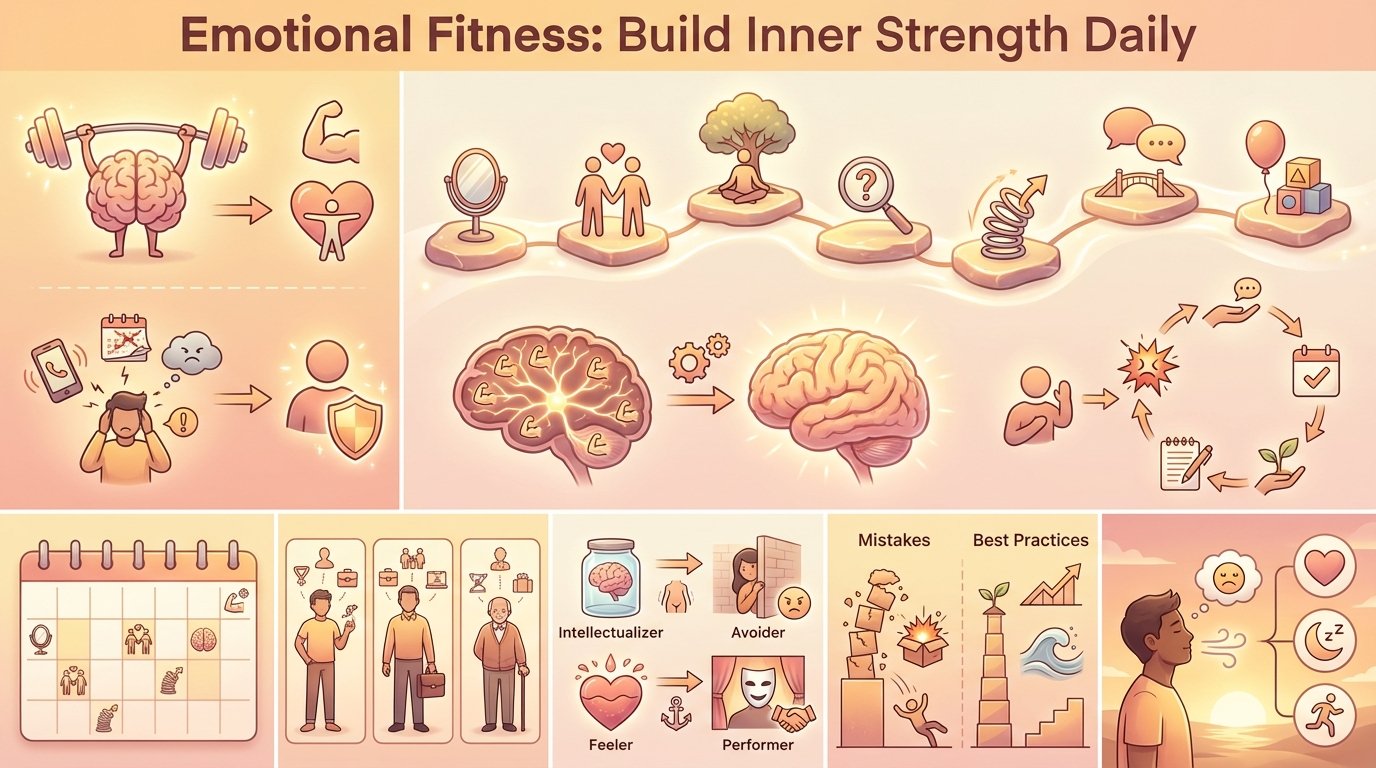
In the sections ahead you will learn what emotional fitness actually means, discover the seven traits identified by leading researchers, and walk away with concrete exercises you can start today. Whether you struggle with <a href='/g/anxiety-management.html'>anxiety management</a> or simply want deeper <a href='/g/emotional-connection.html'>emotional connection</a> with the people around you, this guide meets you where you are.
By the end, you will know exactly how to design your own emotional workout routine, avoid the most common mistakes, and track your progress over time using science-backed methods rooted in emotional intelligence research.
What Is Emotional Fitness?
Emotional fitness is the ongoing, proactive practice of strengthening your ability to experience, process, and express emotions in healthy ways. Unlike traditional therapy, which often begins after a crisis, emotional fitness is preventive. It is about building capacity before you need it. Psychologist Dr. Emily Anhalt, co-founder of Coa and author of Flex Your Feelings, defines emotional fitness as the practice of intentionally and consistently working on your emotional health so you can form strong relationships, communicate effectively, and navigate discomfort with grace.
Not medical advice.
Think of the relationship between emotional fitness and mental health the way you think about physical fitness and physical health. Physical health is the state of your body. Physical fitness is what you do every day to improve that state. Emotional fitness follows the same logic. Your emotional wellbeing is the state. Your emotional fitness practice is what keeps that state strong. The shift from reactive to proactive is what makes this framework so powerful for anyone interested in personal growth.
Surprising Insight: Surprising Insight: Research from the American Psychological Association shows that people who practice emotional skills proactively report higher life satisfaction and stronger relationships than those who only seek help during crises. Emotional fitness, like physical fitness, rewards consistency more than intensity.
Emotional Fitness vs. Emotional Health
Understanding the distinction between the state and the practice.
🔍 Click to enlarge
Why Emotional Fitness Matters in 2026
The modern world places extraordinary demands on our emotional systems. Remote work blurs the line between personal and professional life, making burnout prevention more difficult than ever. Social media creates constant comparison loops that chip away at self-worth. Economic uncertainty triggers anxiety even in people who have never struggled with their emotional wellness before. Without a deliberate emotional fitness practice, most people simply absorb these pressures until something breaks.
Emotionally fit people do not avoid discomfort. They have trained themselves to sit with it, process it, and move through it. This capacity directly supports stress management, improves communication in every relationship, and creates a stable foundation for happiness. Research consistently shows that emotional skills are among the strongest predictors of professional success, relationship satisfaction, and overall wellness.
Perhaps most importantly, emotional fitness is not reserved for people in crisis. It is for everyone. The same way you do not wait for a heart attack to start exercising, you should not wait for a breakdown to start training your emotional muscles. The proactive nature of this practice aligns perfectly with modern approaches to holistic health and health tips that emphasize prevention over cure.
The Seven Traits of Emotional Fitness
Dr. Emily Anhalt's research identifies seven core traits that emotionally fit people practice consistently and compassionately. These are not personality types you are born with. They are muscles you build through deliberate training. Understanding each trait helps you identify where your emotional fitness practice needs the most attention and where you already have natural emotional strength.
Self-Awareness
Self-awareness is the foundation of all emotional fitness work. It means understanding your own emotional patterns, triggers, and default responses. Without emotional awareness, you cannot change what you do not see. An emotional push-up for self-awareness might be pausing before responding to a frustrating email and asking yourself what emotion you are actually feeling. This practice strengthens emotional regulation over time.
Empathy
Empathy is the ability to understand and share the feelings of another person. Training empathy means actively trying to see situations from perspectives different from your own. This trait is essential for emotional bonding and conflict resolution. An emotional push-up for empathy could be genuinely asking a colleague how they are doing and listening without planning your response.
Mindfulness
Mindfulness in the context of emotional fitness means staying present with your emotions rather than escaping into distraction or rumination. It involves noticing your internal state without judgment. Regular meditation practice supports this trait, but even brief moments of intentional presence throughout the day count as training. Mindfulness builds the gap between stimulus and response where all emotional control lives.
Curiosity
Curiosity means approaching your emotions and the emotions of others with genuine interest rather than fear or avoidance. When you feel a strong emotion, curiosity asks why rather than trying to shut it down. This trait supports emotional development because it keeps you learning about yourself throughout your entire life. Curious people tend to have stronger coping strategies because they explore multiple options rather than defaulting to old patterns.
Resilience
Resilience is the ability to recover from setbacks, adapt to change, and keep going through adversity. Emotionally fit people do not avoid difficulty. They develop the capacity to move through it and emerge stronger. Building resilience requires deliberately stepping outside your comfort zone in small ways, which is the essence of what Dr. Anhalt calls emotional push-ups. Each small stretch builds your tolerance for discomfort and strengthens psychological flexibility.
Communication
Effective emotional expression is a trainable skill. This trait involves learning to articulate your feelings clearly, set healthy emotional boundaries, and engage in difficult conversations without shutting down or escalating. People who train their communication muscles report stronger emotional intimacy in their relationships and better outcomes in professional settings.
Play
Play is the most surprising trait on the list, yet it is essential. Emotional fitness requires moments of lightness, creativity, and joy. Play reduces the pressure of constant self-improvement and reminds you that emotional well-being includes pleasure, not just problem-solving. An emotional push-up for play might be doing something silly without worrying about how you look, or approaching a serious conversation with a moment of humor first.
| Trait | Core Skill | Sample Emotional Push-Up |
|---|---|---|
| Self-Awareness | Recognizing your emotional patterns | Name your emotion before responding to conflict |
| Empathy | Understanding others' perspectives | Ask a colleague how they truly feel and listen deeply |
| Mindfulness | Staying present with emotions | Take three conscious breaths before a meeting |
| Curiosity | Exploring emotions with interest | Ask yourself why a comment triggered you |
| Resilience | Recovering from setbacks | Try one new thing that makes you slightly uncomfortable |
| Communication | Expressing feelings clearly | Say a kind but firm no to a request |
| Play | Embracing lightness and joy | Do something creative with no goal in mind |
The Science Behind Emotional Fitness
Emotional fitness is grounded in several well-established areas of psychological research. Cognitive behavioral therapy (CBT) has demonstrated for decades that thoughts, emotions, and behaviors are interconnected and that changing one can shift the others. The concept of neuroplasticity confirms that the brain physically restructures itself in response to repeated practice, meaning your emotional responses can literally be rewired through consistent training. This is why habit formation plays such a critical role in building emotional fitness.
Research from the field of affective neuroscience shows that emotional regulation is not a fixed trait but a skill that improves with practice. Studies published in journals like Emotion and the Journal of Personality and Social Psychology consistently find that people who regularly practice emotional regulation techniques show measurable changes in amygdala reactivity and prefrontal cortex engagement. This means the emotional push-up metaphor is not just poetic. It reflects genuine biological adaptation that supports brain function and cognitive health.
The Neuroscience of Emotional Training
How repeated emotional practice changes the brain over time.
🔍 Click to enlarge
Emotional Push-Ups: Your Daily Practice
Dr. Anhalt coined the term emotional push-ups to describe small, deliberate actions that stretch your emotional comfort zone. Just as a physical push-up is a brief, repeatable exercise that builds strength over time, an emotional push-up is a brief moment of intentional discomfort that builds emotional management capacity. The key is that these actions should feel slightly uncomfortable but not overwhelming. They meet you at your current edge and gently push you forward.
An emotional push-up might be saying no when you usually say yes out of guilt. It might be expressing appreciation to someone you care about when vulnerability feels risky. It might be sitting with sadness for five minutes instead of immediately distracting yourself with your phone. Each of these micro-actions trains a different emotional muscle and supports overall emotional coping ability. Over weeks and months, these small stretches compound into significant behavioral change.
The beauty of emotional push-ups is their accessibility. You do not need a therapist, a gym membership, or special equipment. You need willingness and consistency. Start with one emotional push-up per day. Track what you did and how it felt. Over time, you will notice that actions that once felt impossible become second nature, exactly the way physical exercise transforms from painful to pleasurable as your fitness improves.
How to Build Emotional Fitness: Step by Step
- Step 1: Assess your baseline. Before you begin training, take an honest look at where you stand across the seven traits: self-awareness, empathy, mindfulness, curiosity, resilience, communication, and play. Notice which areas feel strong and which feel underdeveloped.
- Step 2: Choose one trait to focus on. Trying to improve everything at once leads to overwhelm. Pick the trait that would make the biggest difference in your life right now and commit to practicing it for two weeks.
- Step 3: Design your first emotional push-up. Create a small, specific action tied to your chosen trait. If you chose communication, your push-up might be expressing one genuine feeling to a trusted person each day.
- Step 4: Establish a <a href='/g/daily-practices.html'>daily practice</a> window. Attach your emotional push-up to an existing habit using <a href='/g/habit-formation.html'>habit formation</a> principles. For example, do your emotional push-up right after your <a href='/g/morning-rituals.html'>morning rituals</a> coffee.
- Step 5: Track your practice. Use a simple journal, app, or even a tally mark on your calendar. Tracking creates accountability and helps you notice patterns over time. This supports the <a href='/g/growth-mindset.html'>growth mindset</a> needed for long-term progress.
- Step 6: Reflect weekly. At the end of each week, spend ten minutes reviewing what you practiced, what felt easy, what felt hard, and what you learned about yourself. This reflection deepens <a href='/g/self-compassion.html'>self-compassion</a> and accelerates growth.
- Step 7: Add <a href='/g/breathing-techniques.html'>breathing techniques</a>. Pair your emotional push-ups with deep breathing to activate the parasympathetic nervous system. This calms the body and makes it easier to stay present during uncomfortable moments.
- Step 8: Introduce variety after two weeks. Once your first emotional push-up feels manageable, add a second one targeting a different trait. Gradually expand your emotional workout routine just as you would diversify a physical training program.
- Step 9: Seek feedback from trusted people. Ask a close friend or partner if they have noticed any changes in how you communicate or handle stress. External feedback provides data you cannot get from self-reflection alone and strengthens <a href='/g/emotional-connection.html'>emotional connection</a>.
- Step 10: Celebrate progress, not perfection. Emotional fitness is a lifelong practice. There is no finish line. Recognize the effort you put in, even on days when it feels like you failed. Consistency over time matters far more than any single moment of difficulty.
Emotional Fitness Across Life Stages
Young Adulthood (18-35)
Young adults face unique emotional fitness challenges as they navigate identity formation, career uncertainty, and the development of intimate relationships. Building self-esteem and confidence building skills during this stage sets the foundation for decades of emotional health. Key emotional push-ups for this age group include practicing vulnerability in new relationships, learning to set boundaries at work, and developing healthy emotional coping strategies instead of relying on avoidance or substances.
Middle Adulthood (35-55)
Middle adulthood often brings caregiving responsibilities, career plateaus, and existential questions about meaning and purpose. Depression management and stress management become especially important during this stage. Emotional push-ups might include having honest conversations with aging parents, renegotiating relationship dynamics with a long-term partner, or processing career disappointment without letting it define your self-worth. This is also a critical time for fulfillment practices.
Later Adulthood (55+)
Later adulthood presents challenges around loss, health changes, and shifting identity after retirement. Emotional fitness during this stage focuses on processing grief, maintaining social connections, and finding new sources of meaning. Emotional healing work becomes especially valuable as accumulated life experiences sometimes surface unresolved emotional material. Emotional push-ups for this stage might include reaching out to an old friend, trying a new activity outside your comfort zone, or openly discussing end-of-life wishes with family.
Profiles: Your Emotional Fitness Approach
The Intellectualizer
- Moving from thinking about emotions to feeling them in the body
- Practicing vulnerability with trusted people rather than analyzing alone
- Adding embodied practices like <a href='/g/breathing-techniques.html'>breathing techniques</a> to their routine
Common pitfall: Substituting emotional understanding for emotional experience. Knowing why you feel something is not the same as processing it.
Best move: Start a daily body scan practice to reconnect with physical sensations of emotion.
The Avoider
- Learning that discomfort is not danger through gradual exposure
- Building a vocabulary for emotions beyond fine and okay
- Creating safe spaces for <a href='/g/emotional-expression.html'>emotional expression</a> with one trusted person
Common pitfall: Using busyness, humor, or helping others as strategies to avoid confronting personal emotions.
Best move: Commit to one emotional push-up per day that involves naming a specific emotion out loud.
The Feeler
- Developing <a href='/g/emotional-regulation.html'>emotional regulation</a> tools to prevent overwhelm
- Learning to set <a href='/g/emotional-boundaries.html'>emotional boundaries</a> with others
- Balancing emotional openness with discernment about when and with whom to share
Common pitfall: Assuming that feeling everything deeply is the same as processing emotions effectively.
Best move: Practice grounding techniques before and after emotionally intense conversations.
The Performer
- Separating self-worth from external achievement and validation
- Practicing authenticity over impression management
- Building genuine <a href='/g/emotional-connection.html'>emotional connection</a> instead of surface-level charm
Common pitfall: Appearing emotionally open while actually controlling the narrative to maintain a positive image.
Best move: Share one genuine struggle with a trusted friend this week without packaging it as a lesson learned.
Common Emotional Fitness Mistakes
The most common mistake people make with emotional fitness is treating it as a one-time project rather than an ongoing practice. You would never go to the gym for three months, declare yourself fit, and stop exercising. Yet many people complete a round of therapy or read one self-improvement book and consider their emotional work done. Emotional fitness, like physical fitness, requires consistent engagement to maintain the gains you have made.
Another frequent mistake is confusing emotional fitness with emotional suppression. Some people interpret training their emotions as learning to control or hide them. This is the opposite of what emotional fitness teaches. The goal is not to feel less but to feel more skillfully. Effective emotional management means you can experience the full range of human emotion while choosing how to respond rather than reacting on autopilot.
A third mistake is going too hard too fast. Just as overtraining in the gym leads to injury, pushing yourself into emotional situations you are not ready for can be retraumatizing rather than strengthening. The emotional push-up approach works precisely because it is graduated. You start at your current edge, not at someone else's. Respect your own timeline and use self-compassion as your guide rather than harsh self-criticism.
Common Mistakes vs. Best Practices
A comparison of what hinders and what supports emotional fitness growth.
🔍 Click to enlarge
Emotional Fitness and Physical Health
The connection between emotional fitness and health runs deeper than most people realize. Chronic emotional stress activates the sympathetic nervous system, releasing cortisol and adrenaline that over time contribute to inflammation, weakened immunity, and cardiovascular health problems. People who practice emotional fitness techniques show lower resting heart rates, better sleep quality, and stronger immune responses because their nervous systems spend more time in the rest-and-digest state.
Physical exercise is also one of the most powerful emotional fitness tools available. Research consistently shows that regular physical activity reduces symptoms of anxiety and depression, improves mood, and enhances cognitive function. Activities like breathing techniques, yoga, and flexibility training are especially valuable because they combine physical movement with emotional regulation practice. Building a routine that integrates both physical and emotional training creates a virtuous cycle where each supports the other.
Building an Emotional Fitness Routine
A complete emotional fitness routine, like a complete physical fitness routine, addresses multiple dimensions. Your routine should include exercises for self-awareness, empathy, mindfulness, curiosity, resilience, communication, and play. You do not need to work on all seven traits every day, but your weekly schedule should touch each one at least once. Think of it like a workout split where different days target different muscle groups.
A sample weekly routine might look like this. Monday focuses on self-awareness through a ten-minute journaling session about your emotional patterns from the weekend. Tuesday targets empathy with an intentional conversation where you practice active listening. Wednesday is for mindfulness through a guided meditation. Thursday works on curiosity by exploring an emotion you typically avoid. Friday focuses on communication through an honest conversation you have been postponing. Saturday builds resilience through a physical challenge or social situation outside your comfort zone. Sunday is dedicated to play through a creative activity with no productive goal.
Adjust this framework to fit your life. The structure matters less than the consistency. Even five minutes of deliberate emotional practice each day produces measurable results over time. Track your daily routines to build momentum and link emotional fitness to existing habits through habit formation strategies.
Science and Studies
Emotional fitness draws on multiple evidence-based traditions including cognitive behavioral therapy, acceptance and commitment therapy, positive psychology, and affective neuroscience. The research base supporting proactive emotional training is robust and growing, with studies from leading institutions demonstrating measurable benefits across mental, physical, and social domains of holistic health.
- Gross, J.J. (2015). Emotion regulation: Current status and future prospects. Psychological Inquiry, 26(1), 1-26. This foundational paper shows that emotion regulation is a learnable skill with measurable neurological outcomes.
- Anhalt, E. (2025). Flex Your Feelings: Train Your Brain to Develop the 7 Traits of Emotional Fitness. Penguin Random House. Introduces the seven-trait model and emotional push-up framework.
- Davidson, R.J. & Begley, S. (2012). The Emotional Life of Your Brain. Plume. Demonstrates neuroplasticity in emotional processing and how emotional styles can be changed through practice.
- Berking, M. & Whitley, R. (2014). Affect Regulation Training. Springer. Provides clinical evidence for systematic emotional skill training in both clinical and non-clinical populations.
- American Psychological Association (2024). Stress in America Survey. Reports that proactive emotional health practices correlate with higher life satisfaction and lower rates of chronic stress-related conditions.
Your First Micro Habit
Start Small Today
Today's action: Each morning before checking your phone, take three deep breaths and name one emotion you are feeling right now. Say it out loud: I feel excited, I feel anxious, I feel calm. This thirty-second practice builds the self-awareness foundation that all other emotional fitness work depends on.
Naming emotions activates the prefrontal cortex and reduces amygdala reactivity, a process neuroscientists call affect labeling. This tiny daily action literally rewires your brain for better emotional regulation over time.
You are already saying it out loud. Keep the sentence as text and you have a record of how your mornings actually go: VoxFlow keeps what you say as text, on your iPhone, offline, in 99 languages. Free on the App Store.
Keep quitting habit apps after a missed day? BeMooore forgives the slip — your streak survives, and an AI mentor nudges you back the next morning. Free on iOS.
Quick Assessment
When you face an emotionally challenging situation, what is your most common response?
Your default response reveals which emotional fitness traits are strongest and which need more training. No response is wrong. Each reflects a different starting point for growth.
What area of emotional fitness would you most like to strengthen?
The area you most want to improve often reveals the trait that would unlock the most growth across all seven dimensions. Start there.
How do you prefer to practice emotional skills?
Matching your emotional fitness practice to your natural preference dramatically increases consistency. Start with what feels natural, then gradually expand.
Take our full assessment to get personalized recommendations.
Discover Your Style →Next Steps
You now have a complete framework for understanding and building emotional fitness. The seven traits give you a map. Emotional push-ups give you the daily exercises. The step-by-step guide gives you the structure. What remains is simply to begin. Choose one trait that resonates most strongly with your current life situation and design your first emotional push-up around it. Commit to practicing for just two weeks. Track your experience. Notice what shifts. The compound effect of small, consistent emotional training will surprise you.
If you want to deepen your practice, explore related topics like emotional intelligence, emotional regulation, mindfulness, and self-compassion. Each of these areas reinforces your emotional fitness work and opens new dimensions of personal growth. Remember that emotional fitness is not about perfection. It is about showing up, doing the work, and trusting that every emotional push-up counts, even the ones that feel clumsy or incomplete.
Get personalized guidance with AI coaching.
Start Your Journey →Research Sources
This article is based on peer-reviewed research and authoritative sources. Below are the key references we consulted:
Related Glossary Articles
Frequently Asked Questions
What is the difference between emotional fitness and mental fitness?
Mental fitness focuses broadly on cognitive function, mental clarity, and psychological resilience. Emotional fitness specifically targets your ability to experience, process, and express emotions in healthy ways. They overlap significantly but emotional fitness places greater emphasis on relational skills like empathy, communication, and vulnerability.
How long does it take to see results from emotional fitness training?
Most people notice subtle shifts within two to four weeks of consistent practice. Emotional reactions become slightly less intense, recovery from stressful events speeds up, and relationships begin to feel smoother. Significant neuroplastic changes typically require eight to twelve weeks of regular practice, similar to the timeline for physical fitness improvements.
Can emotional fitness replace therapy?
Emotional fitness complements therapy but does not replace it. If you are dealing with clinical anxiety, depression, trauma, or other mental health conditions, professional support is essential. Emotional fitness is a proactive wellness practice, much like exercise is valuable but does not replace medical care when you are injured or ill.
What are emotional push-ups?
Emotional push-ups are small, deliberate actions that gently stretch your emotional comfort zone. Examples include saying no when you usually comply out of guilt, expressing vulnerability with a trusted person, or sitting with an uncomfortable emotion for a few minutes instead of distracting yourself. They are the basic unit of emotional fitness training.
Is emotional fitness only for people who struggle with their emotions?
Absolutely not. Emotional fitness is for everyone, the same way physical fitness is for everyone regardless of current health status. High-performing athletes still train daily. Similarly, emotionally healthy people benefit enormously from ongoing emotional training that strengthens their capacity for connection, communication, and resilience.
How does emotional fitness relate to emotional intelligence?
Emotional intelligence is the awareness and understanding of emotions in yourself and others. Emotional fitness is the active, ongoing practice of strengthening those capacities. You can think of emotional intelligence as the knowledge and emotional fitness as the workout that keeps that knowledge functional and growing.
What is the best way to start an emotional fitness practice?
Start with one small daily practice focused on self-awareness. Each morning, name one emotion you are feeling before checking your phone. After two weeks, add a second exercise targeting a different trait. Build gradually, the same way you would increase weight or distance in physical training. Consistency matters more than intensity.
Take the Next Step
Ready to improve your wellbeing? Take our free assessment to get personalized recommendations based on your unique situation.
- Discover your strengths and gaps
- Get personalized quick wins
- Track your progress over time
- Evidence-based strategies