Dismissive-Avoidant Attachment
Do you feel uncomfortable when relationships get too close? Does emotional vulnerability feel risky or overwhelming? You might have a dismissive-avoidant attachment style—a pattern where people prioritize independence over intimacy, often keeping others at arm's length to protect themselves. This attachment style develops early in life, usually rooted in childhood experiences with emotional neglect or caregiver inconsistency. The good news: understanding your attachment pattern is the first step toward building healthier, more secure relationships.
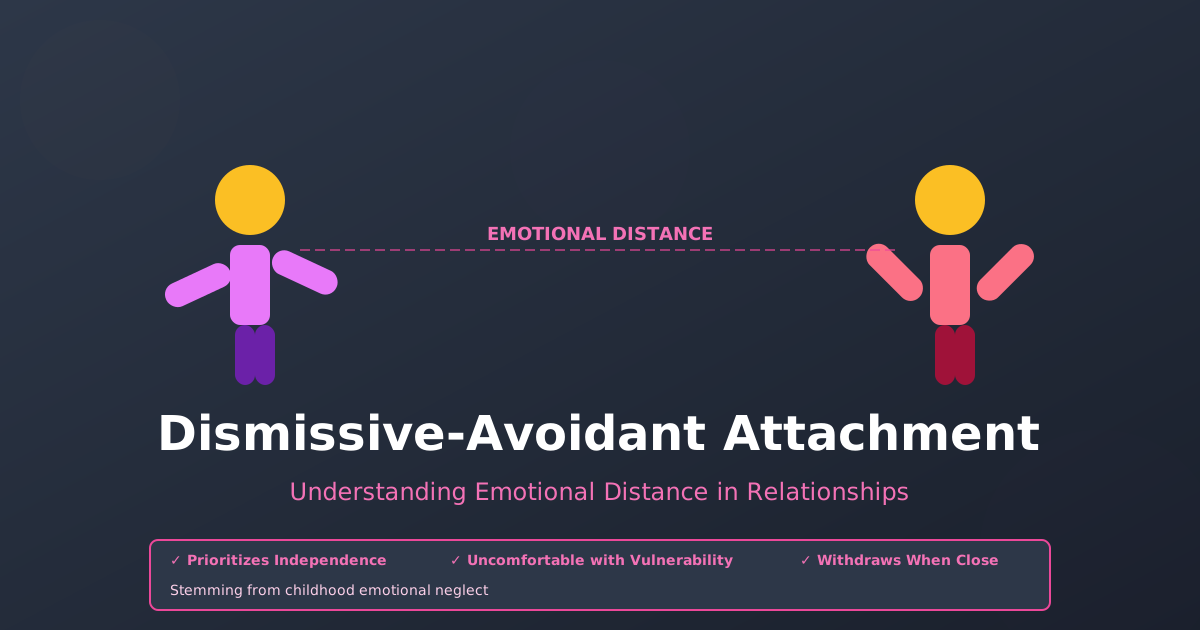
Dismissive-avoidant attachment affects millions of adults worldwide. It's not a flaw or character defect—it's an adaptive survival strategy your nervous system developed to keep you safe. But what once protected you in childhood may now limit your capacity for deep connection, emotional intimacy, and lasting partnership.
This guide explores what dismissive-avoidant attachment really means, why it develops, how it shows up in modern relationships, and most importantly—the practical steps you can take to heal and build secure attachment patterns.
What Is Dismissive-Avoidant Attachment?
Dismissive-avoidant attachment is an insecure attachment style where people feel uncomfortable with emotional closeness and intimacy. Instead of seeking comfort from partners, friends, or family, dismissive-avoidant individuals prefer to rely on themselves. They prioritize autonomy, emotional independence, and personal freedom over interdependence and emotional support.
Not medical advice.
In attachment theory—developed by psychologist John Bowlby and expanded by Mary Ainsworth—there are four primary attachment styles: secure, anxious-preoccupied, dismissive-avoidant, and fearful-avoidant. Dismissive-avoidant sits on the 'avoidant' spectrum, characterized by low anxiety about abandonment but high discomfort with closeness and emotional dependence.
Surprising Insight: Surprising Insight: Research from PMC studies shows that dismissive-avoidant individuals often report lower psychological well-being and relationship satisfaction, yet they're frequently unaware of how their attachment pattern affects their partners and their own emotional fulfillment.
The Four Attachment Styles
Visual breakdown of how attachment styles distribute across dimensions of anxiety (fear of abandonment) and avoidance (fear of closeness).
🔍 Click to enlarge
Why Dismissive-Avoidant Attachment Matters in 2026
In today's world of digital communication, remote relationships, and rapidly changing family structures, dismissive-avoidant attachment has never been more relevant. The ability to stay emotionally distant has become easier than ever—text-based communication, dating apps, and work-from-home setups allow avoidantly attached people to maintain relationships while avoiding genuine vulnerability.
2024-2025 research reveals troubling patterns: people with dismissive-avoidant attachment styles report higher rates of social anxiety, problematic social media use, and parasocial relationships with media figures. They're using digital platforms not to connect but to avoid real intimacy while still meeting basic belonging needs.
Understanding dismissive-avoidant attachment matters because it affects every relationship you have—romantic partnerships, friendships, family bonds, and professional collaborations. Recognizing the pattern allows you to interrupt cycles of sabotage, emotional stonewalling, and ultimately, chronic loneliness despite appearing independent and self-sufficient.
The Science Behind Dismissive-Avoidant Attachment
Dismissive-avoidant attachment originates in childhood, typically developing when caregivers are emotionally unavailable, dismissive of feelings, or inconsistently responsive to a child's needs. If your parents were cold, critical, or taught you that emotions were weakness, your developing brain learned to suppress feelings and maintain emotional distance as a survival mechanism.
Neuroscience research shows that repeated experiences of emotional unavailability literally reshape how your nervous system processes attachment cues. Your brain becomes hypervigilant to signs of emotional demands while simultaneously suppressing the natural drive to seek closeness. This creates a conflict: part of you wants connection, but another part panics when it starts to happen, triggering withdrawal or deactivation strategies.
From Childhood to Adult Dismissive-Avoidant Patterns
How early experiences with emotional neglect create neural pathways that persist into adulthood, driving avoidant behaviors in relationships.
🔍 Click to enlarge
Key Components of Dismissive-Avoidant Attachment
Emotional Suppression
Dismissive-avoidant individuals have learned to override their natural emotional responses. When you feel hurt, sadness, or fear, your instinct is to rationalize it away, minimize it, or simply not acknowledge it at all. This isn't conscious denial—it's an automatic nervous system response that's become habitual over decades. People with this style often report feeling 'numb' or disconnected from their emotions, experiencing relationships intellectually rather than emotionally.
Hyperindependence
Hyperindependence is the belief that you must be completely self-sufficient to be safe and worthy. This manifests as difficulty asking for help, reluctance to burden others with your needs, and pride in 'never needing anyone.' While self-reliance is valuable, hyperindependence becomes pathological when it prevents you from accepting support, sharing vulnerability, or trusting others with your well-being.
Relationship Sabotage Mechanisms
As romantic or intimate relationships deepen, dismissive-avoidant people unconsciously activate sabotage strategies. These include creating unnecessary conflict, picking fights over small issues, withdrawing affection, criticizing partners, or simply disappearing when the relationship feels too close. These behaviors restore emotional distance and provide temporary relief—but ultimately damage the relationship and reinforce the belief that 'closeness is dangerous.'
Deactivation Strategies
Deactivation is the dismissive-avoidant nervous system's way of turning off attachment signals. When a partner tries to be intimate, discuss feelings, or express needs, deactivation kicks in—you become cold, critical, dismissive, or physically distant. You might use humor to deflect, change the subject, or suddenly become busy and unavailable. These aren't intentional cruelties; they're protective mechanisms your nervous system deploys when it perceives intimacy as a threat.
| Relationship Type | Typical Avoidant Behavior | Impact on the Relationship |
|---|---|---|
| Romantic Partnership | Emotional withdrawal, avoiding vulnerable conversations, preference for independence | Partner feels rejected and alone; cycles of pursue-withdraw deepen |
| Close Friendship | Limited self-disclosure, maintaining 'casual' distance, unavailable during crises | Friends feel used or one-sided; genuine connection remains shallow |
| Family Relationships | Minimal contact, surface-level conversations, discomfort with family gatherings | Family feels hurt and excluded; aging parents feel unsupported |
| Professional Relationships | Difficulty collaborating, resistance to feedback, preference for solo projects | Career growth limited; reputation as 'difficult' or 'not a team player' |
How to Apply Dismissive-Avoidant Awareness: Step by Step
- Step 1: Recognize your attachment pattern: Journal about your earliest relationships. Did caregivers respond consistently to your emotional needs? Were emotions welcomed or minimized? Understanding your origins removes shame and creates clarity.
- Step 2: Notice your deactivation triggers: For one week, observe when you withdraw, criticize, or distance yourself. Is it when a partner wants to talk about feelings? When they ask for support? When intimacy increases? Identifying triggers is the first step to choosing different responses.
- Step 3: Name your protective beliefs: Write down the core beliefs driving your avoidance. Examples: 'Closeness means losing myself,' 'Needing others is weak,' 'Relationships always fail.' These beliefs aren't truth—they're survival strategies that may no longer serve you.
- Step 4: Practice tiny vulnerability: Start incredibly small. Tell one trusted person one true feeling per week. Not a crisis or emergency—just something real. Example: 'I felt scared when you were late' instead of pretending not to care.
- Step 5: Slow down your nervous system: When you feel the urge to withdraw, pause. Take three conscious breaths. Notice what you're feeling without acting on it. Your nervous system needs practice learning that closeness is safe.
- Step 6: Challenge catastrophic thoughts: When you think 'If I let them in, they'll hurt me' or 'Admitting I need help will ruin everything,' ask for evidence. How many times has connection actually destroyed you versus protected you?
- Step 7: Build secure connection gradually: Spend time with securely attached people who model healthy intimacy. This rewires your nervous system through observation and safe relationship experience.
- Step 8: Seek professional support: A trauma-informed therapist specializing in attachment can help you process childhood experiences and develop new relational patterns. This isn't weakness—it's the fastest path to healing.
- Step 9: Practice earned security: Research shows people can develop 'earned security'—moving from insecure to secure attachment through conscious work, relationships with stable people, and self-awareness. It's absolutely possible.
- Step 10: Celebrate small wins: Each time you stay present during a difficult conversation, ask for help, or express a genuine feeling, acknowledge it. These are new neural pathways forming—they deserve recognition.
Dismissive-Avoidant Attachment Across Life Stages
Young Adulthood (18-35)
In early adulthood, dismissive-avoidant attachment often manifests as serial short-term relationships or a pattern of 'unavailable' partners. You may feel relief when relationships end, interpret emotional demands as 'needy,' or genuinely believe you're simply 'not the relationship type.' Dating becomes transactional. You might maintain multiple shallow connections while avoiding anything serious, or hook up frequently while avoiding genuine intimacy. Many people in this stage are unaware their pattern stems from attachment history rather than authentic preference.
Middle Adulthood (35-55)
By middle age, dismissive-avoidant patterns often create sophisticated isolation. You may have achieved professional success (avoidant traits sometimes correlate with career focus) but remain relationally empty. Marriages may be emotionally cold, with partners reporting feeling unseen and unheard. You might invest heavily in work, hobbies, or children to avoid intimate partnership. Some people finally recognize the cost: missed emotional connections, difficulty being fully known, relationships that look good on paper but feel hollow inside.
Later Adulthood (55+)
In later years, dismissive-avoidant attachment often results in profound loneliness despite appearing independent and self-sufficient. As health challenges emerge or energy decreases, the costs of hyperindependence become apparent. People regret not building deeper connections earlier. Some finally become open to therapy or healing work. Others remain defended, aging into solitude. Research shows secure attachment in later years strongly predicts well-being and longevity—avoidant attachment predicts health decline and early mortality.
Profiles: Your Dismissive-Avoidant Approach
The Intellectual Avoider
- Understanding that feelings aren't logic problems to solve
- Permission to have emotions without immediately analyzing them
- Recognition that emotional intimacy requires surrendering control
Common pitfall: Using logic and rationalization to dismiss or minimize emotional experiences in yourself and others
Best move: Practice sitting with feelings for one full minute before analyzing them. Notice: What is the sensation? Where is it in your body? What does it need?
The Hyperindependent Achiever
- Recognition that asking for help isn't weakness—it's wisdom
- Understanding that interdependence is stronger than independence
- Permission to slow down and receive support from others
Common pitfall: Taking on everything yourself, burning out, then wondering why nobody 'really knows' you
Best move: This week, ask one person for help with something small. Let them contribute to your well-being. Notice what fears arise.
The Serial Disappearer
- Awareness that intimacy doesn't trap or diminish you
- Understanding that abandoning others mirrors childhood abandonment by caregivers
- Commitment to staying present even when discomfort rises
Common pitfall: Ghosting, sudden withdrawal, or breaking up when relationships approach authenticity or deeper commitment
Best move: When you feel the urge to disappear, pause and communicate instead. Say: 'I'm feeling overwhelmed. I need space, but I'm not leaving.'
The Critic-Defender
- Recognition that constant criticism pushes partners away (not because it's true but because it destroys safety)
- Understanding that criticism serves as armor protecting you from vulnerability
- Willingness to challenge the belief that love means letting someone hurt you
Common pitfall: Finding fault in every partner, criticizing their emotions or needs, using judgment as distance-creation tool
Best move: When you feel critical thoughts rising, pause and ask: 'What about this situation makes me feel unsafe or threatened?'
Common Dismissive-Avoidant Attachment Mistakes
Mistake #1: Assuming your attachment style is unchangeable destiny. Many avoidant people believe 'This is just who I am' or 'I'm not wired for relationships.' Research proves this false. Attachment styles are learned in childhood and can be unlearned and replaced with security in adulthood. Change requires awareness, commitment, and often professional support—but it's absolutely possible. Thousands of people have successfully moved from dismissive-avoidant to secure attachment.
Mistake #2: Blaming your partner for being 'too needy' or 'too clingy' when they seek normal intimacy. Your partner might be securely attached and simply have normal human needs for connection. Their needs aren't pathological—they're healthy. Repeatedly dismissing a partner's emotional needs damages the relationship and deepens your own isolation. Instead: recognize that different attachment styles have different needs, and some compromise is possible.
Mistake #3: Using spiritual or philosophical arguments to justify avoidance. Some dismissive-avoidant people frame their detachment as 'enlightenment,' 'not being needy,' or 'being highly independent.' While independence is healthy, emotional unavailability isn't enlightenment—it's trauma protection. Genuine spiritual growth includes capacity for intimacy, vulnerability, and authentic connection.
The Avoidant Relationship Cycle: How Dismissive-Avoidant Attachment Sabotages Connection
The repetitive cycle showing how avoidant deactivation strategies create distance, triggering anxious pursuit, which triggers further avoidance.
🔍 Click to enlarge
Science and Studies
Recent attachment research from 2024-2025 provides compelling evidence about dismissive-avoidant patterns and their impact on psychological functioning. Multiple peer-reviewed studies from PMC journals and the International Journal of Social Science Research document how attachment styles shape not only romantic relationships but also social anxiety, media habits, and overall life satisfaction.
- 2024 PMC Study: 'Exploring the Association between Attachment Style, Psychological Well-Being, and Relationship Status in Young Adults and Adults' found significant correlations between dismissive-avoidant attachment and lower psychological well-being, with implications for relationship satisfaction and mental health outcomes.
- 2025 Research: Social anxiety studies reveal dismissive-avoidant individuals are more likely to experience anxiety in real-life interactions, leading to increased social media use and parasocial relationships with media figures as compensation mechanisms.
- Meta-analysis: 'Adult attachment, social anxiety, and problematic social media use' (2024) demonstrates the connection between avoidant attachment and digital escapism, showing how technology enables avoidant people to maintain relational distance while meeting basic belonging needs.
- Neuroscience findings: Brain imaging studies show that avoidantly attached individuals have lower activation in areas associated with emotional processing and theory of mind, explaining reduced empathy and difficulty understanding partners' perspectives.
- Longitudinal research: Long-term studies tracking attachment patterns from childhood into adulthood confirm that early emotional neglect predicts adult dismissive-avoidant attachment, validating attachment theory's foundational premises.
Your First Micro Habit
Start Small Today
Today's action: One Honest Check-In: When someone important asks 'How are you really?', pause and answer truthfully for one full minute instead of defaulting to 'Fine.' Share one real feeling, challenge, or experience.
This tiny act rewires your nervous system. You're practicing vulnerability in the lowest-stakes way possible. You're proving to your nervous system that being honest doesn't lead to abandonment or judgment. Over time, you build capacity for deeper authenticity.
Keep quitting habit apps after a missed day? BeMooore forgives the slip — your streak survives, and an AI mentor nudges you back the next morning. Free on iOS.
Quick Assessment
When someone you care about wants to discuss feelings or deepen emotional intimacy, what's your typical response?
Your first answer reflects your attachment security. If you chose #2 or #4, you're likely showing dismissive-avoidant patterns. The quiz continues to help you understand your specific triggers and protective mechanisms.
Growing up, when you felt sad, scared, or vulnerable, what happened?
If you chose #2 or #4, you likely developed dismissive-avoidant strategies as emotional survival. Your nervous system learned that vulnerability = danger. This awareness is crucial because it destigmatizes your avoidance—it was smart protection in childhood.
Which statement feels most true for you?
Responses #2 or #4 indicate hyperindependence or dismissive-avoidance. While self-reliance is valuable, dismissive-avoidant patterns often mask deep loneliness. Research shows secure attachment—which includes healthy interdependence—predicts greater life satisfaction and well-being.
Take our full assessment to get personalized recommendations.
Discover Your Style →Next Steps
Start by identifying your specific deactivation patterns. Which relationships trigger avoidance? What emotions are hardest to feel? What beliefs drive your distance? Write these down. Awareness without judgment is the foundation for change.
Next, practice one micro-habit per week. Start incredibly small: share one real feeling, ask for help once, have a 10-minute vulnerable conversation. Your nervous system needs gradual practice learning that closeness is safe. Over weeks and months, these micro-habits build new neural pathways.
Get personalized guidance with AI coaching.
Start Your Journey →Research Sources
This article is based on peer-reviewed research and authoritative sources. Below are the key references we consulted:
Related Glossary Articles
Frequently Asked Questions
Can dismissive-avoidant attachment be changed?
Absolutely yes. Research shows 'earned security'—where people move from insecure to secure attachment through awareness, therapeutic work, and relationships with securely attached individuals. It requires commitment and patience, but it's entirely possible. Many people have successfully rewired their nervous systems from avoidant to secure.
Is dismissive-avoidant attachment the same as being introverted or independent?
No. Introversion is about how you recharge (alone vs. social settings). Independence is healthy autonomy. Dismissive-avoidant attachment is an insecure pattern rooted in trauma where closeness feels threatening. You can be introverted AND securely attached, or independent AND capable of healthy intimacy.
What's the difference between dismissive-avoidant and fearful-avoidant attachment?
Dismissive-avoidant: low anxiety about abandonment, high discomfort with closeness. You suppress needs for connection and prioritize independence. Fearful-avoidant: high anxiety AND high avoidance. You want connection but fear getting hurt, creating push-pull cycles. Both are avoidant but driven by different underlying fears.
How can I communicate my needs to a dismissive-avoidant partner?
Use clear, non-blaming language. Instead of 'You never want to talk,' try 'I feel disconnected when we don't have vulnerable conversations. I'd like to try talking about our feelings for 15 minutes this week.' Give them space to process. Avoid pursuing when they withdraw—that triggers more avoidance. Suggest professional support.
Is therapy necessary to heal dismissive-avoidant attachment?
While self-awareness and micro-habits help, trauma-informed therapy significantly accelerates healing. Therapists specializing in attachment can help you process childhood experiences, identify deactivation patterns, and practice new relational skills in a safe relationship. It's the most effective path to sustained change.
Take the Next Step
Ready to improve your wellbeing? Take our free assessment to get personalized recommendations based on your unique situation.
- Discover your strengths and gaps
- Get personalized quick wins
- Track your progress over time
- Evidence-based strategies