Communication Boundaries
Communication boundaries are the emotional and relational limits you set to protect your well-being and foster healthier interactions with others. They define what you will and won't accept in conversations, how much emotional energy you'll invest, and what topics feel safe or unsafe to discuss. Clear communication boundaries prevent misunderstandings, reduce conflict, and create space for deeper connection based on mutual respect. Without them, relationships often become exhausting, resentful, and emotionally draining for both people.
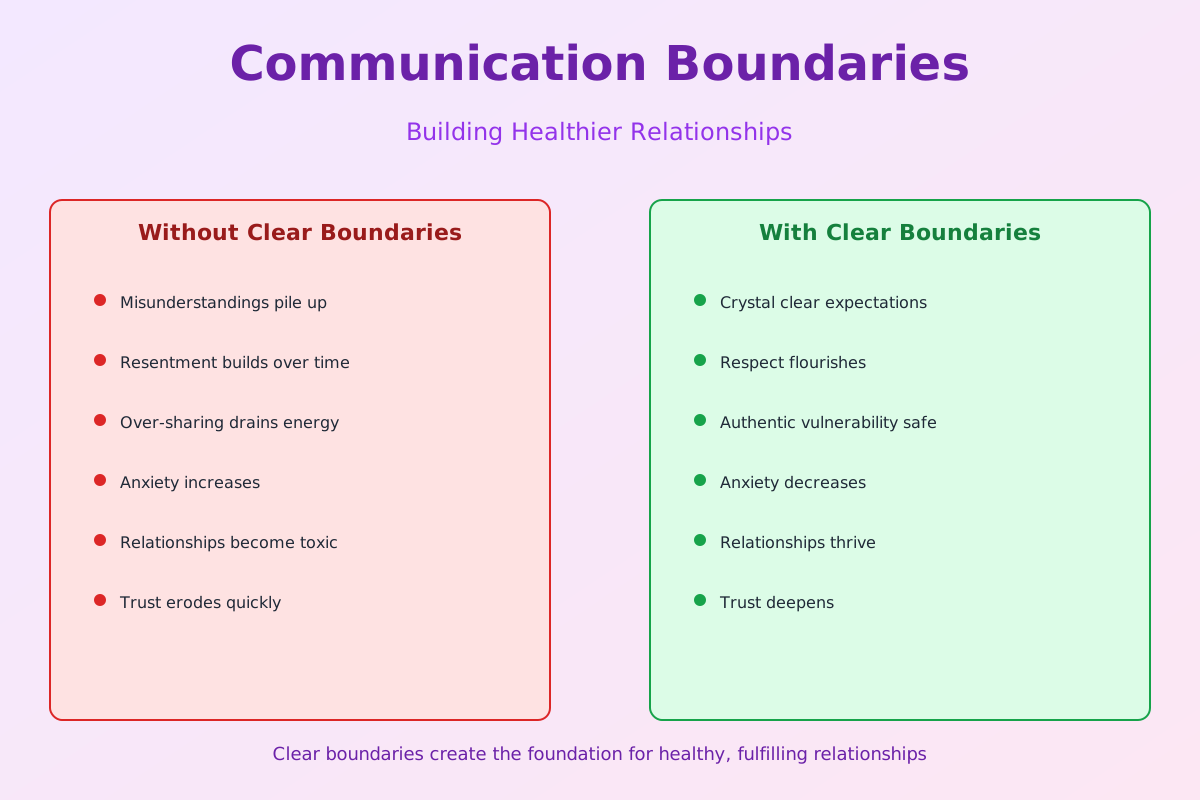
In today's hyperconnected world where technology blurs the lines between professional and personal communication, understanding how to set and maintain healthy communication boundaries has become essential for relationship satisfaction and mental health.
Whether you struggle with over-sharing, take on others' emotions, or avoid difficult conversations entirely, learning to establish clear communication boundaries transforms how you relate to loved ones and protects your emotional reserves for what matters most.
What Is Communication Boundaries?
Communication boundaries are explicit or implicit agreements about how people interact with one another. They define the limits of what topics are acceptable to discuss, how vulnerable you're willing to be, what language feels respectful, and how much emotional labor you can sustainably provide. Communication boundaries work alongside physical, emotional, and digital boundaries to create a complete framework for healthy relationships.
Not medical advice.
These boundaries exist on a spectrum. Some people have porous boundaries and share everything immediately, leaving themselves vulnerable to being overwhelmed by others' problems. Others maintain rigid boundaries and share almost nothing, which can prevent genuine intimacy and connection. Healthy communication boundaries fall between these extremes, allowing for authentic expression while maintaining emotional safety.
Surprising Insight: Surprising Insight: Research shows that couples who explicitly discuss and respect each other's communication boundaries report 47% higher relationship satisfaction and experience significantly fewer conflicts about feeling unheard or disrespected.
The Communication Boundary Spectrum
Visualizes how communication boundaries range from overly porous (over-sharing, no limits) through healthy boundaries (clear, flexible, respectful) to rigid boundaries (withdrawn, isolated, no vulnerability).
🔍 Click to enlarge
Why Communication Boundaries Matter in 2026
In 2026, communication happens across multiple platforms simultaneously—texts, calls, emails, social media, video calls—making it harder than ever to maintain consistent boundaries. People expect immediate responses, work-life boundaries have dissolved, and the constant connectivity creates mental fatigue. Setting clear communication boundaries helps you manage this complexity and protect your emotional energy.
Studies show that individuals who maintain healthy communication boundaries experience 40% less anxiety and depression related to relationships. They report feeling more in control of their emotional life, more respected in their relationships, and better able to have productive conversations even about difficult topics. People without clear boundaries often find themselves drained, resentful, and confused about why relationships feel conflicted.
Communication boundaries are particularly important because they directly affect how conflicts are resolved, how vulnerable you allow yourself to be, and whether you feel safe expressing your authentic self. Relationships with clear communication boundaries have significantly lower rates of abuse, manipulation, and emotional harm because both people know exactly what's acceptable.
The Science Behind Communication Boundaries
Neuroscience research reveals that when people feel their boundaries are violated during communication, it triggers the amygdala—the brain's threat detection center. This activates a fight-or-flight response, making rational conversation nearly impossible. Conversely, when communication boundaries are clearly respected, the brain enters a state of psychological safety, allowing the prefrontal cortex to activate for thoughtful, empathetic dialogue.
Attachment theory shows that people with secure attachment styles (which develop partly through experiencing respectful boundary-setting in childhood) naturally maintain healthy communication boundaries. They can say no without guilt, express needs without aggression, and listen without taking on others' emotions. This neural wiring makes boundaries feel natural rather than selfish. Those with anxious or avoidant attachment styles often struggle with boundaries and benefit from explicit practice in setting and maintaining them.
How Boundaries Affect Brain Activity During Conflict
Shows the neurological differences between conversations with violated boundaries (amygdala activation, threat response) versus respected boundaries (prefrontal cortex activation, rational dialogue).
🔍 Click to enlarge
Key Components of Communication Boundaries
Clarity and Directness
Clear communication boundaries require explicit expression of your limits. Vague hints, subtle sighs, or hoping someone 'just gets it' rarely work. Instead, direct statements like 'I'm not comfortable discussing my salary' or 'I need quiet time after work before we talk about our day' work far better. Directness isn't unkind—it's actually the kindest approach because it eliminates confusion and shows respect for the other person's right to know where they stand.
Consistency and Follow-Through
Boundaries only work when you enforce them consistently. If you sometimes allow others to interrupt you and sometimes don't, they'll push against your boundaries to test what's actually negotiable. Consistency teaches people exactly where your limits are and helps them respect you because they know you respect yourself. This doesn't mean never making exceptions—it means exceptions are truly exceptional and explained, not the default.
Respect for Others' Boundaries
Healthy communication boundaries are reciprocal. You cannot expect others to honor your limits while ignoring theirs. This means listening when others express boundaries, not taking it personally when they need space, and adjusting your behavior accordingly. The best communicators approach boundary-setting as a conversation, not a decree. They ask questions like 'What would help you feel more comfortable in our conversations?' and genuinely listen to the answer.
Flexibility and Compassion
While consistency matters, rigid boundaries can damage relationships. Someone going through grief might need more emotional support from you temporarily. A partner dealing with anxiety might need reassurance more frequently. Healthy boundaries are firm about your core values but flexible about implementation. You can honor someone's need for connection while still taking time for yourself. This balance requires ongoing communication and adjustment as circumstances change.
| Boundary Type | Definition | Example |
|---|---|---|
| Topic Boundaries | Limits on what subjects feel safe to discuss | Not discussing exes with your current partner; keeping parental conflicts private from children |
| Time Boundaries | Limits on when communication happens | No work texts after 6 PM; not discussing serious issues late at night when you're tired |
| Emotional Boundaries | Limits on how much emotional labor you provide | Not absorbing someone else's anxiety as your own; declining to be someone's primary emotional support |
| Vulnerability Boundaries | Limits on how much you share about yourself | Sharing fears only after trust is established; not over-disclosing early in relationships |
| Language Boundaries | Limits on acceptable tone and language | Not tolerating name-calling; requesting calm voices during disagreements |
| Digital Boundaries | Limits on communication across platforms | Not checking work email on weekends; expecting responses within 24 hours, not immediately |
How to Apply Communication Boundaries: Step by Step
- Step 1: Identify your values and limits: Reflect on what truly matters to you and where you consistently feel disrespected or drained in conversations. Your boundaries should protect what you value most.
- Step 2: Name the specific boundary: Instead of 'be nicer to me,' try 'I need you to speak to me with respect, which means no interrupting when I'm speaking and using a calm tone.' Specificity is crucial.
- Step 3: Communicate clearly and calmly: Choose a peaceful moment, not during conflict, to express your boundary. Use 'I' statements: 'I need us to discuss finances weekly so I feel secure' rather than 'You never talk about money.'
- Step 4: Explain the 'why' without over-explaining: People respect boundaries more when they understand the reason. 'I need some alone time after work because it helps me be present with you' is better than just saying no.
- Step 5: Listen to the other person's perspective: After sharing your boundary, genuinely ask how they feel about it. There may be reasonable concerns or adjustments needed that you hadn't considered.
- Step 6: Offer alternatives and flexibility: 'I can't talk about work drama every evening, but I'm happy to discuss it on Thursdays after dinner' shows you care while maintaining your boundary.
- Step 7: Stay calm if they resist: Not everyone accepts boundaries immediately. Some people will push back, test limits, or try to make you feel guilty. This is normal and doesn't mean your boundary is wrong.
- Step 8: Reinforce consistently: The first time you hold a boundary, it might feel awkward. Keep reinforcing it gently but firmly. People eventually learn and respect boundaries that are consistently maintained.
- Step 9: Reassess periodically: Life changes. A boundary that worked last year might need adjustment. Regular check-ins about what's working keep communication healthy and adaptive.
- Step 10: Celebrate when boundaries work: Notice when clearer communication reduces conflict, deepens intimacy, or simply makes interactions feel safer. This reinforces that boundaries aren't limiting—they're liberating.
Communication Boundaries Across Life Stages
Young Adulthood (18-35)
Young adults are often learning to separate from family boundaries while establishing new ones in romantic relationships and friendships. This stage involves discovering what you actually need versus what you were taught to accept. Many people in this phase struggle with saying no, fear abandonment if they set boundaries, or overcompensate with rigid walls. The key task is experimenting with different boundary styles, noticing what helps you feel safe and respected, and building the confidence to advocate for yourself. Dating becomes complicated because you're learning your own boundaries while navigating someone else's, making explicit conversations about expectations essential.
Middle Adulthood (35-55)
By this stage, most people have a clearer sense of their non-negotiable boundaries. The challenge shifts to maintaining them despite increased demands—aging parents, ambitious careers, teenage children, and established relationships that may have drifted into unhealthy patterns. People in middle adulthood often struggle with boundary fatigue: they're setting the same boundaries repeatedly and feeling frustrated when they're not respected. This is the critical period to either recommit to boundaries with compassion or renegotiate them as life circumstances change. Couples who maintain strong communication boundaries at this stage report significantly higher satisfaction and lower divorce rates.
Later Adulthood (55+)
In later adulthood, communication boundaries often become simpler but more important. As physical autonomy may decrease and care relationships shift, clear boundaries about decision-making, privacy, and how support is offered become crucial. Grandparents need boundaries about parenting decisions; people dealing with chronic illness need boundaries about how much they discuss their health; aging parents need boundaries about independence. The wisdom of this stage often includes knowing which boundaries matter most and letting go of others. Many people find their communication becomes clearer and more direct because they care less about others' judgments and more about preserving their energy for relationships that truly matter.
Profiles: Your Communication Boundaries Approach
The Over-Sharer
- Permission to keep some things private
- Understanding that vulnerability has limits
- Practice noticing when sharing becomes exhausting for others
Common pitfall: Oversharing early in relationships and then feeling rejected when people pull back or breach confidence
Best move: Practice the 'pacing' principle: gradually increase vulnerability as trust builds, and notice nonverbal cues that someone is becoming overwhelmed
The Avoider
- Gradual exposure to expressing needs and limits
- Safety that setting boundaries won't cause abandonment
- Permission to start small with low-stakes boundaries
Common pitfall: Building resentment because unspoken expectations pile up, then exploding inappropriately or withdrawing entirely
Best move: Begin with small, specific, low-stakes boundaries (like 'I need 10 minutes of quiet time') and gradually work toward bigger conversations as confidence grows
The Boundary Enforcer
- Understanding that boundaries can be firm yet compassionate
- Recognition that perfect consistency isn't possible or healthy
- Practice listening to others' boundaries with the same respect you expect
Common pitfall: Setting boundaries so rigidly that they prevent intimacy and leave people feeling rejected or criticized
Best move: Balance enforcement with flexibility; explain the 'why' behind boundaries; check in about how others experience your boundary-setting
The Boundary-Confused
- Clear examples of what healthy boundaries look like
- Permission to observe and learn from others' boundary-setting
- Understanding that your history shapes your boundary patterns
Common pitfall: Unclear about what they actually need, so boundaries feel arbitrary, shift frequently, or feel impossible to maintain
Best move: Start with identifying your core values (what matters most to you), then let boundaries flow from those values rather than from reactions to others' behavior
Common Communication Boundaries Mistakes
One of the most common mistakes is setting boundaries from anger rather than clarity. Angry boundaries often sound accusatory ('You never listen to me!') rather than descriptive ('I need you to put your phone down when I'm talking about something important'). When you set a boundary in anger, the other person becomes defensive about the anger rather than hearing your actual need. Always wait until you're calm to discuss significant boundaries.
Another mistake is making exceptions without explanation. If you establish 'no work talk at dinner' but then one night you talk about work for an hour, you've just taught the other person that this boundary is negotiable. If circumstances genuinely require an exception, acknowledge it: 'I know I usually don't like talking work at dinner, but I really need your input on this situation tonight.' This keeps the boundary intact while allowing flexibility.
Many people also mistake boundaries for punishment. Healthy boundaries are protective, not punitive. There's a difference between 'I'm not going to listen to criticism without respect' (boundary) and 'If you criticize me, I'm leaving this relationship' (ultimatum/punishment). The first maintains your dignity; the second creates fear and damages the relationship.
Boundaries vs. Walls vs. Punishment
Illustrates the differences between healthy protective boundaries, rigid walls that prevent connection, and punitive responses that damage relationships.
🔍 Click to enlarge
Science and Studies
Extensive research on communication boundaries confirms their critical importance for relationship health and personal wellbeing. Modern psychology emphasizes that clear boundaries are a sign of emotional maturity and secure attachment, not selfishness or emotional unavailability.
- Psychology Today research (2024) shows that individuals who maintain healthy communication boundaries experience 40% lower rates of anxiety and depression in relationships, and report significantly higher life satisfaction.
- A 2024 study published in Frontiers in Psychology found that couples who explicitly discussed and respected communication boundaries reported 47% higher relationship satisfaction scores and 60% fewer recurring conflicts.
- UC Davis Health Center (2024) research demonstrates that employees and individuals who set clear communication boundaries experience less burnout, maintain better mental health, and show improved emotional regulation in stressful situations.
- The Center for Mindful Therapy research (2024) confirms that clear communication about boundaries facilitates deeper intimacy, reduces misunderstandings, and creates the psychological safety necessary for authentic connection.
- A 2025 study in Frontiers in Psychology found that poor communication and boundary violations were among the strongest predictors of relationship distress, while clear, respectful boundary-setting was correlated with long-term relationship stability and satisfaction.
Your First Micro Habit
Start Small Today
Today's action: This week, identify one repeated interaction that leaves you feeling drained or disrespected. Write down specifically what happens and what you wish was different. Then, in a calm moment, use one sentence to express this boundary: 'I need [specific need] because [brief reason].' Notice what happens.
Starting with one small, specific boundary helps you practice without overwhelming yourself. Written clarity prevents you from getting tongue-tied, and noticing the response builds confidence for bigger conversations. This micro-habit also helps you discover that most people respond better to clear boundaries than you fear.
Keep quitting habit apps after a missed day? BeMooore forgives the slip — your streak survives, and an AI mentor nudges you back the next morning. Free on iOS.
Quick Assessment
When someone asks you for something that inconveniences you, what do you typically do?
Your answer reveals your default boundary style. Those choosing 'pause and respond honestly' have already developed healthy boundary awareness. If you chose other options, that's okay—it shows you have room to practice, which starts with self-awareness.
How do you feel when someone sets a boundary with you?
People who feel hurt by others' boundaries often struggle to set their own because they fear causing similar pain. People who respect others' boundaries naturally find it easier to set and maintain their own. The most secure approach is grateful clarity—appreciating when people communicate their needs.
In your most important relationships, how often do you explicitly discuss what communication styles work for you both?
Successful couples discuss communication preferences explicitly and regularly. Those who 'just understand each other' often discover they actually don't—they've just been lucky so far. Regular conversations about communication boundaries prevent most conflicts.
Take our full assessment to get personalized recommendations.
Discover Your Style →Next Steps
Start by observing your own communication patterns without judgment. Where do you feel drained? When do you resent others? These are clues about boundaries you need to establish. Remember that boundary-setting is a skill that improves with practice—your first attempts may feel awkward, but they get easier and more natural over time. Give yourself grace as you learn.
Consider that the relationships most worth having are those where both people can be honest about their needs and limits. As you develop clearer communication boundaries, you'll naturally attract people who respect them and perhaps release those who don't—and that's the point. Healthier relationships come from clearer communication.
Get personalized guidance with AI coaching.
Start Your Journey →Research Sources
This article is based on peer-reviewed research and authoritative sources. Below are the key references we consulted:
Related Glossary Articles
Frequently Asked Questions
Are communication boundaries selfish?
No. Healthy boundaries are actually generous—they allow you to show up authentically in relationships without resentment. When you honor your own limits, you're more present and less drained with the people you care about. Selfishness is about taking without regard for others; boundaries are about taking care of yourself so you can care for others sustainably.
What if someone gets upset when I set a boundary?
Some people will initially resist because they've grown used to fewer limits. This is normal. Stay calm and compassionate but firm. You might say: 'I understand this might feel different, and I value our relationship, which is exactly why I'm being clear about this.' Most people adjust within a few weeks of consistent boundary maintenance.
How do I set boundaries with people who have power over me (boss, parent)?
This requires more strategic framing. Instead of 'I won't discuss this,' try 'What would work best for you is if we focused on X instead.' Frame boundaries as serving the other person's interests when possible. With authority figures, boundaries are often about what you will do rather than what you won't: 'I respond to emails within 24 hours' rather than 'I don't check email after 6 PM.'
Can boundaries change, or should they stay the same forever?
Healthy boundaries are firm about your core values but flexible in implementation. You might discover that a boundary you thought you needed doesn't actually serve you, or that circumstances have changed and require adjustment. The key is being intentional about changes rather than abandoned boundaries when someone pressures you.
How do I know if I have porous or rigid boundaries?
Porous: You over-share, struggle saying no, feel drained after interactions, worry others will abandon you if you set limits. Rigid: You share little, rarely ask for help, feel uncomfortable with vulnerability, or others describe you as distant. Most people vary by relationship. Notice which category feels most familiar, then practice the opposite slightly.
Take the Next Step
Ready to improve your wellbeing? Take our free assessment to get personalized recommendations based on your unique situation.
- Discover your strengths and gaps
- Get personalized quick wins
- Track your progress over time
- Evidence-based strategies