Business Strategy and Development
Business strategy and development represents the deliberate planning and execution of actions designed to achieve competitive advantage and sustainable growth in your organization. It's the bridge between your vision and reality, combining market analysis, internal assessment, and strategic action plans into a coherent roadmap that guides decision-making at every level. Whether you're launching a startup or scaling an established company, mastering business strategy means understanding your market, defining clear objectives, and creating actionable pathways to success.
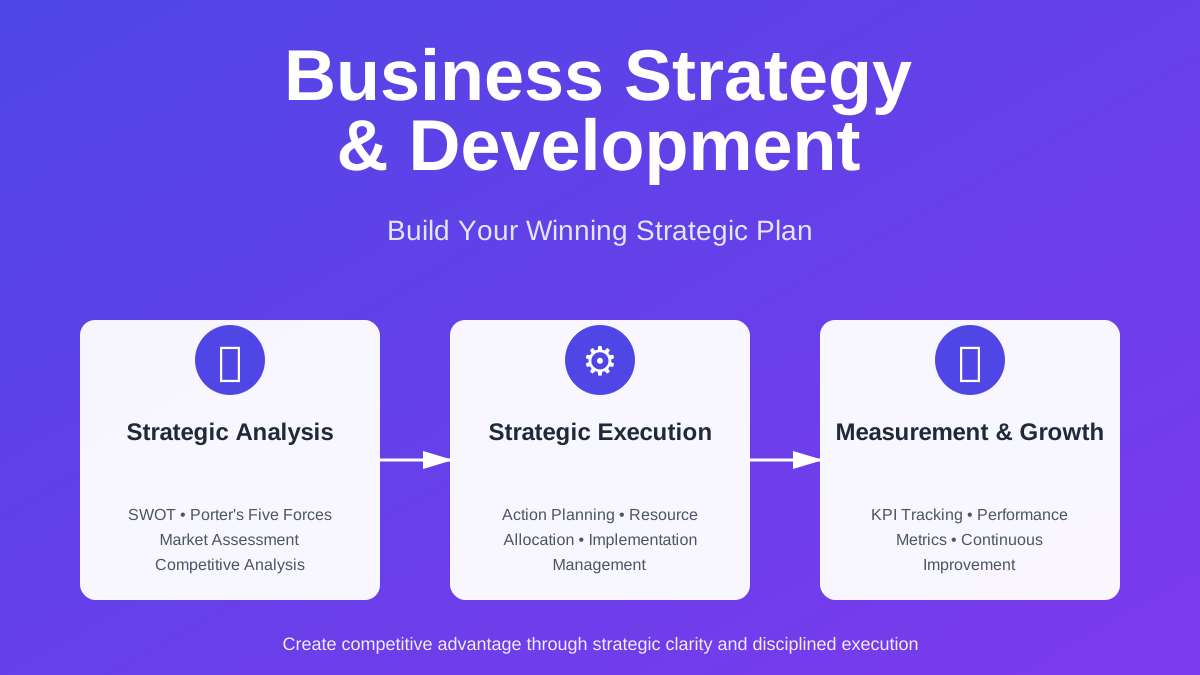
The most successful entrepreneurs recognize that strategy isn't a one-time document gathering dust on a shelf—it's a living, breathing framework that evolves as your business matures and market conditions shift.
In 2026, with AI transforming decision-making and global markets becoming increasingly complex, strategic thinking has never been more critical to business survival and prosperity.
What Is Business Strategy and Development?
Business strategy and development is the comprehensive process of defining your organization's direction, identifying competitive advantages, and creating concrete action plans to achieve long-term goals. It combines strategic planning (understanding where you are and where you want to go) with strategic execution (making it happen with available resources). Unlike tactical decisions that address immediate challenges, strategic choices shape your business trajectory over years.
Not medical advice.
Effective business strategy integrates multiple dimensions: market positioning, competitive analysis, resource allocation, organizational capabilities, and risk management. It answers critical questions: Who are your customers? What unique value do you deliver? How do you compete in your market? What resources do you need? How will you measure success? This comprehensive approach transforms abstract business goals into concrete strategies that guide everyday decisions.
Surprising Insight: Surprising Insight: According to recent research, 85% of business leaders expect higher revenue over the next 12 months, yet many still lack clearly defined strategies to achieve these ambitious targets—creating a critical gap between aspirations and execution.
The Strategic Planning Framework
Shows how vision, analysis, strategy formulation, and execution create a continuous cycle for business growth and adaptation.
🔍 Click to enlarge
Why Business Strategy and Development Matters in 2026
In today's rapidly evolving business environment, strategy has become the critical differentiator between organizations that thrive and those that merely survive. The complexity of markets, acceleration of technological change, and increasing competitive pressure mean that intuition and reactive management are no longer sufficient. Strategic thinking provides the framework to navigate uncertainty while capitalizing on emerging opportunities.
Business strategy matters because it dramatically increases your probability of success. Organizations with clearly defined strategies experience better financial performance, higher employee engagement, and greater adaptability to market changes. Strategy provides direction during uncertainty, helps teams align around common goals, and enables resource optimization by focusing investments on high-impact activities rather than scattered efforts.
Moreover, strategic thinking protects your business from disruption. By regularly analyzing market trends, competitive threats, and your own capabilities, you can anticipate challenges before they become crises. In 2026, with AI and automation reshaping industries, businesses that engage in continuous strategic reassessment maintain competitive relevance and positioning.
The Science Behind Business Strategy and Development
Business strategy development is grounded in organizational theory, behavioral economics, and competitive analysis frameworks developed over decades of research. Strategic management scholars have identified that successful organizations systematically analyze their external environment, assess internal capabilities, formulate coherent strategies aligned with their unique strengths, and implement these strategies with disciplined execution. This scientific approach replaces guesswork with systematic analysis.
Research consistently demonstrates that organizations following strategic planning processes outperform those without formal strategies. Studies show that 95% of business leaders recognize the importance of strategy in enhancing workforce productivity, while organizations that align strategy with execution see measurable improvements in operational efficiency, market responsiveness, and financial outcomes. The science reveals that successful strategy requires balancing stability (maintaining long-term vision) with flexibility (adapting tactics as circumstances change).
Strategic Analysis Framework
Illustrates how external opportunities/threats and internal strengths/weaknesses combine to create competitive positioning and strategic direction.
🔍 Click to enlarge
Key Components of Business Strategy and Development
Market and Competitive Analysis
Effective business strategy begins with deep understanding of your market landscape. This includes analyzing customer needs, identifying competitor strategies, assessing industry trends, and recognizing emerging threats and opportunities. Tools like Porter's Five Forces help you evaluate competitive intensity and industry profitability by examining competitive rivalry, supplier power, buyer power, threat of substitutes, and barriers to entry. PESTEL analysis examines political, economic, social, technological, environmental, and legal factors that influence your business environment.
Internal Capability Assessment
Understanding what your organization does exceptionally well is crucial to developing differentiated strategies. This involves honest evaluation of your resources (financial, human, technological), core competencies, organizational culture, operational capabilities, and brand positioning. SWOT analysis (Strengths, Weaknesses, Opportunities, Threats) provides a structured framework for integrating external market insights with internal reality. This assessment reveals where you have competitive advantages and identifies skill or resource gaps that must be addressed.
Strategic Goal Setting and Objectives
Clear, measurable objectives transform strategic vision into concrete targets. Effective goals follow the SMART framework: Specific (clearly defined), Measurable (trackable with data), Achievable (realistic given resources), Relevant (aligned with overall vision), and Time-bound (with specific deadlines). Whether aiming to increase revenue, expand market share, launch new products, or enter new geographic markets, well-crafted objectives provide focus and enable progress tracking. They should cascade from organizational level through departmental levels to individual contributor responsibilities.
Implementation and Execution Planning
Strategy means nothing without effective execution. Implementation involves creating detailed action plans specifying who does what by when with what resources, defining key performance indicators to track progress, establishing accountability mechanisms, allocating budgets strategically, and communicating plans throughout the organization. Many strategic failures occur not because the strategy was flawed, but because execution was weak. Successful organizations balance macro goals for the year with tactical flexibility, allowing teams to adapt specific approaches while maintaining strategic direction.
| Framework | Primary Purpose | Key Insight |
|---|---|---|
| SWOT Analysis | Comprehensive capability assessment | Identifies internal strengths/weaknesses and external opportunities/threats |
| Porter's Five Forces | Competitive landscape evaluation | Analyzes industry attractiveness and profitability dynamics |
| PESTEL Analysis | Macro-environmental scanning | Examines political, economic, social, tech, environmental, and legal factors |
| Balanced Scorecard | Strategy execution and measurement | Tracks performance across financial, customer, process, and learning dimensions |
| Value Chain Analysis | Operational efficiency assessment | Identifies where competitive advantage emerges in your operations |
How to Apply Business Strategy and Development: Step by Step
- Step 1: Conduct stakeholder interviews and customer research to understand what your market truly needs and values
- Step 2: Perform a comprehensive SWOT analysis identifying your internal strengths, weaknesses, and external opportunities and threats
- Step 3: Apply Porter's Five Forces analysis to evaluate competitive intensity, supplier relationships, buyer power, and industry profitability
- Step 4: Define your unique value proposition—the specific way you create superior value compared to competitors
- Step 5: Establish clear, measurable SMART goals aligned with your vision that guide strategic direction
- Step 6: Identify 3-5 strategic priorities representing the most important areas requiring focus and resource allocation
- Step 7: Create detailed action plans for each priority specifying initiatives, responsible parties, timelines, and resource requirements
- Step 8: Develop key performance indicators and metrics to track progress toward strategic objectives
- Step 9: Communicate strategy throughout your organization ensuring alignment and shared understanding at all levels
- Step 10: Establish regular review cycles to assess progress, identify obstacles, and make adjustments while maintaining overall strategic direction
Business Strategy and Development Across Life Stages
Young Adulthood (18-35)
During early career stages, developing strategic thinking skills positions you for accelerated advancement and entrepreneurial success. Young professionals benefit from studying business frameworks, observing how experienced leaders think strategically, and applying analytical approaches to their own projects. For emerging entrepreneurs, this phase involves validating business ideas through customer discovery before investing heavily, understanding target markets deeply, and building foundational strategic habits that become ingrained over time. Many successful founders began developing their strategic capabilities in their twenties through mentorship and deliberate practice.
Middle Adulthood (35-55)
During peak earning and leadership years, strategic capabilities become essential for business success and career progression. Mid-career professionals increasingly face responsibility for departmental or organizational strategy, requiring sophisticated understanding of competitive dynamics, resource allocation, and organizational change management. Business owners in this phase must balance maintaining current operations with strategic investments in growth, often navigating how to keep established businesses competitive while exploring new opportunities. Many transitions—from startup to scale-up, from product-focused to market-focused positioning—occur in this phase and demand strong strategic thinking.
Later Adulthood (55+)
In later career stages, strategic wisdom becomes valuable as mentors and advisors to emerging leaders and entrepreneurs. Experienced leaders possess decades of pattern recognition that enables faster strategic assessment and more nuanced judgment about business opportunities and risks. This phase often involves strategic decisions about succession planning, legacy building, and portfolio optimization. For business owners approaching retirement, strategic planning focuses on positioning the business for sale or transition, maximizing remaining years of value creation, and considering how to scale operations to increase enterprise value.
Profiles: Your Business Strategy and Development Approach
The Analytical Strategist
- Deep market research and data-driven analysis informing decisions
- Structured frameworks like SWOT and Porter's Five Forces to organize complexity
- Quantitative metrics and dashboards to track strategic progress
Common pitfall: Analysis paralysis where extensive research delays decision-making and action
Best move: Set clear decision deadlines, accepting that 80% of the information will never be available—proceed with best current understanding
The Visionary Entrepreneur
- Freedom to explore bold new ideas and unconventional approaches
- Trusted advisors who can stress-test ambitious vision and keep execution grounded
- Mechanisms to translate vision into concrete action plans and milestones
Common pitfall: Pursuing multiple exciting directions simultaneously, diluting focus and resources
Best move: Prioritize ruthlessly, committing resources to your top 2-3 strategic priorities while declining other good opportunities
The Pragmatic Executor
- Clear strategic direction and objectives to operationalize
- Tools and processes for tracking execution and identifying obstacles quickly
- Authority to remove barriers to implementation and allocate resources flexibly
Common pitfall: Getting so focused on execution excellence that you miss strategic shifts in market conditions
Best move: Build in regular strategic review cycles, allocating time quarterly to reassess market conditions and competitive dynamics
The Collaborative Leader
- Inclusive strategic planning processes engaging diverse perspectives
- Strong communication forums ensuring all stakeholders understand strategic direction
- Alignment mechanisms creating shared ownership of strategic success
Common pitfall: Consensus-seeking processes that delay decisions or water down distinctive strategic positioning
Best move: Lead with genuine openness to input while maintaining clarity about who makes final decisions—transparency prevents frustration
Common Business Strategy and Development Mistakes
One of the most common mistakes is confusing strategy with tactics—creating detailed operational plans while lacking clarity about overall strategic direction. Strategy addresses the 'why' and 'what' (why these priorities matter and what we're trying to achieve), while tactics address the 'how' (specific actions). Organizations fail when they execute excellent tactics that don't advance strategic objectives, essentially running very fast in the wrong direction.
Another critical mistake is creating strategy in isolation without adequate customer and market input. Organizations that develop strategies based primarily on internal perspectives often miss how markets have shifted, what customers genuinely value, or how competitors have repositioned. The best strategies emerge from deep market understanding combined with honest internal assessment. Additionally, many organizations fail by creating perfect strategic plans that never translate into action—strategy documents gathering dust represent investments that generate no value.
Finally, businesses frequently fail by rigidly adhering to initial strategies despite changed circumstances. While strategy should provide consistent direction, successful organizations regularly assess whether fundamental assumptions remain valid. Market conditions shift, competitors respond, technologies emerge, and organizational capabilities develop. Strategic flexibility—maintaining strategic direction while adapting tactics—creates resilience and competitive advantage.
Strategy Implementation Success Model
Shows the interconnected elements that determine whether strategy translates into successful business outcomes and competitive advantage.
🔍 Click to enlarge
Science and Studies
Strategic management research provides compelling evidence about what drives business success. Extensive studies demonstrate that organizations with clearly defined, executed strategies consistently outperform those without formal strategic approaches. Research from leading business institutions reveals that strategic planning processes, when executed properly, lead to measurable improvements in financial performance, operational efficiency, and employee engagement.
- McKinsey studies show that organizations aligned around strategy see 52% higher revenue growth compared to misaligned peers
- Harvard Business Review research indicates that execution quality—translating strategy into action—is the primary differentiator between successful and unsuccessful strategies
- MIT Sloan research on entrepreneurship identifies customer discovery and hypothesis testing as critical steps before major strategic investments
- Strategy execution research demonstrates that organizations using Balanced Scorecard frameworks achieve significantly better strategic results than those without structured measurement systems
- Competitive analysis research shows that Porter's Five Forces framework effectively predicts industry profitability and guides strategic positioning decisions
Your First Micro Habit
Start Small Today
Today's action: Spend 15 minutes today listing your top 3 business challenges, then identify which external market factors or internal capability gaps created each challenge—this simple analysis begins developing your strategic thinking.
Strategic thinking is a learnable skill developed through consistent practice. Starting small with a 15-minute analysis removes activation barriers while building the habit of analyzing business challenges through a strategic lens rather than reactive mode. Over time, this becomes automatic thinking.
Keep quitting habit apps after a missed day? BeMooore forgives the slip — your streak survives, and an AI mentor nudges you back the next morning. Free on iOS.
Quick Assessment
How would you describe your current approach to business decision-making?
Your decision-making style significantly influences what strategic frameworks will resonate most. Analytical leaders benefit from structured tools like SWOT and Porter's Five Forces, while intuitive leaders might focus on rapid hypothesis testing and market feedback loops.
What timeframe guides most of your business planning?
Strategic thinking requires balancing short-term operational excellence with long-term directional clarity. Leaders with longer planning horizons tend to make more differentiated strategic choices, while those focused on quarterly cycles often default to tactical execution.
How frequently do you formally reassess your business strategy?
In today's rapidly changing environment, organizations that review strategy only annually often miss critical shifts and opportunities. The most successful businesses build continuous strategic assessment into their operational rhythms.
Take our full assessment to get personalized recommendations.
Discover Your Style →Next Steps
Developing business strategy and strategic thinking capability is a journey rather than a destination. Whether you're just beginning to think strategically or refining existing approaches, the path forward involves continuous learning, regular practice, and willingness to adapt as circumstances change. The most successful leaders view strategy development not as a periodic exercise but as an integral part of how they run their business.
Start by applying one strategic framework to your current business challenge. Choose the SWOT analysis if you want to assess where you stand, Porter's Five Forces if you want to understand competitive dynamics, or the Balanced Scorecard if you want to track strategy execution. Practice creates capability—the frameworks that seem complex initially become intuitive with repeated application. As your strategic thinking develops, you'll naturally integrate multiple frameworks, making increasingly sophisticated strategic choices that drive meaningful business results.
Get personalized guidance with AI coaching.
Start Your Journey →Research Sources
This article is based on peer-reviewed research and authoritative sources. Below are the key references we consulted:
Related Glossary Articles
Frequently Asked Questions
How long does it take to develop a business strategy?
Initial strategy development typically takes 4-12 weeks depending on organization size and complexity. Smaller organizations might complete strategic planning in 4-6 weeks, while larger enterprises with multiple business units might require 8-12 weeks. However, strategy development is not a one-time event—successful organizations engage in continuous strategic assessment, reviewing and adjusting strategy quarterly while conducting comprehensive updates annually.
What's the difference between strategy and planning?
Strategy addresses the 'what' and 'why'—what competitive advantages will you develop and why these specific directions matter most. Planning addresses the 'how'—the specific actions, timelines, and resource allocations to execute strategy. Think of strategy as the destination and overall route; planning is the detailed turn-by-turn directions and resource logistics.
Can small businesses benefit from formal strategic planning?
Absolutely. While large enterprises benefit from formal strategic planning frameworks, small businesses often benefit even more significantly because strategic clarity helps focus limited resources on highest-impact activities. Small business owners with clear strategies can dramatically outcompete larger, less-focused competitors. Strategy doesn't require elaborate documentation—often a clear written strategy of 5-10 pages provides tremendous value.
How do you know if your strategy is working?
Effective strategy translation into measurable outcomes. Establish key performance indicators aligned with strategic objectives before implementation, then track these metrics regularly. Track not just financial outcomes but also leading indicators—customer satisfaction, market share trends, innovation pipeline strength, and employee engagement. If leading indicators are healthy but financial results lag, you may need time for results to materialize. If multiple indicators show problems, strategy adjustment may be needed.
Should strategy be the same for all organizational levels?
No. Corporate strategy (overall organizational direction) differs from business unit strategy (how each business competes in its market) and functional strategy (how sales, marketing, operations, etc. support business objectives). However, all levels should align—lower levels operationalize higher levels' strategies while providing input that shapes strategic choices. This cascading alignment creates cohesion and prevents conflicting priorities.
Take the Next Step
Ready to improve your wellbeing? Take our free assessment to get personalized recommendations based on your unique situation.
- Discover your strengths and gaps
- Get personalized quick wins
- Track your progress over time
- Evidence-based strategies