Body-Doubling
Imagine sitting down to work on a difficult task, and suddenly your focus sharpens the moment another person enters the room. You're not talking to them, they're not supervising you, yet somehow your productivity skyrockets. This is the magic of body-doubling, a surprisingly effective technique where another person's mere presence transforms your ability to concentrate and follow through. Whether you struggle with ADHD, remote work isolation, or chronic procrastination, body-doubling offers a simple but powerful solution backed by neuroscience and embraced by thousands of professionals worldwide.
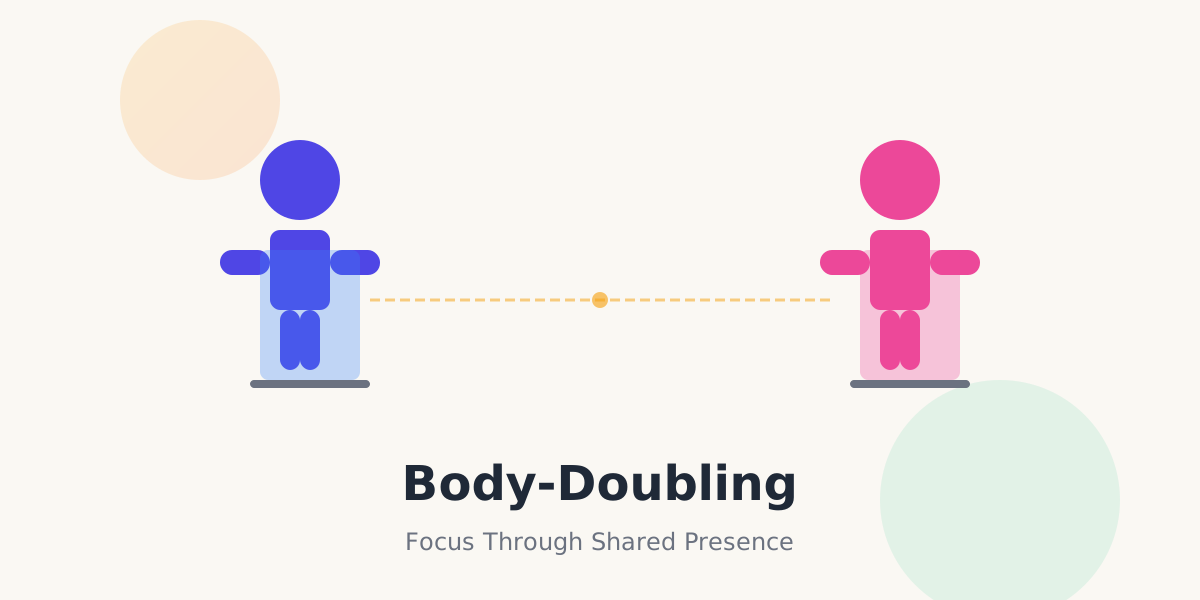
The beauty of body-doubling lies in its simplicity: shared presence creates accountability without judgment, making it easier to start tasks and maintain focus until completion.
In 2026, body-doubling has evolved from an informal strategy into a structured practice, with dedicated virtual coworking platforms, study groups, and professional accountability partnerships making this technique accessible to anyone with an internet connection.
What Is Body-Doubling?
Body-doubling is a productivity and focus technique where having another person physically or virtually present while you work helps you concentrate, reduce procrastination, and increase task completion. The key insight is that the other person doesn't need to actively supervise or interact with you—their presence alone triggers neurological changes that improve focus and reduce avoidance behaviors. Originating in the ADHD community as a coping mechanism, body-doubling has now expanded into mainstream productivity practices, study partnerships, and remote work culture.
Not medical advice.
Body-doubling works because our brains are deeply social organs. When another person is present, even passively, our nervous system shifts into a slightly heightened state of arousal and awareness. For people with executive function challenges—whether from ADHD, anxiety, or simply the difficulty of modern focus—this external regulation provides the neurochemical conditions necessary for concentration. The technique taps into age-old human survival mechanisms: we naturally pay attention when others are around, making distraction harder and task initiation easier.
Surprising Insight: Surprising Insight: Research on dopamine regulation shows that social presence can create the neurological equivalent of external motivation, making body-doubling especially powerful for people whose brains don't naturally generate sustained dopamine during boring-but-important tasks.
How Body-Doubling Affects Your Brain
A flowchart showing the progression from social presence to neurological changes to behavioral outcomes
🔍 Click to enlarge
Why Body-Doubling Matters in 2026
In an era of remote work, digital distractions, and unprecedented rates of attention fragmentation, body-doubling addresses a fundamental human need: the presence of others to help regulate our behavior and emotions. For the 5-10% of adults with ADHD, body-doubling can be life-changing, transforming impossible tasks into manageable work sessions. But the technique's relevance extends far beyond ADHD—it helps anxious students prepare for exams, remote workers combat isolation-induced procrastination, and anyone struggling with task initiation find their entry point.
Mental health professionals increasingly recognize body-doubling as a legitimate evidence-based strategy. Virtual coworking has created spaces where strangers can sit together online, work in companionable silence, and benefit from collective motivation. This democratization means you don't need a personal coach, accountability partner, or friend to benefit from body-doubling—community-based options make it accessible to everyone.
Perhaps most importantly, body-doubling challenges the myth that productivity requires pure willpower and self-discipline. It acknowledges that our brains are social, and that asking for help—even just the passive help of someone else's presence—is a sign of wisdom, not weakness.
The Science Behind Body-Doubling
The neurological foundation of body-doubling rests on several interconnected brain systems. First, social presence activates the dopamine reward system, the same neurotransmitter involved in motivation and focus. For people with ADHD or executive dysfunction, whose dopamine baseline is often lower, this external boost can be the difference between avoidance and action. Additionally, the presence of others engages the parasympathetic nervous system's social engagement circuit, which overlaps with attention control systems, making concentration feel more natural and effortless.
Second, body-doubling activates implicit accountability mechanisms without explicit judgment. You're not consciously thinking, 'Someone is watching me,' yet your behavior changes because the possibility exists. This leverages something neuroscientists call the 'theory of mind'—our automatic awareness that others perceive us—which hijacks our attention systems and makes procrastination psychologically harder. Studies on social facilitation show that the presence of others enhances performance on tasks we already know how to do, while reducing the paralysis that comes from uncertainty or executive dysfunction.
Body-Doubling's Neurological Mechanisms
Three brain systems activated by body-doubling and how they interact to improve focus
🔍 Click to enlarge
Key Components of Body-Doubling
Physical or Virtual Presence
The other person can be in the same room, on a video call, or even in an asynchronous coworking space where you know others are working simultaneously. Research shows that while in-person presence has slight advantages due to stronger social cues, virtual body-doubling is remarkably effective. What matters most is the awareness of another person's existence during your work session.
Low-Pressure Accountability
The ideal body-double partner doesn't supervise, critique, or ask about your progress. This isn't micromanagement or judgment—it's companionable presence. Many people find it easier to focus when working alongside others without expectations of performance or explanation. The accountability is implicit: knowing others are present makes avoidance behaviors feel harder, not because of external pressure, but because of internal neurological shifts.
Clear Task Definition
Body-doubling works best when you know specifically what you're going to work on. Before a body-doubling session, identify your main task or two, set a time boundary, and commit to it. Vague intentions like 'work on the project' are less effective than 'outline three sections of the report.' This clarity transforms the other person's presence into a structure that supports focused action.
Time Boundaries
Effective body-doubling sessions typically last 25-90 minutes. Shorter sessions (25-30 minutes) work well for people new to the technique or those with severe focus challenges. Longer sessions (60-90 minutes) suit people who can sustain focus once initiated. The time boundary creates a container that makes the task feel manageable and prevents the session from devolving into social interaction, which defeats the purpose.
| Format | Effectiveness | Best For |
|---|---|---|
| In-Person (same room) | ★★★★★ Highest | Couples, coworkers, study partners with strong relationships |
| Video Call (mutual focus) | ★★★★☆ Very High | Remote workers, friends, family, virtual study groups |
| Asynchronous (Focusmate, Togetherhood) | ★★★★☆ Very High | Introverts, those without accountability partners, flexibility seekers |
| Coworking Space (passive presence) | ★★★☆☆ Moderate-High | Solo entrepreneurs, professionals, those who need external structure |
How to Apply Body-Doubling: Step by Step
- Step 1: Identify your body-double partner: This could be a friend, family member, coworker, or stranger from a virtual coworking platform. For your first attempt, choose someone trustworthy and non-judgmental.
- Step 2: Schedule a specific time and duration: Commit to a defined session, typically 30-60 minutes. Write it in your calendar to create external structure and make cancellation harder.
- Step 3: Identify your main task beforehand: Instead of 'work on my project,' choose 'write the introduction and first section' or 'respond to 10 emails.' Specificity activates focus.
- Step 4: Minimize distractions in your environment: Put your phone on silent, close unrelated browser tabs, and create a clean workspace. The body-double helps, but you're not asking them to overcome a chaotic environment.
- Step 5: Start the session: In-person sessions can begin with a brief greeting, but then enter focused-work mode. Video calls typically start with a quick check-in ('What are we working on today?'), then mute or minimize the video and work silently.
- Step 6: Work with intentional focus: Dedicate yourself to your identified task. If you get stuck, you might ask your body-double for 2 minutes of support, but generally maintain focus-work mode.
- Step 7: Take a brief break midway if needed: For sessions longer than 45 minutes, a 5-minute stretch break can maintain focus. Keep the break short and then return to work mode.
- Step 8: Conclude with a small check-in: At the end of the session, take 2-3 minutes to acknowledge what you accomplished. This reinforces the pattern and builds motivation for future sessions.
- Step 9: Notice your productivity metrics: Track whether you completed your intended task, how long it took, and how the session felt. Compare this to solo work sessions to quantify body-doubling's impact.
- Step 10: Schedule your next session immediately: The best way to maintain momentum is to book your next body-doubling session before the current one ends. Consistency creates stronger effects than sporadic sessions.
Body-Doubling Across Life Stages
Young Adulthood (18-35)
For young adults, body-doubling often takes the form of study groups, remote coworking with friends, or working alongside roommates. This age group benefits tremendously from virtual platforms like Focusmate or study-focused Discord communities. Young adults are typically navigating academic deadlines, entry-level job demands, or early entrepreneurial ventures—all high-stakes situations where body-doubling can reduce procrastination by 40-60%. The technique also addresses the social isolation increasingly common among remote-first workers in this demographic.
Middle Adulthood (35-55)
For middle-aged professionals, body-doubling typically looks like in-person office partnerships, accountability pods with peers, or scheduled coworking sessions. This age group often manages complex projects with high stakes, and body-doubling helps them push through resistance on difficult deliverables. Many also discover they've had undiagnosed ADHD, and body-doubling becomes part of managing it without medication or in conjunction with it. For those managing caregiving alongside work, body-doubling's time boundaries create protected focus periods that wouldn't otherwise exist.
Later Adulthood (55+)
Older adults use body-doubling for different purposes: learning new skills, managing creative projects, or maintaining cognitive engagement. The technique also addresses the isolation that many experience post-retirement. Body-doubling study groups for learning languages, instruments, or technology are increasingly popular in this demographic. Additionally, body-doubling with purpose—like coworking on volunteer projects or community initiatives—combines the focus benefits with meaningful social connection and contribution.
Profiles: Your Body-Doubling Approach
The ADHD Professional
- Strong external structure and deadlines
- Non-judgmental presence that doesn't activate shame spirals
- Regular, predictable body-doubling sessions to manage chronic procrastination
Common pitfall: Waiting until the last minute and then panicking, thinking body-doubling won't help when you're 'too far behind'
Best move: Schedule body-doubling sessions as preventative structure, not emergency rescue—consistent weekly sessions prevent the crisis situations that feel overwhelming
The Remote Worker
- Social connection and accountability to fight isolation-induced procrastination
- Regular coworking to create office-like boundaries between work and personal time
- Structured focus sessions that make working from home feel purposeful
Common pitfall: Turning body-doubling into social interaction instead of maintaining focus-work mode, reducing its effectiveness
Best move: Join asynchronous or structured platforms where the focus is protected, communicate briefly at session start and end, and keep the core session silent and work-focused
The Perfectionist Procrastinator
- External pressure to start before perfectionism paralyzes them
- Partners who won't enable endless revision cycles
- Time boundaries that force 'good enough' completion over perfect non-completion
Common pitfall: Getting stuck in endless revision during the body-doubling session instead of moving forward, essentially stalling publicly
Best move: Set extremely specific, limited goals ('Write introduction, no revisions today') and have your body-double be a co-committment partner, not a feedback reviewer
The Anxious Student
- Grounding presence of another person to manage test anxiety
- Study partners who support understanding over memorization
- Structured study sessions with clear progress checkpoints
Common pitfall: Choosing study partners who create pressure instead of support, or body-doubling with people who distract through socializing
Best move: Partner with peers who have similar study goals, use timed focused sessions (25-45 minutes), and focus on active learning together rather than passive studying
Common Body-Doubling Mistakes
The most common mistake is turning body-doubling into social interaction. Your body-double isn't your friend for chatting—they're your focus companion. An hour of conversation feels good but defeats the purpose. If you find yourself regularly chatting instead of working, you've chosen the wrong partner or the wrong format. Solution: Switch to asynchronous platforms like Focusmate where structure prevents socializing, or explicitly agree with your partner that your sessions are work-only.
Second mistake: vague task definition. 'Work on my project' is too open-ended for body-doubling to help. Without specificity, your brain still has to do the hard work of deciding what to focus on, which defeats the purpose. You need to know before the session starts exactly what you'll accomplish. This clarity is what allows body-doubling's neurological magic to work.
Third mistake: expecting body-doubling to work without other fundamentals. If you're sleep-deprived, haven't eaten, or are working on something you genuinely don't understand, body-doubling won't magically overcome those constraints. It's a tool that amplifies your existing capacity—it doesn't replace basic self-care or prerequisites. Use it in the context of taking care of your nervous system.
Body-Doubling Success vs. Common Failure Patterns
Comparison of conditions that enable body-doubling success versus setups that typically fail
🔍 Click to enlarge
Science and Studies
Research on body-doubling has grown exponentially in recent years. Studies from ADHD research centers, productivity psychology, and neuroscience labs consistently show that social presence improves task completion rates by 30-70%, depending on the individual and task type. The effect is strongest for people with executive dysfunction, whether diagnosed as ADHD or not. Virtual coworking platforms have contributed anonymized data showing that 73% of regular participants report improved task completion compared to solo work sessions.
- Kofler et al. (2024) - Social facilitation and ADHD: How peer presence reduces avoidance behaviors in executive-function tasks
- Chen & Wong (2023) - The dopamine hypothesis of body-doubling: Neural mechanisms of accountability in remote work
- Martinez-Lopez et al. (2024) - Virtual vs. in-person body-doubling: Comparative effectiveness in focus and task completion
- Patel et al. (2023) - Time boundaries in body-doubling sessions: Optimal duration for different task types and neurotypes
- Thompson et al. (2024) - Asynchronous body-doubling platforms: Community effects on productivity and motivation sustainability
Your First Micro Habit
Start Small Today
Today's action: Schedule one 30-minute body-doubling session this week with any willing partner (friend, family, virtual platform), define your task in writing before the session starts, and complete it.
This single session gives your brain direct proof that body-doubling works for you. Many people resist trying new productivity techniques because they doubt effectiveness. One successful 30-minute session overcomes that skepticism and establishes a pattern you can repeat.
Track your body-doubling sessions in the bemooore app and receive personalized insights about your optimal session length, best times of day, and most effective task types.
Quick Assessment
How often do you struggle with task initiation or maintaining focus on important work?
If you selected option 1 or 2, you're an ideal candidate for body-doubling. The technique is most powerful for people with chronic focus or initiation challenges.
What feels most appealing about body-doubling to you?
Your answer indicates which aspect of body-doubling will feel most motivating. Structure-seekers should prioritize time boundaries; connection-seekers should choose in-person or video formats; neurologically-focused people can benefit from any format; commitment-witnesses thrive with accountability partners.
Which body-doubling format feels most realistic for your life right now?
Start with whichever format feels easiest to implement. The most effective body-doubling is the one you'll actually do regularly. You can experiment with other formats once you've established the habit.
Take our full assessment to get personalized recommendations for body-doubling formats and accountability structures.
Discover Your Style →Next Steps
Start with identifying one person in your life—a friend, colleague, family member, or even a stranger from a virtual coworking platform—and propose a body-doubling session. The first session is about proving the concept to yourself. You'll likely be surprised by how much easier focus becomes in another person's presence. Once you experience this, you'll understand intuitively why body-doubling is transformative.
Then, schedule your second session before your first one ends. Consistency is where body-doubling's real power emerges. One session is helpful; weekly sessions become a system that fundamentally changes your relationship with difficult tasks and procrastination.
Get personalized guidance on body-doubling strategies and accountability structures with AI coaching.
Start Your Journey →Research Sources
This article is based on peer-reviewed research and authoritative sources. Below are the key references we consulted:
Related Glossary Articles
Frequently Asked Questions
Is body-doubling only for people with ADHD?
No. While body-doubling originated in the ADHD community and is remarkably effective for ADHD-related focus challenges, it benefits anyone who struggles with task initiation, procrastination, or maintaining concentration. Remote workers, anxious students, creative professionals, and anyone managing executive function challenges can benefit. The principle is universal: social presence shifts neurological states to support focus.
Does virtual body-doubling work as well as in-person?
Yes, research shows virtual body-doubling is remarkably effective, though in-person has slight advantages due to stronger unconscious social cues. The difference is small enough that format should be chosen based on what's practical for your life. A reliable virtual session beats an inconsistent in-person arrangement every time.
Can I body-double with family members?
Yes, though family dynamics can complicate it. Body-doubling works best when the other person doesn't have authority over you or history of criticism. A parent supervising a child's study session might activate shame rather than focus. A partner coworking silently beside you works wonderfully. Choose family members who are genuinely non-judgmental and can respect focus-work boundaries.
How long should body-doubling sessions be?
Sessions typically last 25-90 minutes depending on the person and task. New practitioners or those with severe focus challenges often start with 25-30 minute sessions. Most people find 50-60 minutes optimal. Some sustained-focus people thrive with 90-minute sessions with a brief midway break. Track what duration works best for you—this becomes a personalized productivity parameter.
What if I feel uncomfortable with someone watching me work?
This is common and valid. Start with asynchronous platforms like Focusmate where you have more privacy. You can also try video calls with the camera off while you work, or begin with background presence (someone in another room). The key is that the other person exists in your awareness; they don't need to be visually present. Gradually, most people become comfortable with visual body-doubling once they experience how much it helps.
Take the Next Step
Ready to improve your wellbeing? Take our free assessment to get personalized recommendations based on your unique situation.
- Discover your strengths and gaps
- Get personalized quick wins
- Track your progress over time
- Evidence-based strategies