50/30/20 Budgeting Rule
Imagine knowing exactly where every dollar goes before you spend it. That's the promise of the 50/30/20 rule—a simple yet powerful budgeting framework that has helped millions of people take control of their finances. Popularized by Senator Elizabeth Warren and her daughter Amelia Warren Tyagi in their book "All Your Worth," this three-part formula divides your after-tax income into three essential categories. The beauty of this approach lies in its simplicity: it doesn't require tracking every expense or obsessive monitoring. Instead, it gives you clear percentages to follow, making budgeting feel less like restriction and more like a roadmap to financial freedom.
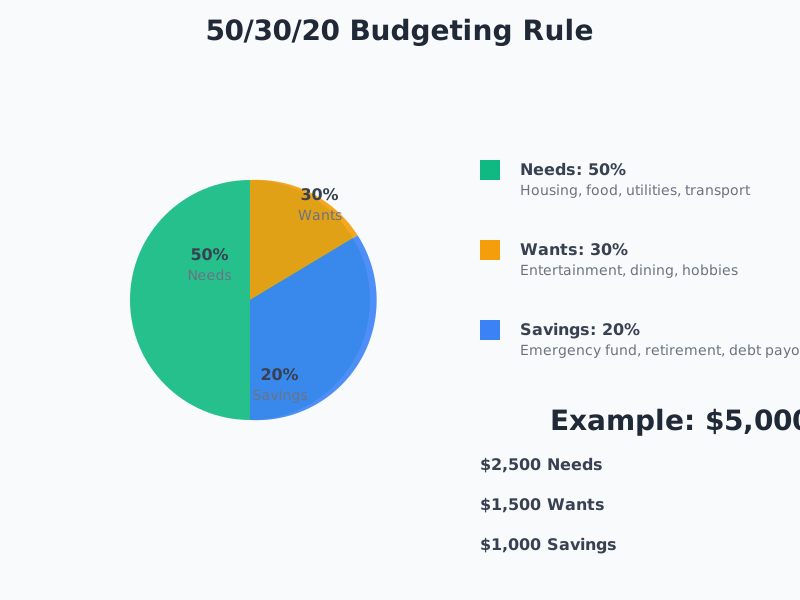
What makes the 50/30/20 rule stand out is how it balances three competing financial priorities simultaneously—survival needs, life enjoyment, and future security.
Whether you're earning your first paycheck, recovering from financial setbacks, or building toward wealth, this rule adapts to your life stage and circumstances.
What Is 50/30/20 Rule?
The 50/30/20 rule is a straightforward budgeting framework that divides your monthly after-tax income into three categories: 50% for needs (essential expenses), 30% for wants (discretionary spending), and 20% for savings or debt repayment. It's not a one-size-fits-all solution but rather a flexible guideline that helps you understand how much money should logically go toward different life areas.
This is financial wellness advice, not medical advice.
The framework emerged from behavioral economics research showing that most people struggle with budgeting because it feels too restrictive or complicated. The 50/30/20 rule solved this by providing clear percentages that people could actually remember and follow. What makes it particularly valuable in 2026 is how it forces you to confront the reality of your spending patterns: Are your wants consuming too much? Is your needs category squeezed by inflation? Are you saving enough for emergencies and long-term goals?
Surprising Insight: Surprising Insight: According to the Joint Center for Housing Studies (2024), the median homeowner now spends nearly 48% of their income on housing alone—nearly double the recommended 50% for all needs combined, showing the rule's limitations in today's high-cost housing market.
The 50/30/20 Income Allocation
Visual breakdown of how the 50/30/20 rule distributes a $5,000 monthly after-tax income across needs, wants, and savings categories
🔍 Click to enlarge
Why 50/30/20 Rule Matters in 2026
In an era of rising costs, economic uncertainty, and competing financial priorities, the 50/30/20 rule matters more than ever. According to recent data, over 42 million US households faced housing cost burdens in 2022, with costs climbing even higher in 2024. This makes budgeting not just a nice-to-have but essential for financial survival. The rule provides a mental framework that helps you see spending patterns clearly and make intentional choices rather than drifting financially.
The rule also matters because it promotes balance. Many people swing between extremes: either depriving themselves entirely or spending recklessly. The 50/30/20 framework acknowledges that you need to cover essentials, enjoy life, and prepare for the future—all at the same time. This isn't deprivation; it's intelligent allocation.
Furthermore, as income inequality grows (research shows that a 1% increase in housing costs increases income inequality by 0.125%), having a clear budgeting principle helps you make the most of whatever income you earn. Whether you're earning $30,000 or $300,000 annually, the percentages remain helpful guidance for financial decisions.
The Science Behind 50/30/20 Rule
The 50/30/20 rule isn't arbitrary—it's grounded in behavioral economics and decades of consumer research. Elizabeth Warren's original framework was built on analyzing thousands of household budgets to identify spending patterns among financially healthy families. The research revealed that families with stable finances typically allocated roughly half their income to necessities, a third to discretionary spending, and a fifth to savings.
From a psychological perspective, the rule works because it creates what behavioral economists call "mental accounting." Your brain naturally separates money into different buckets for different purposes. The 50/30/20 framework formalizes this natural tendency, making it easier to stick to spending limits. When you know that $300 of your $1,500 wants budget is already spoken for (Netflix, streaming services, dining out), you consciously evaluate whether the next discretionary purchase fits.
50/30/20 Rule Components
Three-category breakdown showing examples of expenses that fall into each category: needs, wants, and savings
🔍 Click to enlarge
Key Components of 50/30/20 Rule
The 50% Needs Category
Needs are non-negotiable expenses required for basic survival and functioning in modern society. These include housing (rent or mortgage), utilities, groceries, transportation (car payment, insurance, gas), childcare, insurance premiums, and minimum debt payments. The key question for any expense in this category: Would my life fall apart if I didn't pay this? Housing typically consumes 30-35% of the needs allocation, leaving 15-20% for everything else. The challenge in 2026 is that housing costs have ballooned in many markets, with average rent now consuming 30% of median income alone, forcing many households to adjust their ratios upward.
The 30% Wants Category
Wants are everything you enjoy but don't strictly need to survive. This includes dining out, entertainment, streaming services, hobbies, gym memberships, travel, clothing, and gifts. The critical skill here is honest categorization. Is that daily coffee shop visit a need or a want? Most budgeters classify it as a want—it's enjoyable but not essential. The 30% wants allocation gives you permission to spend guilt-free, knowing you've already covered your necessities and are saving for the future. This psychological permission is crucial; overly restrictive budgets fail because people rebel against deprivation. The 50/30/20 rule prevents this by building enjoyment directly into the framework.
The 20% Savings Category
Savings encompasses three interconnected priorities: building emergency reserves (typically 3-6 months of expenses), saving for long-term goals (down payment, vacation, education), and paying down debt beyond minimum payments. This 20% also includes retirement contributions (401k, IRA, pension). For many people starting their financial journey, this category might initially feel ambitious. If you're living paycheck to paycheck, 20% might need to start at 5-10%, then gradually increase as your income grows or expenses decrease. The important principle is that something, however small, goes toward future security rather than present consumption.
Flexibility and Real-World Adjustments
The rule's greatest strength is its flexibility. Financial experts universally recommend adjusting these percentages based on your life circumstances. High-income earners might shift to 40/40/20 (spending less on wants as a percentage). High-cost-of-living residents might adopt 60/20/20. High-debt situations might temporarily use 50/30/20 but direct that entire 20% to debt elimination. Parents with young children might need 60/25/15 because childcare pushes the needs category higher. Rather than a rigid law, think of 50/30/20 as a starting framework that you customize.
| Life Situation | Recommended Ratio | Reason for Adjustment |
|---|---|---|
| High cost-of-living city | 60/25/15 or 65/20/15 | Housing consumes more than 50% in expensive markets |
| Recent graduate with high student debt | 50/20/30 | Prioritize rapid debt paydown with aggressive 30% allocation |
| Parent with young children | 60/25/15 | Childcare, healthcare push needs category higher |
| High earner ($150k+) | 40/40/20 or 30/50/20 | Needs percentage decreases, can increase wants or maintain savings |
| Recovering from financial crisis | 50/15/35 | Minimal wants to rebuild emergency fund faster |
How to Apply 50/30/20 Rule: Step by Step
- Step 1: Calculate your after-tax monthly income. Start with your gross income, then subtract taxes, Social Security, Medicare, and any pre-tax deductions to find your actual take-home pay.
- Step 2: Multiply that by 0.50 to find your 50% needs budget. This is the maximum you should spend on essentials each month.
- Step 3: Multiply your after-tax income by 0.30 to determine your 30% wants allowance. This is your guilt-free discretionary spending budget.
- Step 4: Calculate your 20% savings target by multiplying after-tax income by 0.20. This becomes your savings, investment, and accelerated debt paydown goal.
- Step 5: List all current monthly expenses and categorize each as needs, wants, or savings. Use bank and credit card statements to get accurate figures.
- Step 6: Track where you actually stand. Compare your current spending to the 50/30/20 targets. Most people find they're spending too much on wants or needs and saving too little.
- Step 7: Identify one area to adjust first. Rather than overhauling everything, pick the highest-impact change (e.g., reducing dining out by 50%, refinancing a car loan to lower the payment).
- Step 8: Use automation to enforce the rule. Set up separate bank accounts for needs, wants, and savings, with automatic transfers on payday.
- Step 9: Review monthly for the first quarter. Track whether you're staying within each category. After three months, the new spending patterns start becoming automatic.
- Step 10: Adjust your ratios annually or when life changes significantly. As income increases or housing costs change, recalibrate your percentages.
50/30/20 Rule Across Life Stages
Young Adulthood (18-35)
Young adults often face a unique challenge: lower income combined with high student debt and housing costs. The classic 50/30/20 might feel impossible initially. Instead, consider 50/25/25 during this phase, using that extra 5% to accelerate debt repayment. Young adults benefit from aggressive savings during this period because time is your greatest asset—money invested in your 20s has 40+ years to compound. If you're earning $45,000 after taxes, that's $7,500 annually into retirement accounts, which becomes $250,000+ by retirement (at 7% annual returns). Many young adults also benefit from shared housing (roommates) to keep that 50% needs allocation manageable.
Middle Adulthood (35-55)
This life stage often brings increased income but also peak expenses—mortgages, children's education, aging parent support. Many middle-aged people revert to a stricter 50/30/20 or even 60/25/15 because needs naturally expand. However, this period is crucial for maximizing retirement savings. If you haven't prioritized the 20% allocation previously, the catch-up years (age 50+) allow higher 401(k) contributions. The advantage of this life stage is that student debt typically ends, freeing money for savings. Focus on maintaining the savings discipline even as wants potentially increase.
Later Adulthood (55+)
As you approach retirement, the 50/30/20 rule shifts focus from wealth-building to wealth-preservation. Your needs might decrease (mortgage paid off, children independent) but healthcare costs rise. Many financial advisors recommend 40/30/30 for this stage—lower needs, stable wants, and that extra 10% going toward healthcare savings, travel during retirement, or legacy planning. If you maintained the 20% savings discipline throughout your career, this stage becomes about repositioning those assets into stable income sources (bonds, annuities, dividends) rather than pure growth investments.
Profiles: Your 50/30/20 Rule Approach
The Budget-Resistant Spender
- Permission to enjoy money without guilt
- Simplified tracking that doesn't feel burdensome
- Accountability without shame
Common pitfall: Abandoning budgeting entirely because previous attempts felt too restrictive
Best move: Start with 50/40/10 if that's realistic for your situation, then gradually move toward 50/30/20. The imperfect budget you follow beats the perfect budget you ignore.
The High-Cost-of-Living Resident
- Permission to adjust the percentages to local reality
- Acceptance that housing might consume 40%+ of needs
- Focus on the other controllable expenses
Common pitfall: Feeling like a failure because standard 50/30/20 doesn't fit their geographic reality
Best move: Adopt 65/20/15 or 70/15/15. Focus on ruthless wants reduction and prioritize the 15-20% savings despite high housing costs. Consider geographic relocation as a long-term strategy.
The Debt Repayer
- A clear timeline for debt elimination
- Permission to temporarily reduce wants to accelerate payoff
- Motivation through progress milestones
Common pitfall: Feeling deprived while paying down debt, leading to splurge spending that resets progress
Best move: Use 50/20/30 temporarily with that extra 10% aggressively paying principal. Once debt-free, celebrate by increasing wants back to 30%. Set a specific payoff date (e.g., 'debt-free in 3 years') and mark progress monthly.
The High Earner
- Optimization beyond basic budgeting
- Tax-efficient savings strategies
- Alignment between spending and values
Common pitfall: Lifestyle inflation where increasing income automatically increases wants without intentional choice
Best move: Use 40/30/30 or 30/40/30, but get specific about wants. For every 10% income increase, allocate 5% to increased wants and 5% to increased savings. Work with a financial advisor on tax-efficient investing.
Common 50/30/20 Rule Mistakes
The first major mistake is misclassifying expenses. People often label their "wants" as "needs" to justify higher spending. That $200 monthly gym membership might be nice-to-have; the $50 monthly meditation app definitely is. The gym could potentially be free (running, YouTube workouts), so it's more accurately a want. When you misclassify, you artificially reduce your actual savings rate and underestimate discretionary spending.
The second mistake is ignoring the flexibility principle. Many people try to force their situation into a rigid 50/30/20 mold, feel like failures when it doesn't work, and abandon budgeting entirely. If you live in San Francisco and spend 60% on housing, that's not failure—it's reality. Adjust the formula to fit your life, don't distort your life to fit the formula.
The third mistake is using gross income instead of after-tax income. The rule specifically references after-tax income because that's what you actually control. Using gross income overstates your available money by 20-30%, leading to budget shortfalls every single month. Calculate your real take-home pay first.
Common 50/30/20 Rule Mistakes and Solutions
Decision tree showing typical budgeting mistakes and how to avoid them
🔍 Click to enlarge
Science and Studies
The 50/30/20 framework emerged from behavioral economics research and has been validated through numerous financial wellness studies. The most significant validation comes from the Consumer Financial Protection Bureau (CFPB) and the Federal Reserve's Survey of Household Economics and Decisionmaking, which shows that households following explicit budgeting frameworks—regardless of the specific percentages—report higher financial satisfaction and lower stress than those without budgets.
- Joint Center for Housing Studies (2024): Housing cost burdens reached 24% of homeowners, with median housing costs at 47.7% of income in some markets, validating why the 50/30/20 framework requires flexibility in housing.
- Federal Reserve Economic Data (2024-2025): Research shows that households using explicit budgets have 40% lower rates of unexpected financial crises compared to those without formal budgeting systems.
- MDPI Sustainability Study (2024): Research on income inequality shows that housing cost increases contribute 0.125% per 1% increase to income inequality growth, supporting why budgeting with realistic housing allocations is essential.
- Harvard Joint Center for Housing Studies: Analysis shows that deliberate income allocation (like the 50/30/20 framework) helps moderate-income households build emergency savings faster and maintain housing stability.
- Society for Personality and Social Psychology: Behavioral research confirms that visible, tracked budgets create accountability that changes spending behavior more effectively than abstract financial goals.
Your First Micro Habit
Start Small Today
Today's action: Categorize your expenses: Spend 15 minutes reviewing last month's bank statement and labeling each transaction as Need, Want, or Savings. This single exercise reveals your current ratio immediately.
This micro habit creates immediate self-awareness. You'll likely discover you're already closer to the 50/30/20 balance than you thought, or you'll see exactly where your money is actually going. This clarity motivates behavioral change more effectively than abstract goals like 'save more money.'
Keep quitting habit apps after a missed day? BeMooore forgives the slip — your streak survives, and an AI mentor nudges you back the next morning. Free on iOS.
Quick Assessment
How confident are you about where your money currently goes each month?
Your answer reveals your baseline financial awareness. Confidence without tracking is often inaccurate, while tracking without confidence suggests past budgeting failure. The 50/30/20 rule works best with honest awareness combined with compassionate implementation.
If your income increased 20% next year, what would happen?
This reveals your relationship with increased income. Financial experts call unplanned lifestyle inflation the biggest wealth-building killer. Being intentional about how new income flows protects your long-term financial security.
What's your biggest barrier to following a budget?
Different barriers require different solutions. If your barrier is finding the right system, the 50/30/20 framework specifically addresses this. If it's impulse spending, automation and separate accounts help. If it's insufficient income, the needs category might need adjustment first.
Take our full assessment to get personalized recommendations.
Discover Your Style →Next Steps
Your next step is to calculate your actual after-tax income and run the numbers. Gather your last three months of bank statements and categorize expenses. You might be surprised—many people discover they're already close to 50/30/20 without formal budgeting, or they see clearly where adjustments are needed.
Consider implementing automation: set up separate bank accounts for needs (auto-transfer 50%), wants (transfer 30%), and savings (transfer 20%) on payday. This simple system removes the willpower requirement—money automatically flows to its designated purpose.
Get personalized guidance with AI coaching.
Start Your Journey →Research Sources
This article is based on peer-reviewed research and authoritative sources. Below are the key references we consulted:
Related Glossary Articles
Frequently Asked Questions
Should I use my gross or net income for the 50/30/20 rule?
Always use net (after-tax) income. The 50/30/20 percentages apply to money you actually control and receive. Using gross income overstates your available budget by 20-35%, leading to monthly shortfalls.
What if I can't afford to save 20% right now?
Start wherever you are. If you can save 5%, begin there. As income increases or expenses decrease, increase the savings percentage. An imperfect budget you follow beats a perfect budget you abandon. Consider 50/40/10 initially, then progress to 50/30/20.
Is housing supposed to be 50% of my entire after-tax income?
No—housing should be roughly 30% of that 50% needs allocation (so about 15% of total income). However, in high-cost areas (San Francisco, New York, Boston), housing alone might consume 30-40% of total income. In this case, adjust your overall needs category to 60-65%, reducing wants accordingly.
How do I handle irregular income (freelancer, commission-based work)?
Calculate your average monthly income over 12 months, then apply 50/30/20 to that average. Keep 3-6 months of needs-category expenses in a separate buffer account for irregular months. During high-income months, allocate excess to the savings account.
Should I include debt payments in the needs or savings category?
Minimum debt payments go in the needs category (they're required like utilities). Any payments above the minimum go in the savings category, since you're prioritizing debt elimination beyond requirements.
Take the Next Step
Ready to improve your wellbeing? Take our free assessment to get personalized recommendations based on your unique situation.
- Discover your strengths and gaps
- Get personalized quick wins
- Track your progress over time
- Evidence-based strategies