Psychology
What if your mind held the key to lasting happiness? Psychology isn't just about treating mental illness—it's about understanding how your thoughts, emotions, and behaviors shape your wellbeing. In 2026, the field of psychology is experiencing a revolution. Rather than focusing solely on fixing what's broken, scientists and practitioners worldwide are asking new questions: What creates flourishing? How can ordinary people build genuine happiness? What does psychological thriving actually look like? The answers are transforming how we approach mental health, relationships, and life satisfaction. Whether you're struggling with stress, seeking deeper fulfillment, or simply curious about how your mind works, psychology offers evidence-based pathways to meaningful change.
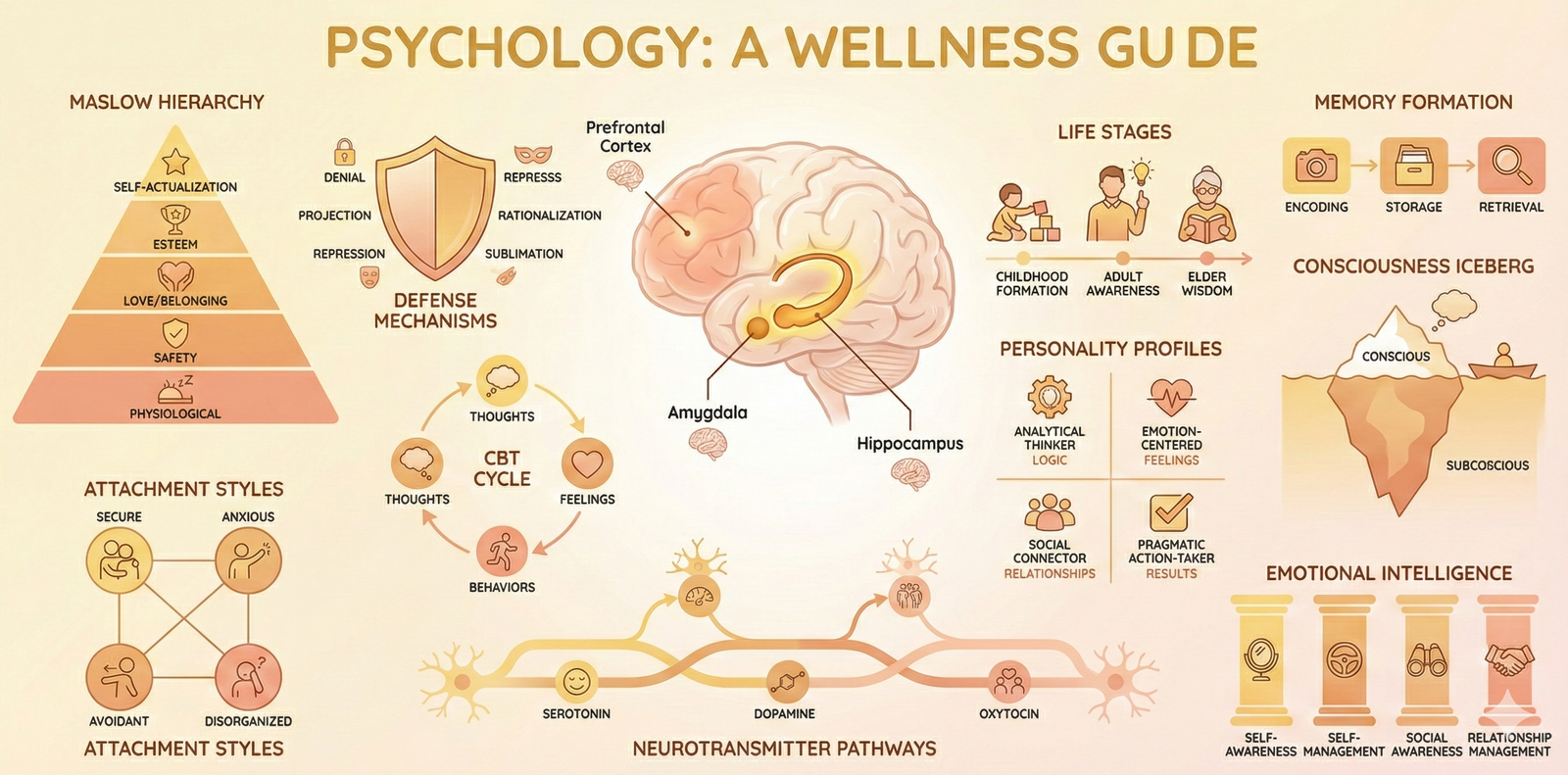
Psychology has evolved from a discipline centered on treating mental disorders into a comprehensive science of human flourishing. Modern psychology integrates insights from cognitive science, neurobiology, and behavioral research to show that happiness isn't something you're born with—it's something you can actively cultivate through understanding and practice.
This article explores the scientific foundations of psychology, reveals how positive psychology interventions create measurable improvements in wellbeing, and shows you exactly how to apply these principles in your daily life. You'll discover actionable strategies backed by decades of research, learn about the psychological profiles that influence your approach to wellbeing, and gain access to evidence-based techniques that actually work.
What Is Psychology?
Psychology is the scientific study of human behavior, thought patterns, emotions, and mental processes. It examines how people think, feel, decide, and act—both as individuals and in social groups. The discipline draws from neurology, biology, sociology, and philosophy to create a comprehensive understanding of what makes us human. Modern psychology encompasses multiple approaches: clinical psychology addresses mental health treatment; cognitive psychology explores how we process information; positive psychology focuses on building wellbeing and human strengths; social psychology examines how we relate to others; and wellness psychology applies psychological science to create healthier, happier lives.
Not medical advice.
The practical application of psychology in everyday life means understanding yourself better—recognizing your thought patterns, emotional triggers, and behavioral habits. It means knowing that when you feel unmotivated, there are psychological principles that can help restore your drive. When relationships feel strained, psychology provides communication and empathy frameworks. When you're facing uncertainty, psychological resilience strategies build your capacity to adapt and thrive. Psychology is ultimately about leveraging the science of how your mind works to create the life you actually want.
Surprising Insight: Surprising Insight: Research shows that 40% of your happiness is within your control through intentional practices, while genetics account for 50% and circumstances for only 10%. This means deliberate psychological interventions can significantly boost your wellbeing.
The Three Pillars of Modern Psychology
Shows how clinical treatment, positive psychology, and behavioral science converge to support human wellbeing from multiple angles.
🔍 Click to enlarge
Why Psychology Matters in 2026
In 2026, we face unprecedented mental health challenges. Anxiety, depression, and stress-related disorders have increased significantly. Simultaneously, we've never had better tools to understand and address psychological wellbeing. International conferences like the World Happiness Summit and the International Conference on Positive Psychology are bringing together thousands of researchers and practitioners to solve the mental health crisis. The 2026 landscape shows that psychology matters because it bridges the gap between suffering and flourishing. Rather than simply managing symptoms, modern psychology helps people discover what genuinely fulfills them.
Psychology matters because it acknowledges that happiness isn't luxury—it's essential infrastructure for resilience. When you understand your psychology, you're better equipped to handle setbacks, maintain relationships, sustain motivation, and build meaningful lives. The research is overwhelming: psychological wellbeing predicts better physical health, stronger relationships, professional success, and longevity. Harvard's Adult Development Study, spanning over 80 years, concluded that relationships are the strongest predictor of a long, happy life. This is psychology in action.
Psychology matters in 2026 because it democratizes wellbeing. You don't need expensive therapy or medications to benefit from psychological science. Gratitude practices, mindfulness meditation, behavioral activation, and social connection all deliver measurable improvements in wellbeing at virtually no cost. Psychology gives you frameworks for understanding why you feel the way you do, and evidence-based tools for changing how you feel. In an uncertain world, psychology offers clarity and agency.
The Science Behind Psychology
The science of psychology rests on neurobiology. Your brain contains approximately 86 billion neurons that communicate through electrical and chemical signals. Neurotransmitters like serotonin, dopamine, and oxytocin directly influence mood, motivation, and social bonding. Brain imaging studies reveal that psychological interventions—like cognitive therapy or meditation—actually change brain structure and function. This is revolutionary: your thoughts and behaviors aren't just abstract; they reshape the physical architecture of your mind. When you practice gratitude regularly, the anterior cingulate cortex and medial prefrontal cortex show increased activation, literally rewiring your brain for positivity.
Research confirms that positive psychology interventions produce measurable changes in wellbeing. A meta-analysis of 49 studies showed that Positive Psychology Interventions (PPIs) significantly improved both subjective wellbeing (life satisfaction and happiness) and psychological wellbeing (sense of purpose and personal growth). The effects persisted 3-6 months after the intervention ended. Specific practices studied include: daily gratitude reflections reducing depression by up to 20%; acts of kindness increasing happiness more than receiving kindness; mindfulness meditation decreasing anxiety and increasing emotional regulation; social connection reducing mortality risk by 26-32%. The evidence is compelling: psychology works.
How Psychology Interventions Change Your Brain
Illustrates the feedback loop: behavioral practices activate specific brain regions, which release neurotransmitters, which reinforce positive psychological states.
🔍 Click to enlarge
Key Components of Psychology
Cognitive Framework
How you think directly influences how you feel and behave. Cognitive psychology reveals that your thoughts aren't facts—they're interpretations shaped by your beliefs, past experiences, and attention patterns. When something frustrating happens, your automatic thoughts might be 'I always fail' or 'This is hopeless.' Cognitive therapy teaches you to examine these thoughts: What's the evidence? Are there other interpretations? This simple skill of thought examination reduces anxiety and depression significantly. Cognitive reframing—consciously choosing more balanced, realistic thoughts—is one of the most powerful psychological tools available.
Emotional Regulation
Emotional regulation is your capacity to recognize, understand, and respond to emotions in healthy ways. It's not about suppressing emotions (which backfires), but about acknowledging them while choosing constructive responses. Psychology teaches specific emotional regulation techniques: naming emotions to reduce their intensity (a process called 'affect labeling'); using the 'box breathing' technique (4-4-4-4) to calm the nervous system; practicing self-compassion when struggling rather than self-criticism. Interestingly, people with high emotional intelligence—the ability to understand emotions in themselves and others—show significantly better relationships, career outcomes, and mental health. Emotional regulation is a learnable skill.
Behavioral Activation
Behavioral activation is the psychology principle that your actions influence your emotions, not just the reverse. When depression makes you want to withdraw, withdrawal deepens depression. Behavioral activation breaks this cycle by encouraging purposeful action. Even small actions—taking a 10-minute walk, texting a friend, tidying one area—trigger positive neurochemical changes. Psychology research shows that behavioral activation is as effective as medication for mild-to-moderate depression. This explains why exercise, social engagement, and pursuing hobbies all improve wellbeing: they're behavioral activations that shift your psychological state.
Social Connection
Humans are profoundly social creatures. Psychology reveals that quality relationships are among the strongest predictors of happiness and longevity. Social connection activates your parasympathetic nervous system (the 'rest and digest' mode), reduces stress hormones, and buffers against depression. Conversely, loneliness activates stress responses and accelerates aging. Psychology offers specific frameworks for building connection: active listening (fully focusing on what others say without planning your response), vulnerability (appropriate self-disclosure that deepens intimacy), and conflict resolution skills. These aren't personality traits—they're learnable psychological competencies that dramatically improve relationship quality.
| Intervention | Key Finding | Duration for Results |
|---|---|---|
| Daily gratitude practice | Increases happiness by 10-15%, reduces depression | 2-3 weeks |
| Mindfulness meditation | Decreases anxiety by 25%, improves emotional regulation | 8 weeks (regular practice) |
| Acts of kindness | Boosts wellbeing more than receiving help | Immediate & cumulative |
| Social connection | Reduces mortality risk by 26-32% | Ongoing practice |
| Behavioral activation | Equals medication effectiveness for mild-moderate depression | 2-4 weeks |
| Cognitive reframing | Reduces anxiety and negative thought patterns | 3-6 weeks |
How to Apply Psychology: Step by Step
- Step 1: Assess your current psychological baseline by noting your mood, stress level, and life satisfaction on a 1-10 scale. This creates a reference point for measuring progress.
- Step 2: Choose one cognitive technique to practice: notice your automatic thoughts for three days, then practice the 'thought examination' method—asking 'What's the evidence? Is this 100% true? What else could this mean?'
- Step 3: Establish a daily gratitude practice by writing three specific things you're grateful for each evening, including why they matter. Keep entries specific rather than generic.
- Step 4: Implement behavioral activation by scheduling one enjoyable activity daily, even if you don't feel motivated. Physical movement (walking, dancing, stretching) is especially powerful.
- Step 5: Practice emotional naming by pausing three times daily to identify exactly what emotion you're feeling and rate its intensity 1-10. This simple practice reduces emotional overwhelm.
- Step 6: Strengthen social connection by having one meaningful conversation daily—something deeper than weather talk. Practice active listening without interrupting or planning your response.
- Step 7: Apply the PERMA model: daily identify moments when you experienced Positive emotions, Engagement, Relationships, Meaning, or Achievement. This trains your brain to notice wellbeing.
- Step 8: Use box breathing for nervous system regulation: inhale for 4 counts, hold for 4, exhale for 4, hold for 4. Repeat 4-5 times when stressed. This activates your calming response.
- Step 9: Track your progress by reassessing your mood, stress, and life satisfaction weekly. Psychology research shows that monitoring itself improves outcomes through awareness.
- Step 10: Build these practices into your existing routines: gratitude with morning coffee, behavioral activation with lunch breaks, social connection during evening calls. Routine integration ensures consistency.
Psychology Across Life Stages
Adultez joven (18-35)
Young adulthood is when identity forms and future patterns establish. Psychology focuses on building emotional resilience, developing healthy relationship patterns, and establishing foundational wellbeing habits. This period often involves identity exploration and occasional uncertainty. Psychological interventions useful for young adults include: understanding attachment styles (how early relationships shape current relationship patterns), developing social skills and emotional communication, building self-efficacy through mastery experiences, and managing identity-related anxiety. Young adults benefit from understanding that psychological patterns formed now often persist—making early investment in mental health literacy incredibly valuable.
Edad media (35-55)
Middle adulthood often involves managing multiple responsibilities: career, family, aging parents. Psychology addresses maintaining wellbeing amid complexity, managing role stress, and finding meaning beyond achievement. This is when many people reassess life satisfaction and realign with deeper values. Relevant psychological strategies include: savoring (fully experiencing positive moments rather than rushing through them), purpose-finding activities that connect daily tasks to meaningful goals, strengthening intimate relationships through vulnerability and communication, and managing stress through acceptance and commitment therapy (ACT). Midlife wellbeing research shows that couples who invest in relationship skills report increased satisfaction despite increased life demands.
Adultez tardía (55+)
Later adulthood brings new psychological opportunities: freedom from career pressures, accumulated wisdom, potential for deepened relationships. Psychology research shows that life satisfaction often increases in later years among those who've invested in wellbeing. Key interventions include: legacy work (creating meaning through mentoring, writing, creating), maintaining cognitive engagement through learning and novelty, sustaining social connections through active relationship investment, and accepting life changes while maintaining agency. Successful aging isn't about avoiding challenges—it's about psychological flexibility and finding continued meaning.
Profiles: Your Psychology Approach
The Analytical Thinker
- Understanding the scientific research behind practices
- Clear frameworks and logical structures
- Measurable progress metrics and data
Common pitfall: Getting stuck in analysis paralysis, overthinking emotions, avoiding action until understanding is 'perfect'
Best move: Start with psychology's evidence-based interventions (which you'll find compelling), then commit to 3 weeks of consistent practice before over-analyzing results
The Emotion-Centered Person
- Validation of emotional experiences
- Depth in understanding yourself
- Practices that directly address emotional wellbeing
Common pitfall: Dwelling in emotions without creating behavioral change, seeking constant emotional validation, struggling with action when unmotivated
Best move: Combine emotional awareness with behavioral activation—acknowledge feelings fully, then take one small action toward what matters to you
The Social Connector
- Understanding relationships and social dynamics
- Group practices and shared experiences
- Meaning through connection with others
Common pitfall: Neglecting personal wellbeing for others' needs, defining self through relationships, avoiding necessary solitude
Best move: Strengthen relationships while developing individual psychological resilience—invest in others AND maintain practices that honor your own needs
The Pragmatic Action-Taker
- Simple, immediately applicable strategies
- Clear cause-and-effect connections
- Results-oriented approaches
Common pitfall: Moving too quickly without emotional processing, avoiding deeper exploration of thought patterns, dismissing practices that don't show immediate results
Best move: Honor your action orientation while building patience with psychological growth—some changes (like rewiring thought patterns) take longer than others
Common Psychology Mistakes
Mistake #1: Believing psychology is only for people with mental illness. Reality: Psychology is for everyone. Just as physical fitness training benefits athletes and non-athletes alike, psychological practices benefit both those with clinical diagnoses and those simply seeking greater wellbeing. The science applies universally—understanding your mind, managing emotions, building relationships, and finding meaning enhance everyone's life.
Mistake #2: Expecting overnight transformation. Psychology works, but it works progressively. Your brain's neuroplasticity means change happens through repeated practice, not single insights. Reading about gratitude isn't the same as daily gratitude practice. Understanding cognitive reframing intellectually differs from repeatedly applying it until new thought patterns become automatic. Research shows meaningful psychological change typically requires consistent practice for 3-12 weeks depending on the intervention.
Mistake #3: Using psychology to eliminate all negative emotions. Healthy psychology isn't about constant happiness. Grief, anger, and sadness serve important functions. They signal something matters, motivate change, and deepen empathy. Psychological health means understanding emotions fully and responding appropriately, not achieving some impossible state of perpetual positivity. The goal is emotional flexibility—feeling what's genuine while maintaining resilience and agency.
The Myth vs. Reality of Psychological Change
Shows the common misconception of sudden transformation versus the actual gradual curve of meaningful psychological growth through consistent practice.
🔍 Click to enlarge
Ciencia y estudios
The scientific foundations of psychology draw from decades of rigorous research. Harvard's Adult Development Study (spanning 85+ years) remains the longest study of happiness, concluding that quality relationships are the single strongest predictor of long, happy lives. The National Institute of Mental Health (NIMH) documents that exercise can be as effective as therapy for depression. Research from Positive Psychology Institute shows gratitude practices increase wellbeing by 10-15%. Meta-analyses across 49 studies confirm that Positive Psychology Interventions produce significant, measurable improvements in wellbeing that persist months after the intervention ends.
- Harvard Medical School research: Strong social connections reduce mortality risk by 26-32% and are equivalent to quitting smoking in health impact
- National Institute of Mental Health: Behavioral activation equals antidepressant medication for mild-to-moderate depression after 3-4 weeks
- Positive Psychology Center (University of Pennsylvania): Daily gratitude practice increases life satisfaction more than cognitive reframing alone
- Cambridge University study: Mindfulness meditation produces changes in brain structure within 8 weeks of regular practice, particularly in regions associated with emotion regulation
- Frontiers in Psychology: Personalized psychology interventions deliver 40% better outcomes than generic approaches, emphasizing the importance of individual customization
Tu primer micro hábito
Comienza pequeño hoy
Today's action: Perform one specific act of kindness today, then notice how it affects your mood. This can be as simple as sending an encouraging message, helping someone with a task, or expressing genuine appreciation.
Acts of kindness trigger dopamine release and activate your brain's reward centers. Psychology research shows that performing kindness increases wellbeing more than receiving it. Starting with a small act makes the practice immediately doable and creates a positive emotional anchor you can build upon.
Track your micro habits and get personalized AI coaching with our app.
Evaluación rápida
How would you describe your current emotional awareness—your ability to recognize and name what you're feeling?
Your emotional awareness level determines which psychology practices will help most. If you're highly aware, cognitive reframing will click naturally. If awareness is limited, starting with emotional naming practices will unlock other improvements.
What's your primary motivation for exploring psychology?
Your motivation reveals which psychological domains to prioritize. Self-understanding benefits from cognitive work; challenges benefit from behavioral interventions; relationships from social psychology; meaning from purpose-finding practices.
Which learning style resonates most with you for psychology practices?
Psychology interventions work best when matched to your learning style. Analytical learners thrive with research-backed approaches; experiential learners need to practice immediately; story-learners benefit from case studies; meaning-centered learners need purposeful framing.
Take our full assessment to get personalized recommendations.
Discover Your Style →Preguntas frecuentes
Próximos pasos
Psychology offers evidence-based pathways to genuine wellbeing. You've learned what psychology is, why it matters, the science behind it, and specific practices you can implement. The next step is choosing one practice and committing to it. Don't try everything simultaneously—research shows that focused, consistent practice with one intervention produces better results than scattered attempts across multiple practices. Pick something that resonates: perhaps daily gratitude, behavioral activation, or social connection intentionality.
Track your progress objectively. Reassess your mood, stress level, and life satisfaction weekly using the same 1-10 scale. This creates evidence of your psychological growth and maintains motivation. Share your intentions with someone—accountability dramatically increases follow-through. Remember that psychological change is progressive. You're literally rewiring your brain through repeated practice, and that takes time. Trust the science, commit to consistency, and notice how understanding your psychology transforms not just how you feel, but how you live.
Get personalized guidance with AI coaching.
Start Your Journey →Research Sources
This article is based on peer-reviewed research and authoritative sources. Below are the key references we consulted:
Related Glossary Articles
Frequently Asked Questions
Is psychology the same as therapy or counseling?
Psychology is the broader scientific field studying human behavior and mental processes. Therapy and counseling are applied psychology—professional services delivered by trained therapists using psychological principles. You can apply psychology yourself through self-help practices, reading, and personal awareness. Professional therapy is valuable when you're struggling significantly or facing mental health challenges.
How long does it take for psychology practices to work?
This varies by practice and person. Some interventions show results within days (behavioral activation, acts of kindness), while others take 3-12 weeks (cognitive reframing, meditation). Most people notice meaningful changes within 3-4 weeks of consistent daily practice. The key is consistency—sporadic practice produces sporadic results. Neuroplasticity (your brain's ability to rewire itself) requires repetition.
Can psychology practices replace medication for depression or anxiety?
Psychology practices are powerful and evidence-based, but they're not a substitute for professional medical evaluation. Medication and therapy often work best together. If you're struggling significantly, consult a mental health professional who can assess your specific situation and recommend appropriate treatment. Psychology practices complement medical treatment; they don't replace professional assessment.
Which psychology practice is most effective for wellbeing?
Research shows that the most effective practice is the one you'll actually do consistently. Social connection appears across studies as the strongest predictor of wellbeing, but if you're introverted, behavioral activation or mindfulness might feel more sustainable. Start with the intervention that intuitively appeals to you, commit to 3 weeks, then assess impact. Consistency trumps intensity.
Is it possible to change deeply ingrained thought patterns?
Yes. Your brain's neuroplasticity means thought patterns can change at any age through repeated practice. This doesn't mean overnight transformation—it typically takes weeks of deliberate cognitive reframing to rewire long-standing patterns. But research confirms that consistent cognitive therapy fundamentally changes how you think. Your brain is not fixed; it's remarkably adaptable.
Take the Next Step
Ready to improve your wellbeing? Take our free assessment to get personalized recommendations based on your unique situation.
- Discover your strengths and gaps
- Get personalized quick wins
- Track your progress over time
- Evidence-based strategies