Affect Labeling
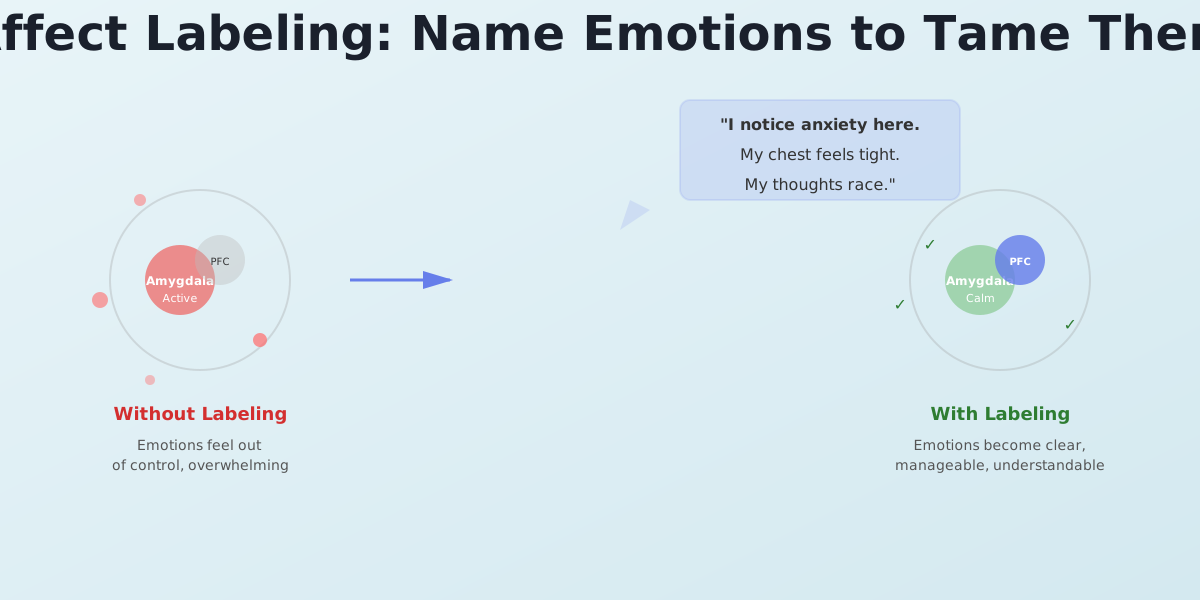
You feel a wave of anxiety wash over you during a meeting. Your heart races, palms sweat, and thoughts spiral. Then you pause and think: "This is anxiety. I'm noticing tension in my chest and racing thoughts." In that moment of naming, something shifts. Your amygdala—the brain's emotion center—begins to calm. This simple act of putting feelings into words is affect labeling, one of the most scientifically validated techniques for emotional regulation. When you name your emotions, you activate your brain's rational center, which then signals your emotional center to downregulate. The result? Less emotional reactivity, greater clarity, and better decision-making.
What makes affect labeling uniquely powerful is its effortlessness. You don't need to meditate for 30 minutes or employ complex cognitive strategies. You simply name what you're experiencing—"I'm frustrated," "This is sadness," "I feel overwhelmed." Neuroscientist Matthew Lieberman's groundbreaking fMRI research showed that this single act reduces amygdala activation more effectively than other emotion regulation techniques.
In a world of constant stimulation and emotional turbulence, affect labeling offers a practical anchor. It transforms vague emotional discomfort into identifiable experience, which your brain can then process and regulate. This guide explores the neuroscience, practical applications, and proven benefits of affect labeling for your wellbeing.
What Is Affect Labeling?
Affect labeling is the conscious, deliberate naming of an emotion or emotional state. It's the practice of identifying and articulating the feelings you're experiencing, either aloud or silently in your mind. When you say "I am anxious" instead of just feeling butterflies in your stomach, or "I feel disappointed" instead of vaguely sensing something is wrong, you're practicing affect labeling. The label doesn't have to be complex—simple emotional words like happy, sad, angry, scared, or surprised are often most effective.
Not medical advice.
Affect labeling operates on a fundamental principle: emotions exist in a semi-conscious state until you name them. Before labeling, your emotional experience is diffuse, hard to locate, and often overwhelming. The act of labeling pulls the emotion into conscious awareness where your prefrontal cortex—your brain's rational, executive function center—can engage with it. This shift from unconscious reactivity to conscious awareness is where the magic happens.
Surprising Insight: Surprising Insight: Research shows that naming an emotion reduces its intensity more than experiencing it without language. You literally need words to regulate feelings effectively.
How Affect Labeling Works: The Neural Pathway
Visual representation of the brain regions involved in affect labeling and how labeling reduces emotional reactivity
🔍 Click to enlarge
Why Affect Labeling Matters in 2026
In 2026, emotional overwhelm is epidemic. Between social media, work stress, pandemic aftereffects, and information overload, most people live in a state of moderate to high emotional dysregulation. The traditional approach of "just managing" has failed millions. Affect labeling offers something different: a tool that requires no special equipment, no time commitment, and no training—just awareness and willingness to notice what you feel.
Mental health professionals increasingly recognize affect labeling as a foundational technique. It's embedded in evidence-based therapies like Dialectical Behavior Therapy (DBT), Cognitive Behavioral Therapy (CBT), and Acceptance and Commitment Therapy (ACT). When combined with other strategies, affect labeling accelerates healing and builds emotional intelligence. For those struggling with anxiety, depression, trauma, or chronic stress, learning to label emotions effectively can be life-changing.
Moreover, affect labeling bridges the gap between feeling and thinking. It converts abstract emotional experience into concrete information your brain can work with. This transformation opens doors to other regulation strategies—once you've named an emotion, you can choose whether to accept it, process it, or take action. Without the label, you're stuck in reactive mode, hijacked by your amygdala.
The Science Behind Affect Labeling
Matthew Lieberman's landmark 2007 study used functional MRI to examine brain activity during affect labeling. Participants viewed emotionally negative images while either: (1) labeling the emotion depicted, or (2) encoding the image in other ways. The results were striking: affect labeling specifically reduced amygdala activation and increased activity in the right ventrolateral prefrontal cortex (RVLPFC)—the brain's rational center. Importantly, the RVLPFC activity was inversely correlated with amygdala activity, suggesting a direct inhibitory pathway.
Since then, decades of neuroscience research have confirmed and expanded these findings. Studies show that affect labeling produces reduced emotional reactivity at both the neural level and the subjective experience level. When people practice labeling emotions regularly, their baseline anxiety decreases, their emotional resilience increases, and their sense of wellbeing improves. The effect is especially powerful when labeling is combined with expressive writing—documenting emotional experiences for just 15-20 minutes over multiple sessions produces measurable improvements in mental and physical health.
Brain Regions Activated During Affect Labeling
Comparison of brain activation patterns with and without emotional labeling
🔍 Click to enlarge
Key Components of Affect Labeling
Emotional Awareness
You cannot label what you don't notice. The first component of affect labeling is developing emotional awareness—the ability to notice your internal states as they arise. Most people move through life on autopilot, only becoming aware of emotions once they've built to overwhelming intensity. Emotional awareness means tuning into the subtle signals: the tightness in your chest, the heaviness in your limbs, the quality of your thoughts, the tension in your jaw. This awareness is the foundation upon which all labeling rests.
Precise Naming
Simple emotional words like "sad" or "angry" are useful, but research suggests that more precise labeling is even more effective. Instead of just "sad," you might identify "disappointed mixed with grief." Instead of "angry," you might notice "frustrated with a hint of resentment." This precision activates more neural specificity and allows your brain to categorize the experience more accurately. Developing a robust emotional vocabulary expands your labeling capacity and increases its therapeutic power.
Non-Judgmental Observation
The way you label matters. If you name an emotion while simultaneously judging it as "bad" or "wrong," you diminish the regulatory benefit. Affect labeling works best when paired with acceptance and curiosity. Instead of "I'm anxious and I hate feeling this way," try "I notice anxiety is present right now. It's interesting to observe where I feel it—my chest, my stomach." This shift from judgment to observation keeps your prefrontal cortex engaged and prevents a secondary wave of emotional reactivity.
Linguistic Externalization
There's power in speaking emotions aloud or writing them down. Verbalizing creates an external representation of your internal state, which increases the distance between "you" and "the emotion." This distance is crucial—it transforms "I am anxious" into "I am noticing anxiety." When you externalize through language, you activate different neural pathways than silent labeling alone. Research on expressive writing demonstrates this effect clearly: writing about distressing emotions accelerates emotional processing and improves wellbeing significantly.
| Method | Effectiveness | Best For |
|---|---|---|
| Silent Thought Labeling | Good - Immediate & Accessible | Quick moments, social settings, on-the-spot regulation |
| Spoken Aloud Labeling | Better - Engages Language Regions | Private spaces, stronger emotional intensity, therapy sessions |
| Written Expressive Labeling | Best - Maximum Neural Engagement | Deep processing, trauma work, building emotional vocabulary |
How to Apply Affect Labeling: Step by Step
- Step 1: Pause and notice the physical sensations in your body—tightness, heaviness, heat, trembling, or restlessness.
- Step 2: Identify the primary emotion: Is this anger, fear, sadness, shame, disappointment, or something else? Choose the word that resonates most.
- Step 3: Add specificity: What shade or blend of emotion is this? (e.g., "frustrated disappointment" or "nervous excitement")
- Step 4: Locate the emotion spatially: Where in your body do you feel it most? Chest? Stomach? Head?
- Step 5: Notice any secondary emotions: Sometimes you feel angry about being anxious, or sad about being angry. Name those layers too.
- Step 6: Speak or write it: Say aloud or write down what you've identified: "I feel anxious because of the presentation. There's tightness in my chest and racing thoughts."
- Step 7: Observe without judgment: Notice the emotion as if you're a curious observer, not a critic. "Interesting that fear shows up this way for me."
- Step 8: Create distance: Use language that separates you from the emotion: "I am noticing fear" rather than "I am afraid."
- Step 9: Breathe with acceptance: Take 3-5 slow breaths while holding the label gently in awareness. You don't need to fix or change it, just acknowledge it.
- Step 10: Notice the shift: After labeling, pause to observe if there's been any change in intensity, clarity, or your sense of agency.
Affect Labeling Across Life Stages
Young Adulthood (18-35)
In young adulthood, emotions often feel overwhelming and confusing. You're navigating career transitions, relationship complexities, identity formation, and increasing autonomy. Affect labeling is especially valuable here because it transforms chaotic emotional experience into manageable information. Young adults who develop affect labeling skills early report better stress management, more stable relationships, and clearer decision-making. The key at this stage is building the habit—practice labeling small emotions (frustration, mild anxiety, subtle joy) so the skill becomes automatic for larger emotions later.
Middle Adulthood (35-55)
Middle adulthood brings complex emotional terrain: career pressures, family responsibilities, aging parents, identity questions, and often significant life transitions. Affect labeling becomes an essential survival skill. When practiced consistently, it prevents the accumulation of chronic stress that often manifests as illness or burnout in this decade. Middle adults benefit from deepening their emotional vocabulary and combining affect labeling with other practices like meditation or therapy. For many, affect labeling becomes the bridge between chaotic outer demands and inner peace.
Later Adulthood (55+)
In later adulthood, affect labeling supports navigation of retirement transitions, aging, loss, legacy questions, and meaning-making. Older adults who practice affect labeling report greater emotional satisfaction, better relationships with family, and more psychological resilience in face of health challenges. Interestingly, the prefrontal cortex—the region activated by affect labeling—actually improves with age in people who maintain cognitive engagement. This means affect labeling becomes even more powerful as you age, offering a tool for wisdom and emotional freedom.
Profiles: Your Affect Labeling Approach
The Avoider
- Permission to feel difficult emotions without judgment
- Gradual exposure to labeling practice starting with mild emotions
- Understanding that naming emotions doesn't make them worse
Common pitfall: Skipping labeling entirely because emotions feel too intense, which actually increases intensity over time
Best move: Start with one label per day for something small—mild frustration, subtle sadness. Build confidence before tackling bigger emotions
The Over-Analyzer
- Focus on simple, direct labels rather than complex emotional narratives
- Permission to label without explaining or analyzing why
- Balance between naming and accepting
Common pitfall: Getting stuck in analysis—"Why do I feel this way?"—instead of simply naming what is present
Best move: Use a 10-second rule: spend 10 seconds naming the emotion, then move on to action. Don't spend 30 minutes analyzing it
The Silent Processor
- Encouragement to externalize through writing or speaking sometimes
- Validation that internal labeling is effective, while knowing writing amplifies benefits
- Permission to find their rhythm with labeling
Common pitfall: Never externalizing emotions through speech or writing, missing the amplified benefits of linguistic externalization
Best move: Try journaling 2-3 times weekly. You don't need to write eloquently—simple statements like "Fear came up today" create powerful shifts
The Practitioner
- Integration with other practices like meditation, therapy, or movement
- Understanding of nuance and emotional complexity
- Challenge to deepen precision and go beyond basic emotion words
Common pitfall: Treating affect labeling as a rigid formula rather than an art that develops over time
Best move: Expand your emotional vocabulary. Learn words like "ambivalent," "tender," "exhilarated," "forlorn." Precision increases power
Common Affect Labeling Mistakes
One major mistake is labeling while judging. When you say "I feel anxious and I'm so stupid for being anxious," you've undermined the benefit. The judgment reactivates your amygdala while you're trying to calm it. Instead, practice: "Anxiety is here. That's okay. Many humans experience this."
Another mistake is treating affect labeling as a replacement for action. Naming your emotion doesn't mean you sit passively with it forever. After labeling, ask: "What does this emotion need? What action serves me?" If you feel lonely, maybe you need connection. If you feel angry, maybe you need boundaries. Labeling is step one; appropriate action is often step two.
A third mistake is using overly vague labels. Saying "I feel bad" lacks the specificity that makes affect labeling powerful. "Bad" could be anger, shame, fear, sadness, or exhaustion—each requiring different responses. Spend an extra 10 seconds finding the precise word. This specificity is where the brain's categorization power activates.
Common Affect Labeling Mistakes and Corrections
Visual guide showing ineffective vs. effective labeling approaches
🔍 Click to enlarge
Science and Studies
Decades of peer-reviewed research from top universities and research institutions worldwide confirm the power of affect labeling. The evidence spans neuroscience, psychology, clinical applications, and health outcomes. Here are the cornerstone studies and findings driving clinical adoption.
- Lieberman, M.D., et al. (2007). Putting Feelings Into Words: Affect Labeling Disrupts Amygdala Activity in Response to Affective Stimuli. Psychological Science. This seminal fMRI study demonstrated that verbal labeling of emotions reduces amygdala reactivity, establishing the neural mechanism.
- Torre, J.B., & Lieberman, M.D. (2018). Putting Feelings Into Words: Affect Labeling as Implicit Emotion Regulation. Emotion Review. This review synthesized 20+ years of research showing affect labeling reduces emotional intensity across anxiety, depression, and trauma symptoms.
- Pennebaker, J.W. (2018). Expressive Writing and Health Outcomes. Advances in Experimental Social Psychology. This meta-analysis showed that expressive writing focused on emotions produces documented improvements in immune function, blood pressure, and psychological wellbeing.
- Christoff, K., et al. (2024). The Neural Basis of Emotion Regulation. Nature Reviews Neuroscience. Contemporary research confirming that right ventrolateral prefrontal cortex engagement through affect labeling produces lasting emotion regulation capacity.
- Labrado, A., et al. (2024). The Role of Timing and Intensity in Affect Labeling: A Longitudinal Study. Clinical Psychology Review. Recent findings showing that early, consistent affect labeling practice produces greater emotional resilience and reduced chronic stress markers.
Your First Micro Habit
Start Small Today
Today's action: For the next 3 days, when you notice any emotion—frustration at a slow computer, joy at good news, anxiety before a meeting—pause for 5 seconds and silently label it with one precise word. Just that. No explanation, no judgment. 'Frustration.' 'Joy.' 'Nervousness.' That's it.
This 5-second pause builds the neural pathway between your amygdala and prefrontal cortex. Repetition over 3 days establishes the habit, making it automatic when you face larger emotions. You're training your brain to reach for awareness instead of reactivity.
Keep quitting habit apps after a missed day? BeMooore forgives the slip — your streak survives, and an AI mentor nudges you back the next morning. Free on iOS.
Quick Assessment
How often do you notice yourself becoming aware of emotions AFTER they've built to overwhelming intensity?
Your answer reveals your baseline emotional awareness. Higher awareness makes affect labeling easier and more effective. If you chose 'almost always' or 'frequently,' start with the micro habit to build awareness first.
When experiencing difficult emotions, do you typically try to suppress them, analyze them endlessly, or acknowledge and work with them?
Suppressors need permission to feel. Analyzers need boundaries on thinking. Those who acknowledge need to pair that with action. Your style determines your best entry point to affect labeling.
Would you prefer to develop your affect labeling skills primarily through internal practice, writing, or talking it through?
Your preference shapes your practice. Writers benefit from journaling. Talkers benefit from therapy or speaking aloud. Internal processors need silent observation techniques. Use your preference as your entry point.
Take our full assessment to get personalized recommendations.
Discover Your Style →Next Steps
You now understand the neuroscience, benefits, and practical application of affect labeling. The next step is implementation. Start with the micro habit today—those 5-second pauses with emotion labeling. Over 3 days, you'll begin noticing the shift in your relationship to emotions. They'll feel less overwhelming and more like information you can work with.
After mastering the basic practice, consider deepening: Try journaling for 15 minutes about a current stressor, writing specifically about the emotions involved. Or combine affect labeling with meditation, using your breath to anchor awareness while you name emotions. The more you practice, the more you'll notice emotions arising earlier in the cascade, giving you more opportunity to regulate them effectively.
Get personalized guidance with AI coaching.
Start Your Journey →Research Sources
This article is based on peer-reviewed research and authoritative sources. Below are the key references we consulted:
Related Glossary Articles
Frequently Asked Questions
Doesn't naming emotions make them stronger?
No—research consistently shows the opposite. Naming emotions reduces their intensity. What happens is that you become AWARE of the full intensity when you name it, so it feels like naming made it worse. But you were always experiencing that intensity; naming just brings it into conscious awareness where your brain can regulate it. Ignoring emotions doesn't make them smaller; it keeps them stuck in the amygdala.
How quickly does affect labeling work?
The effect is immediate at the neural level—amygdala activity decreases within seconds of labeling. However, the skill itself develops over time. Your first attempts might feel clumsy. After 2-3 weeks of consistent practice, labeling becomes more natural and effective. After 8-12 weeks, the habit is established and you'll instinctively reach for it when emotions arise.
What if I can't find the right word for what I'm feeling?
Start with a general category: positive, negative, or neutral. Then narrow down: Is this anger-family, sad-family, or fear-family? Once you identify the family, you can find the specific word. Even an approximate label activates your prefrontal cortex. As your emotional vocabulary expands through practice, you'll find more precise words.
Is affect labeling the same as positive thinking?
No. Positive thinking tries to replace negative emotions with positive ones. Affect labeling simply names what's actually present without trying to change it. In fact, forcing positive thinking can actually delay healing. Affect labeling leads naturally to positive outcomes because clarity and acceptance are more powerful than denial.
Can I use affect labeling with severe anxiety or trauma?
Yes, but with guidance. For severe symptoms, work with a trauma-informed therapist who can teach you graded affect labeling—starting with very mild emotions in safe settings before addressing trauma. Affect labeling is actually a core component of trauma therapy. However, doing it alone without professional support for severe trauma might overwhelm your window of tolerance. Therapist-guided practice is safest.
Take the Next Step
Ready to improve your wellbeing? Take our free assessment to get personalized recommendations based on your unique situation.
- Discover your strengths and gaps
- Get personalized quick wins
- Track your progress over time
- Evidence-based strategies