Emocional Límites
Emocional límites are the invisible lines that separate your feelings, needs, and wellbeing from those of others. They define how much emocional energy you're willing to invest in relationships, how much responsibility you take for others' emotions, and where you draw the line between self-care and caretaking. In our hyperconnected world where emocional demands can feel endless, learning to set healthy emocional límites has become esencial for maintaining mental salud, preventing burnout, and building authentic relationships. Límites aren't walls that keep people out—they're tools that help you protect your paz while still showing up meaningfully in the lives of those you care about.
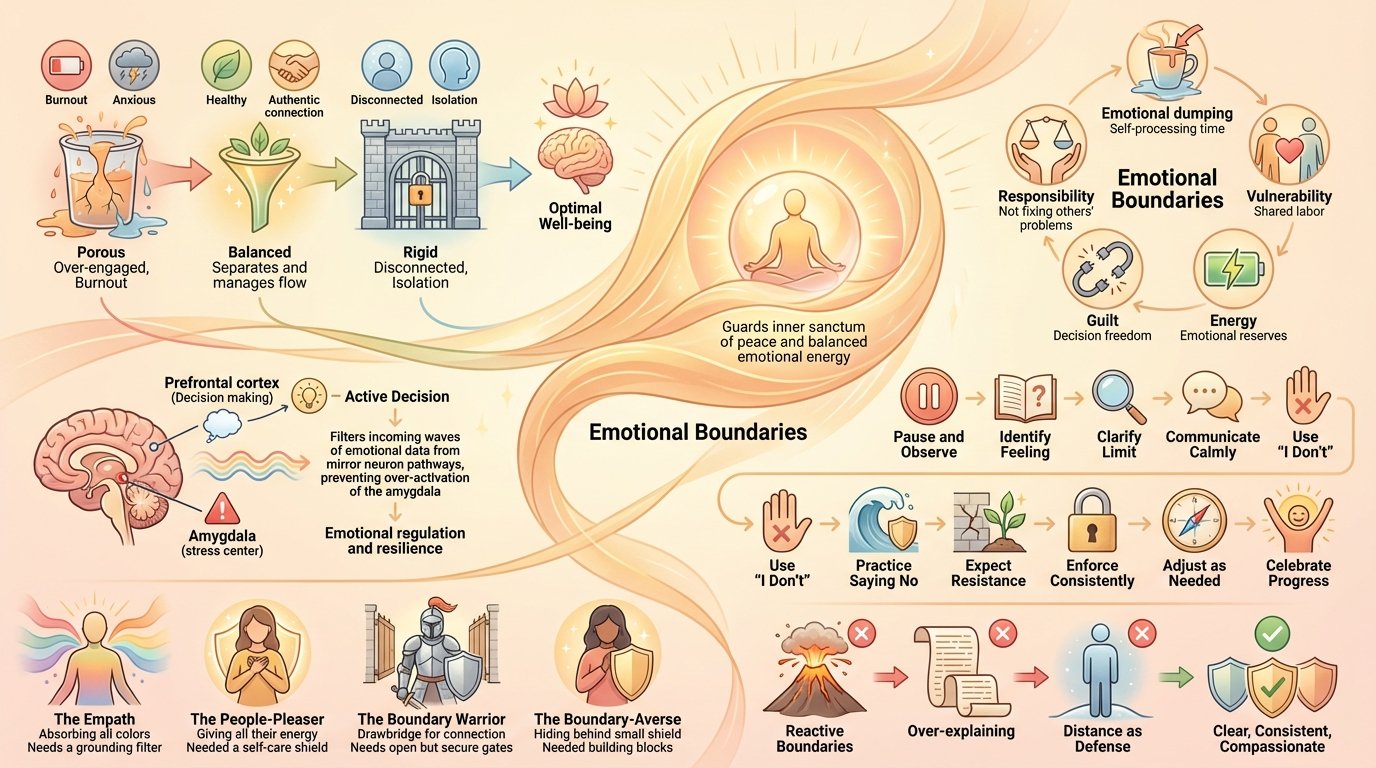
Without límites, you might find yourself constantly drained by others' problems, taking on emotions that aren't yours to carry, or sacrificing your own needs for paz in relationships.
When you establish claro emocional límites, you crea space for genuine conexión, reduce ansiedad and estrés, and desarrolla a stronger sense of self-worth.
What Is Emocional Límites?
Emocional límites are the personal guidelines you establish to protect your emocional salud and wellbeing. They represent your limits on what you will and won't tolerate from others regarding their emotions, demands, and behaviors. Specifically, emocional límites define how much emocional apoyo you can give, what personal information you share, how you respond to others' emocional outbursts, and what responsibility you take for others' feelings. Unlike physical límites, which are concrete and visible, emocional límites are psychological—they exist in how you think about and respond to situations. Healthy emocional límites allow you to remain compassionate and caring while protecting yourself from emocional manipulation, exhaustion, and unhealthy relación dynamics.
Not medical advice.
Emocional límites exist on a spectrum. Some people have porous límites, significado they absorb others' emotions easily and struggle to separate their feelings from those around them. Others have rígido límites, maintaining such emocional distance that they appear frío or unavailable. The sweet spot is flexible límites—the capacidad to abierto your heart while still protecting yourself. These límites apply to all relationships: romantic partnerships, familia dynamics, friendships, workplace relationships, and even interactions with strangers. Setting límites isn't selfish; it's an act of self-respect and an inversión in your long-term mental salud.
Surprising Insight: Surprising Insight: Research shows that people with well-defined emocional límites report 45% lower estrés levels and 30% higher relación satisfaction than those without claro límites, according to studies in Psychiatry Research and the Journal of Social and Personal Relationships.
The Spectrum of Emocional Límites
Understanding where your límites fall and how to mover toward healthy, flexible límites
🔍 Click to enlarge
Why Emocional Límites Asunto in 2026
In 2026, emocional límites have become critical for mental salud in ways previous generations never experienced. The constant connectivity of digital vida means trabajo invades our personal tiempo, social media exposes us to others' emotions constantly, and the news cycle creates collective ansiedad. Without emocional límites, you're vulnerable to compassion fatigue from absorbing others' estrés, social media-induced ansiedad, work-related burnout, and relación enmeshment where you lose your sense of self.
Mental salud professionals recognize that burnout, ansiedad, and depresión are increasingly linked to débil emocional límites. When you can't say no to others' demands, take on responsibility for their emotions, or struggle to separate their moods from your own, your nervous system stays in a state of chronic estrés. Setting emocional límites isn't just about feeling better temporarily—it's about rewiring your relación with estrés and building resiliencia for long-term wellbeing. In the context of moderno trabajo, familia expectations, and social obligations, límites are no longer optional for mental salud; they're esencial infrastructure.
The 2023 Mental Salud State of the World Report found that individuals with débil límites experienced 3x higher rates of burnout and ansiedad disorders. As our world becomes more demanding and interconnected, the capacidad to protect your emocional space becomes an increasingly valuable vida skill.
The Science Behind Emocional Límites
The neuroscience of emocional límites involves several key brain systems. Your prefrontal cortex—the decision-making part of your brain—activates when you're about to set a boundary. This is why saying no feels uncomfortable at first; it requires consciente esfuerzo and goes against ingrained people-pleasing patterns. Your amygdala (emotional center) can trigger ansiedad when boundary-setting because it perceives potencial rejection as a threat. With practice, setting límites becomes easier because your brain rewires the threat response. Cognitive Behavioral Terapia (CBT) research shows that people who practice boundary-setting for just 8 weeks show measurable changes in brain activation patterns related to estrés and emocional regulation.
Mirror neurons—the cells responsible for empathy—can trabajo against you with débil límites. These neurons cause you to absorb others' emotions unconsciously, which is why being around anxious people can make you anxious, or why absorbing a partner's estrés becomes automatic. Healthy emocional límites don't deactivate empathy; instead, they add a filtering layer that lets you feel for others without absorbing their emocional states. Research from UC Davis Salud shows that atención plena practices combined with intentional boundary-setting help regulate mirror neuron activity, reducing emocional contagion while maintaining compassion.
Brain Systems Involved in Emocional Límites
How your brain processes boundary-setting and emocional regulation
🔍 Click to enlarge
Key Components of Emocional Límites
Self-Awareness
Before you can set límites, you must entiende your limits. Self-awareness in the context of emocional límites means knowing what situations trigger you, recognizing when you're absorbing others' emotions, understanding your emocional capacidad, and being honest about your needs. Many people struggle with límites because they've spent years prioritizing others' needs and losing touch with their own limits. Practices like journaling, terapia, and atención plena help desarrolla this crucial self-awareness. When you're consciente of your patterns—like automatically taking on a friend's problems or feeling responsible for a partner's felicidad—you crea space to respond differently.
Claro Comunicación
Setting a boundary means nothing if you can't communicate it clearly. Effective boundary comunicación uses specific language, maintains a calma tone, and avoids apologizing for your needs. The phrase "I don't" (not "I can't") is statistically more effective—research shows people who say "I don't" are 64% more likely to maintain their límites because it signals identity-level compromiso that others rarely desafío. Clarity also means explaining your boundary without over-justifying, which can undermine it. Instead of "I can't escuchar to this right now because I'm stressed and it might make me depressed," try "I don't engage in detailed problem-solving after 9 PM" or "I'm not available to discutir this today."
Consistency
Límites only trabajo when you maintain them consistently. Inconsistent límites—sometimes enforcing them, sometimes not—actually crea more relación conflict than no límites at all. Your nervous system learns that the boundary isn't real, so it stops trying. Others aprende that your limits are negotiable. Consistency doesn't mean being harsh or inflexible; it means honoring your stated limits across different situations and with different people. This often requires saying the same boundary repeatedly until it becomes established. Therapists recognize that the first 3-5 weeks of boundary-setting are the hardest because people often test whether you really mean it.
Compassionate Enforcement
Brené Brown, a leading researcher on vulnerability and límites, emphasizes that "boundaries are not mean; límites are not selfish; límites are not rude. Límites are the prerequisite for compassion and empathy." Enforcing your límites with compassion means maintaining care for others while still protecting yourself. You can set a firm boundary while acknowledging the other person's feelings. For example: "I entiende you're overwhelmed, and I also can't absorb your estrés. Here's what I can help with..." This prevents límites from becoming weapons while still being effective.
| Boundary Type | What It Protects | Example |
|---|---|---|
| Emocional Dumping | Your capacidad to process your own feelings | "I care about you, and I can escuchar for 20 minutes. After that, I need a break." |
| Responsibility | Your paz from taking on others' problems | "I can offer suggestions, but I can't fix this for you or be responsible for your choices." |
| Vulnerability | Your right to shared rather than one-sided emocional labor | "I'm not comfortable being your only apoyo system. Have you considered terapia?" |
| Guilt | Your decisions from being controlled by others' disappointment | "I entiende you're disappointed. My respuesta is still no." |
| Energy | Your emocional reserves from depletion | "I'm not available for deep conversations this semana. Can we reconnect next semana?" |
How to Apply Emocional Límites: Step by Step
- Step 1: Pausa and observe: When someone makes an emocional demand, pausa before responding. Notice whether you're saying yes because you want to or because you miedo disappointing them. This 3-second pausa activates your prefrontal cortex and transforms reactive responses into consciente choices.
- Step 2: Identify your feeling: Name what you're experiencing. Are you anxious, drained, resentful, or guilty? Your emotions provide crucial information about where your límites are being violated. Journal about situations that leave you feeling depleted.
- Step 3: Clarify your limit: Ask yourself what boundary would help you feel protected. Do you need less contact, specific tiempo limits, different topics, or emocional separation? Be specific about what you do and don't want.
- Step 4: Communicate calmly: Choose a calma momento—not during conflict—to communicate your boundary. Use claro language: "I've noticed... I'm feeling... I need..." Avoid blame language that makes others defensive.
- Step 5: Use "I don't" language: Instead of "I can't," say "I don't" when posible. "I don't engage with criticism after 9 PM" is more poderoso than "I can't hablar about this now."
- Step 6: Practice saying no: Inicio with small límites in low-stakes situations. Saying no to a text response delay, a social invitation, or a request is practice for bigger boundary conversations. Confianza grows through repetition.
- Step 7: Expect resistance: When you cambia your patterns, others often resist. They might test your boundary, guilt-trip you, or get angry. This is normal. People adjusted to your viejo patterns and need tiempo to accept your nuevo ones.
- Step 8: Enforce consistently: The first tiempo you set a boundary, people often test it. Enforcing it repeatedly without hostility shows you're serious. This is not about punishment; it's about consistency.
- Step 9: Adjust as needed: Límites aren't rígido rules; they evolve as relationships cambia. Regularly check in with yourself about whether your actual límites still serve you.
- Step 10: Celebrate your progress: Acknowledge how different you feel when your límites are honored. Notice reduced ansiedad, better sueño, improved relationships, and increased paz. Reinforcing the positive outcome strengthens your compromiso to límites.
Emocional Límites Across Vida Stages
Adultez joven (18-35)
Joven adults often struggle with límites because they're transitioning from familia dependence to independence while still seeking approval. Peer pressure remains fuerte, romantic relationships are often enmeshed, and workplace dynamics can be confusing. The key task is developing límites with familia members who still treat you like a child, establishing healthy patterns in nuevo romantic relationships before unhealthy patterns solidify, and learning to navigate workplace relationships without people-pleasing. Joven adults benefit from recognizing that setting límites isn't about being ungrateful to familia or unfriendly at trabajo; it's about establishing healthy independence.
Edad media (35-55)
Middle adults often face the heaviest emocional demands: caring for aging parents, supporting adult children, managing demanding careers, and maintaining partnerships. Without claro emocional límites, middle adulthood becomes a burnout pressure cooker. The desafío is learning to say no to some demands to protect your capacidad for what matters most, establishing límites around elder care, and recovering from years of débil límites that may have created enmeshed relación patterns. Many middle adults report that setting límites más tarde in vida feels risky—like jeopardizing relationships they've invested in for decades. The reality is that claro límites often strengthen relationships by removing resentment and creating authentic conexión.
Adultez tardía (55+)
Older adults often face nuevo boundary challenges: managing how much emocional labor they provide to extended familia, setting limits with adult children who still treat them as parents, maintaining their own needs and identity as they age, and grieving losses without becoming their family's emocional dumping ground. Paradoxically, más tarde adulthood is when many people finally feel empowered to set límites because they care less about others' approval and more about their own paz. Those who desarrolla fuerte límites in this stage often report their most satisfied, authentic relationships because they're no longer trying to be what others need them to be.
Profiles: Your Emocional Límites Approach
The Empath
- Permission to feel differently from others around you
- Practices to crea emocional separation while maintaining compassion
- Recognition that absorbing others' emotions doesn't help them
Common pitfall: Believing that absorbing others' emotions is the same as being a good amigo or partner
Best move: Desarrolla a daily practice that grounds you in your own emocional baseline—meditation, journaling, or tiempo in nature—before engaging deeply with others' emotions
The People-Pleaser
- Understanding that disappointing others is part of healthy functioning
- Practice with small límites to construye confianza
- Permission to prioritize your own needs without guilt
Common pitfall: Saying yes to everything, then resenting the people they've agreed to help
Best move: Practice the 24-hour rule: when asked for something, say 'I'll let you know' and give yourself tiempo to check in with your actual capacidad before responding
The Boundary Warrior
- Integration of límites with warmth and conexión
- Recognition that límites don't prevent vulnerability
- Ways to maintain límites while staying engaged
Common pitfall: Using límites as walls that keep people at emocional distance, leading to loneliness
Best move: Practice compassionate boundary-setting by explicitly connecting your boundary to care: 'I need this boundary because I care about you and want to show up well for you'
The Boundary-Averse
- Educación about what límites actually are
- Evidence that límites strengthen rather than damage relationships
- Small, manageable first steps to construye confianza
Common pitfall: Avoiding límites because you miedo conflict, then experiencing more conflict from resentment and misalignment
Best move: Inicio with small, specific, time-limited límites: 'I'm not available to hablar about this after 9 PM' or 'I can help with this, but not with that'
Common Emocional Límites Mistakes
The biggest mistake people make is setting límites when angry or exhausted. Límites established in reactive moments often sonido harsh and damage relationships unnecessarily. Instead, set límites from a calma state and use language that maintains conexión while being firm about your limits.
Another common mistake is over-explaining your boundary. When you extensively justify why you need a boundary, you inadvertently signal that the boundary is negotiable if someone can make a good counter-argument. Fuerte límites include simple explanation: "Here's my limit. Here's why (briefly). Here's what I can do instead." This prevents endless negotiation.
Finally, many people confuse límites with distance. You can set a claro emocional boundary while remaining close and caring. Límites don't mean becoming frío or unavailable; they mean protecting your emocional capacidad while staying engaged. The objetivo is flexible límites that allow genuine conexión without depletion.
From Boundary Mistakes to Mastery
Common boundary-setting errors and how to correct them
🔍 Click to enlarge
Ciencia y estudios
Research consistently shows the conexión between emocional límites and mental salud. Studies from leading institutions demonstrate that boundary-setting is not selfish but esencial for wellbeing, sustainable relationships, and preventing burnout and ansiedad disorders.
- A 2020 study in Psychiatry Research found that people with healthy emocional límites showed significantly better emotion regulation and responded more calmly to estrés than those with débil límites.
- A 2021 study in Clinical Psychology Review demonstrated that individuals who struggled to set límites reported higher rates of ansiedad and depresión, with therapeutic boundary-setting showing measurable improvement.
- A 2022 study in Psychological Salud found that professionals who regularly enforced límites experienced 40% lower burnout rates compared to those without claro límites.
- A 2023 study in the Journal of Marriage and Familia showed that couples who communicated and respected límites experienced higher emocional satisfaction and stability.
- A 2024 study by UC Davis Salud confirmed that atención plena combined with intentional boundary-setting produced measurable changes in stress-related brain activation within 8 weeks.
Tu primer micro hábito
Comienza pequeño hoy
Today's action: Today, practice a 3-second pausa before responding to one emocional demand. Notice whether you want to say yes or whether you're saying yes to avoid disappointing someone. Just observe—don't force a different response. This tiny pausa rewires your nervous system to recognize choice instead of automatic compliance.
A 3-second pausa activates your prefrontal cortex and prevents reactive responses. Research shows this simple practice builds conciencia of when límites are needed, which is the first step to actually setting them. The pausa transforms unconscious people-pleasing into consciente choice.
Track your micro habits and get personalized AI coaching with our app.
Evaluación rápida
When someone makes an emocional demand on you, what's your first instinct?
Your response reveals your actual boundary pattern. Those choosing the first three options have room to desarrolla more intentional boundary-setting practices.
How do you typically feel after a deep conversación with a amigo or familia member?
This indicates your actual emocional boundary eficacia. The fourth option reflects integrated límites that maintain compassion while protecting your paz.
When setting a boundary feels difícil, what's usually the obstacle?
Identifying your barrier to boundary-setting helps target your trabajo. Most people need permission (boundaries aren't selfish), practice (for confianza), or clarity (understanding what you actually need).
Take our full assessment to get personalized recommendations.
Descubre Your Style →Preguntas frecuentes
Próximos pasos
Begin with self-awareness. For the next semana, notice situations where you say yes when you want to say no, where you absorb others' emotions, or where you feel resentful after interactions. Write them down. These observations show you where límites are needed. Don't cambia anything yet—just observe and construye conciencia.
After building conciencia, practice your first small boundary. Choose a low-stakes situation and set a claro, specific limit. Notice how it feels. This is your foundation. Building confianza with small límites prepares you for bigger, more emotionally importante límites with closer relationships. Remember, boundary-setting is a skill that improves with practice.
Get personalized guidance with AI coaching.
Inicio Your Journey →Research Sources
This article is based on peer-reviewed research and authoritative sources. Below are the key references we consulted:
Related Glossary Articles
Frequently Asked Questions
Aren't emocional límites selfish?
No. Límites are an act of self-respect that enables you to show up authentically in relationships. Brené Brown's research shows that people with fuerte límites are the most compassionate because they can give from a place of fortaleza rather than depletion. Límites protect your capacidad to care for others.
How do I set a boundary without hurting someone?
You can set a firm boundary while maintaining compassion. Use language like: 'I care about you, and I also need this boundary.' Focus on stating your limit clearly rather than softening it with apologies that undermine it. Their reaction to your boundary is their responsibility; stating it clearly is yours.
What if someone gets angry when I set a boundary?
Anger is a common initial response to límites because the other person has grown accustomed to your previous patterns. This doesn't mean your boundary is wrong; it means they need tiempo to adjust. Quedarse consistent and calma. Most people adjust within 2-4 weeks if you maintain the boundary consistently.
Can you have límites and still be close to someone?
Absolutely. Healthy límites actually strengthen relationships by preventing resentment and creating authentic conexión. Límites define how you relate, not how much you care. You can be emotionally intimate while maintaining claro limits on emocional dumping, responsibility, or tiempo.
How do I handle límites with familia members who've always overstepped?
Inicio temprano in the relationship-shift conversación—not during conflict. Be specific about what you do and don't want going forward. Familia members may resist more than others because cambia threatens established dynamics. Consistency over tiempo proves you're serious. It often takes multiple conversations and boundary-setting instances for familia members to genuinely accept nuevo patterns.
Take the Next Step
Ready to improve your wellbeing? Take our free assessment to get personalized recommendations based on your unique situation.
- Discover your strengths and gaps
- Get personalized quick wins
- Track your progress over time
- Evidence-based strategies