Therapy for Men
Imagine walking into a room where you finally feel safe enough to say what you have been carrying for years. No judgment, no expectations to toughen up, just honest conversation. That room exists, and it is called therapy. Yet only 17 percent of American men saw a <a href="/g/mental-health.html">mental health</a> professional in 2023, compared with nearly 29 percent of women. The gap is not about willingness alone. It is about a culture that taught boys to push through pain, to solve problems solo, and to see asking for help as weakness. This article will challenge that belief with evidence, practical steps, and real-world strategies designed specifically for how men think, feel, and heal.
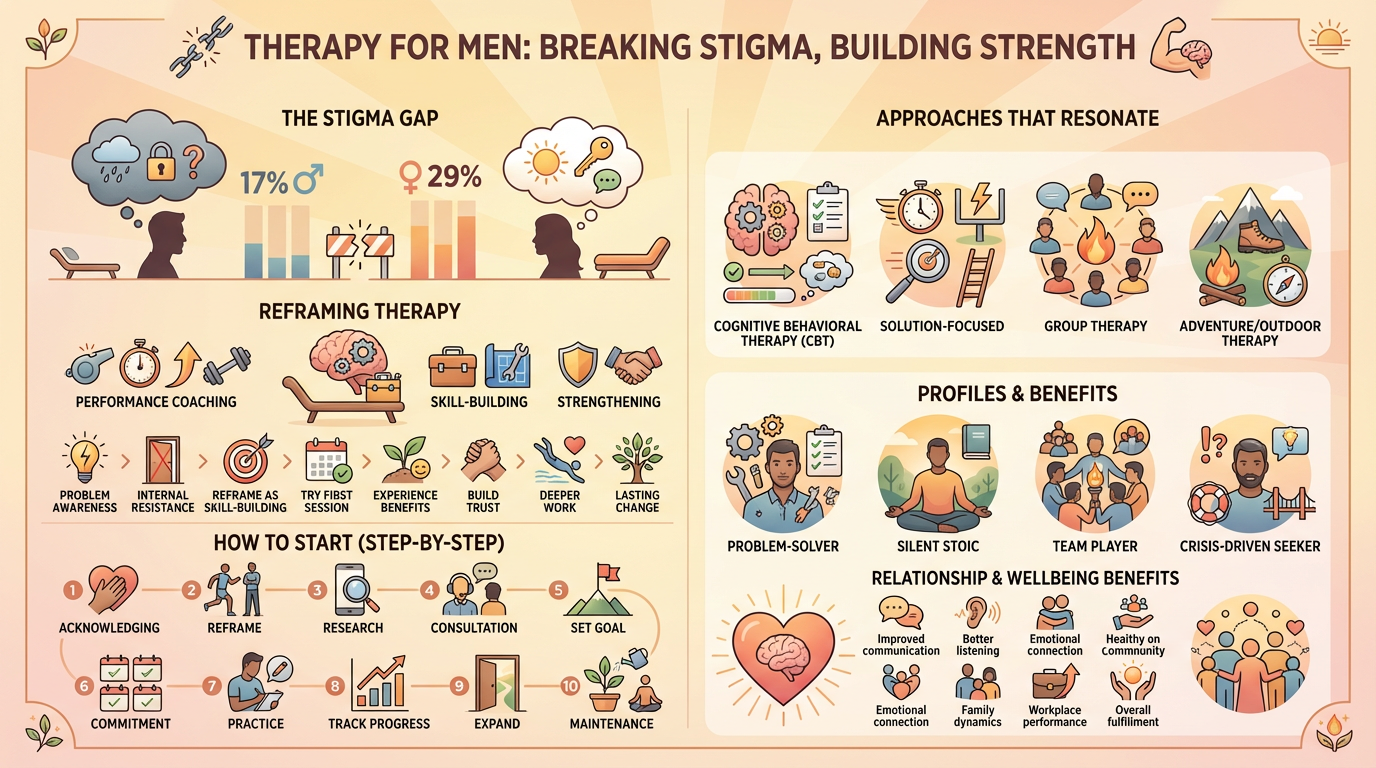
You will learn why traditional therapy models often feel like a poor fit, which approaches actually resonate with men, and how to take the first step without feeling like you are surrendering control.
Whether you are dealing with anger that shows up sideways, anxiety you have been ignoring for years, or a quiet sense that life should feel better than it does, this guide meets you where you are.
What Is Therapy for Men?
Therapy for men refers to structured psychological support tailored to address the unique emotional, cultural, and social barriers that men face when seeking help. It encompasses a range of evidence-based approaches, from cognitive behavioral therapy to psychodynamic work and group formats, adapted to match how many men prefer to process their experiences. Rather than asking men to change who they are, effective therapy meets them within their existing strengths while expanding their emotional vocabulary and coping toolkit.
Not medical advice.
The concept is broader than simply placing a man in a therapist's office. It involves understanding that men often express distress differently, through irritability, substance use, overwork, or withdrawal rather than tearfulness or explicit sadness. A therapist trained in men's mental health recognizes these patterns and works with them rather than against them. The goal is not to make men more like the stereotypical therapy client but to create a therapeutic environment where emotional healing feels natural, practical, and productive.
Surprising Insight: Surprising Insight: Research shows that men who frame therapy as performance coaching or skill-building are significantly more likely to engage and stay in treatment than those told to explore their feelings.
The Therapy Engagement Cycle for Men
How men typically move from resistance to active engagement in therapy.
🔍 Click to enlarge
Why Therapy for Men Matters in 2026
The numbers tell a stark story. Over six million men in the United States experience depression annually, yet the condition goes undiagnosed far more often in men than in women. Men account for nearly four out of every five suicide deaths in the country, and a 2025 Gallup analysis found that one in four males aged 15 to 34 reported feeling lonely a significant part of the day. These are not abstract statistics. They represent fathers, brothers, partners, and friends who are struggling in silence because society has not made it easy for them to speak up. Strengthening emotional resilience through therapy directly addresses these challenges.
The cultural landscape is shifting, but slowly. Workplace burnout, relationship breakdowns, and the ongoing effects of social isolation are pushing more men toward a breaking point. At the same time, younger generations are increasingly open to seeking help, creating a window of opportunity. Therapy is no longer seen as something reserved for crisis. For many men, it is becoming a proactive tool for building emotional intelligence, improving communication, and maintaining overall wellbeing.
Beyond the individual, untreated mental health issues in men ripple outward. They affect romantic partnerships, family dynamics, friendships, and workplace performance. When men learn to process their emotions effectively, every relationship in their life benefits. Therapy is not just self-care, it is an investment in connection and belonging for everyone around them.
The Science Behind Therapy for Men
Decades of research confirm that psychotherapy is effective for men across a wide range of conditions, including depression, anxiety, post-traumatic stress, and substance use disorders. A landmark meta-analysis published in the American Psychological Association's journal found that men respond to therapy at rates comparable to women when the therapeutic approach matches their communication style and preferences. The key difference is not in effectiveness but in engagement. Men are more likely to drop out early, which is why therapist fit and approach matter enormously.
Neuroscience adds another layer. Studies using functional MRI show that men and women often process emotional information through different neural pathways. Men tend to activate the amygdala and prefrontal cortex in ways that prioritize action-oriented responses over verbal emotional processing. This does not mean men feel less, it means they may benefit from therapy styles that incorporate problem-solving, goal-setting, and concrete behavioral strategies alongside emotional exploration. Approaches like CBT align naturally with this processing style, which is why research consistently shows strong outcomes for men in structured, skills-based therapeutic formats.
Therapy Approaches and Male Engagement
Comparing how different therapy modalities align with common male preferences.
🔍 Click to enlarge
Key Components of Effective Therapy for Men
Overcoming Stigma and Building Trust
The single greatest barrier to men entering therapy is stigma. Research from the National Institutes of Health shows that traditional masculine norms, including self-reliance, emotional restriction, and toughness, are directly linked to higher self-stigma and lower willingness to seek help. Effective therapy for men starts before the first session, with outreach and framing that normalizes mental health care. Therapists who work well with men often position therapy as coaching, skill-building, or performance optimization rather than a sign that something is wrong. Once trust is established, men often become deeply engaged clients. Building self-worth and challenging limiting beliefs about masculinity are essential parts of this process.
Choosing the Right Therapeutic Approach
Not every therapy style works equally well for every man. Cognitive behavioral therapy tends to resonate because of its structured, goal-oriented nature. Men receive clear instructions, set measurable targets, and track progress, much like training for a sport or managing a project. Solution-focused brief therapy appeals to men who want quick, practical results without open-ended exploration. Psychodynamic therapy, while deeper and longer-term, works well for men who are ready to examine recurring patterns in relationships and behavior. Mindfulness-based cognitive therapy offers tools for men who struggle with stress but find traditional talk therapy uncomfortable, using breathing techniques and meditation as entry points.
The Power of Group Therapy
Group therapy holds particular power for men. In a group setting, men interact with others facing similar challenges, which normalizes their experience and reduces the isolation that often accompanies mental health struggles. Research on group CBT for male depression found that the format strengthened social support networks and improved the generalization of therapeutic strategies into daily life. Men who might resist individual therapy often find group formats more comfortable because the structure resembles familiar social settings like sports teams or work groups. The shared experience creates a sense of belonging that many men have been missing.
Developing Emotional Literacy
Many men enter therapy with a limited emotional vocabulary. They may recognize anger and frustration but struggle to identify sadness, grief, shame, or vulnerability beneath the surface. A core component of effective therapy for men involves gradually expanding this vocabulary without shaming the client for what they do not yet know. Therapists use techniques like emotion wheels, body-based awareness exercises, and journaling prompts to help men connect physical sensations with emotional states. Over time, this emotional literacy transforms not only the therapeutic process but also the man's relationships, work life, and sense of personal fulfillment.
| Approach | Best For | Key Strength |
|---|---|---|
| Cognitive Behavioral Therapy (CBT) | Anxiety, depression, anger | Structured, goal-oriented, trackable progress |
| Solution-Focused Brief Therapy | Specific life challenges | Quick results, practical strategies |
| Group Therapy | Isolation, relationship issues | Shared experience, social support |
| Psychodynamic Therapy | Recurring patterns, deep wounds | Root cause exploration, lasting insight |
| Mindfulness-Based Therapy | Stress, burnout, physical tension | Body-based, low verbal demand |
| Adventure or Outdoor Therapy | Engagement-resistant clients | Active, experiential, non-traditional |
How to Start Therapy as a Man: Step by Step
- Step 1: Acknowledge the discomfort. Feeling resistant to therapy is normal and does not mean you are weak. Recognize that discomfort is a sign you are approaching something important. <a href="/g/acceptance.html">Acceptance</a> of your current state is the first step.
- Step 2: Reframe the purpose. Think of therapy as a performance tool rather than a fix for being broken. Athletes use coaches, executives use advisors, and therapy serves a similar function for your <a href="/g/emotional-health.html">emotional health</a>.
- Step 3: Research therapist fit. Look for therapists who specialize in men's issues, use action-oriented approaches, or have experience with the specific challenges you face. A poor therapist fit is the number one reason men quit early.
- Step 4: Start with a phone consultation. Most therapists offer a free 15-minute call. Use this to assess whether you feel comfortable and whether the therapist's style matches your preferences. Trust your gut.
- Step 5: Set a concrete goal for your first three sessions. Having a specific target, whether it is managing anger, improving <a href="/g/sleep-quality.html">sleep</a>, or navigating a relationship conflict, gives you something measurable to work toward.
- Step 6: Commit to at least four sessions before judging. Therapy takes time to build momentum. One awkward session does not represent the entire experience. Give the process a genuine chance.
- Step 7: Practice between sessions. Apply the strategies discussed in therapy to your daily life. Keep a brief journal, try the <a href="/g/coping-mechanisms.html">coping techniques</a> you learned, or set small behavioral experiments.
- Step 8: Track your progress. Use a simple scale of one to ten for your target issue each week. Seeing gradual improvement reinforces engagement and keeps you motivated through difficult phases.
- Step 9: Expand beyond the original goal. Once you see results in one area, explore other aspects of your <a href="/g/emotional-wellbeing.html">emotional wellbeing</a>. Many men discover that therapy opens doors they did not know existed.
- Step 10: Build a maintenance plan. Work with your therapist to create a long-term strategy for maintaining gains, whether that involves periodic check-ins, <a href="/g/mindfulness.html">mindfulness</a> practices, or group support.
Therapy for Men Across Life Stages
Young Adulthood (18-35)
Young men face a unique set of pressures including career uncertainty, identity formation, relationship challenges, and the weight of social comparison amplified by digital culture. This life stage is where many men first encounter anxiety and depression, yet it is also the stage where stigma runs highest. Young men are the least likely demographic to seek therapy. However, those who do engage early build emotional intelligence skills that serve them for decades. Therapy at this stage often focuses on confidence building, managing academic or career stress, navigating first serious relationships, and developing a strong sense of self-esteem independent of external validation.
Middle Adulthood (35-55)
The middle years bring a different kind of pressure. Many men are juggling career demands, parenting responsibilities, aging parents, and the growing awareness that time is limited. This is often when suppressed emotions from earlier decades begin to surface, sometimes as anger, substance use, or a vague sense of emptiness. Therapy at this stage frequently addresses burnout, midlife transitions, marital challenges, and questions of purpose and meaning. Men in this phase often benefit from psychodynamic approaches that explore how early life patterns are playing out in current relationships and choices. Growth mindset work helps men see this stage as a period of expansion rather than decline.
Later Adulthood (55+)
Later life presents challenges that many men are unprepared for, including retirement identity loss, health concerns, grief over lost relationships or abilities, and deepening loneliness as social networks shrink. Men over 55 have some of the highest suicide rates, yet they are among the least likely to seek therapy. For this group, therapy can provide a space to process grief, rebuild social connections, find new sources of fulfillment, and develop resilience in the face of aging. Group therapy is particularly effective for older men, offering both structure and companionship that counteracts the isolation many experience after retirement.
Profiles: Your Therapy Approach
The Problem-Solver
- Structured sessions with clear agendas
- Concrete tools and homework assignments
- Measurable progress toward specific goals
Common pitfall: Treating therapy as a task to complete rather than an ongoing process of growth.
Best move: Start with CBT or solution-focused therapy, then gradually explore deeper emotional patterns as trust builds.
The Silent Stoic
- A patient therapist who does not push too hard too fast
- Non-verbal processing options like journaling or body-based work
- Validation that silence is acceptable in sessions
Common pitfall: Shutting down after one difficult session and concluding that therapy does not work.
Best move: Try mindfulness-based therapy or adventure therapy where talking is not the only mode of engagement.
The Team Player
- Shared experiences with other men facing similar challenges
- A sense of accountability and mutual support
- Normalizing conversations about emotions in a group context
Common pitfall: Staying on the surface in group settings and avoiding personal vulnerability.
Best move: Join a men's therapy group and commit to at least eight sessions before evaluating its impact.
The Crisis-Driven Seeker
- Immediate strategies for managing acute distress
- A bridge from crisis stabilization to ongoing support
- Help building long-term prevention rather than only reacting to emergencies
Common pitfall: Leaving therapy once the immediate crisis passes without building lasting skills.
Best move: Use the crisis as a catalyst to establish an ongoing therapeutic relationship that prevents future breakdowns.
Common Therapy for Men Mistakes
The most common mistake men make with therapy is waiting until a crisis forces their hand. By the time men seek help, they are often dealing with multiple compounded issues, a marital separation, job loss, substance dependency, or severe depression, that could have been addressed far earlier with proactive support. Treating therapy as a last resort rather than a regular practice for emotional maintenance means men start from a much harder position.
Another frequent error is quitting after one or two sessions because of a poor therapist fit. Not every therapist is right for every client. Some men need an older therapist, others need someone their own age. Some need a male therapist, while others find that working with a female therapist opens different doors. The mistake is not choosing the wrong therapist, it is giving up on the entire concept of therapy because of a single mismatch. Shopping for the right fit is a sign of self-awareness, not indecision.
A third mistake involves treating therapy as a passive experience. Men who sit back and wait for the therapist to fix them rarely see meaningful results. Therapy works best when clients actively participate: doing homework between sessions, challenging their own beliefs, practicing new coping strategies, and bringing real-world situations into the room for analysis. Personal growth requires active engagement, and therapy is no exception.
Why Men Leave Therapy Early
Common dropout triggers and how to prevent them.
🔍 Click to enlarge
How Therapy Improves Relationships
One of the most powerful yet underappreciated benefits of therapy for men is its impact on relationships. Men who develop emotional awareness in therapy bring those skills home. They become better listeners, using active listening techniques instead of defaulting to problem-solving mode when their partner needs to vent. They learn to identify and communicate their own needs rather than withdrawing or erupting in frustration. They develop the capacity for vulnerability, which research consistently identifies as the foundation of deep emotional connection.
Therapy also helps men understand their attachment patterns. Many men operate from an avoidant attachment style, keeping emotional distance to protect themselves from perceived rejection or engulfment. Through therapeutic exploration, they learn where these patterns originated and develop the security to move toward closer emotional intimacy. The result is not just a better romantic relationship but improved friendships, stronger family bonds, and a greater sense of belonging in community.
Men who engage in therapy often report that their ability to handle conflict improves dramatically. Instead of escalating arguments or shutting down entirely, they develop tools for staying present during difficult conversations, setting healthy boundaries, and repairing ruptures with genuine empathy rather than defensive apologies.
Breaking the Stigma: Cultural Shifts
The stigma around men seeking therapy is real but eroding. Public figures from athletes to business leaders are speaking openly about their mental health journeys, gradually normalizing the idea that strength includes knowing when to ask for help. Research from Brown University highlights that redefining masculinity to include emotional expression and help-seeking is essential for closing the treatment gap. This does not mean abandoning traditional masculine values. Many men find that therapy actually strengthens qualities they already value, such as resilience, discipline, and the capacity to protect and provide for loved ones.
Workplace culture plays a significant role. Companies that offer employee assistance programs and normalize mental health conversations see higher rates of men accessing therapy. When behavioral health support is presented alongside physical health benefits, the perceived stigma drops significantly. Men who might never search for a therapist on their own will use an employer-provided service because it feels more like a professional development resource than a mental health intervention.
The language we use matters enormously. Framing therapy sessions as mental fitness training, performance optimization, or strategic coaching resonates with men who would never describe themselves as needing emotional support. The substance of the work remains the same. Only the framing changes. And that small shift in language can be the difference between a man who suffers in silence and one who walks through the door.
Science and Studies
A substantial body of research supports the effectiveness of therapy for men when delivered in formats that match male communication and processing styles. The following citations represent key findings from leading institutions.
- American Psychological Association (2019) published guidelines for psychological practice with boys and men, identifying restrictive masculine norms as a significant barrier to treatment engagement.
- National Institute of Mental Health reports that over 6 million American men experience depression annually, with men being four times more likely than women to die by suicide.
- Spendelow (2015), published in the American Journal of Men's Health, demonstrated that CBT adapted for male communication styles produces significant reductions in depressive symptoms.
- A PMC systematic review (2022) on men's experiences of mental illness stigma found that stigma operates across the lifespan and affects help-seeking at every age, but is most acute in younger men.
- Anxiety and Depression Association of America (ADAA) reports that more than 3 million men in the US live with panic disorder, agoraphobia, or related phobias, most of which respond well to structured therapy.
Your First Micro Habit
Start Small Today
Today's action: Spend two minutes each evening writing down one thing that bothered you during the day and one word that describes how it made you feel. This builds emotional awareness without pressure.
This habit bridges the gap between experiencing emotions and naming them, which is the foundational skill that makes therapy effective. Research shows that labeling emotions reduces their intensity by engaging the prefrontal cortex.
Keep quitting habit apps after a missed day? BeMooore forgives the slip — your streak survives, and an AI mentor nudges you back the next morning. Free on iOS.
Quick Assessment
When you feel emotionally overwhelmed, what is your typical response?
Your response reveals your current coping style. Pushing through and withdrawing are common male patterns that may benefit from therapy to develop healthier processing strategies.
What would make you most likely to try therapy?
Understanding your motivation style helps you choose the right therapeutic approach. Most men respond best to structured, goal-oriented formats, which is exactly how CBT and solution-focused therapy work.
How comfortable are you discussing emotions with others?
Your comfort level with emotional expression is a starting point, not a limitation. Therapy helps expand this capacity at your own pace, and many men find that starting with structured techniques makes emotional conversations easier over time.
Take our full assessment to get personalized recommendations.
Discover Your Style →Next Steps
You have just explored the landscape of therapy for men, from the science behind it to practical steps for getting started and the common barriers that keep so many men from seeking help. The most important takeaway is this: therapy is not a sign of weakness, it is a strategic decision to invest in your emotional health, your relationships, and your long-term wellbeing. Whether you start with a two-minute journaling habit tonight or book a consultation with a therapist this week, every step forward counts.
If you are not ready for therapy yet, begin with building emotional awareness through daily practices. Explore mindfulness, develop coping strategies that work for your personality, and talk honestly with someone you trust. The path to better mental health does not have to start with a therapist's office. It starts with the decision to stop carrying everything alone.
Get personalized guidance with AI coaching.
Start Your Journey →Research Sources
This article is based on peer-reviewed research and authoritative sources. Below are the key references we consulted:
Related Glossary Articles
Frequently Asked Questions
Is therapy really effective for men?
Yes. Research consistently shows that men respond to therapy at rates comparable to women when the approach matches their communication style. CBT, group therapy, and solution-focused formats are particularly effective because they align with how many men prefer to process challenges: through action, structure, and measurable progress.
How do I find a therapist who understands men's issues?
Look for therapists who list men's mental health, masculinity, or gender-specific issues in their specialties. Psychology Today's directory allows you to filter by specialty. Ask during the initial consultation whether they have experience working with men and how they adapt their approach to male communication styles.
What if I feel uncomfortable talking about my feelings?
That discomfort is completely normal and is shared by the majority of men entering therapy. Good therapists for men do not force emotional disclosure. They use structured exercises, goal-setting, and behavioral strategies that gradually build emotional vocabulary over time. You do not need to be ready to cry to benefit from therapy.
How long does therapy typically take?
It depends on the issue and approach. Solution-focused brief therapy may involve 6 to 12 sessions for a specific problem. CBT programs typically run 12 to 20 sessions. Psychodynamic therapy is longer-term and may continue for months or years. Many men start with a short-term approach and extend if they find value in the process.
Can therapy help with anger issues?
Absolutely. Anger is one of the most common reasons men seek therapy, and it responds very well to treatment. CBT helps identify the thought patterns that trigger anger, while skills-based approaches teach regulation techniques that prevent escalation. Many men discover that anger is masking other emotions like hurt, fear, or sadness, and addressing those root causes provides lasting relief.
Is online therapy as effective as in-person sessions?
Research shows that online therapy can be equally effective for many conditions, particularly anxiety and depression. For men who find visiting a therapist's office uncomfortable or impractical, teletherapy removes a significant barrier. The key is consistent attendance and genuine engagement regardless of the format.
What is the difference between therapy and coaching?
Therapy addresses mental health conditions, emotional patterns, and psychological wellbeing, and is conducted by licensed professionals. Coaching focuses on performance, goal achievement, and forward-looking strategies. Many effective therapists for men blend elements of both, creating a hybrid approach that feels practical while also doing deep emotional work.
Take the Next Step
Ready to improve your wellbeing? Take our free assessment to get personalized recommendations based on your unique situation.
- Discover your strengths and gaps
- Get personalized quick wins
- Track your progress over time
- Evidence-based strategies