Supply in Narcissism
You've noticed something strange. A person in your life—partner, family member, friend—constantly needs reassurance. They want endless compliments, attention, and admiration. When you stop providing it, they explode with anger, withdraw dramatically, or suddenly shower someone else with affection. This exhausting pattern is narcissistic supply: the psychological fuel that powers narcissistic personalities. Understanding this dynamic isn't academic—it's survival. Knowing how narcissistic supply works is the first step to recognizing when you're being manipulated and reclaiming your emotional energy.
Narcissistic supply is more than simple ego-feeding. It's a psychological addiction rooted in neuroscience, childhood development, and how narcissists regulate their fragile sense of self. People with narcissistic personality disorder don't just enjoy praise—they require it like oxygen.
This article reveals the hidden mechanics of supply cycles, the red flags that signal you're being exploited, and concrete strategies to protect yourself without guilt.
What Is Supply in Narcissism?
Narcissistic supply refers to the constant stream of attention, admiration, validation, and power that individuals with narcissistic personality disorder (NPD) seek from others to maintain their inflated self-image. The concept was formally introduced by psychoanalyst Otto Fenichel in 1938 as 'narcissistic sustenance'—the interpersonal support drawn from one's environment that feels essential to self-esteem. In modern psychology, it describes an addiction-like dependency on external validation that narcissists use to regulate their fragile, unstable sense of self-worth.
Not medical advice.
Think of narcissistic supply like a battery. Narcissists operate with a deeply depleted internal battery—they have minimal capacity for genuine self-esteem or self-soothing. Instead of building self-worth from inside (through accomplishment, relationships, or values), they extract it from outside. Every compliment, fearful reaction, argument, or admiring glance is fuel they plug into their internal battery to feel whole, superior, or even real.
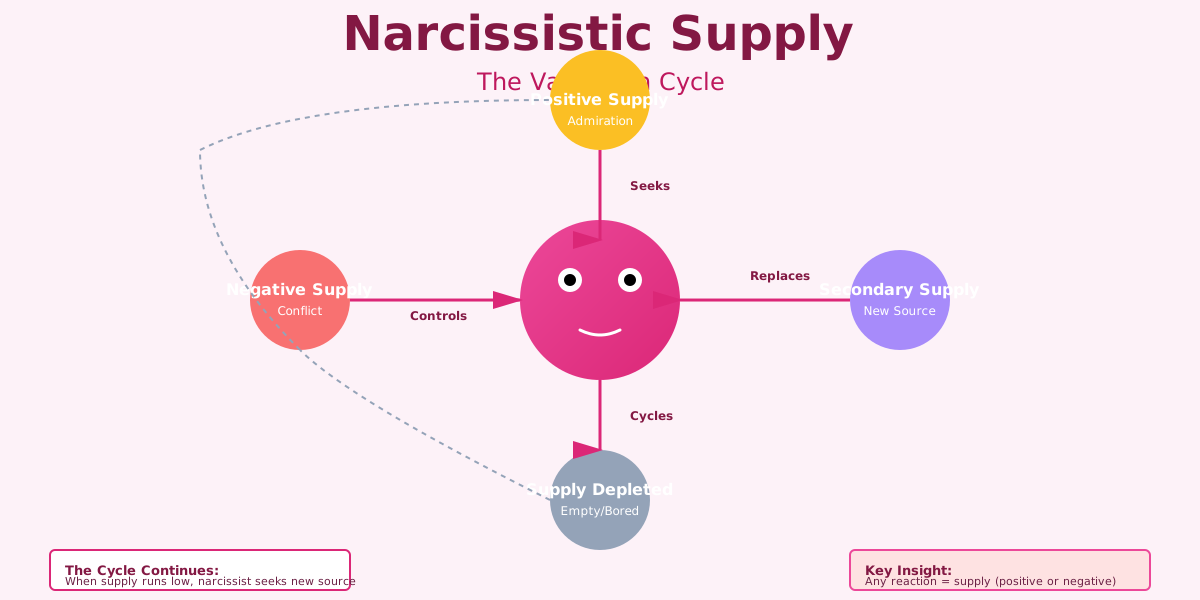
Surprising Insight: Surprising Insight: Narcissists experience both positive supply (admiration, praise, attention) AND negative supply (fear, anger, conflict, humiliation) as emotionally sustaining. Any reaction that positions the narcissist as central to your emotional world feeds their system.
The Narcissistic Supply Cycle
Visual representation of how narcissists seek, extract, and cycle through supply sources
🔍 Click to enlarge
Why Supply in Narcissism Matters in 2026
In 2026, the need to understand narcissistic supply is more critical than ever. Social media has weaponized narcissistic supply-seeking. Platforms like Instagram, TikTok, and X (Twitter) provide narcissists with industrial-scale sources of validation—likes, followers, engagement metrics—creating a perfect storm for narcissistic expression. Research shows narcissism scores are rising, particularly among younger generations, and the accessibility of narcissistic supply through digital channels makes toxic relationships increasingly common.
Workplace narcissism is also epidemic. Narcissists naturally gravitate toward positions of power and visibility—management, entrepreneurship, public-facing roles. They extract supply from employees, clients, and colleagues daily. Understanding how supply works helps you navigate toxic bosses, colleagues, and power dynamics without absorbing their manipulation as personal failure.
Personally, recognizing narcissistic supply patterns directly protects your mental health, relationships, and self-esteem. When you understand that someone's constant need for reassurance, criticism of you, or sudden rage isn't about you—it's about their supply system—you stop internalizing their behavior. This distinction alone is life-changing.
The Science Behind Supply in Narcissism
Neuroscience reveals that narcissistic supply operates through dopamine dysregulation. Research published in peer-reviewed journals shows that individuals high in narcissism have altered dopamine signalling in brain regions associated with reward, self-esteem regulation, and social dominance (the ventral striatum and prefrontal cortex). When a narcissist receives admiration, their brain floods with dopamine—creating a neurochemical high similar to cocaine use. This isn't metaphorical; brain imaging studies confirm the parallel. The narcissist's brain literally becomes addicted to external validation in the way a substance-dependent person becomes addicted to drugs.
Additionally, research shows that individuals with NPD have weakened connectivity between brain regions responsible for empathy and reward. They literally cannot derive satisfaction from others' wellbeing; they can only feel rewarded by dominance, admiration, or control. This neurological reality explains why narcissists are not simply 'selfish people who can change if they try'—their brains are wired differently. The addiction to supply is both psychological and neurobiological.
Brain Chemistry of Narcissistic Supply
How dopamine and brain regions regulate narcissistic supply seeking
🔍 Click to enlarge
Key Components of Supply in Narcissism
Positive Supply
Positive supply is admiration, praise, attention, love, and flattery. It's what we typically imagine: someone seeking compliments, fishing for validation, or basking in public recognition. Narcissists who extract positive supply might be charming, charismatic, and initially magnetic. They love-bomb new romantic partners, shower friends with attention initially, or seek public acclaim. The narcissist feels powerful, superior, and desirable. For those providing positive supply, the trap is invisible—it feels good at first. You feel seen, valued, and special. Then the narcissist either demands escalating levels of praise or suddenly discards you for a 'better' source.
Negative Supply
Negative supply is anger, fear, tears, conflict, and emotional distress—yours. This is the shocking discovery for many people in narcissistic relationships. The narcissist doesn't want you to be happy; they want you to be emotionally activated. If you cry, argue, beg them to stop, or react with fear, you're providing supply just as effectively as someone praising them. Negative supply gives narcissists a sense of dominance and control. It proves they matter to you. This explains why narcissists provoke arguments, betray you, gaslight you, or create chaos—they're not trying to improve the relationship; they're harvesting emotional reactions for supply.
The Cycle: Idealization, Devaluation, Discard
Narcissistic relationships follow a predictable three-phase cycle. Phase one is idealization: you're the most perfect person they've ever met, and they shower you with attention and affection. During this phase, they're extracting positive supply in abundance—your admiration, love, and belief in them. Phase two is devaluation: as the narcissist becomes bored or feels entitled, they begin critical, cruel, or dismissive behavior. They might have an affair, humiliate you publicly, or suddenly withdraw affection. Now they're extracting negative supply—your pain, confusion, and desperate attempts to win them back. Phase three is discard: when you've become too depleted to provide either positive or negative supply effectively, they abruptly leave you for a new supply source. They may later hoover (attempt to re-engage) if their new supply runs dry or they need a secondary source.
Primary and Secondary Supply Sources
Narcissists rarely have just one supply source. Their intimate partner or family member is typically the primary supply source—the person they're most invested in maintaining because this person is most accessible and provides both positive and negative supply reliably. Secondary supply sources include friends, colleagues, social media followers, or casual acquaintances. Tertiary sources might be casual interactions (waiters, strangers) that provide momentary admiration. A sophisticated narcissist maintains a portfolio of supply sources so that if one dries up, others remain. This is why they often begin grooming a new romantic partner before discarding the old one—they're securing the transition before they lose primary supply.
| Supply Type | What Narcissist Receives | How You Might Provide It |
|---|---|---|
| Positive Supply | Admiration, superiority, specialness | Praise, attention, sexual desire, loyalty, belief in their importance |
| Negative Supply | Control, dominance, proof of impact | Anger, tears, begging, fear, desperate attempts to fix the relationship |
| Narcissistic Injury | Rage response (temporarily supplies dominance) | Criticism, boundaries, saying 'no', leaving them, succeeding without them |
| Social Supply | Public admiration, status elevation | Bragging about them, showing them off, introducing them to important people |
How to Apply Supply in Narcissism: Step by Step
- Step 1: Observe behavioral patterns without judgment. Does someone constantly seek compliments? Do they rage when you disagree? Do they seem to transfer affection to others suddenly? Track the pattern for 2-4 weeks without trying to fix it.
- Step 2: Identify the supply cycle. Are you in idealization (everything feels perfect)? Devaluation (you're being criticized or neglected)? Discard (they're pulling away)? Understanding which phase you're in changes how you respond.
- Step 3: Notice what triggers rage or withdrawal. If the narcissist becomes angry when you set boundaries, don't raise concerns, or succeed independently, they're experiencing narcissistic injury—a depletion of supply. This is not your fault; it's their system failing.
- Step 4: Recognize what you're providing. Are you giving positive supply (reassurance, admiration, attention)? Negative supply (emotional reactions, arguments, desperate fixes)? Both keep the cycle alive.
- Step 5: Assess your emotional cost. How much energy are you expending to maintain this person's emotional equilibrium? Track your mood, sleep, anxiety, and self-esteem. Narcissistic relationships are energy vampirism.
- Step 6: Choose a strategy: No Contact (complete cessation of supply), Grey Rock (minimal, boring responses), or Structured Contact (limited communication if shared custody or workplace contact is unavoidable).
- Step 7: If using Grey Rock, practice emotionless responses: 'Ok,' 'That's interesting,' 'I see.' Don't engage with provocations, share vulnerabilities, or show strong emotions. A grey rock has no supply.
- Step 8: If going No Contact, block all communication channels (phone, email, social media, mutual friends). Don't check their social media. Don't respond to hoover attempts. One message breaks the boundary.
- Step 9: Build your internal supply. Recognize that you need to transition from deriving self-esteem from external validation (which kept you dependent on the narcissist) to internal sources: values, achievements, genuine relationships, self-compassion.
- Step 10: Seek professional support. A trauma-informed therapist can help you process the relationship and rebuild healthy attachment patterns. Many survivors of narcissistic abuse develop codependency patterns that repeat unless addressed.
Supply in Narcissism Across Life Stages
Young Adulthood (18-35)
In young adulthood, narcissistic supply seeking often appears as love-bombing in romantic relationships and social media performanism. Young narcissists are building their supply portfolio, and romantic partners are idealized as primary sources. If you're in this stage, be alert to rapid intensity escalation, early declarations of 'you're the one,' or love-bombing followed by sudden coldness. Narcissistic partners in this age group often have active secondary supply sources (flirting with exes, maintaining attention from multiple romantic interests). Digital platforms amplify supply-seeking—constant posting, fishing for likes, and comparing follower counts are common.
Middle Adulthood (35-55)
Middle-aged narcissists often extract supply through workplace power, financial dominance, and family control. They may appear successful, accomplished, and admirable externally—but behind closed doors, they're tyrannical, dismissive, or emotionally abusive toward partners and children. Supply-seeking in this stage often involves maintaining a public image (perfect career, beautiful home, well-behaved kids) while privately controlling and belittling those closest to them. Divorce rates spike during this phase as partners finally recognize the pattern and leave. Some narcissists respond by escalating abuse to prevent loss of primary supply (their partner); others quickly replace the ex with a new supply source.
Later Adulthood (55+)
Older narcissists often become more fragile and aggressive about supply as age, health decline, and reduced social circles threaten their sources. They may become increasingly paranoid, bitter, or enmeshed with adult children as primary supply sources. Retirement is particularly destabilizing for narcissists whose primary supply came from workplace admiration and status. Some pivot to family control ('I'm getting older, so you owe me attention and obedience'), financial manipulation of heirs, or attention-seeking through manufactured health crises. Understanding this stage is critical for adult children who may feel obligated to provide supply as caregivers.
Profiles: Your Supply in Narcissism Approach
The Empathetic Giver
- Permission to stop trying to 'fix' the narcissist through more love/patience
- Understanding that your empathy is being weaponized against you
- Validation that leaving isn't abandonment; it's self-preservation
Common pitfall: Believing that if you just love them better, understand them deeper, or sacrifice more, they'll change. This is the core trap for empaths in narcissistic relationships.
Best move: Recognize that narcissists don't need more love; they need professional treatment they typically refuse. Your job is not to heal them. Accept the reality: You cannot love someone into emotional health if they don't have the capacity or willingness to change.
The Unconscious Codependent
- Awareness of the codependency cycle: narcissist's need for supply + your need to feel needed = locked loop
- Clarity that 'being there for them' sometimes means not being there
- Gradual retraining of your nervous system to feel okay when someone else is unhappy
Common pitfall: Unable to tolerate the narcissist's anger or withdrawal, so you immediately return to providing supply to restore peace. This teaches the narcissist that escalation works.
Best move: Develop a high tolerance for their upset. When they rage or withdraw, stay calm and maintain your boundary. They're testing whether you'll crack. If you don't, they may eventually leave you for someone more compliant—which is freedom, not loss.
The Confused Detacher
- Clarity on why you're detaching and what you're protecting
- A clear plan for low-contact or no-contact (vs. passive detachment that keeps you bound)
- Grief support for the loss of the idealized version of the narcissist you believed existed
Common pitfall: Detaching emotionally but staying in the relationship, which is exhausting and sends mixed signals to the narcissist. They interpret silence or coldness as supply deprivation and escalate manipulation.
Best move: Choose a clear exit strategy. If you're staying (shared kids, financial entanglement), use structured grey-rock communication. If you're leaving, make a decisive break. Ambivalence traps you in limbo and gives narcissists false hope to exploit.
The Recovering Survivor
- Validation that healing from narcissistic abuse is real and takes time
- Awareness of trauma responses (hypervigilance, people-pleasing, difficulty trusting)
- Integration of the experience without letting it define your future relationships
Common pitfall: Unconsciously recreating narcissistic dynamics with new partners because the trauma patterns are familiar. Or becoming so protective that you struggle to trust anyone.
Best move: Work with a trauma-informed therapist on attachment patterns. Learn to recognize early red flags of narcissistic behavior before you're emotionally invested. Build healthy interdependence (not codependence and not avoidance).
Common Supply in Narcissism Mistakes
Mistake #1: Thinking your love can fix the narcissist. This is the deadliest myth. You believe that if you just love them harder, understand them deeper, or sacrifice more, they'll recognize your value and reciprocate. They won't. Narcissists don't have the neurological capacity for genuine reciprocal love. Pouring more love into a narcissistic relationship is like pouring water into a bathtub with an open drain—no matter how much you pour, it never fills. The narcissist will only escalate demands, moving the goalposts so you're always failing. This belief traps millions in toxic relationships for decades.
Mistake #2: Retaliating with negative supply. When a narcissist hurts you, your instinct is to hurt them back—argue, yell, cry, express your pain dramatically. You think this proves they've wronged you. But to the narcissist, your negative emotional reaction is supply. You've just provided them with proof of impact and dominance. They won. The more distraught you become, the more they win. This is why narcissists provoke arguments—not to resolve conflict, but to harvest your emotional energy.
Mistake #3: Disappearing without explanation. If you suddenly go no-contact without warning, the narcissist experiences this as unbearable supply deprivation and will escalate to extreme measures to restore supply—harassment, flying monkeys (recruiting others to contact you), spreading rumors, financial retaliation, or even physical pursuit. A clean break, while necessary, must be done with safety planning and ideally legal boundaries if the narcissist is dangerous.
Common Mistakes in Narcissistic Relationships
Mistakes that keep you trapped in the supply cycle
🔍 Click to enlarge
Science and Studies
Research on narcissistic supply comes from multiple disciplines: neuroscience, clinical psychology, and relationship studies. The evidence is overwhelming that narcissistic supply operates as a genuine addiction with neurobiological underpinnings.
- Neuroimaging studies (PMC5679127) show that individuals with pathological narcissism have altered frontostrial connectivity associated with reward-seeking behavior, similar to substance addiction.
- Research on intimate relationships (PMC9541508) confirms that partners of narcissists report elevated anxiety, depression, and somatic symptoms from emotional abuse tied to narcissist's supply-seeking.
- Addiction literature (PMC6757332) demonstrates that narcissism correlates with increased risk of substance abuse, suggesting narcissists use drugs/alcohol as supplementary supply sources when human supply is insufficient.
- Psychological studies document the idealization-devaluation-discard cycle as a consistent pattern in narcissistic relationships, explaining why narcissists rapidly cycle through partners.
- Neurotransmitter research shows that grandiose narcissism involves dopamine dysregulation specifically in brain regions tied to self-esteem regulation, explaining why external validation becomes an addiction.
Your First Micro Habit
Stop One Type of Supply
Today's action: For the next 3 days, notice which type of supply you're providing (positive: reassurance/admiration, or negative: emotional reactions). Pick ONE small action you stop doing. Example: Don't offer unprompted compliments. Don't respond emotionally to provocations. Don't initiate contact. Track what happens.
This micro habit breaks the automaticity of the supply cycle. Most people don't realize how much supply they're providing until they consciously pause it. The narcissist's reaction (often escalation, withdrawal, or hoovering) will confirm you were indeed the primary supply source. This clarity is empowering.
Keep quitting habit apps after a missed day? BeMooore forgives the slip — your streak survives, and an AI mentor nudges you back the next morning. Free on iOS.
Quick Assessment
How often do you find yourself seeking reassurance or validation from someone in your life?
People in narcissistic relationships often flip between giving constant reassurance to the narcissist and needing excessive reassurance from them. If you're in the 'constantly' camp, you're in a codependent dynamic where the narcissist has trained you to need their supply.
When this person is upset with you, what's your instinct?
Healthy responses are #1 and #2. Response #3 suggests you're enabling their emotions and providing caretaking supply. Response #4 suggests they're harvesting negative supply from your reactions. Both #3 and #4 keep you trapped in the cycle.
If you disappeared from this person's life for 3 months, how would they likely respond?
Answers #1-#3 suggest a healthy relationship. Answer #4 is a red flag for narcissism. Narcissists cannot tolerate supply deprivation. Extreme reactions confirm you were serving a supply function, not participating in a mutual relationship.
Take our full assessment to get personalized recommendations.
Discover Your Style →Next Steps
Understanding narcissistic supply is a breakthrough moment. You suddenly see the relationship—or the person—clearly. You realize their constant need for reassurance isn't a sign that they need more love; it's evidence of pathology. Their rage when you set boundaries isn't justified; it's supply deprivation. This clarity is painful but liberating. You can now make decisions based on reality, not hope.
Your first action: Assess your current situation. Are you in a narcissistic relationship? Are you providing positive supply (reassurance, admiration)? Negative supply (emotional reactions)? Both? Write this down. Then decide: Can you go no-contact? If not, can you implement grey rock? Talk to a therapist about your options. You're not obligated to provide supply to anyone, and recognizing this is the first step to freedom.
Get personalized guidance with AI coaching.
Start Your Journey →Research Sources
This article is based on peer-reviewed research and authoritative sources. Below are the key references we consulted:
Related Glossary Articles
Frequently Asked Questions
Is everyone who seeks attention narcissistic?
No. All humans need attention and validation—that's healthy. The difference is quantity and source. Healthy people need occasional external validation but have strong internal self-esteem. They can receive rejection without identity collapse. Narcissists require constant external validation and cannot self-soothe without it. If someone needs reassurance daily or rages when they don't receive it, that's pathological.
Can narcissists be satisfied with supply?
Never permanently. Narcissists' supply satisfaction is like an addict's high—it wears off. They always need more. The same level of admiration that felt amazing six months ago now feels insufficient. This is why relationships with narcissists escalate in drama, why they constantly seek new supply sources, and why they discard people who've 'run out' of usefulness.
If I stop providing supply, will the narcissist change?
Unlikely. Supply deprivation typically causes escalation, not insight. The narcissist will rage, manipulate, hoover, or find new supply sources—but they won't become introspective. Narcissists rarely seek treatment unless forced by legal consequences or social collapse. Stopping supply protects you, not them.
Is going no-contact always necessary?
No-contact is ideal but not always possible (shared children, workplace, family ties). In those cases, grey rock (boring, minimal responses) or structured contact (limited, pre-planned communication) works. The goal is minimizing supply. Even a 70% reduction in supply you provide is healing.
Will the narcissist ever miss me or realize what they lost?
Narcissists don't miss you in the way healthy people do. They miss the supply you provided. If their current supply sources dry up, they might hoover (attempt to re-engage you). This isn't love or insight—it's supply-seeking. If you reconnect, the cycle restarts.
Take the Next Step
Ready to improve your wellbeing? Take our free assessment to get personalized recommendations based on your unique situation.
- Discover your strengths and gaps
- Get personalized quick wins
- Track your progress over time
- Evidence-based strategies