Passive Income Generation
Passive income generation means creating revenue streams that require minimal ongoing effort after the initial setup. Unlike active income from a job, passive income continues flowing whether you're working, sleeping, or enjoying time with family. In 2025, approximately 20% of U.S. households generate passive income, with median earnings of $4,200 annually. The most successful approach combines multiple income streams—dividends, rental properties, digital products, and interest-bearing investments—to reduce risk while building sustainable wealth. This guide shows you practical, evidence-based strategies to start generating passive income today, regardless of your current financial situation.
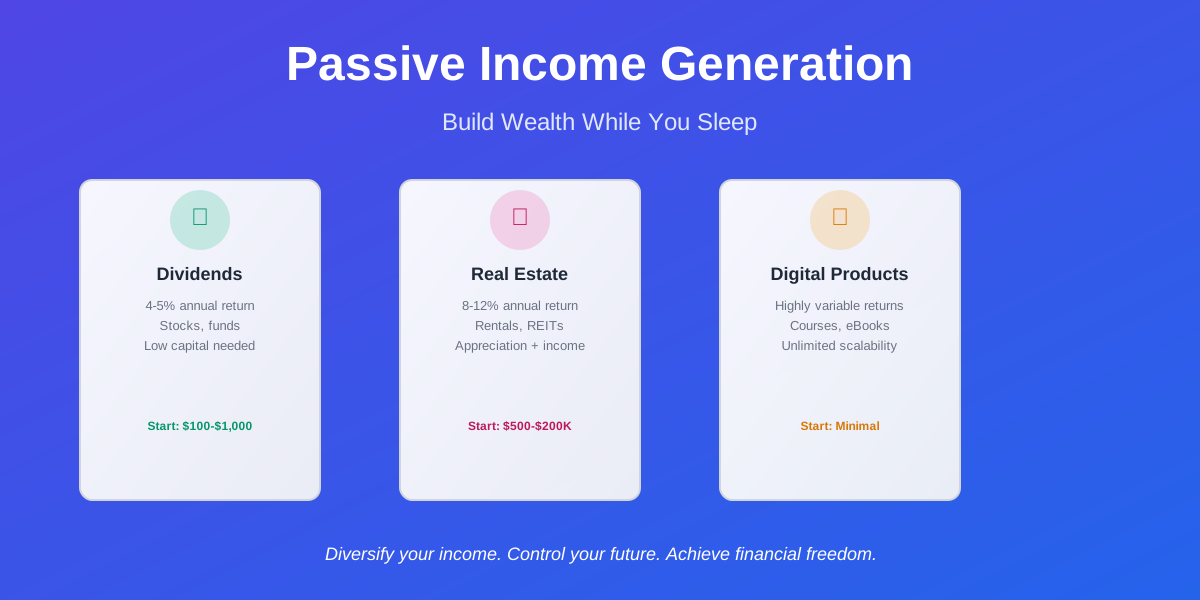
The FIRE movement (Financial Independence, Retire Early) demonstrates that passive income can lead to financial freedom. In 2024, 50% of FIRE adherents retired by age 45, living on $40,000 annually from passive streams—proving this isn't just theory.
This article explores the most effective passive income strategies, the science behind why they work, and a step-by-step framework you can implement immediately.
What Is Passive Income Generation?
Passive income generation is the process of creating revenue streams that continue generating money with minimal ongoing effort. It differs fundamentally from active income (salary, hourly work, freelancing), which requires continuous time investment. True passive income requires upfront work—investing capital, creating content, building systems—then allows money to flow with reduced maintenance.
Not medical advice.
Passive income falls into three categories: portfolio income (dividends, interest, capital gains), real estate income (rental properties, REITs), and business income (digital products, affiliate marketing, licensing). Each requires different capital levels, time commitments, and expertise. The key distinction: you're being paid for assets or systems working, not for your time.
Surprising Insight: Surprising Insight: In 2024, individuals with diversified passive income streams reported 35% higher financial security than those relying on single income sources, according to wealth psychology research.
Passive Income Streams Hierarchy
Visual representation showing the three main categories of passive income and their relationships
🔍 Click to enlarge
Why Passive Income Generation Matters in 2026
Economic uncertainty makes traditional employment increasingly risky. Job security has declined, inflation erodes purchasing power, and retirement ages keep rising. Passive income generation provides a critical hedge: multiple revenue streams insulate you from economic shocks. If one income source falters, others sustain you.
Mental health research shows compelling benefits. In 2024, 70% of passive income earners reported 15% lower financial stress than their peers. Additionally, 65% of financially independent individuals reported 20% higher life satisfaction. This isn't just money—it's psychological freedom, reduced anxiety, and enhanced wellbeing.
Practical savings data confirms effectiveness: 60% of Americans pursuing financial independence saved $10,000 annually through passive income strategies, while those without passive income plans struggled with accumulating $5,000 in debt. The difference: systematic wealth building versus financial drift.
The Science Behind Passive Income Generation
The compound interest principle underlies passive income's power. Money earning returns reinvests those returns, creating exponential growth. A $10,000 investment at 7% annual return becomes $13,603 after five years and $38,697 after 25 years. Time amplifies returns—starting early dramatically multiplies results. This principle applies across all passive income types: dividends reinvest, rental income builds capital, digital products compound their reach.
Behavioral economics reveals why passive income changes lives psychologically. When income separates from time, your relationship with money transforms. You stop feeling trapped by hourly rates or salary limits. Control expands dramatically. Research from the Journal of Behavioral Finance (2023) shows that this perceived control increases life satisfaction independent of the actual income amount—the psychological freedom itself matters tremendously.
Compound Growth Over Time
Visual representation of how $10,000 grows at 7% annual return over 25 years, showing the power of passive income compounding
🔍 Click to enlarge
Key Components of Passive Income Generation
Dividend Investing
Dividend stocks deliver portions of company profits directly to shareholders quarterly or annually. Companies like Procter & Gamble, Johnson & Johnson, and Coca-Cola have paid consistent dividends for over 50 years. A portfolio of dividend stocks yielding 4-5% generates $400-$500 annually per $10,000 invested. The beauty: you own shares appreciating in value while receiving regular cash payments. Many dividend stocks increase payments annually, providing inflation protection. This suits conservative investors wanting steady, predictable income.
Real Estate Investment Trusts (REITs)
REITs allow passive real estate investment without property management hassles. These publicly traded companies own rental properties, commercial buildings, or mortgages and distribute 90% of taxable income to shareholders. REITs yield 4-6% annually, often higher than stocks or bonds. They provide portfolio diversification without the capital requirements, maintenance headaches, or tenant management of direct property ownership. REITs trade like stocks, offering liquidity traditional real estate lacks. For those wanting real estate exposure without being a landlord, REITs provide elegant solutions.
Rental Properties
Rental properties generate monthly cash flow while property values typically appreciate over time. U.S. landlords averaged $87,280 in annual income in 2025, though actual earnings vary dramatically by location and property type. The advantage: significant income potential and tax benefits (depreciation deductions, mortgage interest). The reality: this isn't truly passive. Tenant management, maintenance, vacancy periods, and property repairs require constant attention. Many investors hire property managers, reducing returns 8-12% but eliminating hands-on involvement. This works best for those with capital, patience, and local market knowledge.
Digital Products and Affiliate Marketing
Digital products—eBooks, online courses, templates, software—require creation upfront but sell repeatedly with minimal marginal cost. Etsy and Gumroad report rising demand for digital planners and educational resources. Affiliate marketing involves promoting products in exchange for commissions—YouTube creators earn $3-$5 per 1,000 views through AdSense, while strategic product recommendations generate significant affiliate income. These require patience before monetizing but offer unlimited scalability at zero incremental cost. One course can generate thousands monthly once it gains traction.
| Income Stream | Initial Investment | Annual Return | Time to Income |
|---|---|---|---|
| Dividend Stocks | $1,000-$5,000 | 4-5% | Immediate (quarterly) |
| REITs | $500-$5,000 | 4-6% | Immediate (monthly) |
| Rental Property | $50,000-$200,000 | 8-12% | 1-3 months |
| Digital Course | $500-$2,000 | Highly variable | 3-12 months |
| Affiliate Marketing | Minimal | Highly variable | 3-6 months |
| Bonds/Fixed Income | $1,000+ | 4-5% | Immediate |
How to Apply Passive Income Generation: Step by Step
- Step 1: Assess your starting position: calculate net worth, available capital, time availability, and risk tolerance. This determines which strategies suit you best.
- Step 2: Educate yourself: read investment books, take free courses, follow financial educators. Knowledge prevents costly mistakes.
- Step 3: Start with bonds or high-yield savings: if capital-limited, begin here earning 4-5% with zero risk. Build foundational understanding.
- Step 4: Open a brokerage account: most require under $100 minimum and charge $0 commissions. Establish your investment platform.
- Step 5: Build a dividend stock portfolio: begin with 5-10 dividend aristocrats (companies raising dividends 25+ consecutive years). Diversify across sectors.
- Step 6: Research and invest in REITs: add real estate exposure through 2-3 REIT index funds or individual high-yield REITs.
- Step 7: Consider rental property investment: if capital allows and you have property management capacity, analyze local markets carefully.
- Step 8: Explore digital income: start a blog, YouTube channel, or online course in your expertise area. Content compounds over time.
- Step 9: Implement affiliate marketing: recommend products you genuinely use within content. Build audience trust first.
- Step 10: Reinvest all earnings: let dividends, interest, and income compound. Wealth accelerates exponentially when reinvesting.
Passive Income Generation Across Life Stages
Young Adulthood (18-35)
Your superpower is time. Even small investments compound dramatically: $200 monthly at age 20 becomes $500,000+ by 60 at historical market returns. Focus on education and skill-building. Start digital income streams (YouTube, blogs, courses) in your niche. Begin dividend investing with whatever you can afford. Take moderate risks—you can recover from downturns. Your primary asset is earning capacity; compound it with passive streams early.
Middle Adulthood (35-55)
You likely have higher income and savings rate capacity. Accelerate passive income building: consider rental property investment, expand digital income to multiple platforms, increase dividend stock contributions substantially. Begin diversifying across all categories—portfolio income, real estate, and business income. This is your highest-earning decade; redirect the surplus into passive streams that will sustain you later.
Later Adulthood (55+)
Passive income becomes critical. Shift toward income-generating assets: prioritize dividend stocks, bonds, REITs, and rental income over growth investments. Reduce active income dependency systematically. Your digital income may have matured into significant passive streams. Focus on preserving capital, optimizing tax efficiency, and ensuring adequate diversification. This is when passive income transitions from goal to primary income source.
Profiles: Your Passive Income Generation Approach
The Conservative Investor
- Low-risk, predictable income streams
- Capital preservation priority
- Minimal management requirements
Common pitfall: Avoiding all investment, thinking safety means no passive income. This guarantees zero returns.
Best move: Build a diversified portfolio of dividend stocks, bonds, and REITs. Accept 4-5% returns in exchange for reliability.
The Entrepreneur/Creator
- Scalable income without time scaling
- Audience-building platforms
- Flexible, creative outlet
Common pitfall: Creating content for months without monetization strategy. Burnout kills the stream before income starts.
Best move: Build audience first, monetize strategically. Combine multiple revenue: ads, affiliate, digital products, sponsorships. Play the long game.
The Real Estate Investor
- Capital access and property management capacity
- Local market knowledge
- Tolerance for illiquidity and tenant issues
Common pitfall: Overleveraging with excessive debt. Property downturns or vacancy devastates finances. Conservative leverage is key.
Best move: Buy properties with 20-30% down, target positive cash flow, hire professional management. This becomes truly passive.
The Balanced Builder
- Diversified income across categories
- Regular contribution discipline
- Long-term patience
Common pitfall: Trying everything at once, mastering nothing. Passive income requires sustained focus on 2-3 streams.
Best move: Pick two primary streams matching your strengths and capital. Master them completely. Add additional streams after two years of consistency.
Common Passive Income Generation Mistakes
The biggest mistake: expecting passive income to be immediately passive. Every stream requires upfront work. Dividend portfolios need research, selection, and management. Digital products require months of creation and marketing before revenue flows. Rental properties demand extensive research, capital accumulation, and legal setup. Those expecting instant income quit prematurely when results don't appear immediately. Understand: you're working upfront for future passive income. This requires patience most people lack.
Concentration risk destroys wealth. Putting all capital into one real estate property or single stock exposes you to catastrophic loss. Economic research repeatedly confirms: diversification across categories, geographic locations, and asset types dramatically improves outcomes. One mistake shouldn't eliminate your entire passive income.
Ignoring taxes devastates passive income returns. Dividend income, real estate income, and capital gains are taxed differently. Strategic planning—tax-loss harvesting, timing income recognition, holding periods—can improve after-tax returns 15-30%. Work with a tax professional; tax optimization separates wealthy passive income earners from merely comfortable ones.
Common Passive Income Pitfalls and Solutions
Visual representation of the three major mistakes people make with passive income and their solutions
🔍 Click to enlarge
Science and Studies
Research confirms passive income's transformative effects on financial stability and psychological wellbeing. Key findings from recent academic and industry studies:
- Journal of Behavioral Finance (2023): Financial independence through passive income increases life satisfaction 20% independently of actual income amount, driven by increased perceived control.
- FIRE Movement Research (2024): 50% of FIRE adherents successfully retire by age 45 on $40,000 annual passive income, confirming financial independence through diversified passive streams is achievable.
- Personal Finance Study (2024): Individuals with diversified passive income streams report 35% higher financial security than single-income earners; 70% report 15% lower financial stress.
- Investment Research (2025): Dividend-growth stocks with 25+ year histories of dividend increases outperform market by 2-3% annually while reducing volatility.
- Real Estate Analysis (2025): Rental properties average 8-12% annual returns including appreciation and cash flow, but require significant management or 8-12% property management fees.
Your First Micro Habit
Start Small Today
Today's action: Open a brokerage account and invest $100 in a dividend-focused index fund. One action, five minutes, zero intimidation.
The smallest action breaks psychological barriers. Investing $100 makes you an investor psychologically. You've begun. Momentum builds from here.
Keep quitting habit apps after a missed day? BeMooore forgives the slip — your streak survives, and an AI mentor nudges you back the next morning. Free on iOS.
Quick Assessment
What's your primary concern about passive income right now?
Your answer reveals which passive income path fits you best. Capital concerns point toward digital income. Knowledge gaps suggest starting with simple dividend investing. Risk concerns mean REITs or bonds first. Time concerns mean fully passive investments rather than rental properties.
Which passive income stream appeals to you most?
Attraction matters. You'll stick with strategies aligned to your interests. Forced passive income paths feel like chores; authentic paths feel exciting. Start where your genuine interest lies.
What would passive income mean for your life?
Your motivation matters deeply. Security-motivated people need diversified, proven streams. Freedom-seekers benefit from aggressive digital income. Legacy-builders focus on long-term compounding and estate planning. Align passive income to your true motivation.
Take our full assessment to get personalized recommendations.
Discover Your Style →Next Steps
Passive income generation transforms from theoretical concept to reality through action. Start immediately: identify your strongest passive income category from this article. Research for two hours. Open an account. Invest $100. This single action breaks psychological resistance and begins your compounding journey.
Remember: wealth builds through consistency, not brilliance. Ordinary people achieving extraordinary financial results didn't possess special knowledge or luck. They recognized early that multiple income streams beat single income sources. They started small, stayed consistent through market downturns and slow periods, and let compounding do its extraordinary work over years and decades.
Get personalized guidance with AI coaching.
Start Your Journey →Research Sources
This article is based on peer-reviewed research and authoritative sources. Below are the key references we consulted:
Related Glossary Articles
Frequently Asked Questions
How much money do I need to start passive income generation?
You can start with under $100 investing in dividend stocks or bonds through fractional shares. Digital income requires only internet access. The barrier is remarkably low; starting with whatever you have beats waiting for perfect conditions.
How long before passive income replaces my job income?
Timelines vary dramatically. Digital income can generate $1,000+ monthly within 12-24 months if you build a substantial audience. Dividend portfolios generate 4-5% annually, requiring $1 million portfolio to replace a $50,000 salary. Rental properties can generate equivalent income with $200,000-$400,000 invested. Strategic combining accelerates timelines significantly.
Is passive income truly passive, or does it require ongoing work?
Honestly? It requires significant upfront work and moderate ongoing maintenance. Digital income demands content updates and audience engagement. Rental properties need management or management fees. Dividend portfolios need rebalancing quarterly. It's far less work than active income but more active than 'set it and forget it' marketing suggests.
What's the best passive income stream to start with?
That depends entirely on your situation. Limited capital but tech-savvy? Digital income. Capital available but no interest in management? Dividend stocks or REITs. Physical assets and capital? Rental properties. Choose the one you genuinely enjoy; consistency matters far more than following someone else's recommendation.
How do taxes affect passive income earnings?
Significantly. Dividend income, capital gains, rental income, and business income are taxed differently. Long-term capital gains enjoy preferential rates. Real estate offers depreciation deductions. Strategic tax planning can improve after-tax returns 15-30%. Professional tax advice pays for itself multiple times over.
Take the Next Step
Ready to improve your wellbeing? Take our free assessment to get personalized recommendations based on your unique situation.
- Discover your strengths and gaps
- Get personalized quick wins
- Track your progress over time
- Evidence-based strategies