Financial Freedom in 3 Months
What if you could transform your financial life in just 90 days? The idea sounds impossible, but hundreds of thousands of people have accelerated their path to financial freedom by implementing a focused, systematic approach during a concentrated three-month period. Financial freedom in 3 months isn't about becoming a millionaire overnight—it's about fundamentally reshaping your relationship with money, building powerful financial habits, and taking decisive action that compounds over time. In 2026, as economic uncertainty persists and inflation remains a concern, the 90-day sprint has become a proven methodology for people at all income levels to establish the foundation for lasting financial independence. This article explores the science, strategies, and step-by-step systems you can use to make this transformation real in your own life.
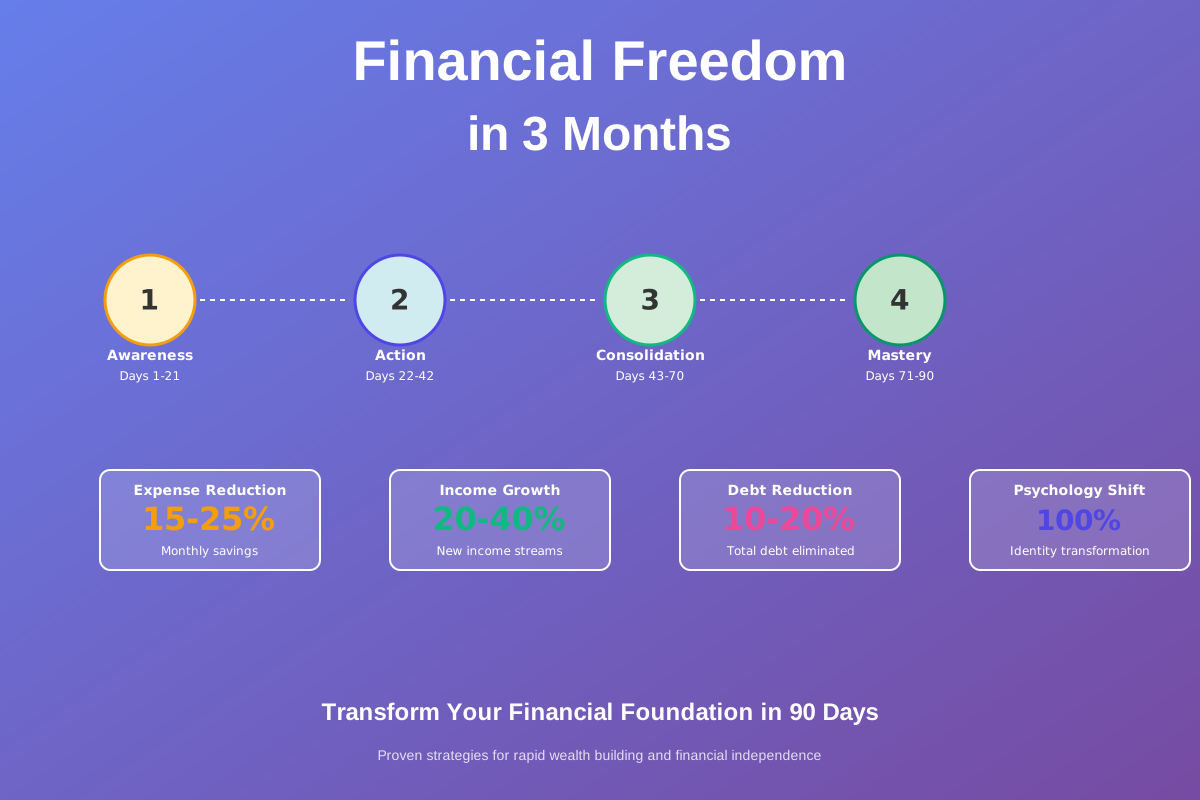
The beauty of a 90-day timeframe is that it's short enough to maintain laser focus and see tangible results, yet long enough to establish genuine habits that stick. Research from behavioral economics shows that 90 days is the optimal window for rewiring your financial brain and locking in new behaviors that become automatic. During this period, you'll track every dollar, identify money leaks, create multiple income streams, and develop the psychological framework of someone who is genuinely free.
Whether you're starting from credit card debt, living paycheck-to-paycheck, or simply want to accelerate your wealth-building journey, this guide provides the exact roadmap used by thousands of people who have successfully compressed years of financial progress into three concentrated months of deliberate action.
What Is Financial Freedom in 3 Months?
Financial freedom in 3 months is a concentrated 90-day sprint designed to fundamentally transform your financial position, psychology, and trajectory. It's not about abandoning your regular job or becoming wealthy beyond recognition—instead, it's about making targeted, high-impact changes across income, expenses, debt, and mindset that accelerate your movement toward true financial independence. This approach combines behavioral psychology, practical money management, and income acceleration into a unified system.
Not medical advice.
The core concept rests on research from behavioral economics and neuroscience showing that 90 days is precisely long enough for your brain to rewire around new financial habits and behaviors. During this period, the neural pathways associated with spending, saving, and earning become more automatic. You're not just changing numbers on a spreadsheet—you're fundamentally reprogramming how you think about and interact with money at the deepest level.
Surprising Insight: Surprising Insight: Research shows that automatic enrollment in savings programs increases participation from 30% to 90%, and automatic savings features alone have increased average savings rates from 3.5% to 13.6% in just 40 months. The key difference? Making the right choice the default, not the exception.
The 90-Day Financial Transformation Arc
Visual representation of the four phases of the 90-day journey, showing baseline financial position, rapid changes in weeks 1-4, consolidation in weeks 5-8, and acceleration and compound effects in weeks 9-12.
🔍 Click to enlarge
Why Financial Freedom in 3 Months Matters in 2026
In 2026, the traditional path to financial independence feels increasingly broken. Economic uncertainty, inflation persistence, rising housing costs, and wage stagnation mean that passive approaches no longer work. People who wait for someday to manage their finances will likely never achieve financial freedom. The 90-day sprint methodology addresses this urgency by creating a compressed timeline that produces measurable results quickly, reigniting your sense of agency and control over your financial life.
The psychological impact of seeing real progress in 90 days cannot be overstated. When you reduce debt by 5-15%, build a true emergency fund, establish new income streams, and develop unshakeable financial habits—all within three months—your entire identity shifts. You stop being someone who aspires to financial freedom and become someone who actively builds it. This identity shift is what sustains long-term financial success, making the 90-day sprint not just a money-management challenge but a life-transformation tool.
Additionally, a concentrated 90-day focus forces you to confront your real financial situation without the ability to procrastinate or make excuses. The intensity creates accountability and momentum. Studies on goal-setting and behavior change consistently show that people who commit to a specific, time-bound challenge achieve 3-4x better results than those without a deadline. The 3-month timeframe leverages this psychological principle to produce results that might otherwise take years.
The Science Behind Financial Freedom in 3 Months
The research supporting 90-day financial transformation draws from multiple disciplines: behavioral economics, habit formation psychology, and neuroscience. Central to this approach is the understanding that financial behavior is not purely rational—emotions, habits, social influences, and environmental design shape how we earn, spend, and save far more than conscious deliberation does. By redesigning your financial environment and hacking your own psychology, you can achieve in three months what might otherwise take years.
Neuroscience research on neuroplasticity shows that your brain physically rewires itself when you consistently practice new behaviors. The 90-day window is optimal: it's long enough for these neural pathways to solidify into genuine habits that feel automatic, yet short enough that motivation remains high and you can maintain the intensity required. Research on habit formation indicates that repetition of a behavior for 66-90 days moves it from requiring willpower to becoming automatic—exactly why this timeframe is so effective for financial transformation.
How Financial Habits Form During 90 Days
Brain diagram showing neural pathway strengthening across weeks 1-12, with automation threshold reached around day 66-75, explaining why the 90-day timeframe creates lasting behavioral change.
🔍 Click to enlarge
Key Components of Financial Freedom in 3 Months
Complete Financial Awareness and Tracking
The first and most critical component is developing comprehensive awareness of your financial reality. You cannot change what you don't measure. During the first 14 days of your 90-day sprint, you must track every single expense—not just the big ones, but coffee purchases, subscription services, transportation costs, and impulse spending. This radical transparency serves multiple purposes: it shows you exactly where your money is going, reveals psychological patterns around spending, identifies quick-win opportunities to cut expenses, and creates the data foundation for all subsequent decisions. Use apps, spreadsheets, or manual tracking—the tool matters less than the consistency and completeness of tracking. Many people discover that this simple act of tracking reduces unnecessary spending by 15-25% immediately, as awareness itself becomes a behavior-changing intervention.
Strategic Expense Reduction and Elimination
With complete awareness comes the ability to make strategic cuts without sacrificing quality of life. The goal is not to suffer through deprivation—that approach fails. Instead, you identify and eliminate expenses that don't contribute meaningfully to your wellbeing while protecting those that do. Common opportunities include: renegotiating insurance and subscription services (saving 10-20%), switching to lower-cost providers for utilities and phone service, reducing dining out and food waste, and pausing discretionary purchases temporarily. The key insight from behavioral economics is that you should automate these reductions—cut the subscriptions immediately, set lower spending limits on cards, or put savings in a separate account—rather than relying on willpower each time you're tempted to spend. Within weeks, you should be able to redirect 15-30% of your current spending toward savings and debt payoff without feeling deprived.
Aggressive Income Acceleration and Multiple Streams
While expense reduction is important, income acceleration is where the real transformation happens. The 90-day sprint specifically targets new income generation: starting a side hustle aligned with your skills (freelancing, consulting, tutoring, selling products), asking for a raise at your current job backed by documented value creation, taking on short-term contract work or gig opportunities, or monetizing an existing hobby or interest. The goal is to increase total household income by 15-40% during the three months. This might mean an extra $300-800 per month from a side business, a $2000-5000 raise at your primary job, or some combination. The beauty of income acceleration is that it doesn't require you to cut your lifestyle—you can maintain your current spending while redirecting all new income to financial goals. Side hustles launched during months 1-2 should be generating meaningful income by month 3, providing momentum heading into the future.
Psychological Reprogramming and Money Mindset Shift
The often-overlooked component is the psychological transformation. Financial freedom requires shifting your identity from someone who struggles with money to someone who actively builds wealth. This involves daily practice: reading about successful people who built wealth from similar circumstances, visualizing yourself having achieved financial freedom by the end of the 90 days, using affirmations specifically designed for your financial goals, and surrounding yourself with people who support your financial transformation. Research from financial psychology shows that people with abundance-oriented money mindsets make better financial decisions, take more calculated risks, and persist through challenges. By deliberately cultivating this mindset through daily practice, you activate different parts of your brain related to opportunity recognition and resourcefulness. Many 90-day participants report that their biggest shift isn't the money saved—it's the fundamental change in how they see themselves and possibilities.
| Component | Week 1-2 Target | Week 5-8 Target | Week 9-12 Target |
|---|---|---|---|
| Expense Tracking | 100% of spending documented | Consistent tracking habits | Automated systems in place |
| Expense Reduction | Identify $100-300/month cuts | Execute cuts; save 15% of income | Protect new habits from erosion |
| Income Growth | Research opportunities, plan launch | First side income appearing | $300-800 new monthly income |
| Debt Reduction | Total debt calculated, strategy set | 5-10% debt reduction | 10-20% total debt reduction |
| Savings Rate | Set emergency fund goal | Build 1-2 months expenses saved | 3-4 months emergency fund |
| Psychological Shift | Daily abundance practice begins | Identify progress and celebrate | New identity solidifies |
How to Apply Financial Freedom in 3 Months: Step by Step
- Step 1: Days 1-3: Gather all financial accounts, statements, and debt information. Calculate your total net worth, total debt, monthly income, and regular monthly expenses. Write these numbers down without judgment—this is your baseline.
- Step 2: Days 4-7: Set up comprehensive expense tracking using an app (YNAB, Mint) or spreadsheet. Install this tracking so that every purchase is recorded in real-time. Spend these first two weeks just tracking without judgment or change.
- Step 3: Days 8-14: Analyze your spending patterns. Create categories for essential expenses (housing, utilities, food) and discretionary spending (dining out, entertainment, impulse purchases). Identify the top five spending categories and the largest individual expenses.
- Step 4: Days 15-21: Make your first strategic cuts. Cancel unused subscriptions, downgrade services, negotiate better rates on insurance/phone, and commit to a specific daily spending limit for discretionary purchases. Expect to reduce expenses by 10-20% through these easy wins.
- Step 5: Days 22-35: Begin your income acceleration work. Draft your resume or client pitch; identify freelance opportunities; start planning a side business; schedule a meeting with your manager to discuss a raise. Take concrete action on at least two income opportunities during this period.
- Step 6: Days 36-42: Launch your highest-potential income generator. This might be activating your first freelance client, starting your side business, or beginning your job search for a higher-paying position. Take imperfect action—perfectionism delays results.
- Step 7: Days 43-56: Consolidate your new spending habits and income structures. Track results: how much have you saved, how much new income have you generated? Celebrate wins. Troubleshoot challenges. Strengthen systems to make good choices automatic—lower spending limits, automatic transfers to savings, calendar reminders for tracking.
- Step 8: Days 57-70: Attack debt aggressively with your new surplus income and savings. Use either the debt snowball method (smallest balance first for psychological wins) or debt avalanche method (highest interest rate first for financial optimization). Make significant progress on your highest-interest debt.
- Step 9: Days 71-77: Expand your money mindset work. Read one book or listen to one course about financial success and abundance mentality. Begin journaling about your financial wins and progress. Notice how your relationship with money is changing—from fear and avoidance to agency and possibility.
- Step 10: Days 78-84: Build your emergency fund to 3-4 months of living expenses, or get it to your target amount. Having this safety net is fundamental to feeling and being financially free. This removes the fear that drives poor financial decisions and provides a true foundation.
- Step 11: Days 85-90: Review your entire 90-day transformation. Calculate your net worth change, debt reduction, new income generation, and expense reductions. Document these wins. Most importantly, identify the habits and systems you want to maintain and strengthen moving forward. You're not returning to your old life—you're launching into a new level.
- Step 12: Days 91+: Establish your next 90-day goal. Financial freedom isn't achieved in one sprint—it's a series of focused periods building on each other. Decide what your next milestone is: investing, additional income streams, reaching a specific net worth, or beginning your path to early retirement.
Financial Freedom in 3 Months Across Life Stages
Young Adulthood (18-35)
Young adults have the massive advantage of time—your money can compound for 40+ years, and seemingly small changes now have exponential impact later. Your 90-day sprint should focus heavily on building foundational habits and avoiding high-interest debt that becomes a trap. A side hustle during this phase might become a significant income stream later. Prioritize establishing an automated savings system, building your emergency fund, and starting to invest (even small amounts compound powerfully). If you have student loans or credit card debt, aggressive payoff during this period prevents decades of interest payments and accelerates wealth building exponentially. Young adults who complete a focused 90-day financial sprint typically see their net worth trajectory change dramatically—from decades of low savings to accelerated wealth building that becomes easier as compound interest kicks in.
Middle Adulthood (35-55)
Middle-aged individuals typically have higher income but also higher expenses (mortgages, kids' education, aging parents). Your 90-day sprint offers a critical opportunity to refocus on financial goals before the final working years. This phase should emphasize income maximization through career advancement or business development, optimizing major expenses (refinancing mortgages, reviewing insurance), and creating aggressive saving and investment plans for retirement. Many high-earners in this phase have never tracked their spending comprehensively and discover they're leaking 20-30% of income through unconscious spending. A 90-day focus yields dramatic results. Additionally, middle-aged individuals should prioritize building investment knowledge and automating investment contributions so wealth compounds powerfully during the final 15-25 working years.
Later Adulthood (55+)
Later-stage adults should use a 90-day sprint to optimize for either early retirement, transition to part-time work they love, or ensure comfortable retirement income. Focus areas include: calculating retirement expenses accurately, ensuring investment allocations match your timeline, reviewing insurance and estate planning, and potentially converting skills into consulting or advisory work that generates income without full-time employment demands. For some in later adulthood, a 90-day sprint means determining whether early retirement is realistic, what adjustments would be needed, or what part-time income would make retirement comfortable. This stage isn't about starting from zero—it's about optimization and ensuring your final working years generate maximum security and alignment with your values.
Profiles: Your Financial Freedom Approach
The Disciplined Saver
- Clear tracking and metrics
- Structured goals with deadlines
- Accountability systems
Common pitfall: Becomes so focused on cutting expenses that they neglect income growth and miss significant opportunities
Best move: Balance expense reduction with aggressive income acceleration during the 90 days. You're great at the savings part—now focus 50% of your effort on income growth to get exponential results.
The Entrepreneurial Income Generator
- Systems to track what's working
- Business model clarity
- Profit focus over revenue growth
Common pitfall: Generates new income but fails to protect it through expense discipline and ends up with high revenue, low profit, and no real wealth building
Best move: Your superpower is making money—now pair it with expense awareness. Know your numbers. Automate 30-40% of new income directly to savings and investment so that growth actually builds wealth, not just busy-ness.
The Overwhelmed and In Denial
- Non-judgmental assessment
- Simplicity and one-step-at-a-time approach
- Emotional support and accountability
Common pitfall: Avoids looking at finances altogether, making problems worse, and missing opportunities to improve when improvement is possible
Best move: Start with just one tracking tool and one week of complete honesty. You don't have to fix everything at once. Small wins build momentum. Many who felt overwhelmed are shocked to discover they can actually turn things around relatively quickly with focused effort.
The Natural Investor
- Income to invest
- Structured investment plan
- Risk-appropriate portfolio allocation
Common pitfall: Has knowledge about investing but no actual capital because cash flow is poorly managed, leading to high income but low net worth
Best move: Your 90-day sprint must focus on creating investable surplus through either expense reduction or income growth. Once you have cash available, your investment knowledge becomes powerful. Build the foundation before building on top of it.
Common Financial Freedom in 3 Months Mistakes
The most common mistake is treating the 90-day sprint as exclusively about cutting expenses and suffering. This creates a feast-or-famine pattern where people white-knuckle their way through 90 days of deprivation, then explode back into old spending patterns because the approach is unsustainable. The most successful 90-day transformations balance expense reduction with income growth, allowing new income to support new savings without requiring constant sacrifice. Reduce expenses by 10-20%, but grow income by 20-40%—the combination creates sustainable change without resentment or burnout.
A second major mistake is failing to address the psychological and habitual components of financial behavior. You can create a perfect budget and tracking system, but if you haven't shifted your underlying beliefs about money, abundance, and yourself as a financially capable person, the external changes won't stick. The people who maintain their 90-day progress are those who invested in the mindset shift simultaneously with the action steps. Daily affirmations, visualization, reading about success, and surrounding yourself with people who support your goals are not optional feel-good additions—they're foundational to lasting change.
A third mistake is abandoning the sprint before the neural and habitual programming fully develops. People often feel momentum and positive change around day 45-60, then let discipline slip because the initial crisis intensity has passed. Weeks 7-12 are actually the most critical because this is when temporary willpower-driven changes become automatic habits. Staying disciplined through the full 90 days, not 60 or 75, is what determines whether changes are temporary or permanent. Mark day 90 on your calendar and commit to reaching it fully before you modify your approach.
Common Pitfalls and Their Solutions in the 90-Day Journey
Timeline showing typical points where people fail in 90-day financial transformation and evidence-based solutions to overcome each challenge.
🔍 Click to enlarge
Science and Studies
The 90-day financial transformation approach is grounded in multiple research findings from behavioral economics, psychology, and neuroscience. Studies consistently show that automatic systems and behavioral defaults dramatically outperform willpower-dependent approaches. Research from financial services companies demonstrates that automatic enrollment in savings and investment programs increases participation from 30% to 90%, and automatic savings features increase average savings rates from 3.5% to 13.6% in just 40 months. The key insight: when you make the right choice automatic and the default option, behavior change becomes effortless.
- ResearchGate Study (2025): Financial Freedom: Pathways, Challenges, and Strategies—comprehensive examination of behavioral and systemic factors enabling financial independence, showing that successful financial freedom requires integrated approaches combining psychology, systems, and sustained action.
- Vanguard Behavioral Research (2025): Principles for Behavioral Design: Nudging for Better Investor Outcomes—demonstrates that properly designed financial systems and behavioral nudges significantly improve long-term wealth-building outcomes by making desired behaviors automatic rather than dependent on willpower.
- Financial Psychology Research (2025): Shows that people with abundance-oriented money mindsets make better financial decisions, recognize more opportunities, persist longer through challenges, and achieve superior long-term financial outcomes compared to scarcity-focused individuals.
- Habit Formation Research: Studies on neuroplasticity and habit development show that 66-90 days of consistent behavioral repetition creates sufficient neural pathway strengthening that behaviors become automatic, requiring minimal willpower to maintain.
- Behavioral Economics Guide 2025: American consumer debt exceeds $17.5 trillion with credit card balances alone above $1.2 trillion, demonstrating the pressing need for practical systems that address the behavioral and systemic obstacles to financial freedom.
Your First Micro Habit
Start Small Today
Today's action: Today, choose one recurring expense to eliminate or reduce (cancel a subscription, downgrade a service, or negotiate a better rate). Just one. Document the savings. This single action creates awareness of your financial leakage and builds momentum for larger changes. Repeat this with one new expense every 2-3 days during your first 30 days.
Micro habits leverage the psychological power of small wins. This first small action rewires your brain to see yourself as someone taking control of their finances. It's so small that resistance is minimal, yet the cumulative impact across 90 days transforms your financial position. Each small win builds momentum and identity shift.
Keep quitting habit apps after a missed day? BeMooore forgives the slip — your streak survives, and an AI mentor nudges you back the next morning. Free on iOS.
Quick Assessment
Where are you currently in your financial journey?
Your starting position shapes which components of the 90-day sprint will have the biggest impact. Those just starting benefit most from foundational habit building. Those with debt benefit most from aggressive payoff strategies. Those comfortable financially benefit from income acceleration and investment focus.
What's your biggest challenge with money currently?
Your specific challenge determines your 90-day priorities. Expense tracking is foundational if you don't know where money goes. Income growth is critical if you earn but don't save. Debt payoff sequencing matters if debt is the constraint. Asset optimization matters if you have capital but poor strategy.
How willing are you to make focused changes for 90 days?
Your readiness determines the intensity of your 90-day plan. High readiness allows for aggressive action across all components. Constrained readiness requires prioritizing the highest-leverage changes. Uncertainty suggests starting with tracking and awareness before action. Feeling overwhelmed means starting with just one focus area and building from there.
Take our full assessment to get personalized recommendations.
Discover Your Style →Next Steps
Your financial freedom journey begins not with some distant future date, but with a single decision to commit to the next 90 days with complete focus and intention. The transformation you're seeking is possible, and the timeframe is realistic. Thousands of people across all income levels and circumstances have used the 90-day sprint to fundamentally change their financial reality—not through miraculous luck or inheritance, but through focused action on the systems and psychology that actually drive financial results.
Start today by taking one action: gather your financial statements, track your actual spending for one week with complete honesty, and set a date 90 days from now as your transformation completion date. Put this date on your calendar. Tell someone who will support your commitment. From this single point forward, every decision, every spending choice, every moment of discipline and persistence compounds toward freedom. Ninety days from now, you'll be unrecognizably further along your financial journey than you are today.
Get personalized guidance with AI coaching.
Start Your Journey →Research Sources
This article is based on peer-reviewed research and authoritative sources. Below are the key references we consulted:
Related Glossary Articles
Frequently Asked Questions
Is 90 days really enough time to achieve actual financial freedom?
Complete financial freedom (generating enough passive income to not work) typically takes years, but 90 days is absolutely sufficient to fundamentally transform your financial foundation and accelerate your entire timeline toward freedom. Most people see 15-40% improvement in their financial metrics within 90 days: reduced debt, increased savings rate, new income streams, and shifted psychology. These changes compound powerfully. Someone might not achieve complete freedom in 90 days, but they'll have built the systems and identity that makes freedom inevitable rather than unlikely.
What if I have very high debt or very low income?
The 90-day sprint works at all income levels because it's fundamentally about behavior change and optimization, not about absolute amounts. Someone with $50,000 in debt and $35,000 income might reduce debt by $5,000-8,000, increase income by $500/month through a side gig, and fundamentally shift their financial trajectory. Someone with $100,000 in debt and $80,000 income might accomplish $15,000 in debt reduction plus $1,500 monthly income growth. The percentages and trajectory matter more than absolute numbers. Even from difficult starting positions, focused 90-day action creates visible progress and momentum.
What if I fail during the 90 days? Should I restart?
Perfect execution isn't required for dramatic results. Even people who maintain 80-90% adherence to their 90-day plan see substantial improvements. If you slip, simply resume your plan the next day without guilt or shame. Research on behavior change shows that one-off deviations don't undermine progress—inconsistency over weeks undermines progress. If you fall off track for a full week or more, recommit and get back to tracking and action immediately. You don't need to restart from day 1 unless you choose to—just continue from where you paused. Many successful people had 2-3 slip periods during their 90 days and still achieved remarkable results.
Should I focus more on cutting expenses or growing income?
The research and results strongly suggest income growth is higher-leverage than expense cutting, especially for those not in crisis situations. Someone can typically reduce expenses by 10-25%, but increase income by 20-100% through side work or career advancement. However, both matter. The sweet spot is cutting 15% of expenses and growing income 30-40%, creating a dual-track transformation. Those in crisis (high debt, very tight budget) should start with expense reduction to create breathing room, then shift to income growth. Those already comfortable should focus more heavily on income acceleration.
How do I maintain the changes after the 90 days end?
The key to maintenance is that by day 90, your new behaviors should feel automatic, not willpower-dependent. Your tracking is habitual, your spending limits are automatic through banking systems, your side income is running, and your mindset has shifted. These don't require constant conscious effort to maintain because they're wired in neurologically. What changes is you might relax the intensity (you don't need to track every penny forever), but the habits and systems remain. Plan your next 90-day sprint before the first one ends, targeting the next milestone in your financial journey. This forward momentum prevents backsliding. The people who maintain their progress are those who treat financial transformation as an ongoing journey of 90-day sprints, each building on the previous one.
Take the Next Step
Ready to improve your wellbeing? Take our free assessment to get personalized recommendations based on your unique situation.
- Discover your strengths and gaps
- Get personalized quick wins
- Track your progress over time
- Evidence-based strategies