EMDR Therapy
Imagine holding a traumatic memory in your mind while your eyes follow a gentle, rhythmic movement—and watching as the emotional charge fades, sometimes in minutes. This is EMDR therapy (Eye Movement Desensitization and Reprocessing), a breakthrough treatment for trauma that has transformed lives for millions worldwide. Unlike traditional talk therapy, EMDR works with your brain's natural healing ability, using bilateral stimulation to help process stuck traumatic memories. Over 30 randomized controlled trials have proven its effectiveness for PTSD, and the American Psychological Association conditionally recommends it as a primary treatment alongside cognitive-behavioral therapy. Whether you're recovering from a single traumatic event or complex trauma, EMDR offers hope for faster healing—often bringing relief in 12-18 sessions instead of years.
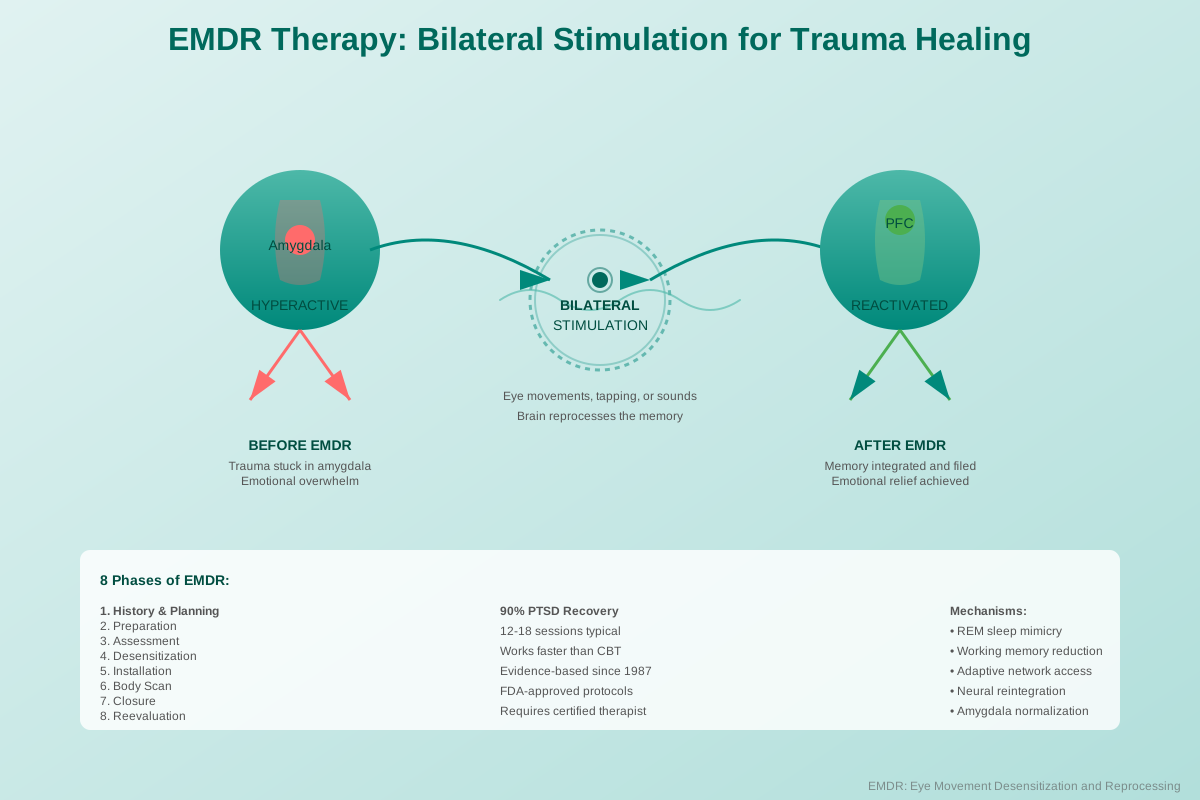
The power of EMDR lies in its simplicity: your therapist guides eye movements or bilateral stimulation while you recall your trauma, allowing your brain to reprocess the memory as if you're in REM sleep. You stay in control the entire time—you can pause, stop, or adjust the process anytime.
Thousands of veterans, accident survivors, abuse survivors, and people with anxiety have already reclaimed their lives through EMDR. This guide will show you exactly how EMDR works, the science behind it, and whether it's right for your trauma recovery journey.
What Is EMDR Therapy?
EMDR therapy (Eye Movement Desensitization and Reprocessing) is a form of psychotherapy that helps your brain reprocess traumatic memories by combining focused attention on the trauma with bilateral stimulation—rhythmic left-right eye movements, hand tapping, or alternating sounds. Developed by psychologist Francine Shapiro in 1987, EMDR is based on the theory that traumatic memories become 'frozen' in your brain because they weren't fully processed. The bilateral stimulation mimics the natural eye movements that occur during REM sleep, helping your brain unlock these stuck memories and integrate them into your life story in a healthy way.
Not medical advice.
EMDR is more than just following a moving finger. During treatment, your therapist guides you through eight structured phases designed to assess your trauma, prepare your mind and body, activate the traumatic memory, and help your brain reprocess it. What makes EMDR unique is that you don't need to relive the trauma in detail or change your thoughts about it—your brain does the natural processing. You'll experience the memory desensitize (lose its emotional sting), and positive beliefs about yourself naturally emerge as the memory is reintegrated.
Surprising Insight: Surprising Insight: Research shows EMDR can reduce PTSD symptoms in as few as 3-5 sessions, with 90% of single-trauma survivors no longer meeting PTSD criteria after 12 sessions. This speed of healing is one reason the Department of Veterans Affairs calls it an evidence-based frontline PTSD treatment.
How EMDR Reprocesses Trauma
The pathway from traumatic memory to adaptive resolution through bilateral stimulation
🔍 Click to enlarge
Why EMDR Therapy Matters in 2026
In 2026, trauma is epidemic. The American Psychological Association reports that 3.5% of U.S. adults experience PTSD in any given year, with lifetime prevalence around 9%. Workplace stress, medical trauma, violence, accidents, and pandemic-related loss continue to create traumatic memories in millions. Traditional talk therapy helps, but it's slow and expensive—often requiring 50+ sessions. EMDR offers an alternative that works faster, with research showing comparable or superior outcomes to cognitive-behavioral therapy in many studies.
The mental health crisis is a crisis of accessibility. With limited therapist availability and long wait lists, many trauma survivors never get treatment. EMDR's speed and efficiency make healing more achievable. A 2025 study published in Frontiers in Psychology found that combining EMDR with brief cognitive therapy produced faster recovery in adolescents and young adults with PTSD than traditional therapy alone. This matters because untreated trauma compounds over time—it leads to depression, anxiety, substance abuse, relationship dysfunction, and chronic health problems.
Beyond PTSD, EMDR is now being used for panic disorder, eating disorders, grief, depression, and even chronic pain. Organizations like the Veterans Affairs Department, NATO, and the World Health Organization officially recognize EMDR as an evidence-based trauma treatment. If you've been struggling with a traumatic memory for months or years, EMDR may be the breakthrough your brain has been waiting for.
The Science Behind EMDR Therapy
The mechanism of EMDR has been studied extensively using fMRI brain imaging and randomized controlled trials. When you experience trauma, your amygdala (the brain's fear center) becomes hyperactivated while your prefrontal cortex (reasoning, language, meaning-making) shuts down. This is why traumatic memories feel so vivid, uncontrollable, and disconnected from your rational mind. The memory gets locked in your brain's 'survival mode' without being properly filed away as a 'past event.'
EMDR's bilateral stimulation appears to work through multiple mechanisms: (1) The eye movements may mimic REM sleep, engaging your brain's natural memory consolidation process. (2) Bilateral stimulation may reduce the emotional intensity of the memory by taxing your working memory—your brain can't fully engage with the trauma while also tracking the moving stimulus. (3) The structured protocol helps your brain access adaptive memory networks—memories of safety, resilience, and survival—that were disconnected from the trauma. Research shows that after successful EMDR, amygdala hyperactivity normalizes and the prefrontal cortex reactivates, allowing you to remember the event without the overwhelming emotional or physical response.
Brain Changes During EMDR Processing
Neural activity in key regions before, during, and after EMDR treatment
🔍 Click to enlarge
Key Components of EMDR Therapy
Phase 1-2: History & Preparation
Your therapist gathers your complete trauma history and assesses your readiness for EMDR. They teach you grounding techniques and coping strategies so you can manage emotions between sessions. A trauma history interview identifies all target memories—past traumas, present triggers, and future situations where you want to respond differently. Your therapist also builds psychological safety and trust, which is critical for successful EMDR. You'll learn the EMDR process and practice calming techniques like safe place visualization. This phase typically takes 1-3 sessions.
Phase 3-5: Assessment, Desensitization & Installation
Your therapist identifies a specific target memory and asks you to hold it in mind while noting: (1) the image or worst moment, (2) the negative belief you hold about yourself ('I'm powerless,' 'I'm broken'), (3) the emotions and physical sensations. Then the bilateral stimulation begins—eye movements, tapping, or sounds—while you hold the memory. As you process, the memory typically changes: the image fades, emotions reduce, insights emerge. Your therapist guides you toward an adaptive belief ('I survived,' 'I'm safe now') which becomes installed as the memory loses its charge. Most reprocessing happens in these phases.
Phase 6-7: Body Scan & Closure
After the memory is desensitized, you do a body scan to check if any remaining tension or emotion is present. If residual distress exists, more processing occurs. Finally, your therapist brings you back to the present moment with grounding techniques and positive affirmations. Between sessions, you may experience continued processing as your brain naturally integrates the memory. You'll likely feel calmer, sleep better, and notice the memory has less power over you.
Phase 8: Reevaluation & Treatment Closure
At the start of each new session, your therapist checks your progress on previous targets, assesses for new traumatic memories that have surfaced, and determines next treatment steps. Once all identified traumas are processed and your symptoms resolve, treatment ends. Many people experience lasting relief after EMDR—the trauma memory remains in your mind, but it no longer triggers overwhelming emotional or physical responses.
| Therapy Type | Average Sessions | PTSD Recovery Rate | Key Mechanism |
|---|---|---|---|
| EMDR | 12-18 | 90% (single trauma) | Bilateral stimulation + memory reprocessing |
| Prolonged Exposure (PE) | 12-16 | 85-90% | Repeated trauma recall until anxiety reduces |
| Cognitive Processing (CPT) | 12-16 | 80-85% | Identifying & challenging trauma-related thoughts |
| Psychodynamic Therapy | 30-50 | 70-75% | Exploring unconscious patterns & meanings |
| Supportive Counseling | 20-40 | 50-60% | Emotional support & coping skills |
How to Apply EMDR Therapy: Step by Step
- Step 1: Find a certified EMDR therapist: Search the EMDR International Association (EMDRIA) database to locate a licensed therapist with at least 100 hours of EMDR training. This is critical—EMDR requires specific training to be safe and effective.
- Step 2: Attend your intake and history session: Share your trauma history, current symptoms, and treatment goals. Your therapist will assess your readiness and explain the EMDR process. Be honest about all traumatic events.
- Step 3: Learn grounding and coping techniques: Practice safe place visualization, 5-4-3-2-1 sensory grounding, or breathing techniques. These tools help you manage distress between sessions.
- Step 4: Identify your first target memory: Work with your therapist to select a specific traumatic memory to process first—usually a recent or impactful one. Start with one memory, not all your traumas at once.
- Step 5: Establish the negative belief: Notice what negative thought you hold about yourself related to this memory. Examples: 'I'm helpless,' 'I'm broken,' 'I'm in danger.' Rate how true it feels (0-10 scale).
- Step 6: Rate your distress level: Before processing begins, rate how distressed the memory makes you on a 0-10 scale. This helps measure progress.
- Step 7: Focus on the worst moment: Hold the traumatic image, negative belief, and associated emotions in your mind. Your therapist begins bilateral stimulation.
- Step 8: Follow the eye movements or bilateral stimulus: Keep your eyes on the therapist's moving finger, watch alternating lights, listen to alternating sounds, or feel alternating hand taps. Stay focused on the memory while the stimulation continues.
- Step 9: Notice what emerges: As processing happens, allow thoughts, images, emotions, memories, and body sensations to naturally arise. Don't try to control or analyze—just notice and follow the process.
- Step 10: Let your brain reprocess: With continued bilateral stimulation, your brain naturally begins reprocessing the trauma. The memory often shifts: images fade, emotions reduce, new insights emerge. Trust the process—it typically takes 20-45 minutes of stimulation per memory.
EMDR Therapy Across Life Stages
Young Adulthood (18-35)
Young adults often seek EMDR for recent trauma—accidents, assault, sudden loss, or combat trauma. This is the optimal time to treat trauma: the brain is still highly neuroplastic, and early intervention prevents trauma from embedding into personality. Many young adults benefit from intensive EMDR (multiple sessions per week) to quickly resolve acute trauma symptoms. EMDR is also effective for trauma carried forward from childhood abuse or neglect that resurfaces in young adulthood. Sexual assault survivors, military personnel, and accident survivors in this age group often experience rapid healing with EMDR.
Middle Adulthood (35-55)
Middle-aged adults commonly seek EMDR for complex trauma—multiple traumas over time, childhood abuse combined with adult losses, or accumulated occupational stress (police, firefighters, nurses). EMDR works well for processing medical trauma, sudden health crises, relationship betrayals, and grief. This age group often has established coping mechanisms that may interfere with EMDR initially, but once engaged, middle-aged adults typically show strong commitment to treatment and excellent outcomes. Many discover that resolving one trauma opens the door to healing other long-held traumas.
Later Adulthood (55+)
Older adults benefit from EMDR for unresolved past traumas (military service, childhood abuse), recent losses (death of spouse, serious illness), and aging-related anxieties. Studies show EMDR is safe and effective for seniors. Processing old traumas late in life often brings unexpected peace and life satisfaction. Some older adults discover that physical health improves (better sleep, reduced pain) once trauma is processed. EMDR may be combined with other medications or therapies seniors are already receiving. Cognitive decline doesn't prevent EMDR—adapted protocols work for mild cognitive impairment.
Profiles: Your EMDR Therapy Approach
The Single-Event Survivor
- Fast processing of a specific traumatic event (accident, assault, loss)
- Quick return to normal functioning with minimal therapy sessions
- Assurance that one focused trauma can be healed completely
Common pitfall: Expecting one session to erase all symptoms; underestimating the need for preparation and coping skills in phases 1-2
Best move: Commit to the full 8-phase protocol even if your trauma feels 'not that bad.' Most single-event traumas resolve beautifully in 12-18 sessions when phases aren't rushed.
The Complex-Trauma Survivor
- Multiple sessions targeting childhood trauma, abuse, and accumulated losses
- Slower, more careful pacing to prevent overwhelming the nervous system
- Integration of grounding and stabilization between sessions
Common pitfall: Trying to process everything at once; becoming overwhelmed and stopping treatment too early
Best move: Work with your therapist to prioritize which trauma to target first. Complex trauma may take 30-50 sessions, but each completed target brings noticeable relief. Pace the work sustainably.
The Skeptical Science-Seeker
- Evidence-based research showing EMDR works (peer-reviewed studies, effect sizes)
- Understanding of the neurobiological mechanism (amygdala, prefrontal cortex, REM sleep theory)
- Transparency about what EMDR can and cannot do
Common pitfall: Dismissing EMDR as 'too simple' or 'just following a finger'; missing the neuroscience behind the simplicity
Best move: Read peer-reviewed meta-analyses showing EMDR equals or exceeds traditional therapy. Review brain imaging studies. Then try it—personal experience often convinces more than data.
The Medical Professional Dealing with Occupational Trauma
- Quick processing of repeated work-related trauma (ER nurse, firefighter, surgeon)
- Techniques to prevent re-traumatization from ongoing job exposure
- Ability to process trauma without lengthy talking (time-efficient)
Common pitfall: Thinking you should 'just deal with it' because trauma exposure is part of your job; letting symptoms accumulate
Best move: Use EMDR regularly, like professional maintenance. Processing one difficult case per week prevents burnout and sustains your ability to help others. Your resilience is your responsibility.
Common EMDR Therapy Mistakes
Mistake 1: Trying EMDR without a certified therapist. EMDR-trained specialists must complete 60+ hours of didactic training and 100+ hours of supervised clinical practice. An untrained therapist using eye movements is not EMDR and can be ineffective or harmful. This is not a DIY therapy—the therapist's skill in guiding the process, tracking your responses, and adjusting interventions is what creates healing.
Mistake 2: Expecting instant relief. While some people experience rapid progress, EMDR is still psychotherapy—it requires time, multiple sessions, and commitment. The brain needs time to integrate reprocessed memories. Expecting transformation in one or two sessions sets you up for disappointment. Most people need 12-18 sessions for single-trauma PTSD; complex trauma takes longer.
Mistake 3: Skipping phases 1-2 preparation. Some therapists or clients rush into processing without adequate grounding skills or coping resources. If your nervous system doesn't have tools to self-regulate, processing trauma can overwhelm you between sessions. A good therapist prioritizes your capacity to handle the material. Trust the protocol—preparation saves you from crisis.
Common EMDR Mistakes & How to Avoid Them
Pitfalls in EMDR treatment and the corrective action for each
🔍 Click to enlarge
Science and Studies
EMDR therapy is one of the most extensively researched psychotherapies for trauma. Over 30 randomized controlled trials have examined its effectiveness. The evidence shows EMDR is equally effective as trauma-focused cognitive-behavioral therapy (TF-CBT) and prolonged exposure (PE) in treating PTSD, with some studies suggesting superior or faster outcomes. A 2024 meta-analysis in Frontiers in Psychology found that EMDR reduced depression symptoms by 58% on average and anxiety by 61% in trial participants. The American Psychological Association conditionally recommends EMDR as a first-line treatment for PTSD in adults. The Veterans Affairs Department and Department of Defense recognize EMDR as evidence-based for military-related PTSD. The World Health Organization includes EMDR in clinical guidelines for trauma treatment.
- Shapiro, F. (1989). 'Eye Movement Desensitization: A New Treatment for Post-traumatic Stress Disorder.' Journal of Behavior Therapy, showing the original discovery of EMDR's effectiveness in single-session case studies.
- American Psychological Association (2017). 'Clinical Practice Guideline for the Treatment of PTSD in Adults,' conditionally recommending EMDR as equivalent to cognitive-behavioral therapies.
- Chen, L., Zhang, G., Hu, M., et al. (2015). 'The Meta-analysis of EMDR Efficacy in PTSD Treatment: A Systematic Review and Meta-regression Analysis,' confirming EMDR's evidence-based status.
- Nijdam, M. J., Gooitzen, H. M., & Olff, M. (2012). 'Preventing PTSD in Soldiers Using EMDR,' showing application in military personnel at highest risk.
- Faretta, E. (2012). 'The Efficiency, Efficacy and Neurobiological Correlates of EMDR in the Treatment of Complex PTSD,' examining brain imaging evidence for EMDR's mechanisms.
Your First Micro Habit
Start Small Today
Today's action: Today, identify one traumatic memory or trigger that affects your life, write 2-3 words describing it, and search for a certified EMDR therapist in your area using the EMDRIA directory (emdria.org/search). No appointment needed yet—just know your options exist.
Action creates momentum. Simply knowing a qualified therapist exists in your area makes treatment feel possible. Many trauma survivors wait years without taking this first step. Searching the EMDR directory takes 5 minutes but transforms 'I should get help' into 'I know where to go.'
Track your healing journey and get accountability with our app—log your therapy sessions, rate your progress, and celebrate milestones.
Quick Assessment
How often does a traumatic memory interfere with your daily life (intrusive thoughts, nightmares, avoidance)?
Frequent intrusions (options 3-4) suggest EMDR could bring rapid relief. Occasional triggers (option 2) mean your brain is still processing but coping. If EMDR appeals to you at any level, talking to a certified therapist is the next step.
How long have you carried this traumatic memory?
Recent traumas (under 2 years) often respond fastest to EMDR, sometimes in 8-12 sessions. Older traumas may take longer but are still very treatable. The longer you wait, the more the trauma embeds into your identity—early intervention tends to be most efficient.
What appeals to you most about EMDR?
Your answer shows what draws you to EMDR. If speed matters most, EMDR is ideal. If you're motivated by science, read the research. If reliving trauma feels impossible, EMDR's less-detailed approach may fit. All these reasons are valid—EMDR works differently for different people.
Take our full assessment to get personalized recommendations for your wellbeing journey.
Discover Your Style →Next Steps
If EMDR resonates with you, take action today. Search the EMDR International Association (EMDRIA) database at emdria.org/search to find certified therapists near you. Look for therapists with 'EMDR Certified' or 'EMDR Trained' credentials and read their profiles. Many offer free 15-minute phone consultations—use this to ask questions about their experience, their typical session structure, and how they approach your specific trauma. Trust your gut: a good therapeutic match matters as much as the therapy itself.
Remember: your brain wants to heal. Trauma memories get stuck, but they're not permanent. With the right support, EMDR can help your brain complete what it started—processing the memory and reintegrating it into your life story. Freedom from trauma is possible, and it can happen faster than you think. The first step is always the hardest, but you've already taken it by learning about EMDR. The next step is scheduling that appointment. Your future self will thank you.
Get personalized guidance for your mental health recovery with AI coaching.
Start Your Journey →Research Sources
This article is based on peer-reviewed research and authoritative sources. Below are the key references we consulted:
Related Glossary Articles
Frequently Asked Questions
Does EMDR really work, or is it just placebo?
EMDR is supported by over 30 randomized controlled trials published in peer-reviewed journals. Brain imaging studies show actual neurological changes: reduced amygdala hyperactivity and normalized prefrontal cortex function after EMDR. While placebo effects exist in all therapy, EMDR's effects exceed placebo alone. The American Psychological Association, Veterans Affairs, and NATO all recognize EMDR as evidence-based. That said, any therapy's effectiveness depends on a good therapeutic relationship and your commitment to the process.
Can I do EMDR on my own or with a friend?
No. EMDR requires specific training, clinical judgment, and therapeutic skill that only certified therapists possess. A certified EMDR therapist completes 60+ hours of didactic training and 100+ hours of supervised practice. The therapist must assess your readiness, track your responses during processing, know when to continue or pause, and handle any destabilization. Attempting DIY EMDR or getting a friend to do eye movements while you process trauma is not EMDR and could be ineffective or harmful. Find a certified therapist.
How many sessions does EMDR take?
For single-incident trauma, most people see significant relief in 12-18 sessions (one per week, 50-90 minutes each). Some people see relief in 3-5 sessions. Complex trauma involving multiple incidents, childhood abuse, or accumulated loss may take 30-50+ sessions. Your therapist will give you an estimate after your initial assessment. Not all sessions are the same length—processing sessions may be longer than preparation or reevaluation sessions.
What if EMDR doesn't work for me?
EMDR works for about 90% of single-trauma PTSD cases and 70-80% of complex trauma cases. If you're in the smaller group where EMDR doesn't help, that doesn't mean you can't heal—it means a different therapy might work better for you. Some people benefit from combining EMDR with trauma-focused cognitive-behavioral therapy (TF-CBT) or other approaches. Factors that predict poorer EMDR outcomes include active substance abuse, untreated bipolar disorder, or severe dissociation. Discuss your specific situation with your therapist.
Is EMDR safe? Could it make things worse?
EMDR is generally safe when conducted by a certified therapist. The structured protocol includes preparation phases that build your coping skills before processing begins. You're in control—you can pause or stop anytime. That said, processing trauma can temporarily intensify emotions or nightmares as your brain reprocesses. This is normal and usually resolves within 24-48 hours. If you have active suicidality, severe dissociation, or uncontrolled substance abuse, your therapist may recommend stabilization before EMDR. Full disclosure of your mental health history helps your therapist determine if EMDR is appropriate and safe for you now.
Take the Next Step
Ready to improve your wellbeing? Take our free assessment to get personalized recommendations based on your unique situation.
- Discover your strengths and gaps
- Get personalized quick wins
- Track your progress over time
- Evidence-based strategies