Creatine
Creatine is one of the most researched and proven supplements for enhancing muscle strength, athletic performance, and cognitive function. This naturally occurring compound, synthesized in your body from amino acids, works by boosting cellular energy production, enabling you to train harder, recover faster, and build lean muscle more effectively. Whether you're an athlete seeking performance gains, someone focused on strength training, or an aging adult concerned with maintaining muscle mass and brain health, creatine offers compelling science-backed benefits supported by over 25 years of rigorous research involving thousands of participants across all ages and fitness levels.
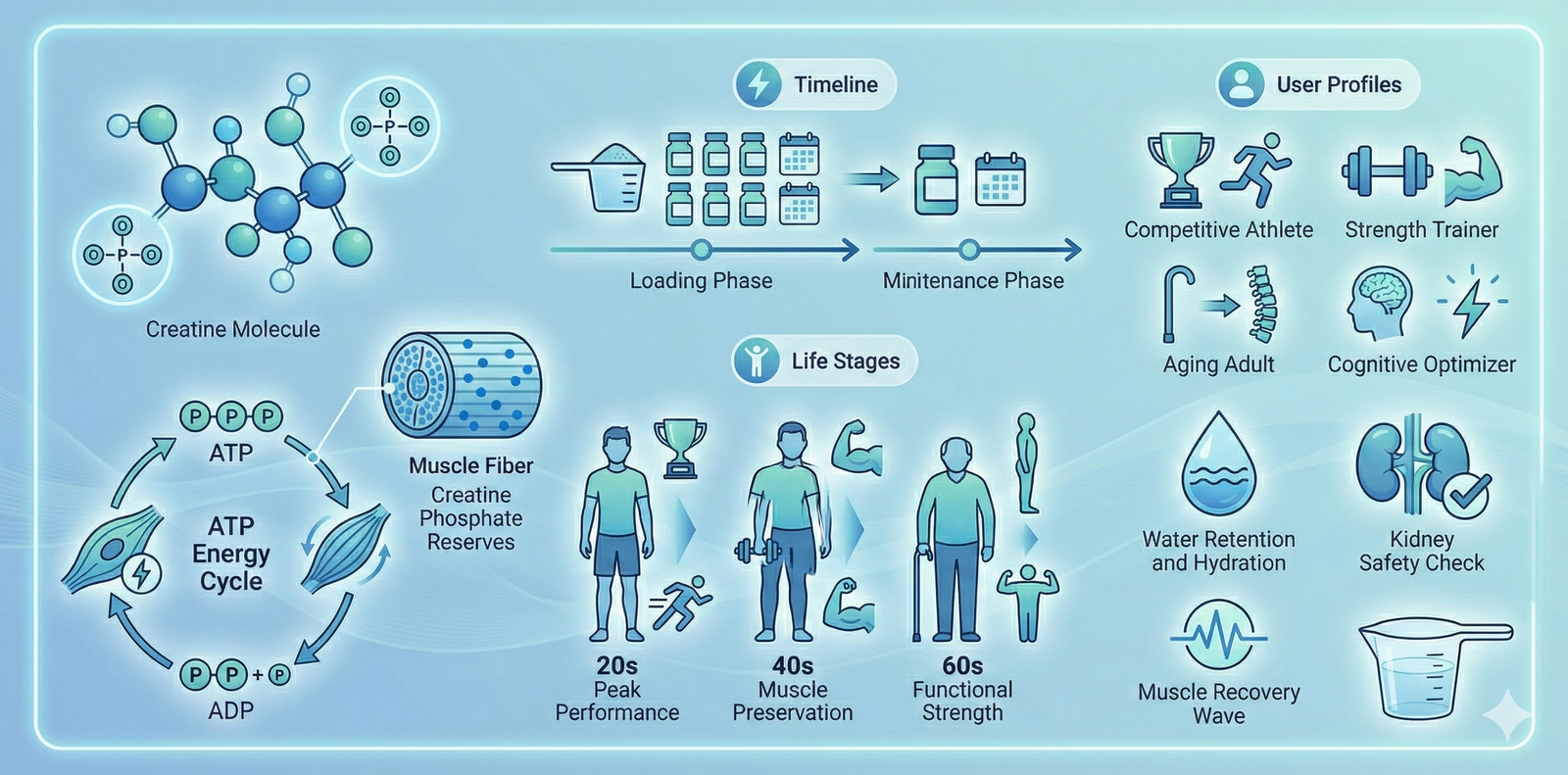
The most striking finding: creatine monohydrate supplementation combined with resistance training produces an 8% greater increase in muscle strength compared to training alone—with documented gains in lean body mass, functional ability, and even cognitive markers in recent clinical trials.
Recent 2025 research shows creatine may support brain health and healthy aging beyond just muscle building, with emerging evidence for cognitive benefits and potential applications in neurodegenerative conditions.
What Is Creatine?
Creatine is a naturally occurring amino acid compound synthesized primarily in your kidneys and liver from arginine, glycine, and methionine. Your body produces approximately 1 gram of creatine daily, while dietary sources like meat, fish, and eggs contribute additional amounts. About 95% of the creatine in your body is stored as phosphocreatine in skeletal muscle tissue, where it plays a critical role in ATP (adenosine triphosphate) regeneration—the primary energy currency your cells use during intense physical activity.
Not medical advice.
When you engage in high-intensity exercise lasting seconds to minutes, your muscles rapidly deplete ATP. Phosphocreatine acts as a backup energy source, donating a phosphate group to ADP to quickly regenerate ATP, sustaining muscle contractions during brief bursts of maximal effort. Creatine supplementation increases intramuscular creatine and phosphocreatine concentrations, expanding this energy buffer and allowing you to perform more repetitions, heavier weights, or faster sprints before fatigue sets in.
Surprising Insight: Surprising Insight: Meta-analyses of over 12,800 study participants show creatine monohydrate supplementation poses no safety concerns for kidney function, liver health, or athletic performance even at doses up to 30 grams daily for 14 years—making it one of the most thoroughly researched and well-tolerated nutritional supplements available.
How Creatine Powers Your Muscles
The cellular energy pathway showing how creatine supplementation increases ATP availability during high-intensity exercise
🔍 Click to enlarge
Why Creatine Matters in 2026
In 2026, creatine supplementation has gained renewed scientific attention beyond traditional sports nutrition contexts. The International Society of Sports Nutrition, American Academy of Sports Medicine, and major sports organizations now recognize creatine as a cornerstone ergogenic aid backed by robust evidence. Recent research from 2024-2025 has expanded our understanding of creatine's benefits to include cognitive enhancement, bone health support, and therapeutic applications for neurodegenerative conditions like Alzheimer's disease.
For athletes and fitness enthusiasts, creatine remains the most effective legal supplement for increasing strength gains and lean muscle mass during resistance training. Studies consistently show that creatine users gain 1-2 kg more lean mass over 8-12 weeks compared to placebo when combined with strength training. For aging populations, creatine offers a safe intervention for combating sarcopenia (age-related muscle loss) and maintaining functional independence. For cognitively active individuals and those focused on brain health, emerging evidence suggests creatine supplementation may enhance memory, processing speed, and potentially provide neuroprotective benefits.
The convergence of these benefits makes creatine particularly relevant to busy professionals, aging adults, and performance-focused individuals seeking evidence-based interventions that address multiple dimensions of health—physical strength, cognitive vitality, and functional longevity—through a single, safe, cost-effective supplement.
The Science Behind Creatine
The mechanism of creatine's effect on athletic performance operates through adenosine triphosphate (ATP) energy metabolism. During high-intensity exercise, ATP—the energy currency of cells—is rapidly hydrolyzed to provide energy for muscle contractions. Phosphocreatine serves as a rapid-acting ATP buffering system, donating its phosphate group to ADP to regenerate ATP within seconds. Creatine supplementation increases intramuscular phosphocreatine stores by 20-40%, extending the duration during which muscles can maintain maximal force production before ATP depletion forces a reduction in effort intensity.
Beyond the energy system, creatine supports muscle hypertrophy through several mechanisms: enhanced work capacity allowing greater training volume, increased myogenic satellite cell activation driving muscle protein synthesis, improved recovery between sets through faster ATP regeneration, and potentially direct effects on muscle protein expression. Neurologically, creatine crosses the blood-brain barrier and supports cerebral ATP production and methylation reactions, explaining emerging cognitive benefits documented in recent trials showing improvements in memory, processing speed, and attention in both young adults and aging populations.
Creatine Effects Across Body Systems
Multi-system benefits of creatine supplementation spanning muscular performance, energy metabolism, bone health, and cognitive function
🔍 Click to enlarge
Key Components of Creatine
Creatine Monohydrate
Creatine monohydrate is the most researched, cost-effective, and effective form of creatine supplementation. It consists of creatine bound to a monohydrate (one water molecule), with hundreds of peer-reviewed studies demonstrating its efficacy for increasing muscle strength, power output, and lean mass during resistance training. Approximately 95% of creatine supplementation studies utilize creatine monohydrate, making it the gold standard. It's affordable, shelf-stable, and produces consistent results across diverse populations from adolescents to elderly adults.
Phosphocreatine (The Active Form)
Phosphocreatine is the active form of creatine stored in muscle tissue that directly participates in ATP regeneration. When you supplement with creatine monohydrate, your body converts it to phosphocreatine, which accumulates in muscles over 2-4 weeks until saturation. Higher intramuscular phosphocreatine concentrations extend your capacity to maintain maximum force production during repeated high-intensity efforts, enabling you to perform additional repetitions or maintain heavier loads before strength declines.
ATP-ADP Cycle (Energy Production)
The ATP-ADP cycle is the fundamental energy mechanism creatine supports. ATP (adenosine triphosphate) provides energy by breaking one high-energy phosphate bond, converting to ADP (adenosine diphosphate). During intense exercise, ADP accumulates as ATP is rapidly consumed. Phosphocreatine donates its phosphate to ADP, regenerating ATP and maintaining energy availability. Increased phosphocreatine from supplementation speeds this regeneration process, sustaining muscle contractions during brief maximal efforts. This mechanism underlies creatine's proven benefits for strength training, power sports, and repeated high-intensity intervals.
Body Creatine Stores (Saturation Kinetics)
Your body maintains creatine stores primarily in skeletal muscle, with smaller amounts in the brain, heart, and kidneys. Creatine supplementation increases intramuscular creatine concentration from baseline levels (~120 mmol/kg dry muscle) to saturated levels (~160 mmol/kg dry muscle)—a 20-40% increase. This saturation occurs gradually over 2-4 weeks with 3-5 grams daily, or 4-7 days with a loading protocol of 20 grams daily divided into 4-5 doses. Individual saturation kinetics vary based on muscle mass, training status, vegetarian diet (lower baseline stores), and genetic factors affecting creatine transporter efficiency.
| Protocol Type | Duration to Saturation | Daily Dosage | Muscle Strength Gain |
|---|---|---|---|
| Standard Loading | 4-7 days | 20g/day (4-5 doses) × 5-7 days, then 3-5g/day | 8-20% increase with training |
| No Loading | 21-28 days | 3-5g/day continuous | 8-15% increase with training |
| Higher Maintenance | 14-21 days | 8-10g/day continuous | 12-25% increase; cognitive benefits |
| Aging Adults | 28 days | 5-7g/day with resistance training | 10-18% strength gain; improved function |
How to Apply Creatine: Step by Step
- Step 1: Choose creatine monohydrate: Select a reputable brand offering micronized creatine monohydrate (100% pure, unflavored) at 99.9% purity—this is the most researched, cost-effective, and effective form. Brands should list 'creatine monohydrate' as the sole ingredient.
- Step 2: Decide your protocol: Choose between a loading phase (20g/day for 5-7 days, then 3-5g/day) for faster saturation, or no-loading protocol (3-5g/day from day one) which takes 3-4 weeks but avoids potential gastrointestinal discomfort. Both approaches produce identical long-term results.
- Step 3: Mix with fluids: Dissolve your creatine dose (3-10g) in 200-300ml of water or combine with fruit juice (carbohydrates enhance creatine uptake via insulin). Stir well as creatine is relatively insoluble in cool water; warm water improves dissolution.
- Step 4: Time strategically: Consume creatine with meals or post-workout snacks when insulin levels are elevated, as this enhances creatine transporter activity and muscle uptake. Consistent timing matters less than total daily intake, so pick a time that fits your routine.
- Step 5: Start resistance training: Begin or intensify a structured strength training program combining compound movements (squats, deadlifts, bench press) with hypertrophy-focused repetitions (6-12 reps per set, 3-4 sets per exercise). Creatine amplifies strength gains only when combined with resistance training.
- Step 6: Stay hydrated: Increase daily water intake by 500-1000ml above baseline, as creatine draws water into muscle cells (beneficial for performance but requires adequate total body hydration). Aim for pale yellow urine indicating proper hydration status.
- Step 7: Continue consistently: Maintain creatine supplementation daily at 3-5g (or 8-10g for enhanced cognitive/aging benefits) regardless of training days. Creatine effect depends on sustained elevated intramuscular levels, requiring daily intake even on rest days.
- Step 8: Monitor strength progression: Track barbell weights, repetitions, or machine loads weekly. Expect to notice strength gains within 2-4 weeks as creatine saturation increases alongside training adaptations. Typical gains: 5-20% strength increase, 1-2kg lean mass gain over 8-12 weeks.
- Step 9: Assess energy & performance: Notice improved recovery between sets, ability to perform additional repetitions with familiar weights, and reduced muscle fatigue during high-intensity efforts. These subjective performance metrics precede measurable body composition changes by 1-2 weeks.
- Step 10: Maintain long-term: Continue creatine supplementation indefinitely while training, as there are no known adverse effects with multi-year use. Stop supplementation and expect creatine stores to deplete and return to baseline over 3-4 weeks post-cessation.
Creatine Across Life Stages
Young Adulthood (18-35)
Young adults benefit from creatine supplementation primarily through enhanced strength and lean muscle gains during resistance training. This age group typically has high baseline ATP turnover during intense workouts, and creatine amplifies training adaptations by improving work capacity (ability to perform additional sets and repetitions). Research shows creatine enables young adults to gain 1-2kg additional lean mass over 8-12 weeks compared to training alone. Additionally, emerging evidence suggests cognitive benefits for memory and processing speed during peak mental performance years. For athletes in explosive sports (sprinting, weightlifting, soccer), creatine provides measurable performance gains for repeated high-intensity efforts.
Middle Adulthood (35-55)
Adults in midlife face declining natural testosterone and growth hormone, contributing to gradual muscle loss (~0.5-1% yearly). Creatine supplementation combined with resistance training directly counters this trend, preserving muscle mass and strength during this critical decade. Studies show middle-aged adults achieve 10-18% strength gains and measurable functional improvements (stair climbing, standing from a chair) with creatine plus training. This age group particularly benefits from combined muscular and cognitive benefits, with recent trials showing memory improvements and processing speed enhancements relevant to work performance and mental acuity. Creatine is especially valuable for busy professionals balancing work and fitness, as it amplifies training efficiency—enabling greater results from fewer weekly training sessions.
Later Adulthood (55+)
Aging adults (55+) represent the demographic with perhaps the greatest benefit from creatine supplementation. Sarcopenia (age-related muscle loss) accelerates after age 50, contributing to falls, frailty, and lost independence. Meta-analyses show creatine monohydrate (5-7g daily) combined with resistance training significantly improves muscle strength, whole-body lean mass, regional muscle size and density, bone area and thickness, and functional capacity (walking speed, stair climbing) in older adults. A 2025 Alzheimer's disease trial using 20g daily creatine showed preliminary evidence for cognitive benefits. For aging adults, creatine offers a safe, evidence-based intervention addressing multiple domains simultaneously: preserving muscle mass and strength, maintaining bone density, supporting functional independence, and potentially supporting cognitive health—making it particularly relevant to healthy aging strategy.
Profiles: Your Creatine Approach
The Competitive Athlete
- Maximum strength and power gains for sports performance
- Fast ATP regeneration during repeated high-intensity efforts
- Enhanced recovery between training sessions and competitions
Common pitfall: Expecting immediate results before creatine saturation (takes 2-4 weeks) or using ineffective creatine forms that lack research backing
Best move: Use standard creatine monohydrate at 3-5g daily (no loading necessary), integrate into periodized strength training program, time intake post-workout with carbohydrates and protein for optimal absorption, track performance metrics weekly
The Strength Trainer Seeking Muscle Gain
- Additional work capacity to perform more repetitions and sets
- Enhanced lean muscle gain from training-induced hypertrophy
- Faster recovery enabling more frequent or intense training volume
Common pitfall: Assuming creatine alone builds muscle without adequate resistance training or consuming insufficient protein for muscle protein synthesis
Best move: Combine creatine monohydrate (3-5g daily) with progressive resistance training targeting 6-12 rep ranges, ensure adequate daily protein intake (1.6-2.2g per kg body weight), maintain consistent training for 8-12 weeks to observe measurable lean mass gains (1-2kg typical)
The Aging Adult Focused on Functional Health
- Preservation and restoration of muscle mass and strength
- Maintenance of bone density and functional independence
- Support for cognitive function and brain health during aging
Common pitfall: Starting creatine without concurrent resistance training (creatine requires muscle-loading stimulus to show benefit) or taking insufficient doses (older adults may benefit from 5-7g daily, higher than standard recommendations)
Best move: Use 5-7g creatine monohydrate daily with twice-weekly resistance training emphasizing compound movements (squats, deadlifts, row variations), ensure adequate hydration and total protein intake, expect 8-18 weeks for noticeable functional improvements (stair climbing ease, rising from chairs, walking speed)
The Cognitive Performance Optimizer
- Enhanced memory, processing speed, and mental clarity
- Support for brain ATP production and mitochondrial function
- Long-term neuroprotection and cognitive aging prevention
Common pitfall: Expecting cognitive benefits without resistance training (which independently supports brain health) or using insufficient doses (cognitive trials use 8-10g, higher than traditional sports doses)
Best move: Use 8-10g creatine monohydrate daily (higher than standard sports recommendations), combine with both resistance training and aerobic exercise for synergistic brain benefits, maintain consistent supplementation for 4-8 weeks before assessing cognitive changes (memory, word recall, mental processing speed improvements)
Common Creatine Mistakes
The most frequent mistake is expecting creatine to build muscle in the absence of resistance training. Creatine is not an anabolic hormone; it simply provides enhanced energy substrate for muscle contractions. Without the mechanical tension and metabolic stress from strength training, creatine supplementation produces minimal muscle growth. Combine creatine with a well-designed resistance program for results.
Second mistake: discontinuing creatine prematurely, believing 2-3 weeks of use should show results. Creatine requires 2-4 weeks to saturate muscle tissue and 8-12 weeks of consistent use plus training to produce observable strength and body composition changes. Initial feelings of bloating (from increased intramuscular water) are not 'wasted' creatine—they indicate successful muscle uptake. Continue supplementation and allow the training stimulus to drive strength gains.
Third mistake: using high loading doses (20g daily) without considering gastrointestinal side effects. While loading accelerates saturation by a few days, it increases risk of stomach upset, especially if consumed in single large doses. Standard non-loading protocol (3-5g daily) eliminates this risk while producing identical long-term results over a 3-4 week timeframe. Choose consistency over speed when managing a sensitive stomach.
Common Creatine Mistakes & Solutions
Visualization of three primary mistakes people make with creatine supplementation and evidence-based corrections
🔍 Click to enlarge
Science and Studies
The scientific evidence for creatine monohydrate spans over 25 years of rigorous peer-reviewed research involving thousands of participants across diverse age groups, fitness levels, and athletic backgrounds. Meta-analyses and systematic reviews consistently demonstrate creatine's efficacy for enhancing muscle strength, power output, lean body mass, and functional capacity when combined with resistance training. Recent 2024-2025 research has expanded the understanding of creatine's benefits beyond athletics to include cognitive enhancement, bone health support, and potential neuroprotection in aging and disease states.
- Creatine supplementation and resistance training produce an 8% greater increase in muscle strength compared to training alone (meta-analysis, 22 studies, Journal of the International Society of Sports Nutrition)
- Combined creatine and exercise increases lean body mass by 1-2kg over 8-12 weeks, with 14% greater gains in weightlifting performance versus placebo (NIH/PubMed systematic review, 2023)
- Recent 2024 meta-analysis of 16 randomized controlled trials shows creatine significantly improves memory and processing speed, with moderate certainty of evidence for cognitive benefits (Frontiers in Nutrition)
- Creatine monohydrate supplementation (≥3g daily) in older adults improves muscle strength, whole-body lean mass, regional muscle size, bone area and thickness, and functional ability with no serious adverse effects noted across 20+ years of research (PMC, 2025)
- Two Alzheimer's disease trials (2025) using 20g creatine daily for 8 weeks showed significant improvements in cognitive markers and preliminary evidence for increased brain creatine concentration via MRI imaging (Alzheimer's & Dementia, Smith et al.)
Your First Micro Habit
Start Small Today
Today's action: Day 1: Purchase one container of creatine monohydrate powder (100% pure, unflavored) and mix 5 grams with 8 oz of water or juice immediately after your next workout. Drink within 30 seconds, then continue your normal post-workout meal.
Starting with a single daily dose makes supplementation automatic and eliminates decision fatigue. Post-workout consumption with fluid and carbohydrates enhances creatine muscle uptake. This creates the habit anchor (post-workout routine) that makes consistency effortless over the following 4-12 weeks as creatine saturates muscle tissue.
Track your daily creatine intake and monitor strength metrics with our app's built-in workout logging—connect your performance gains to this simple daily habit.
Quick Assessment
How would you describe your current approach to strength training or physical fitness?
Your answer helps determine whether creatine would be immediately beneficial (response 3-4) or whether starting a resistance program first would maximize your return on supplementation investment.
What is your primary health and performance goal over the next 6-12 months?
Goals 1 and 3 show the strongest alignment with creatine's evidence-based benefits. Goals 2-4 require combining creatine with consistent training for maximum impact.
How would you characterize your consistency with long-term health habits (supplements, exercise, nutrition)?
Creatine requires 8-12 weeks minimum combined with training for observable benefits. Responses 3-4 indicate high probability of experiencing meaningful results. Responses 1-2 suggest focusing first on building core training consistency before adding supplementation.
Take our full assessment to get personalized recommendations for optimizing your fitness and health strategy.
Discover Your Style →Next Steps
If you're committed to enhancing strength, building lean muscle, or supporting cognitive health, creatine monohydrate supplementation combined with resistance training offers compelling evidence-based benefits. Your immediate next step is to assess your current training consistency: if you're already training with weights 2-4 times weekly, creatine will amplify your results within 4-12 weeks. If you don't yet have a structured resistance program, start with 2-3 weeks of consistent training before adding creatine supplementation—this builds the habit foundation and ensures you'll maintain the 8-12 week protocol necessary to experience full benefit.
Select one specific action from this article that resonates with your goals. Whether it's purchasing your first container of creatine monohydrate, scheduling your first week of resistance training sessions, or committing to 8-10g daily dosing for cognitive benefits—choose a single micro habit to start with, implement it for the next 4-12 weeks, and track your progress weekly. The majority of people who experience creatine's transformative effects began with a single small decision to optimize one aspect of their training, nutrition, or health routine.
Get personalized guidance with AI coaching for building sustainable training and supplementation habits.
Start Your Journey →Research Sources
This article is based on peer-reviewed research and authoritative sources. Below are the key references we consulted:
Related Glossary Articles
Frequently Asked Questions
Does creatine cause kidney damage?
No. Meta-analyses of over 12,800 participants show no evidence that creatine monohydrate at recommended doses (3-5g daily) damages kidney function in otherwise healthy individuals. Research spanning 20+ years with doses up to 30g daily for 14 years found no adverse renal effects. People with existing kidney disease should consult their doctor before supplementing.
Will creatine make me gain water weight?
Yes, initially. Creatine draws water into muscle cells, typically causing 0.5-1kg weight gain in the first 1-2 weeks as intramuscular water content increases. This is not fat gain—it's beneficial intramuscular hydration that supports muscle performance. Muscle tone improves as creatine combines with training stimulus to build lean mass. Long-term body composition changes favor lean mass over body fat when combined with resistance training.
Is creatine safe for women?
Yes, creatine is equally safe and effective for women. Research shows women benefit from creatine's strength, power, and lean mass gains identically to men when combined with resistance training. Creatine does not affect hormones or cause androgenic effects. Dosing is the same: 3-5g daily regardless of sex. Some research suggests women may require slightly longer saturation periods, but final outcomes are identical.
Can teenagers take creatine?
Yes. International Society of Sports Nutrition states creatine is safe for athletes of all ages when proper hydration and training protocols are followed. Adolescents (15+) can supplement safely at standard adult doses. The American Academy of Pediatrics recognizes creatine as safe for teenage athletes. Younger individuals (under 15) should consult their pediatrician, though research suggests no safety concerns even at young ages.
How long until I see results from creatine?
Strength gains typically become noticeable within 2-4 weeks as creatine saturates muscle tissue and training begins accumulating mechanical tension. Observable body composition changes (measurable muscle gain, increased definition) usually appear after 8-12 weeks combined with progressive resistance training. Cognitive benefits (memory, processing speed) may appear within 4-8 weeks at higher doses (8-10g daily). Patience and consistency are essential; discontinuing prematurely prevents experiencing creatine's full benefit.
Take the Next Step
Ready to improve your wellbeing? Take our free assessment to get personalized recommendations based on your unique situation.
- Discover your strengths and gaps
- Get personalized quick wins
- Track your progress over time
- Evidence-based strategies