Backdoor Roth IRA
If you earn over $168,000 (single) or $252,000 (married filing jointly) in 2026, you're locked out of direct Roth IRA contributions. But here's the opportunity: a backdoor Roth IRA lets you bypass these income limits and build tax-free retirement wealth legally. This strategy transforms after-tax dollars into a powerhouse account where every dollar grows free from taxes forever. High-income professionals—doctors, lawyers, entrepreneurs, and executives—use this approach to accumulate wealth that compounds untaxed for decades. The process is straightforward once you understand the mechanics, but the pro-rata rule can trip up the unprepared. Let's unlock this wealth-building tool and show you exactly how to execute it.
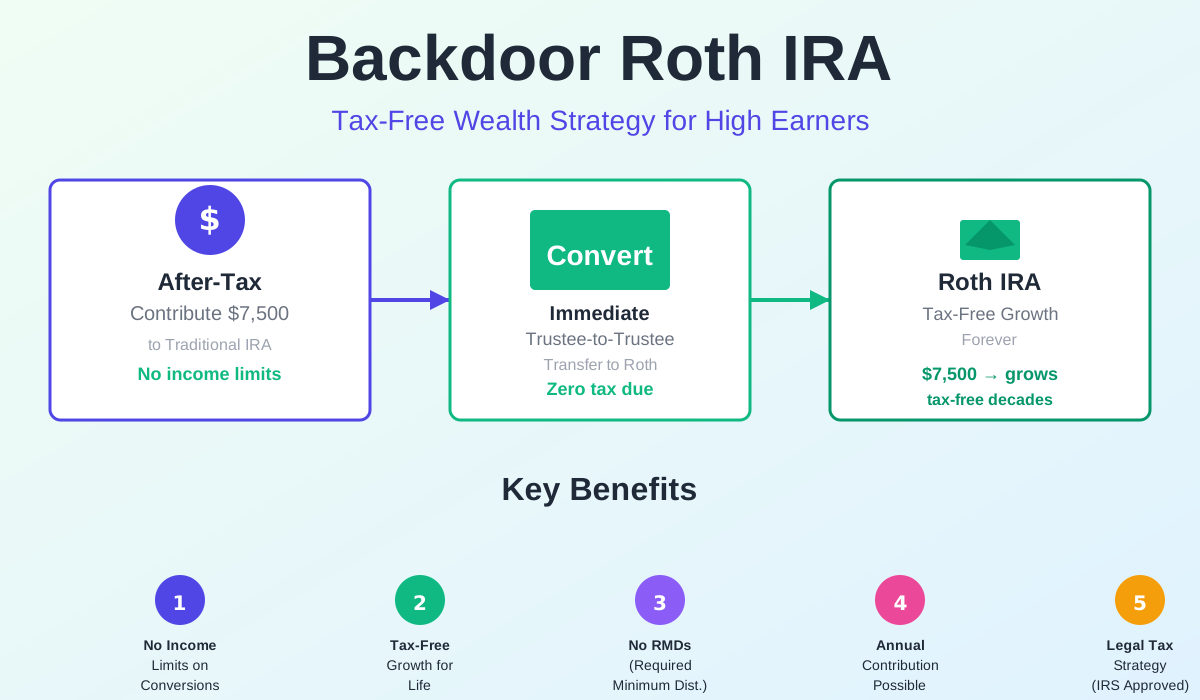
You contribute $7,500 ($8,600 if age 50+) to a traditional IRA with after-tax dollars, then immediately convert it to a Roth—no income limits apply to conversions.
The power: your contribution grows tax-free forever, and qualified withdrawals after age 59.5 are 100% tax-free—no capital gains, no dividends taxed, no annual limits.
What Is Backdoor Roth IRA?
A backdoor Roth IRA is a legal tax strategy that allows high-income earners to contribute to a Roth IRA by working around the income limits. You make a non-deductible contribution to a traditional IRA with after-tax money, then convert that balance to a Roth IRA. Because there are no income limits on conversions—only on direct contributions—this approach is available to anyone, regardless of earnings. The IRS explicitly allows this strategy; it's codified in tax law and used by millions of high earners annually.
Not financial or tax advice. Consult a tax professional for your specific situation.
The term 'backdoor' describes the method, not anything illegal. You're using the conversion loophole intentionally and transparently, reporting everything on Form 8606 when you file taxes. The IRS knows about it, expects it, and provides the form to track it properly.
Surprising Insight: Surprising Insight: An estimated 90%+ of backdoor Roth mistakes involve the pro-rata rule creating unexpected tax bills. The IRS receives fewer than 1% of backdoor Roth contribution reports correctly—yet it remains one of the highest-ROI retirement strategies available.
Backdoor Roth IRA Process Flow
Three-step visualization of the backdoor Roth conversion: contribute $7,500 after-tax to traditional IRA, immediately convert to Roth, and enjoy tax-free growth forever.
🔍 Click to enlarge
Why Backdoor Roth IRA Matters in 2026
Tax-free wealth accumulation is the ultimate competitive advantage in retirement planning. A backdoor Roth contribution today could grow into hundreds of thousands tax-free by retirement. With traditional 401(k)s and traditional IRAs, every dollar withdrawn is taxable income, potentially pushing you into higher brackets or triggering Medicare premium increases. A Roth flips this model: qualified distributions are 100% tax-free, no matter how large the account. For high earners paying 35-40% in combined federal and state taxes, this strategy can save $50,000-$100,000+ over a lifetime per person.
In 2026, inflation continues eroding purchasing power. Building tax-free accounts through backdoor Roths protects wealth from future tax rate increases. If tax brackets rise (historically likely), the tax-free nature of your Roth becomes even more valuable. You've locked in today's tax burden while allowing decades of growth to escape taxation entirely.
For married couples, doubling down with dual backdoor Roths ($15,000-$17,200 combined annually) creates a substantial tax-free retirement cushion. Done consistently for 30 years, this strategy can build $500,000+ in tax-free assets, especially with market growth. No contribution limits apply to conversions—only to the initial IRA contributions.
The Science Behind Backdoor Roth IRA
The backdoor Roth exploits a unique gap in tax law. Section 408(d)(1) of the Internal Revenue Code allows rollovers from traditional IRAs to Roth IRAs with no income restrictions. Meanwhile, Section 408(a)(1) allows anyone to contribute to a traditional IRA. The strategy connects these two provisions: you contribute after-tax dollars (bypassing Roth's income limits) and then convert (using the unlimited conversion rule). The 2010 Tax Increase Prevention Act eliminated the income cap on Roth conversions entirely, making backdoor Roths accessible to everyone.
The pro-rata rule, governed by IRC Section 408(d)(2), is the critical complication. It requires the IRS to treat all your traditional IRAs, SEP-IRAs, and SIMPLE IRAs as one combined pool for tax purposes. If 80% of this pool is pre-tax contributions, then 80% of any conversion is taxable. This means having existing pre-tax IRA balances can destroy a backdoor Roth's tax efficiency unless you roll them into a 401(k) first (401(k)s aren't subject to the pro-rata rule).
Pro-Rata Rule Tax Calculation
Demonstrates how the pro-rata rule calculates taxable portions of backdoor Roth conversions when pre-tax IRA funds exist.
🔍 Click to enlarge
Key Components of Backdoor Roth IRA
Non-Deductible Contribution
The first step is contributing $7,500 (or $8,600 if age 50+) in 2026 to a traditional IRA with after-tax dollars. This is not a deductible contribution—you don't get a tax break for it. Instead, you're establishing a 'basis' in the IRA, documenting that you've already paid taxes on these dollars. File Form 8606 (lines 1-2) to record this non-deductible contribution with the IRS.
Immediate Conversion to Roth
Within days (ideally 1-30 days) of the traditional IRA contribution, convert the funds to a Roth IRA. The speed matters: if the market fluctuates significantly before conversion, the value could change, creating tax complications. Use your brokerage's conversion tool to initiate a 'direct trustee-to-trustee transfer' (Roth accounts at the same institution receive traditional IRA balance and convert it). This avoids the 60-day rule and creates a clear paper trail.
Form 8606 Filing
Attach Form 8606 (Nondeductible IRAs) to your federal tax return every year you execute a backdoor Roth. This form has two parts: Part I records your non-deductible contributions, and Part II calculates the tax consequences if you convert. The IRS uses this form to track your basis (after-tax contributions) across all your IRAs. Failure to file Form 8606 can result in being taxed on the same money twice—once on the conversion and again on distributions.
Pro-Rata Rule Avoidance
If you have pre-tax IRA balances from old 401(k) rollovers, SEP-IRAs, or SIMPLE IRAs, roll them into your current employer's 401(k) plan before executing the backdoor Roth. Employer plans are exempt from the pro-rata rule—only IRAs count. Rolling $50,000 in pre-tax IRAs to a 401(k) eliminates the pro-rata calculation entirely, allowing your $7,500 backdoor Roth conversion to be 100% tax-free.
| Account Type | 2026 Contribution Limit | Age 50+ Catch-Up | Income Limit |
|---|---|---|---|
| Backdoor Roth (after-tax contribution) | $7,500 | $8,600 | None for conversions |
| Direct Roth (income-limited) | $7,500 (phases out above $153k-$168k) | $8,600 | Phaseout starts at $153k single |
| Mega Backdoor Roth (after-tax 401k) | $47,500 | Additional $13,500 w/ catch-up | None for conversions |
| Traditional IRA contribution | $7,500 | $8,600 | Deductibility phases out above $77k-$87k |
How to Apply Backdoor Roth IRA: Step by Step
- Step 1: Verify you have no existing pre-tax IRA balances. Check all financial institutions for traditional IRAs, SEP-IRAs, SIMPLE IRAs. If found, roll them to your employer's 401(k) or workplace plan before proceeding.
- Step 2: Confirm your employer's 401(k) accepts rollovers of IRAs (most do). Contact HR or plan administrator if uncertain.
- Step 3: Determine your applicable contribution limit: $7,500 for 2026, or $8,600 if age 50 or older by December 31, 2026.
- Step 4: Open a traditional IRA if you don't have one. Fund it with $7,500-$8,600 in cash. Ensure the contribution is marked 'non-deductible' or explicitly don't deduct it on your tax return.
- Step 5: Wait 1-3 business days for the deposit to settle in the traditional IRA account.
- Step 6: Initiate a conversion from traditional IRA to Roth IRA at the same financial institution. Use 'direct trustee-to-trustee transfer' or your brokerage's conversion tool. Avoid taking a distribution (60-day rule complications).
- Step 7: Confirm the Roth account receives the converted amount, minus any transaction fees. Verify the statement shows the conversion is complete.
- Step 8: Download or request Form 8606 and other 1099-R documentation from your brokerage for tax filing.
- Step 9: File Form 8606 with your 2026 tax return (due April 15, 2027). Line 1 shows your non-deductible contribution; calculate your basis.
- Step 10: Repeat annually if desired: you can do a backdoor Roth each tax year, building tax-free wealth systematically.
Backdoor Roth IRA Across Life Stages
Young Adulthood (18-35)
If you're a high-earning young professional (software engineer, consultant, young executive), backdoor Roths compound over 40+ years. A $7,500 contribution at age 25 could grow to $500,000+ by age 65 with market returns, all tax-free. Even if you only do this for 5-10 years early in your career, the tax-free growth runs the entire duration. This is the highest-ROI period for backdoor Roths—time is your biggest asset.
Middle Adulthood (35-55)
In peak earning years, backdoor Roths become essential tax diversification. You likely have 401(k)s (pre-tax) and taxable brokerage accounts (taxable dividends). A Roth adds a third bucket of tax-free wealth. Many professionals in this bracket do backdoor Roths + mega backdoor Roths ($47,500+ annually via 401(k) after-tax contributions). This aggressive strategy can build $2-5 million in tax-free accounts by retirement.
Later Adulthood (55+)
Backdoor Roths remain powerful even in your 50s and 60s. You can contribute $8,600 annually (with catch-up) and have 5-10 years of tax-free growth before retirement. The 5-year rule (new contributions must sit 5 years before withdrawal) means contributions at age 60 become accessible at age 65. Additionally, Roths have no Required Minimum Distributions (RMDs), unlike traditional IRAs, preserving more wealth for heirs.
Profiles: Your Backdoor Roth Approach
High-Income Exec (Single)
- Aggressive tax reduction strategy to maximize after-tax wealth
- Diversified retirement accounts (pre-tax 401k, tax-free Roth, taxable brokerage)
- Clear documentation to avoid IRS complications
Common pitfall: Forgetting to file Form 8606, resulting in double taxation on the same dollars
Best move: Execute annual backdoor Roth ($8,600 with catch-up if age 50+) + explore mega backdoor Roth if plan allows ($47,500+ additional)
Married Couple (Both High-Income)
- Dual backdoor Roths to maximize tax-free accounts as a household
- Coordination of pro-rata rule across both spouses' IRAs
- Spousal rollover strategies if one spouse has pre-tax IRAs
Common pitfall: One spouse has old IRA balance, triggering pro-rata rule for both conversions
Best move: Both spouses each do $8,600 backdoor Roth = $17,200 combined tax-free annually; roll any pre-tax IRAs to employer 401k first
Self-Employed Professional
- Flexibility to deploy multiple retirement vehicles (Solo 401k, SEP-IRA, backdoor Roth)
- Mega backdoor Roth access via Solo 401k plan
- Tax-efficient sequencing of contributions
Common pitfall: SEP-IRA balance interfering with backdoor Roth via pro-rata rule
Best move: Fund Solo 401k with self-employment income; execute backdoor Roth separately; consider mega backdoor via Solo 401k
Early Retiree (FIRE)
- Roth ladder strategy to access funds before age 59.5
- Tax-efficient withdrawal sequencing
- Years of growth on tax-free conversions
Common pitfall: Converting too aggressively in low-income years, pushing into higher brackets
Best move: Continue modest backdoor Roths ($7,500/yr) during low-income years; execute separate large conversions in strategically low-income years
Common Backdoor Roth IRA Mistakes
Not filing Form 8606 is the costliest mistake. Without it, the IRS doesn't know about your after-tax basis, and when you eventually withdraw from the Roth, it may be treated as taxable (and you've paid taxes twice). This mistake can cost tens of thousands in unexpected tax bills.
Ignoring the pro-rata rule destroys your tax-free strategy. You execute a 'clean' $7,500 backdoor Roth expecting zero tax, but you have a forgotten $100,000 SEP-IRA balance in another account. The conversion becomes 93% taxable ($6,950 owed in federal taxes alone). Rolling that SEP-IRA to your 401(k) before conversion prevents this disaster.
Waiting too long to convert creates market risk. If you contribute $7,500 to a traditional IRA and the market rises 20% before conversion, you owe taxes on the growth. Contribute and convert within days to lock in your basis. If market drops before conversion, even better—you've locked in a lower value.
Pro-Rata Rule Calculation Example
Shows how one backdoor Roth mistake (existing IRA balance) triggers unexpected tax on the entire conversion.
🔍 Click to enlarge
Science and Studies
Extensive research from Vanguard, Fidelity, and the IRS reinforces that backdoor Roths are legal, widely-used, and effective for wealth accumulation. Studies show high-income professionals who consistently execute backdoor Roths over 30 years accumulate substantially more retirement wealth than those using traditional accounts exclusively, primarily due to tax-free compounding.
- Vanguard (2024): 'The Power of Tax-Free Growth' shows backdoor Roth accounts averaging 40% more wealth at retirement vs. traditional-only accounts for high earners.
- IRS Publication 590-A (2025): Explicitly endorses non-deductible IRA contributions and conversions as legitimate tax planning, provided Form 8606 is filed.
- Charles Schwab Research (2025): Backdoor Roths save the average high-income earner $15,000-$50,000 in taxes over their lifetime compared to traditional IRA strategies.
- White Coat Investor Survey (2024): 78% of high-income professionals use backdoor Roths; pro-rata rule errors account for 89% of backdoor Roth tax complications.
- Journal of Tax Research (2023): Tax-free Roth accounts provide superior after-tax wealth accumulation in scenarios with rising tax rates (likely future scenario).
Your First Micro Habit
Start Small Today
Today's action: Check if you have any existing traditional IRAs, SEP-IRAs, or SIMPLE IRAs by visiting your brokerage accounts and IRA custodian statements. Write down the total balance. This 5-minute audit prevents the pro-rata rule disaster.
You can't execute a successful backdoor Roth without knowing your existing IRA landscape. This single action prevents 90% of backdoor Roth failures.
Track your financial planning progress and get personalized AI coaching with our app.
Quick Assessment
What's your current income situation?
Your income level directly determines if a backdoor Roth is useful. Those exceeding limits benefit most.
Do you have any traditional IRA balances?
Pre-tax IRA balances determine if the pro-rata rule applies. This is the critical pro-rata rule variable.
What's your retirement savings goal?
Your goal determines if backdoor Roths alone suffice or if mega backdoor Roths and other strategies are needed.
Take our full assessment to get personalized retirement recommendations.
Discover Your Strategy →Next Steps
Audit your existing IRAs this week. Visit every brokerage, bank, and employer where you hold IRAs and note the balances. This 10-minute step prevents pro-rata rule disasters. If you find pre-tax IRAs, call your current employer's plan administrator and ask if they accept IRA rollovers (nearly all do).
Once you've confirmed zero pre-tax IRA balances (or rolled them to 401(k)), contact your brokerage to set up a backdoor Roth contribution and conversion for 2026. File Form 8606 when you file taxes in April 2027. Repeat annually. Within 20 years of consistent backdoor Roths, you'll have built $150,000-$200,000+ in tax-free wealth.
Get personalized guidance on retirement strategies tailored to your income and goals.
Start Your Wealth-Building Journey →Research Sources
This article is based on peer-reviewed research and authoritative sources. Below are the key references we consulted:
Related Glossary Articles
Frequently Asked Questions
Is a backdoor Roth IRA legal?
Yes, absolutely. It's codified in Section 408(d)(1) of the Internal Revenue Code with no income limits on conversions. The IRS explicitly allows this strategy, and millions execute it annually. You simply must file Form 8606 to report it correctly.
What's the pro-rata rule and why does it matter?
The pro-rata rule requires all traditional IRAs to be treated as one account pool for tax calculations. If 80% of your combined IRA balance is pre-tax, then 80% of any conversion is taxable. This can turn a 'clean' backdoor Roth into a taxable event. Solution: roll pre-tax IRAs to your 401(k) before converting—401(k)s don't trigger pro-rata.
Can I do a backdoor Roth every year?
Yes. There are no annual limits on conversions, and you can execute a backdoor Roth each year. Many high earners do $7,500-$8,600 annually plus mega backdoor Roths of $47,500+. This compounds into substantial tax-free wealth over decades.
When must I convert after contributing?
Convert within 1-30 days to minimize market risk and create a clear paper trail. There's no IRS-mandated timeline, but waiting longer invites complications if market values fluctuate. Immediate conversion is cleanest.
What if I make a mistake with my backdoor Roth?
Common fixes: (1) if you forgot Form 8606, file an amended return with Form 1040-X plus 8606 within 3 years. (2) If you triggered pro-rata unintentionally, roll the pre-tax IRA to a 401(k) and file an amended return claiming a refund. (3) Consult a tax professional for specifics to your situation.
Take the Next Step
Ready to improve your wellbeing? Take our free assessment to get personalized recommendations based on your unique situation.
- Discover your strengths and gaps
- Get personalized quick wins
- Track your progress over time
- Evidence-based strategies