AI Freelancing
Imagine completing projects 3 times faster while delivering better quality—and getting paid for it. That's what's happening right now for freelancers who've mastered AI tools like ChatGPT, Jasper, and automation platforms. In 2026, freelancers using AI are earning 40-60% more per hour than they did just two years ago. The market isn't replacing human freelancers; it's rewarding those who leverage AI to amplify their value.
The fastest wealth creators aren't the ones doing work manually anymore—they're the ones multiplying their output through smart AI collaboration. ChatGPT went from zero users to 200 million in just three months. Today, 77% of freelancers use AI tools, and the income gap between AI-adopters and traditionalists is widening fast.
But here's the real insight: AI freelancing isn't about replacing yourself with a robot. It's about becoming a 10x performer by automating the boring parts and focusing on what only humans can do—creativity, strategy, client relationships, and complex problem-solving.
What Is AI Freelancing?
AI freelancing is the strategic use of artificial intelligence tools—like ChatGPT, Jasper, Grammarly, Canva's Magic Studio, and code generators—to multiply your productivity as an independent contractor. Rather than performing every task manually, you partner with AI to handle drafting, research, editing, design concepts, and repetitive workflows, freeing you to focus on high-value, high-margin work.
Not medical advice.
AI freelancing exists in three dimensions: using AI to do your current work faster (productivity gains), offering AI-enhanced services to clients (new revenue streams), and creating AI-augmented products (passive income). A copywriter might use ChatGPT to draft 5 variations instantly instead of 2 hours of thinking. A developer might use GitHub Copilot to auto-complete boilerplate code. A designer might use Canva AI to generate 10 logo concepts in 30 seconds. Each approach multiplies value differently.
Surprising Insight: Surprising Insight: Within eight months of ChatGPT's launch, freelance writing jobs dropped 30%, software development gigs fell 21%, and graphic design work shrank 17%—but top earners captured that work at 2-3x the previous rates by offering AI-powered services. The market compressed, but value concentrated upward.
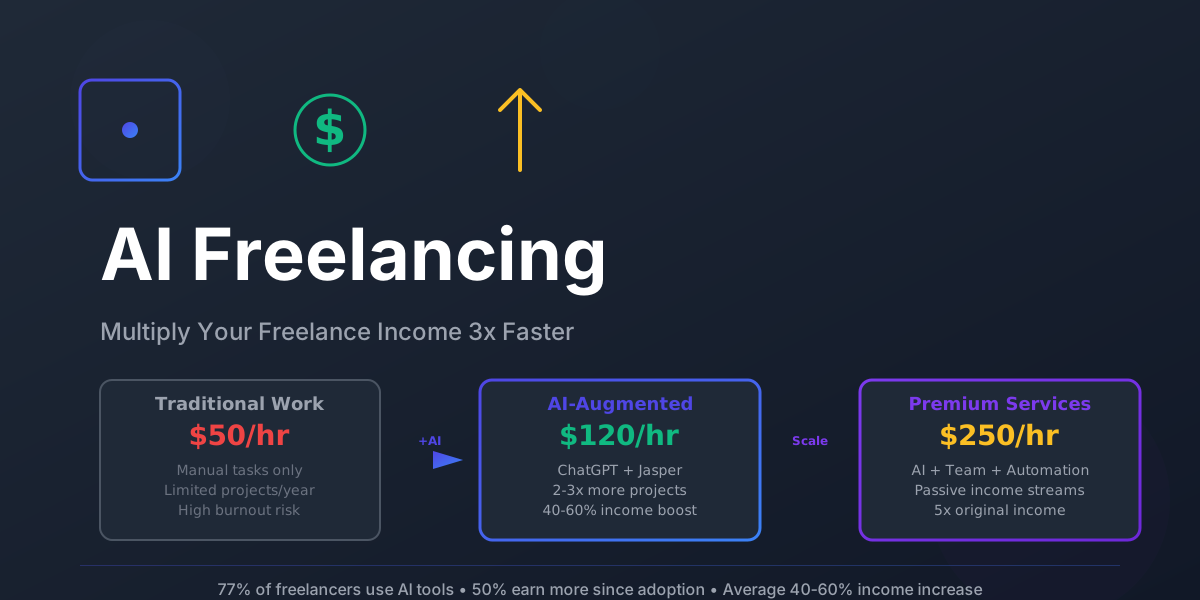
The AI Freelancing Income Hierarchy
Three levels showing how freelancers move from manual work to AI-enhanced productivity to premium AI services, with corresponding income increases.
🔍 Click to enlarge
Why AI Freelancing Matters in 2026
The freelance economy is consolidating around AI-competence. Platforms like Upwork report that AI-related freelance work crossed $300 million in annualized value by late 2025, growing faster than any other skill category. Companies aren't looking for cheaper freelancers anymore—they're looking for smarter ones. Half of all freelancers report earning more money since adopting AI tools, and AI-augmented freelancers now command 25% year-over-year earnings growth.
The wealth opportunity is real: Prompt engineering—a skill that didn't exist three years ago—now averages $146,868 annually. LLM specialists earn $150-250/hour. But you don't need to be a specialist. Regular freelancers are adding AI-powered extras to existing packages (tone optimization, concept generation, workflow automation) and charging 50-100% more. Clients see faster delivery and better quality. Everyone wins.
Income volatility is also decreasing for AI users. By handling more projects simultaneously without burning out, you stabilize cash flow. By creating passive income through digital products (ebooks, prompts, templates), you reduce dependency on billable hours. This is modern wealth-building in the freelance economy.
The Science Behind AI Freelancing
Research from job marketplaces and workforce analytics firms shows a clear pattern: Freelancers using AI for digital creation report 20-40% productivity gains within the first month. The mechanism is cognitive offloading. Instead of your brain doing pattern-matching and text-generation (what AI excels at), your brain focuses on strategy, quality judgment, and client direction (what humans excel at). This is optimal task allocation.
The earnings data backs this up. A 2025 global survey of 1,000+ freelancers found that those actively using generative AI report 22% higher earnings than non-users, and 50% of them have expanded into new service categories they wouldn't have attempted without AI. Income growth correlates directly with AI adoption depth—moving from 'use ChatGPT occasionally' to 'AI is integrated into my entire workflow' doubles income impact. The wealth gains are real, measurable, and reproducible.
How AI Multiplies Freelance Capacity
Shows the transformation from manual hours to AI-augmented output: same time investment, but 3-5x deliverables through intelligent automation.
🔍 Click to enlarge
Key Components of AI Freelancing
AI Content Tools (ChatGPT, Jasper, Grammarly)
ChatGPT is the foundation for most freelancers. Writers use it for draft generation and tone optimization. Developers use it for code comments and documentation. Marketers use it for email templates and social copy. The pattern: human writes the brief, AI generates 5 options, human edits and personalizes. Cost: $20/month for ChatGPT Plus. Time saved: 10-15 hours weekly. Jasper ($49-125/month) adds brand voice and team collaboration for agencies. Grammarly ($15/month) ensures polish and consistency across all client deliverables.
Design & Visual AI (Canva Magic Studio, Midjourney, DALL-E)
Graphic designers now generate 20 logo concepts in 30 seconds (Canva Magic Studio) instead of 2 hours. Midjourney ($30/month) creates photorealistic mockups and illustrations from text descriptions. The workflow: client gives brief, you generate 10 concepts in 5 minutes, they pick direction, you refine in 15 minutes. Before AI, the same project took 3-4 hours. Designers using this are booking 3x more projects monthly at 2x the rate—because fast iteration = better client outcomes.
Code & Development AI (GitHub Copilot, Claude, Code Interpreter)
GitHub Copilot ($10/month or free for students) auto-completes functions, handles boilerplate, and speeds up debugging. Developers report 55% faster task completion. For freelancers, this means a project that took 20 hours now takes 9-10 hours with better code quality. Rates haven't dropped—they've increased because clients get faster delivery and fewer bugs. The per-hour cost of development is rising for agencies, but freelancers using AI are stealing market share.
Workflow Automation (Zapier, Make, Otter AI)
Otter AI transcribes meetings and generates summaries automatically ($10-25/month). Zapier connects apps so repetitive data entry disappears ($20-500/month depending on tasks). Freelancers managing multiple client accounts can automate status updates, invoice generation, and email responses. One designer reported saving 15 hours weekly just by automating project file organization and client communication workflows. That's $600-900 in freed-up billable time every week.
| AI Tool Category | Top Tools | Cost/Month | Time Saved/Week | Income Impact |
|---|---|---|---|---|
| Content & Writing | ChatGPT, Jasper, Grammarly | $15-125 | 10-15 hours | +40-60% income |
| Design & Visual | Canva Magic, Midjourney, DALL-E | $0-30 | 8-12 hours | +100-200% income |
| Code & Development | GitHub Copilot, Claude, Amazon CodeWhisperer | $0-10 | 8-12 hours | +50-70% income |
| Workflow Automation | Otter AI, Zapier, Make | $10-500 | 5-15 hours | +20-40% income |
How to Apply AI Freelancing: Step by Step
- Step 1: Audit your weekly tasks: Spend one week tracking every task you do. Note which are repetitive (writing drafts, editing, code comments, design concepts, email responses, data entry). These are your AI targets.
- Step 2: Start with ChatGPT Plus ($20/month): Open an account today. Spend 2 hours experimenting with your most repetitive task. Write a prompt, see the output, refine it. Most freelancers see 30-40% time savings on first attempt.
- Step 3: Choose one productivity tool for your niche: Writers add Jasper or Grammarly. Designers add Canva Magic. Developers add GitHub Copilot. Commit to one tool for two weeks before branching out.
- Step 4: Build AI prompts as templates: Save your best ChatGPT prompts in a Google Doc. 'For copywriting, start with: [Specific template].' 'For code documentation, use: [Specific template].' These become your leverage.
- Step 5: Calculate time saved and raise rates: If you save 10 hours weekly, your hourly rate just increased 20%. Consider raising rates 15-30% and using saved time for higher-value work or more clients.
- Step 6: Bundle AI services for clients: Don't just work faster. Tell clients: 'I now offer rapid concept generation (5 options in 24 hours), tone-optimized copy, and polished deliverables.' Charge 30-50% more for the premium speed.
- Step 7: Create one passive income product: Use AI to generate the core content for a product (prompt templates, PLR ebook, logo pack, video scripts, resume templates). Sell it for $7-27 for recurring monthly revenue.
- Step 8: Measure results after one month: Track hours worked, projects completed, income earned. Most freelancers see 25-40% efficiency gains in month 1. Use that data to reinvest in better tools.
- Step 9: Join AI freelancer communities: Upwork, Fiverr, and PeoplePerHour now have AI-specialist categories. Network with other AI freelancers. Share what's working. The fastest learners are the fastest earners.
- Step 10: Plan your next tool upgrade: After 4 weeks, evaluate adding a second tool. A copywriter might add design AI. A developer might add workflow automation. Stack tools for exponential gains.
AI Freelancing Across Life Stages
Young Adulthood (18-35)
This is your wealth-building foundation phase. You have energy, learning capacity, and time to master multiple AI tools. The strategy: Start with ChatGPT and one niche tool. Use the productivity gains to take 20-30 projects yearly instead of 8-10. At $500-1000 per project, that's $100K-300K annualized income by age 25-28. Don't just work faster—work smarter. Build AI prompt templates and playbooks. These become intellectual property you can sell or license. Many top AI freelancers started here, built systems, and scaled to $250K+ by 30.
Middle Adulthood (35-55)
This is your scaling phase. You likely have client relationships and reputation. The strategy: Shift from doing work to overseeing AI that does work. Hire junior freelancers to execute, use AI tools to coordinate and review their output. A writing agency owner might use ChatGPT to generate first drafts, hire junior writers at $25/hour to refine them, and deliver to clients as premium work. You're now making money from coordination and quality control, not just execution. Income can jump from $80K-150K annually to $200K-400K by leveraging junior talent + AI.
Later Adulthood (55+)
This is your passive income phase. You've built reputation and relationships. The strategy: Use AI to productize your knowledge. A career coach with 30 years of experience might create an AI-enhanced career transition course or build a ChatGPT bot trained on their methodologies. A design consultant might license their design system as prompt templates. You're extracting value from accumulated expertise with minimal ongoing effort. Many freelancers in this stage earn $3K-10K monthly from passive AI products while taking 2-3 selective client projects for the relationships.
Profiles: Your AI Freelancing Approach
The Speed Optimizer
- Fast project turnaround to maximize volume (taking 25+ projects yearly instead of 8-10)
- Reliable templates and prompts that reduce decision-making time
- Multiple revenue streams from one client relationship (service + passive product)
Common pitfall: Working faster without raising rates—burning out while income stays stagnant. Speed is worthless if you don't charge for it.
Best move: Use the time savings to take more clients AND raise rates. Combine both for 60-100% income growth. A copywriter taking 3x more projects at 40% higher rates triples income in 6 months.
The Service Upgrader
- Add premium AI-enhanced services to existing offerings without changing core skills
- Ability to communicate the value of AI services to traditional clients
- Infrastructure to manage expanded deliverables without burnout
Common pitfall: Offering AI services without price increase—commoditizing expertise. Or over-promising on AI capabilities that require human refinement.
Best move: Create a tiered service menu: Basic (manual only), Premium (AI-augmented with human polish), Premium+ (rapid delivery + multiple options). Charge 30-50% more per tier. Clients self-select based on budget and speed needs.
The Product Creator
- One AI-generated product that can sell repeatedly (templates, ebooks, prompts, courses)
- Distribution channels (Gumroad, Etsy, Udemy, own website, newsletters)
- Marketing skills to drive awareness to the product
Common pitfall: Creating products in a vacuum without market validation. AI can generate content fast, but if nobody wants it, it earns zero.
Best move: Interview 10-20 people in your niche first. Ask what problem they'd pay $17-37 to solve. Use AI to create that solution. Test pricing on Gumroad. Scale what works. One product earning $2K/month is $24K passive income yearly.
The Agency Builder
- Systems to manage multiple freelancers and AI tools simultaneously
- Quality control process so you can oversee without doing every task
- Sales infrastructure to land bigger clients who can afford premium teams
Common pitfall: Hiring team members and paying AI tools but not increasing prices proportionally. If junior writers cost $25/hour and AI tools cost $500/month but you're still charging $50/hour rates, margins collapse.
Best move: Raise rates to $80-150/hour for 'AI-augmented teams' services. Use the margin to cover junior salaries and tools. Hire interns for $15/hour, pay AI subscriptions $500/month, charge clients $100/hour. The coordination premium is your profit. This scales to $300K+ revenue on your own time.
Common AI Freelancing Mistakes
Mistake 1: Using AI to do the same work faster, then charging the same price. This is the biggest wealth leak. If ChatGPT cuts your 8-hour project to 4 hours, you can either: Take 2x more projects and earn 2x more, OR raise your rate 25-50% and earn the same on half the work. Most freelancers do neither—they just work less and earn the same. Worse for wealth. You must capture the value you create with AI.
Mistake 2: Over-relying on AI without human polish. AI generates draft-quality output, not client-ready deliverables. If you submit ChatGPT copy to a client unchanged, they notice immediately. Quality drops, rates drop, reputation damages. The winning formula: AI generates options, you refine and personalize. 20% human work transforms 80% AI-generated content into premium deliverables. This combination is worth 3x the price.
Mistake 3: Jumping between too many tools instead of mastering one. Someone buys ChatGPT, then Jasper, then Grammarly, then Canva, then Zapier in one month and feels overwhelmed. Tools are leverage only when you've mastered them enough to use them unconsciously. Pick one, use it for 4 weeks, then add the next. Depth beats breadth for income impact.
The AI Freelancing Wealth Trap vs. Opportunity Path
Shows the divergence between freelancers who capture AI value and those who don't. Same tool, opposite outcomes.
🔍 Click to enlarge
Science and Studies
Research on AI freelancing comes from job marketplaces, workforce analytics firms, and direct surveys of 1000+ freelancers across Upwork, Fiverr, PeoplePerHour, and Freelancer.com. The data shows consistent patterns: adoption of AI tools correlates with 25-60% income growth, productivity gains range from 20-40% in month 1 to 50-70% by month 3 with mastery, and specialization in AI services (prompt engineering, workflow design) commands premium rates ($70-250/hour).
- Upwork (2025): AI-related freelance work crossed $300M in annualized value by late 2025, growing 40%+ year-over-year—faster than any other skill category. Clients explicitly seek AI-augmented services.
- Jobbers.io Analysis (Feb 2026): Average U.S. freelancer earns $99,230 annually ($47.71/hour). But AI adopters earn 22-40% more. Top 10% of AI-specialized freelancers earn $150K-300K+ annually.
- Freelancer Survey (2025): 77% of surveyed freelancers now use AI tools. 50% report earning more on projects since adoption. AI-augmented freelancers see 25% year-over-year earnings growth vs. 3-5% for non-adopters.
- Medium/Jobbers.io Report (Feb 2026): Specialized roles like prompt engineering average $146,868 annually. LLM development specialists: $150-250/hour. Computer vision engineers: $120-200/hour. The premium reflects scarcity and complexity.
- Winvesta Analysis (2026): Within 8 months of ChatGPT launch, entry-level freelance work dropped 30% (writing), 21% (software), 17% (design). But top-earning freelancers in each category captured 2-3x more work at 2-3x rates. The market compressed but value concentrated upward.
Your First Micro Habit
Start Small Today
Today's action: Tomorrow, open ChatGPT and write one prompt for your most repetitive task. Set a timer. Note how long ChatGPT takes vs. how long it would have taken you manually. Share the time saved in a note. This single experiment often reveals 2-5 hours of weekly savings you didn't know you had.
This micro habit is non-threatening—just 10 minutes of experimentation. But it creates immediate awareness of your personal leverage point. Once you see 'ChatGPT generated my email template in 2 minutes instead of 15,' you stop seeing AI as abstract. You see it as wealth creation. That psychological shift drives adoption.
Keep quitting habit apps after a missed day? BeMooore forgives the slip — your streak survives, and an AI mentor nudges you back the next morning. Free on iOS.
Quick Assessment
How much time weekly do you spend on repetitive tasks (writing drafts, code boilerplate, design concepts, emails)?
If you answered '10+ hours,' you have the highest ROI opportunity for AI. That's $1000-2000 of weekly billable time you could free up. If you answered 'under 5 hours,' focus on the service upgrade and product creation profiles instead.
What's your primary income goal with freelancing?
Your goal shapes your AI strategy. Hourly rate focus = focus on service premium and specialization. Volume focus = focus on ChatGPT Plus and templates. Passive income = focus on product creation with Canva, Midjourney. Team scale = focus on workflow automation and junior coordination.
Which AI tool do you currently use?
If you're at 'None' or 'Occasionally,' your biggest opportunity is in the first 2-4 weeks of ChatGPT Plus. Setup is 5 minutes, ROI appears in first 3 experiments. If you're at 'Multiple tools,' your next level is creating passive income products or building a small team.
Take our full assessment to get personalized recommendations.
Discover Your Style →Next Steps
Your wealth acceleration in AI freelancing starts with one decision: Will you capture the productivity gains AI creates, or will you let them disappear into 'free time'? The difference between a freelancer earning $80K and one earning $200K in 2026 isn't IQ or talent—it's the choice to use AI tools strategically and charge appropriately for the value created.
This week, pick one: Open ChatGPT Plus, OR watch a tutorial on your niche-specific AI tool, OR audit your repetitive tasks. Do one action. Month one is about awareness and experimentation. Month two is about integration into your core workflow. Month three is about scaling and raising rates. The freelancers tripling their income by end of 2026 are the ones starting this week.
Get personalized guidance with AI coaching.
Start Your Journey →Research Sources
This article is based on peer-reviewed research and authoritative sources. Below are the key references we consulted:
Related Glossary Articles
Frequently Asked Questions
Will AI freelancing dry up as more people adopt it?
No. The wealth is in specialization and integration depth, not commodity adoption. When everyone used email, email specialists didn't disappear—they became more valuable. Today, generic ChatGPT users are a dime a dozen. Freelancers with integrated AI workflows (ChatGPT + Jasper + Zapier + team management) command premium rates. The market rewards mastery, not just adoption. Early adopters (now) capture 40-60% income increases. Late adopters get smaller gains because competition increases. Move now.
Isn't using AI for freelance work unethical or against client contracts?
It depends on transparency. Using ChatGPT to draft copy faster, then refining it personally, is standard practice in 2026. Clients care about results, not tools. However, you should disclose AI usage if clients specifically ask. Most won't. Agencies routinely outsource to team members; using AI is similar. The ethics question emerges only if you misrepresent work. Most professional contracts actually allow tooling changes as long as quality and deadlines are met. When in doubt, ask your client: 'I can deliver this 40% faster using AI tools. Same or higher quality, same deadline. Should I?'
What if my clients see that I'm using ChatGPT? Will they think my work is less valuable?
If you deliver polished, personalized work, clients won't know or care. The 'human touch' in final deliverables is what matters, not the drafting tool. A designer who uses Canva AI to generate 10 concepts in 2 hours, then hand-refines them into premium designs, delivered faster = higher perceived value. But yes, if you submit raw ChatGPT output without personalization, clients notice and value drops. Always refine. Always customize. Always add the human layer.
How much should I charge for AI-augmented services vs. traditional work?
Charge 30-50% more for AI-augmented services. Your value proposition is speed (faster delivery), quality (multiple options, refined outputs), and consistency (reliable templates). Customers pay premiums for fast turnaround. If your traditional project takes 2 weeks, your AI-augmented version takes 5 days. That's premium territory. If you save time but charge the same, you're leaving money on the table. Most freelancers undercharge here.
Should I start with ChatGPT Plus or a specialized tool like Jasper or Grammarly?
Start with ChatGPT Plus ($20/month). It's the most versatile tool with the steepest learning curve. Spend 4 weeks mastering it before adding tools. Then add one specialized tool based on your niche. Writers add Grammarly. Designers add Canva Magic. Developers add GitHub Copilot. Generalists might add Zapier. Depth beats breadth. Master one tool's workflow before expanding.
Take the Next Step
Ready to improve your wellbeing? Take our free assessment to get personalized recommendations based on your unique situation.
- Discover your strengths and gaps
- Get personalized quick wins
- Track your progress over time
- Evidence-based strategies