Guía to Inner Peace
In a world filled with constant noise, demanding schedules, and endless distractions, finding inner peace feels like chasing a distant dream. Yet inner peace is not reserved for monks in monasteries or enlightened sages. It's a practical skill anyone can develop through simple, evidence-based techniques. Inner peace is the state of mental calm, clarity, and emotional balance that allows you to navigate life's challenges with resilience and grace. When you cultivate inner peace, you experience reduced stress, better focus, improved relationships, and a deeper sense of life satisfaction. This guide reveals the science-backed pathways to inner peace and provides actionable steps to begin your journey today.
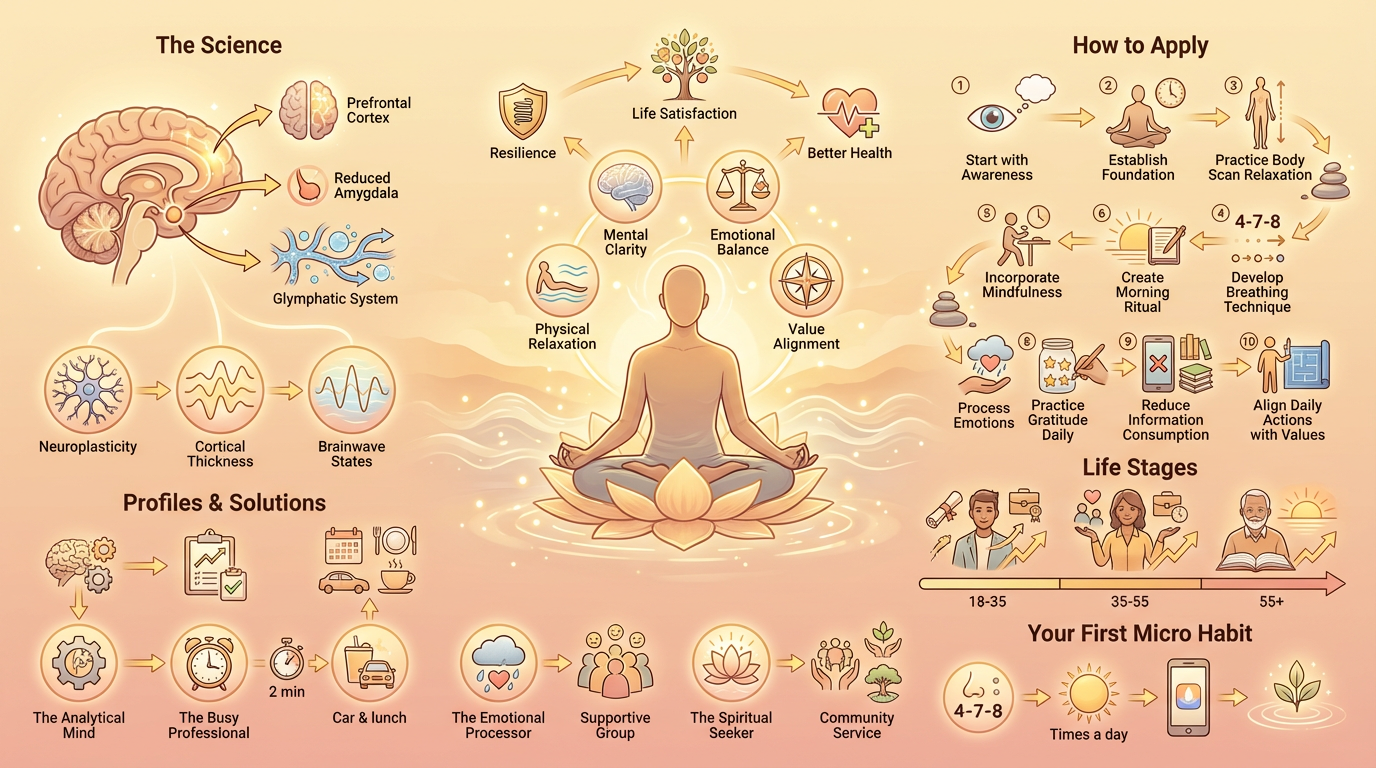
Inner peace isn't about eliminating all problems or pretending difficulties don't exist. It's about developing the mental flexibility to respond to life events with composure rather than reactivity. It's the quiet confidence that comes from knowing you can handle whatever comes your way.
Whether you're struggling with anxiety, overwhelmed by work stress, or simply seeking a deeper sense of wellbeing, this comprehensive guide provides the tools, techniques, and understanding you need to transform your inner world.
What Is Inner Peace?
Inner peace is a psychological state characterized by mental clarity, emotional stability, and freedom from excessive worry or disturbance. It represents a condition of contentment and acceptance of present circumstances while maintaining hope for the future. Inner peace is not the absence of emotions or challenges, but rather the ability to experience all emotions without being overwhelmed or controlled by them.
No es asesoramiento médico.
Inner peace emerges from the integration of several psychological and physiological factors. It involves a calm nervous system, clear thinking patterns, emotional regulation, and alignment between your values and actions. Research shows that people with high inner peace demonstrate greater resilience, better immune function, lower blood pressure, and improved overall health outcomes. Inner peace is increasingly recognized as a foundational component of human flourishing and mental wellbeing.
Surprising Insight: Surprising Insight: Recent neuroscience research found that meditation stimulates your brain's natural waste removal system, clearing harmful proteins similar to what happens during sleep, providing deep restorative benefits for mental clarity and calm.
The Inner Peace Dimensions
A framework showing how inner peace integrates mental clarity, emotional balance, physical relaxation, and value alignment into a unified wellbeing state
🔍 Click to enlarge
Why Inner Peace Matters in 2026
In 2026, the importance of inner peace has never been greater. Global stress levels continue to rise due to economic uncertainty, rapid technological change, and information overload. People report higher rates of anxiety, depression, and burnout than in previous decades. At the same time, there's growing recognition that external solutions alone cannot solve internal suffering. Inner peace has become essential for mental health, physical wellness, and meaningful relationships.
Organizations increasingly recognize that employees with greater inner peace demonstrate higher productivity, better decision-making, enhanced creativity, and lower absenteeism. Schools are integrating mindfulness programs to help students manage stress and improve academic performance. Healthcare systems are incorporating meditation and stress reduction techniques as preventive medicine. The shift toward inner peace represents a fundamental recognition that true wellbeing comes from within.
Perhaps most importantly, inner peace provides the psychological foundation for living authentically. When your mind is calm and emotions are balanced, you can connect more deeply with others, pursue meaningful work, and experience genuine happiness rather than constant distraction and worry.
The Science Behind Inner Peace
Neuroscience research reveals that inner peace correlates with specific brain changes and neural patterns. Regular meditation and mindfulness practice increase gray matter in brain regions responsible for learning, memory, and emotional regulation. Studies show that consistent practitioners develop enhanced activity in the prefrontal cortex, which governs rational thinking and emotional control, while decreasing reactivity in the amygdala, the brain's alarm center.
A groundbreaking 2025 study found that meditation activates the glymphatic system in your brain, facilitating the removal of harmful proteins and metabolic waste similar to what occurs during sleep. This explains why meditation practitioners report feeling refreshed and mentally clear after practice. Brainwave studies show that meditation creates a unique state of relaxed alertness, distinct from both normal wakefulness and sleep, marked by specific frequencies associated with focus and inner calm.
Brain Changes Through Meditation Practice
Visualization showing how regular meditation strengthens areas for emotional control while reducing stress response reactivity
🔍 Click to enlarge
Key Components of Inner Peace
Mental Clarity
Mental clarity is the foundation of inner peace. It means your thoughts flow naturally without excessive rumination, worry loops, or mental fog. Clarity develops through practices that quiet mental chatter, such as meditation and mindfulness. When your mind is clear, you can focus on what matters, make better decisions, and experience genuine presence in each moment.
Emotional Balance
Emotional balance doesn't mean suppressing or ignoring feelings. Instead, it means experiencing emotions fully while maintaining perspective and not being controlled by them. Emotional balance develops through awareness, acceptance, and healthy expression of emotions. When you cultivate emotional balance, you respond to situations rather than react impulsively, creating better outcomes in all areas of life.
Physical Relaxation
Inner peace extends beyond the mind to include physical relaxation. Your nervous system has two main modes: sympathetic activation for stress and danger, and parasympathetic activation for rest and recovery. Inner peace requires activating your parasympathetic system through techniques like deep breathing, progressive muscle relaxation, and gentle movement. When your body is relaxed, your mind naturally becomes calmer, creating a positive feedback loop.
Values Alignment
A crucial but often overlooked component of inner peace is living in alignment with your core values. When your actions match your beliefs and priorities, you experience integrity and authenticity. Conversely, when you act against your values, internal conflict and stress emerge. Regular reflection on what truly matters to you and intentional alignment of your choices with these values creates deep, lasting inner peace.
| Dimension | Description | Key Benefits |
|---|---|---|
| Mental Clarity | Focused thinking, reduced rumination, clarity on goals and meaning | Better decision-making, improved memory, enhanced focus |
| Emotional Balance | Healthy emotion regulation without suppression or overwhelm | Stronger relationships, reduced reactivity, improved resilience |
| Physical Relaxation | Parasympathetic activation, reduced muscle tension, balanced nervous system | Lower blood pressure, better sleep, improved immunity |
| Values Alignment | Living authentically according to core beliefs and priorities | Greater fulfillment, reduced internal conflict, authentic self-expression |
How to Apply Inner Peace: Step by Step
- Step 1: Start with awareness: Notice your current mental and emotional state without judgment. Are you tense, scattered, or calm? This baseline awareness is essential for measuring progress. Spend five minutes simply observing your inner state as if you're watching clouds pass through the sky.
- Step 2: Establish a meditation foundation: Choose a quiet space where you won't be interrupted. Sit comfortably with your spine upright. Begin with just five minutes daily. Focus entirely on your breath, noticing the natural rhythm of inhalation and exhalation. When your mind wanders, gently return attention to the breath without self-criticism.
- Step 3: Practice body scan relaxation: Systematically bring awareness through your entire body, from head to toes. Notice any areas of tension or holding. As you bring awareness to each part, allow muscles to soften and relax. This 10-minute practice activates your parasympathetic nervous system and releases physical stress.
- Step 4: Develop a breathing technique: Learn the 4-7-8 breathing technique: inhale for four counts, hold for seven counts, exhale for eight counts. This specific pattern is clinically proven to activate your relaxation response. Practice this for two minutes whenever you feel stressed or before bed.
- Step 5: Incorporate mindfulness into daily activities: Transform ordinary moments into mindfulness practice. Eat slowly, tasting each bite fully. Walk deliberately, feeling your feet connect with the ground. Listen completely during conversations. These simple practices anchor you in the present moment where peace naturally exists.
- Step 6: Create a morning ritual: Begin each day with fifteen minutes of intention-setting. Meditate, stretch, journaling your goals and gratitude. This practice primes your nervous system for calm and sets the tone for your entire day.
- Step 7: Process emotions consciously: When difficult emotions arise, pause and observe them. Name the emotion specifically. Notice where you feel it in your body. Allow it to exist without judgment. Ask what this emotion needs or what it's trying to teach you. This creates emotional intelligence and integration.
- Step 8: Practice gratitude daily: Each evening, write or mentally review three specific things you appreciated that day. This shifts your brain's focus toward positive experiences and cultivates contentment, a natural companion to inner peace.
- Step 9: Reduce information consumption: Limit news, social media, and stimulating content. These trigger your nervous system's stress response. Replace with calming activities: reading, nature time, meaningful conversations, creative pursuits.
- Step 10: Align daily actions with values: At week's beginning, identify three actions that express your core values. Complete these intentionally. This practice of value-aligned action builds authentic inner peace that external circumstances cannot shake.
Inner Peace Across Life Stages
Adultez Joven (18-35)
Young adults often face intense pressure around career establishment, relationships, identity formation, and comparing themselves to peers. Inner peace during this stage develops through self-discovery and building healthy habits early. Establishing a meditation practice, developing emotional awareness, and practicing boundaries creates the foundation for lifelong resilience. Young adults benefit from understanding that success and fulfillment aren't about achieving external milestones constantly but about internal alignment and presence.
Edad Media (35-55)
Middle-aged adults often experience peak demands from careers, families, and aging parents, creating what many call the sandwich generation effect. Inner peace during this phase requires conscious prioritization and letting go of perfectionism. Practices like morning meditation, effective boundary-setting, and regular self-care become crucial for preventing burnout. This life stage offers the wisdom to recognize what truly matters, enabling more conscious choices about time and energy investment.
Adultez Tardía (55+)
Older adults often experience more inner peace naturally as career pressure diminishes and life priorities clarify. However, this stage also brings unique challenges including health concerns, loss of loved ones, and questions about legacy and meaning. Inner peace in later adulthood deepens through acceptance practices, spiritual exploration if meaningful, and remaining socially connected. This stage offers opportunity for profound peace as external validation matters less and authentic living becomes paramount.
Profiles: Your Inner Peace Approach
The Analytical Mind
- Understanding the scientific evidence supporting meditation
- Structured progression with measurable progress markers
- Logical frameworks explaining how practices work
Common pitfall: Getting caught in analysis paralysis, reading endless information without practicing, requiring perfect conditions before starting
Best move: Commit to a simple practice for 30 days before evaluating. Keep a brief log of mood changes. This gives you real data to satisfy your analytical mind while building actual experience.
El profesional ocupado
- Ultra-short practices fitting into tight schedules
- Flexibility in timing and location
- Integration into existing daily routines
Common pitfall: Believing meditation requires 45-minute quiet sessions, feeling too busy to practice, expecting massive results immediately
Best move: Start with 2-minute breathing exercises during commutes or lunch breaks. Even micro-practices accumulate. Schedule meditation like any important appointment and protect this time fiercely.
The Emotional Processor
- Permission to feel deeply
- Techniques that honor emotions rather than suppress them
- Community and shared experience
Common pitfall: Using meditation to avoid emotions instead of processing them, feeling like you're doing it wrong because emotions still arise, isolating instead of connecting
Best move: Explore emotion-focused meditation styles. Join a meditation group where you can share experiences. Remember that feelings are data, not problems to eliminate. Emotional processing is your path to peace.
The Spiritual Seeker
- Connection to meaning and purpose beyond ego
- Practices grounded in contemplative traditions
- Integration of inner peace with life purpose
Common pitfall: Spiritual bypassing where you use spirituality to avoid practical life problems, becoming judgmental of less advanced practitioners, losing groundedness in daily reality
Best move: Balance meditation with engaged action in your community. Let spiritual practice deepen your service and compassion. Ground your insights in kindness toward yourself and others in regular life.
Common Inner Peace Mistakes
One frequent mistake is expecting inner peace to develop instantly. Peace is not a destination you reach after a few meditation sessions but a skill you develop progressively through consistent practice. Many people try meditation once or twice, experience a moment of calm, then become discouraged when they don't maintain that state. Understanding that peace deepens gradually prevents premature abandonment of practice.
Another common error is trying to suppress or eliminate all difficult emotions. True inner peace includes the capacity to feel anger, sadness, fear, and frustration fully while maintaining your sense of centeredness. When you practice acceptance instead of resistance, you paradoxically find emotions move through you more naturally and completely. Suppressed emotions create internal conflict and tension that undermines genuine peace.
Many people also fail to address the practical life factors that undermine peace. Meditation is powerful but cannot compensate for consistently poor sleep, high caffeine intake, relationship conflict, or misaligned values. Inner peace requires integrating practices with lifestyle choices that support your nervous system's ability to rest and recover.
Common Barriers to Inner Peace and Solutions
Diagram showing how different obstacles to peace can be addressed through specific approaches
🔍 Click to enlarge
Ciencia y Estudios
Scientific research on inner peace and meditation has expanded dramatically in recent years, moving from skepticism to mainstream acceptance in medical and psychological communities. Multiple peer-reviewed studies demonstrate measurable benefits of meditation practices on brain structure, mental health, and physical wellbeing. Research consistently shows that regular practitioners experience lower cortisol levels, reduced inflammation markers, improved immune function, and better cardiovascular health.
- A 2024 meta-analysis from PMC/MDPI found that mindfulness meditation induces measurable neurobiological changes including increased cortical thickness, enhanced brain connectivity, and improved neurotransmitter function, directly supporting inner peace and emotional stability.
- A 2025 study from Vanderbilt University found that meditation stimulates the glymphatic system, the brain's waste removal mechanism, functioning similarly to deep sleep and providing profound restorative benefits for mental clarity and peace.
- Research in Frontiers of Psychology (2025) demonstrated that mindfulness programs significantly reduce stress, anxiety, depression, and improve sleep quality and life satisfaction among college students, with effects sustained long-term.
- A study on mindfulness-based stress reduction published in Frontiers of Psychology (2024) showed sustained psychological benefits including improved emotional regulation, enhanced resilience, and increased overall wellbeing persisting years after formal program completion.
- Research in eNeuro (2025) using eye-tracking methodology found that guided mindfulness meditation improves attentional control mechanisms in both young and older adults, enhancing the mental clarity component of inner peace.
Tu Primer Microhábito
Comienza pequeño hoy
Today's action: Perform the 2-minute conscious breathing practice: Sit comfortably, breathe in for four counts, hold for seven counts, exhale for eight counts. Repeat ten times. Do this before breakfast and before bed. Notice the calm afterward.
This micro habit works because it directly activates your parasympathetic nervous system, the relaxation response. Just two minutes sends a signal to your body that you're safe. Doing this twice daily creates momentum through repetition without overwhelming your schedule. The specific breath pattern is neuroscience-backed and proven effective. After two weeks, you'll notice improved calmness throughout your day, which motivates continued practice without relying on willpower alone.
Track your breathing practice consistency and meditation streaks with the Bemooore app. Get personalized AI insights into how your practice correlates with your overall wellbeing, mood patterns, and stress levels. Let our AI coach remind you at the same time each day, building unbreakable habits without friction or relying on motivation.
Evaluación Rápida
How would you currently describe your relationship with inner peace and mental calm?
Your current experience with calm shows where to focus practice. If you're in the first two categories, starting with even a two-minute daily practice will create noticeable shifts within weeks.
Which aspects of inner peace do you most want to develop?
Different approaches work best for different goals. Mental clarity benefits from focused meditation, emotions from acceptance practices, physical tension from body-based techniques, and value alignment from reflective practices.
What's your preferred way to learn and develop new skills?
Matching your inner peace practices to your learning style creates higher adherence and faster progress than forcing yourself into incompatible methods.
Take our full assessment to get personalized recommendations for your inner peace journey.
Discover Your Style →Preguntas Frecuentes
Próximos Pasos
Your journey to inner peace begins with a single small step. Choose one practice from this guide that resonates with you. Commit to practicing daily for 30 days before evaluating results. This gives your nervous system and mind time to shift. Notice changes in your mood, sleep quality, ability to handle challenges, and general sense of wellbeing throughout your day.
Remember that developing inner peace is a skill, not a talent you either have or don't have. Everyone can develop it through consistent practice. Be patient and kind with yourself throughout the process. Some days will feel easier than others, and that's completely normal. The practice of returning to calmness again and again, day after day, is what transforms your capacity for peace.
Get personalized AI guidance and track your inner peace development with the Bemooore app.
Comienza tu Viaje →Research Sources
This article is based on peer-reviewed research and authoritative sources. Below are the key references we consulted:
Related Glossary Articles
Frequently Asked Questions
How long does it take to develop inner peace?
Many people notice initial benefits like reduced tension within the first week of consistent practice. More substantial changes in baseline calm typically develop within 4-6 weeks. Deeper transformation happens over months and years. The key is consistency rather than duration of individual sessions.
Do I need to meditate for a long time to see benefits?
No. Research shows that even 2-5 minutes of daily meditation creates measurable benefits. Consistency matters more than duration. Starting small prevents overwhelm and builds sustainable habits. You can always extend your practice later as it becomes natural.
What if my mind keeps wandering during meditation?
Mind-wandering is completely normal and not a sign of failure. Meditation isn't about achieving a blank mind but noticing when your mind wanders and gently returning focus. Each return to your breath strengthens your mental clarity muscle. Expect wandering and treat it as part of the practice.
Can I practice inner peace techniques while doing other activities?
Absolutely. You can practice mindful breathing while commuting, body awareness while exercising, or gratitude while eating. These informal practices are just as valuable as formal meditation and integrate peace into your daily life naturally.
Is inner peace the same as happiness?
They're related but distinct. Happiness often depends on external circumstances, while inner peace is an inner quality that can exist alongside any emotion. You can experience sadness or anger while maintaining inner peace as the underlying current beneath the surface emotion.
What if I don't believe in meditation or spirituality?
Inner peace is not spiritual or religious. The science is clear: meditation and mindfulness create measurable brain changes and health benefits regardless of your beliefs. You can develop inner peace through a purely physiological lens focusing on nervous system regulation and cognitive patterns.
Can children develop inner peace?
Yes. Children often have natural capacity for presence that adults have lost. Simple practices like mindful breathing, nature walks, and emotion naming help children develop emotional intelligence and calm early in life, setting them up for greater wellbeing throughout life.
How do I maintain inner peace during stressful times?
Consistency is crucial. When stress increases, your practice becomes more important, not less. Short daily practice during calm times builds a reservoir you can draw from during challenges. Think of it like emotional fitness training that strengthens you over time.
Take the Next Step
Ready to improve your wellbeing? Take our free assessment to get personalized recommendations based on your unique situation.
- Discover your strengths and gaps
- Get personalized quick wins
- Track your progress over time
- Evidence-based strategies