Friendships
In a world that often feels disconnected and fast-paced, friendships stand as pillars of meaning, joy, and resilience. Whether you're seeking to deepen existing bonds, build new connections, or understand why some friendships thrive while others fade, this guide explores the profound science and practical strategies behind meaningful friendships. Research consistently shows that the quality of our relationships—particularly friendships—is one of the strongest predictors of happiness, health, and longevity. Yet building and maintaining friendships requires intention, vulnerability, and understanding. This article uncovers how authentic connections form, why reciprocity matters, and how you can cultivate friendships that nourish both your soul and your wellbeing.
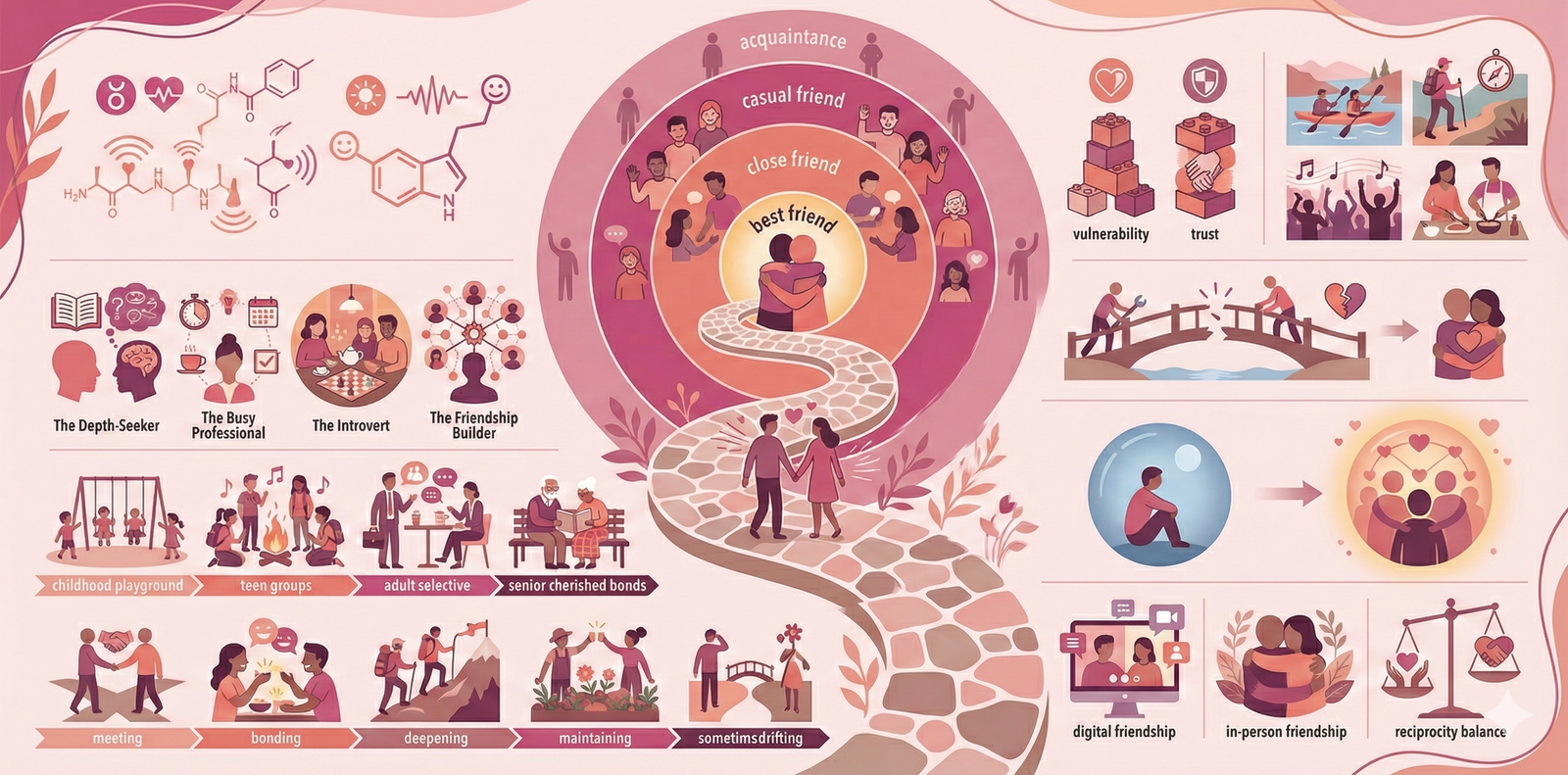
Discover the surprising truth: people with meaningful friendships report 16% higher life satisfaction than those without close friends, and quality matters far more than quantity.
Learn proven strategies to move beyond surface-level conversations, navigate reciprocity gracefully, and build lifelong bonds that weather change and distance.
¿Qué son las amistades?
Friendships are voluntary, reciprocal relationships built on mutual trust, affection, and shared interests. Unlike family bonds or professional relationships, friendships are chosen and maintained through consistent effort, vulnerability, and genuine care. They range from casual friendships—people we enjoy spending time with occasionally—to deep, intimate friendships where we share our fears, dreams, and authentic selves. The defining characteristic of meaningful friendships is the willingness to invest emotionally and invest time in another person's wellbeing, expecting nothing in return but genuine connection. Friendships are fundamentally different from transactional relationships; they're built on genuine regard, mutual respect, and the desire for the other person's wellbeing simply because you care about them.
No es consejo médico.
Friendships exist across cultures and throughout human history as essential elements of social life. From childhood friendships that shape our identity to adult friendships that provide support through major life transitions, friendships offer a unique form of connection that isn't bound by obligation or expectation. They give us permission to be ourselves, provide accountability, celebrate our wins, and stand beside us during struggles. In modern times, friendships face unique challenges—geographic distance, digital distractions, and demanding schedules—yet remain more valuable than ever to our mental health, physical wellbeing, and sense of purpose. The ancient Greeks understood the value of friendship so deeply that Aristotle categorized it as one of life's essential components, and modern research confirms his wisdom with empirical evidence about how friendships literally extend our lifespans and improve our quality of life.
The psychology of friendship has evolved significantly in recent decades. Researchers now understand that friendships serve multiple functions in our lives simultaneously. They're sources of emotional support during difficult times, providers of joy and laughter during good times, and anchors of stability throughout life's transitions. Friendships also serve practical functions—they connect us to wider social networks, introduce us to new ideas and perspectives, and create communities where we feel we belong. Perhaps most importantly, friendships validate our existence; knowing that someone values us, understands us, and chooses to spend time with us affirms that we matter in the world. This validation is so powerful that it protects against depression, anxiety, and the existential loneliness that can plague even people surrounded by family and colleagues.
Surprising Insight: Surprising Insight: Only about 50% of friendships are reciprocal, meaning your friend considers you a friend at the same level you consider them. However, even non-reciprocal friendships can be valuable—research shows that having someone who considers you a friend is the next best relationship after mutual friendship.
The Friendship Connection Spectrum
Visual representation of how friendships develop from acquaintances to lifelong bonds, showing the progression from surface-level connections to deep, reciprocal relationships.
🔍 Click to enlarge
Por qué importan las amistades en 2026
In 2026, friendships matter more than ever as loneliness reaches epidemic levels in many developed nations. Remote work, digital communication, and geographic mobility have made maintaining friendships more challenging, yet research shows that strong social connections are more vital to our health and happiness than ever before. The COVID-19 pandemic starkly demonstrated how essential friendships are to our mental resilience—those with strong friendships experienced significantly lower rates of depression and anxiety during isolation.
Friendships directly impact your physical health. Studies show that people with strong social connections have lower blood pressure, healthier cholesterol levels, and a 50% higher overall survival rate. Beyond health metrics, friendships provide the emotional scaffolding we need to navigate life's challenges. They offer perspective during crises, celebrate our achievements without jealousy, and give us a sense of belonging that's increasingly difficult to find elsewhere. In a world of constant change and uncertainty, friendships provide stability, meaning, and joy.
The importance of friendships increases with age. Research shows that the relative importance of friendship to happiness grows throughout our lifespan, becoming particularly crucial in later adulthood. For young adults in college, forming friendships in the first few weeks significantly increases the likelihood of thriving academically and emotionally. For middle-aged adults, friendships provide a counterbalance to work stress and family obligations. For older adults, friendships become a vital source of purpose, connection, and physical health.
La ciencia detrás de las amistades
The neuroscience of friendship reveals that meaningful connections literally change our brains. When we spend time with friends we trust, our bodies release oxytocin—the bonding hormone—which lowers stress hormones like cortisol, reduces blood pressure, and boosts mood-regulating neurotransmitters including dopamine and serotonin. This is why time with good friends feels like medicine. Brain imaging studies show that friendships activate reward centers similar to other pleasurable activities, yet with the added benefit of reducing anxiety and increasing resilience. Friends literally help us regulate our nervous systems. The biological response to friendship is so powerful that it affects not just our mood in the moment, but our long-term health outcomes including cardiovascular health, immune function, and even brain aging. Studies using PET scans show that when we think about people we love and trust, specific brain regions light up—the same regions that activate during experiences of physical pleasure, suggesting that friendship activates our brain's reward system in a uniquely powerful way.
The concept of reciprocity in friendships reveals fascinating psychological dynamics. Researchers have found that friendships begin as exchange relationships, where both parties keep mental tabs on fairness—you listen to my problems, I listen to yours. However, the strongest, longest-lasting friendships evolve into communal relationships where both people contribute without constantly calculating equity. They see the friendship as a shared investment rather than a transaction. This shift from exchange to communal basis typically occurs as trust deepens and commitment solidifies. Understanding this progression helps explain why some friendships feel effortless while others feel strained. Early in friendship formation, we track reciprocity carefully because we're still assessing whether we can trust this person. But as we transition into communal relationships, this accounting falls away—we stop counting because we fundamentally believe the other person has our best interests at heart and we have theirs. This transformation from exchange to communal is what separates casual friends from lifelong friends, and it's one of the most important psychological transitions in human relationships.
Research on friendship and health outcomes has produced startling findings. A landmark meta-analysis of 148 studies found that people with strong social relationships had a 50% increased likelihood of survival compared to those with weak social relationships. This effect was comparable to other major health factors like smoking, alcohol consumption, obesity, and physical activity. In other words, having strong friendships is as important to your health as exercising regularly or maintaining a healthy weight. Another study found that social isolation increases mortality risk by 26%, while loneliness increases it by 32%—effects stronger than obesity and as strong as smoking 15 cigarettes a day. These aren't just about happiness; the biological mechanisms show that friendship literally protects and extends your life.
How Friendship Types Impact Wellbeing
Comparison showing how different friendship types—reciprocal, one-sided, and casual—affect mental health, stress levels, and overall happiness.
🔍 Click to enlarge
Key Components of Friendships
Authenticity and Vulnerability
The foundation of meaningful friendships is the willingness to be genuine. This means sharing not just your successes and happy moments, but also your fears, insecurities, and struggles. Vulnerability isn't weakness—it's the bridge that transforms casual friendships into deep bonds. When you allow someone to see your real self, flaws included, and they respond with acceptance, profound trust develops. The research is clear: we feel closer to people when we're vulnerable with them. This doesn't mean oversharing with everyone, but rather finding friends with whom emotional honesty is safe and reciprocated. Vulnerability creates what psychologists call intimate self-disclosure, which activates the other person's empathy and care circuits in the brain. When your friend sees your authentic struggles and responds with understanding rather than judgment, they signal that they accept you fully—flaws and all. This acceptance is deeply healing because so much of our social anxiety comes from fear of rejection if others see who we really are. When you're vulnerable and discover that someone accepts you anyway, the relief and gratitude that follows bonds you profoundly to that person.
Reciprocity and Mutual Support
Healthy friendships involve balanced give-and-take. While no friendship is perfectly equal at every moment, the overall pattern should feel reciprocal—you both give support, celebrate each other's wins, and invest time and energy. Reciprocity establishes fairness and prevents resentment. Research shows that 10th graders were at significantly higher risk of depression if they gave more support than they received from friends. In adult friendships, reciprocity looks like being there when someone needs you, asking how they're doing, remembering important events in their lives, and celebrating alongside them. It also means allowing friends to support you—accepting help, sharing your struggles, and trusting them with your vulnerabilities. True reciprocity is subtle; it's not about keeping score but about noticing patterns over time. Do you both make effort to maintain contact, or does one person always initiate? Do you both share vulnerable moments, or does one person always listen while the other stays guarded? Do you both celebrate each other's wins, or is the joy one-directional? Over time, healthy reciprocal friendships develop a rhythm where both people feel they're getting something valuable from the relationship.
Consistent Investment of Time and Attention
Friendships require time to develop and even more time to deepen. In our busy world, this is perhaps the biggest challenge to friendship formation. Building a truly meaningful connection usually takes time—research suggests months to years of consistent interaction. For long-distance friendships, small rituals create what psychologists call relationship anchors: consistent touchpoints that maintain connection across time and space. This might be weekly video calls, monthly in-person visits, or consistent messaging. The key is predictability—knowing you can count on this friend for regular contact. Even casual check-ins matter; simply remembering to text on someone's birthday or ask how their big presentation went demonstrates that they occupy space in your mind and heart. The investment of time is about more than frequency; it's about quality presence. Spending two hours fully present with a friend, phones away, genuinely interested in their life, creates more connection than dozens of distracted hangouts. Consistent time investment signals that the friendship is important enough to protect from competing demands, which is a powerful message to your friend about their value to you.
Emotional Attunement and Understanding
True friends understand you—not just your surface preferences, but your deeper values, fears, and dreams. They notice when something's wrong without you having to announce it. They ask thoughtful questions and listen deeply rather than waiting for their turn to talk. This emotional attunement develops through genuine interest and active listening. It means putting aside your phone, making eye contact, and being fully present when your friend is sharing. It means remembering details from previous conversations and following up on them. If your friend mentioned worrying about a job interview next week, a truly attuned friend will ask about it when you talk again—not because they scheduled it in their phone, but because they genuinely care about how it went. Emotional attunement also involves respecting boundaries—understanding that different friends have different needs for communication frequency, depth of sharing, or types of interaction. Some friends might need space for quiet time and deep conversation; others might need action-based activity. Some might need to talk about emotions frequently; others might prefer to address feelings more indirectly. Strong friendships honor these differences while maintaining connection, recognizing that how your friend needs support might look different from how you need it, and that's okay.
| Component | What It Looks Like | Impact on Friendship |
|---|---|---|
| Authenticity | Sharing your real self, fears, and insecurities | Creates foundation of trust and deeper connection |
| Reciprocity | Balanced give-and-take of support and time | Prevents resentment and builds mutual investment |
| Consistency | Regular contact and predictable presence | Strengthens bonds and provides security |
| Attunement | Understanding and emotional sensitivity | Builds intimacy and emotional safety |
How to Apply Friendships: Step by Step
- Step 1: Identify your friendship values: Reflect on what friendship means to you. Do you value depth or breadth? Intellectual stimulation or emotional support? Activity-based fun or intimate conversations? Understanding your own needs clarifies what you're looking for.
- Step 2: Assess your current friendships: Honestly evaluate which friendships feel reciprocal, which feel one-sided, and which feel nurturing. This clarity helps you know where to invest energy and where you might need to adjust expectations.
- Step 3: Move beyond surface-level conversations: Challenge yourself to go deeper. Instead of only discussing surface topics like work or weather, ask meaningful questions: 'What's been on your mind lately?' or 'What are you excited about right now?' Share something real about yourself first to give permission for deeper conversation.
- Step 4: Take initiative: Don't wait for invitations. Reach out to people you want to know better. Send that text, make that plan, and keep showing up. Consistency is how casual friendships become meaningful ones.
- Step 5: Practice active listening: When a friend shares, listen to understand rather than to respond. Put away distractions, ask follow-up questions, and remember details to bring up later. This demonstrates that you genuinely care about their life.
- Step 6: Be vulnerable: Share something real, something that matters to you. This could be a fear, an insecurity, or something you're struggling with. Vulnerability opens the door for others to do the same, deepening trust rapidly.
- Step 7: Show up during difficult times: Real friendship shows its true colors when life gets hard. When a friend is struggling, reach out. Offer specific help: 'I'm bringing dinner Wednesday' rather than 'Let me know if you need anything.' Be present without trying to fix everything.
- Step 8: Respect boundaries: Different friendships have different rhythms and intensities. Some friends need more space, others want constant contact. Healthy friendships honor these differences while maintaining connection. Ask what works for them.
- Step 9: Celebrate wins without jealousy: Real friends celebrate each other's successes genuinely. When a friend achieves something, their win is your win. This abundance mindset strengthens bonds and creates positive associations with each other.
- Step 10: Practice forgiveness and grace: All friendships involve misunderstandings, hurt feelings, or disappointment. Instead of cutting ties, strong friendships involve addressing issues, apologizing when wrong, and choosing to move forward. Forgiveness is what allows friendships to deepen even through conflict.
Friendships Across Life Stages
Adultez joven (18-35)
Young adulthood is the optimal window for forming friendships that can last a lifetime. This is when you're often meeting new people—through college, work, or new cities—and when you have the time and flexibility to spend with friends. Research shows that friendships formed in college years often become some of our closest lifelong friendships because they're formed during a period of self-discovery and vulnerability. During young adulthood, the challenge is often choosing depth over breadth—it's tempting to maintain many casual friendships, but the most nourishing friendships require focused investment. This is the time to be intentional about who you invest in, to be courageous about vulnerability, and to prioritize quality time over social quantity.
Edad media (35-55)
Middle adulthood brings new challenges to friendship. Career demands, family responsibilities, and sometimes geographic moves can strain friendships formed earlier. Yet this is also when friendships become increasingly valuable as anchors of stability and perspective amid professional and personal pressures. Research shows that middle-aged adults benefit profoundly from diverse friendships—some close, intimate friends and others who share specific interests or activities. The challenge is maintaining friendships despite busy schedules. Strong friendships during this stage often involve saying no to some obligations to say yes to meaningful connection. It's also when lifelong friendships truly prove their value—friends who've known you for decades understand your journey in a way new friends cannot.
Adultez tardía (55+)
In later adulthood, the importance of friendship to overall happiness and health reaches its peak. Research clearly shows that older adults with strong friendship networks report higher happiness, better cognitive function, and longer lifespans than those who are isolated. This is the stage when some earlier friendships deepen into their richest forms—you've weathered decades together, understood each other's evolution, and built profound trust. New friendships in later adulthood are equally valuable, offering connection, purpose, and fresh perspectives. The challenge at this stage is often logistical—health issues, mobility changes, or loss of friends through death. Prioritizing friendships becomes a health necessity, not just an emotional luxury. Technology becomes valuable for maintaining long-distance friendships when travel becomes difficult.
Profiles: Your Friendships Approach
The Depth-Seeker
- Finding 2-3 deeply intimate friends rather than many casual ones
- Permission to have fewer but more meaningful connections
- Friends who value vulnerability and emotional honesty
Common pitfall: Isolating yourself or expecting all friendships to match the depth you crave, potentially rejecting valuable casual friendships
Best move: Nurture your close friendships intensely while staying open to connections at different levels. Quality doesn't mean you can't also enjoy casual friendships for different purposes.
El profesional ocupado
- Friendships that fit into packed schedules
- Friends who understand limited availability
- Efficient but meaningful ways to stay connected
Common pitfall: Letting friendships atrophy due to work commitments, then feeling isolated when needing support
Best move: Create relationship anchors—consistent touchpoints like monthly dinners or weekly calls—rather than sporadic contact. Protect this time like professional appointments.
The Introvert
- Deeper one-on-one friendships rather than large group dynamics
- Friends who respect need for alone time and solitude
- Quality conversation time without constant activity
Common pitfall: Assuming you're bad at friendships because you prefer depth to breadth, or withdrawing too much and losing connections
Best move: Own your friendship style. Introversion is perfect for deep, meaningful friendships. Be clear with friends about what works for you, and seek friends who thrive in one-on-one connection.
The Friendship Builder
- Recognizing your gift for connection while ensuring reciprocity
- Preventing burnout from always being the initiator
- Friends who eventually match your energy investment
Common pitfall: Putting all the effort into friendships, becoming resentful when friends don't reciprocate, or attracting friends who take advantage of your generosity
Best move: Celebrate your gift for connection, but establish expectations that friendships are mutual. It's okay to reduce effort with friends who consistently don't reciprocate, while doubling down on those who do.
Common Friendships Mistakes
One of the biggest mistakes people make is expecting friendships to happen automatically without consistent investment. We meet someone, click immediately, and assume the friendship will naturally continue. In reality, friendships require ongoing effort—regular communication, making time together, and continued vulnerability. Without this investment, even the best connections fade. The solution is treating friendships with the same intentionality we give to professional relationships or romantic partnerships. Schedule time with friends. Initiate contact regularly. Show up even when it's inconvenient. Friendships that seem effortless are still effortful; they just feel effortless because the effort is consistent and mutual. Think of friendships like gardens; without regular tending, even the most fertile soil becomes overgrown. You wouldn't expect a garden to thrive without planting seeds and watering regularly—friendships work the same way. The friend who seems to maintain friendships effortlessly isn't lucky; they're disciplined about showing up, reaching out, and making time.
Another critical mistake is staying in one-sided friendships out of guilt, history, or hope they'll improve. Sometimes a friendship is fundamentally unbalanced—one person always initiates, one person always listens while rarely sharing, or one person's needs constantly overshadow the other's. While all friendships have unbalanced seasons, patterns of one-sidedness create resentment and drain your emotional energy. The solution isn't abandonment; it's recalibrating expectations. You can enjoy someone's company during activities without expecting emotional intimacy. You can step back from being the constant supporter. It's also okay to let some friendships fade if they consistently feel draining rather than nourishing. This doesn't mean cutting someone off harshly; it means responding less frequently to invitations, creating more space, and not carrying the burden of maintaining the entire relationship. Sometimes people who've known us for years but consistently don't reciprocate aren't bad people—they might just be emotionally unavailable, struggling with their own issues, or fundamentally not equipped for the kind of friendship you're seeking. Accepting this and adjusting your expectations is actually healthier for both people than trying to force reciprocity that won't come.
A third mistake is avoiding difficult conversations to preserve peace. If a friend hurt you, disappointed you, or crossed a boundary, addressing it directly requires courage but strengthens the friendship. Avoiding the conversation leads to festering resentment that eventually explodes or causes slow, silent distance. Strong friendships involve addressing issues with curiosity rather than blame. Use phrases like 'I felt hurt when...' or 'Can we talk about something?' Give the friend a chance to understand your perspective and share theirs. Many friendships deepen significantly after they've weathered and resolved conflict together. Conflict itself isn't the problem; avoidance is. When you can address something that bothered you, hear your friend's perspective, and navigate to resolution together, you've demonstrated that the friendship is strong enough to survive disagreement. You've also deepened trust because your friend knows you'll be honest with them rather than pretending everything's fine while silently nursing hurt feelings.
A fourth mistake is comparing your friendships to others or feeling you 'should' have more friends. Social media creates the illusion that everyone else has large, thriving friendship circles when in reality most people report having fewer close friends than they'd like. What matters isn't quantity but quality. Some of the happiest people have 2-3 genuinely close friends while others thrive with a larger, more diverse social network. The key is knowing what works for you and building friendships intentionally rather than chasing a number or comparing to others' highlight reels. Similarly, friends come and go naturally throughout life. You don't need to maintain every friendship you've ever had; instead, invest most deeply in those relationships that feel mutual, nourishing, and aligned with who you are becoming.
Friendship Pitfalls and Paths Forward
Visual guide showing common friendship mistakes and the practical solutions that strengthen connections.
🔍 Click to enlarge
Ciencia y estudios
The research on friendships and wellbeing is remarkably consistent: quality relationships are among the strongest predictors of happiness, health, and longevity. Landmark studies from Harvard Medical School's 80-year Study of Adult Development show that people with the strongest social connections live longer, stay mentally sharp longer, and experience greater happiness throughout their lives. Neuroscience research from institutions like MIT shows that friendship reciprocity can influence behavioral change—we become more like our close friends, including adopting their health habits and perspectives. Multiple meta-analyses confirm that social isolation carries health risks comparable to smoking and obesity, while strong friendships boost immune function and reduce inflammation.
- Harvard Study of Adult Development: Strong relationships keep people happy and healthy across the lifespan (Harvard Health Publishing, 2024)
- PMC Research: Quality of friendships and well-being in adolescence shows reciprocal friendships as crucial protective factor (PMC, 2025)
- Friendship Reciprocity Study: Reciprocal friendships associated with higher well-being; one-sided friendships increase depression risk in teens and adults (MIT Media Lab)
- NIH Studies: Social connections lower stress hormones, boost mood-regulating neurotransmitters, and correlate with 50% higher survival rates (NIH/PMC, 2024)
- Psychology Today Research: Friendship importance increases with age; older adults with strong networks report higher happiness and cognitive function (Psychology Today, 2025)
Tu primer micro hábito
Comienza pequeño hoy
Today's action: Send a genuine message to one friend today—not surface-level chitchat, but something real. Ask how they're truly doing, share something that's been on your mind, or express appreciation for them. Keep it to 2-3 sentences max. Just one friend, one genuine message, today.
This micro habit lowers the barrier to meaningful connection. It takes only 2 minutes but signals to your friend that they matter. Consistent small gestures compound into strengthened bonds. When you make authentic connection a daily micro habit rather than a someday goal, friendships naturally deepen.
Track your micro habits and get personalized AI coaching with our app.
Evaluación rápida
How satisfied are you with your current friendships?
Your answer reveals whether you need to build new friendships, deepen existing ones, or strengthen reciprocity. Start where you are with honest assessment.
What's your biggest challenge in building meaningful friendships?
Different obstacles require different solutions. Time scarcity needs ruthless prioritization. Shallow conversations need intention to go deeper. Value mismatch needs wider searching. Distance needs relationship anchors like weekly calls or monthly visits.
How do you typically respond to a friend's vulnerability or struggle?
The strongest friendships involve holding space for others' emotions without trying to fix, control, or relate it back to yourself. Emotional attunement—being present without agenda—is a learnable skill that deepens friendships.
Take our full assessment to get personalized recommendations.
Discover Your Style →Preguntas frecuentes
Próximos pasos
Start with an honest assessment of your current friendships. Which feel reciprocal and nourishing? Which feel one-sided or draining? Which would you like to deepen? Which have drifted due to circumstance? This clarity helps you know where to invest energy and what adjustments might serve you better. Consider which of the friendship-building strategies resonates most with you—perhaps you need to move beyond surface conversations, perhaps you need to initiate more, or perhaps you need to set better boundaries in one-sided friendships. Write down the names of 3-5 people you consider genuine friends, and reflect on what makes those relationships feel solid. Often when we examine our best friendships, we notice patterns about what works: maybe you see these people regularly, maybe you share vulnerable moments with them, maybe you can go weeks without contact and pick up right where you left off. Understanding what makes a friendship feel good to you gives you a template for building and nurturing other relationships.
Then commit to one small action this week: Send a genuine message to one friend. Initiate making plans with someone you'd like to know better. Have a deeper conversation with an existing friend. Create a recurring calendar reminder to check in with important people. These small, consistent actions compound into transformed friendships. The goal isn't perfection or constant availability; it's showing up authentically and investing regularly in the people who matter to you. Consider creating a simple system for friendship maintenance—whether that's a calendar reminder to check in monthly with certain friends, a list of people you want to deepen relationships with, or a specific day each week you dedicate to friend communication. This might sound mechanical, but in reality it's the opposite: it's being intentional about something that matters to you rather than hoping it will happen naturally. The same way you protect time for exercise or work meetings, protecting time for friendships signals that they're a priority in your life.
Most importantly, recognize that investing in friendships is not selfish or self-indulgent—it's essential self-care. Strong friendships are one of the most consistent predictors of happiness, health, and longevity. By nurturing your friendships, you're investing in your own wellbeing while simultaneously giving others the gift of connection and belonging. As you read this article, consider reaching out to one person you've been meaning to contact. Not a surface-level 'how are you,' but a genuine check-in: 'I was thinking about you and realized it's been too long since we caught up. How have you really been?' That one action—that moment of genuine connection—is where friendship transformation begins.
Get personalized guidance with AI coaching.
Start Your Journey →Research Sources
This article is based on peer-reviewed research and authoritative sources. Below are the key references we consulted:
Related Glossary Articles
Frequently Asked Questions
How long does it take to develop a meaningful friendship?
Research suggests meaningful friendships typically take several months to over a year of consistent interaction. The depth accelerates when both people are intentionally vulnerable and invest time regularly. Casual friendships can form quickly, but deep trust requires time. Rather than waiting for a specific timeline, focus on consistency and genuine investment.
Is it normal to have only a few close friends?
Absolutely. Research shows that quality matters far more than quantity. The optimal number of very close friends is typically 2-5 people. You can also have casual friends and acquaintances at different levels. Strong relationships require focused attention, so having fewer close friends often means deeper, more satisfying connections than spreading yourself across many superficial relationships.
What should I do if a friendship feels one-sided?
First, have an honest conversation with yourself about whether it truly is one-sided or if you're in a season of imbalance. Then communicate kindly with your friend about what you're experiencing. Sometimes they'll be shocked and adjust; sometimes they'll have their own perspective. You can then choose to recalibrate expectations, invest less emotionally, or step back from the friendship. It's okay to have friendships at different levels of intimacy.
How do I make new friends as an adult?
Adult friendships form through consistent, repeated interaction around shared interests or values. Join clubs, classes, volunteer groups, or activities aligned with your interests. Consistency matters more than luck—regularly showing up to the same group increases familiarity and gives friendships time to develop. Be willing to initiate and suggest getting together outside the activity. Vulnerability and genuine interest in others accelerate friendship formation.
How can I maintain long-distance friendships?
Create relationship anchors—consistent, predictable touchpoints like weekly video calls, monthly check-ins, or annual visits. Choose a communication style that works for both of you, whether that's texting, calling, or video. Be present during interactions—put phones away and give full attention. Technology makes long-distance friendships more viable than ever, but intention is essential.
Take the Next Step
Ready to improve your wellbeing? Take our free assessment to get personalized recommendations based on your unique situation.
- Discover your strengths and gaps
- Get personalized quick wins
- Track your progress over time
- Evidence-based strategies