Wealth Management
Imagine having a comprehensive strategy that handles every aspect of your finances—from daily budgeting to retirement planning, tax optimization, and legacy creation. Wealth management is the holistic approach that transforms your financial scattered pieces into a coherent, powerful system. Rather than managing money reactively, jumping from one crisis to the next, wealth management enables you to proactively build and protect assets over decades. Whether you're earning a modest income or managing substantial investments, the principles of effective wealth management apply. This guide reveals the exact strategies that high-net-worth individuals use, adapted for anyone who wants to stop stressing about money and start building real, lasting financial security.
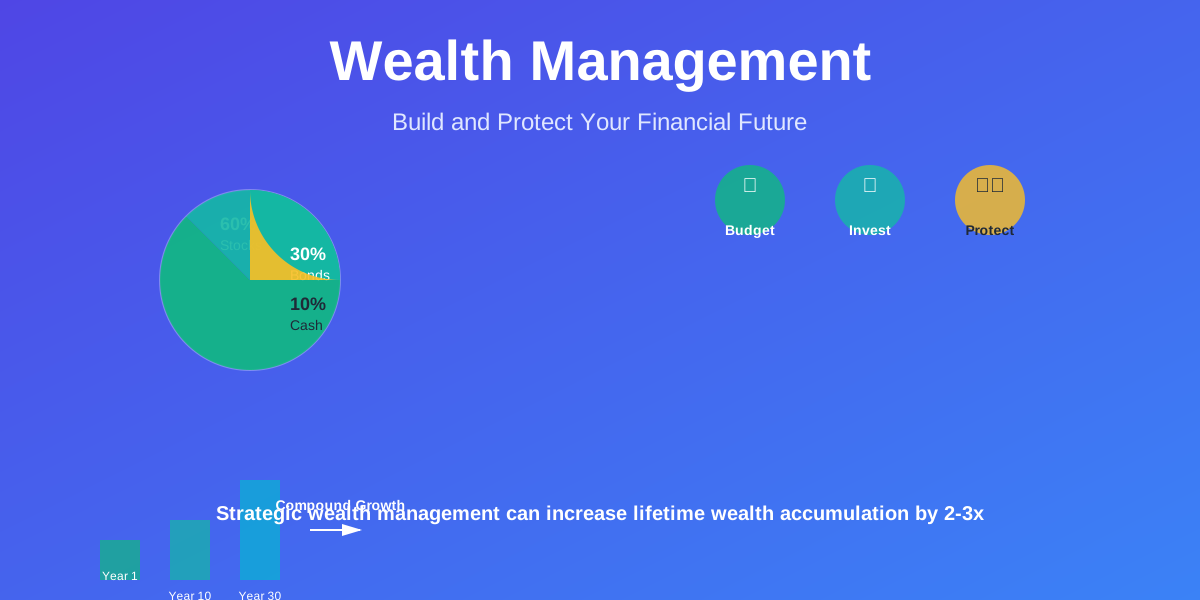
The wealthiest individuals aren't necessarily the highest earners—they're the ones who manage their money strategically. They understand asset allocation, they protect against taxes, they diversify investments, and they plan for life's major transitions. These aren't secrets; they're learnable skills.
Within the next 10-15 minutes, you'll understand the complete wealth management framework, discover the exact steps to apply it, and identify which approach fits your situation best. This knowledge can literally add hundreds of thousands to your lifetime wealth.
What Is Wealth Management?
Wealth management is a comprehensive approach to managing personal finances that integrates investment management, financial planning, tax planning, estate planning, and risk management into one coordinated strategy. It's not simply investing money or cutting expenses—it's orchestrating all aspects of your financial life toward specific, meaningful goals. Effective wealth management considers your entire financial situation, from income and expenses to assets, liabilities, and long-term objectives, creating a unified plan rather than isolated actions.
Not medical advice.
Wealth management became increasingly important because modern financial life has become complex. Tax laws change, investment options multiply, inflation erodes purchasing power, and life circumstances shift. Without a strategic framework, most people react to these changes instead of preparing for them. They make suboptimal decisions about money, miss tax advantages, fail to diversify properly, and don't plan adequately for retirement or major life events. Wealth management solves this by creating a system—a set of proven approaches that handles complexity automatically.
Surprising Insight: Surprising Insight: Studies show that individuals who follow comprehensive wealth management plans accumulate 2-3 times more wealth over their lifetime than those who manage finances reactively, even when both groups have similar incomes.
The Wealth Management Ecosystem
Visual showing how investment management, financial planning, tax optimization, estate planning, and risk management interconnect to create comprehensive wealth management.
🔍 Click to enlarge
Why Wealth Management Matters in 2026
In 2026, wealth management has become essential because of several converging factors. First, inflation continues to erode purchasing power, making strategic investing crucial. Estate tax exemptions have increased to $15 million per person, but this represents a temporary opportunity window—effective planning now protects your wealth from significant tax burdens when laws change. Second, investment options have proliferated beyond stocks and bonds to include cryptocurrencies, alternative assets, and complex instruments requiring sophisticated understanding.
Technology is reshaping wealth management itself. AI now assists with budgeting, fraud detection, expense categorization, and investment recommendations. Many brokers and fintech platforms now offer automated wealth management through robo-advisors, making professional-level guidance accessible even to those with modest assets. However, this democratization of tools makes human guidance more valuable—understanding when to use automation versus when to seek personalized advice is itself a wealth management skill.
Perhaps most importantly, 2026 brings greater emphasis on values-aligned investing and sustainable wealth building. The rise of ESG (Environmental, Social, Governance) investing, impact funds, and conscious capitalism means that building wealth no longer means compromising your values. Modern wealth management integrates what you care about with how you build assets.
The Science Behind Wealth Management
Research from behavioral economics reveals that wealth building isn't primarily about intelligence or luck—it's about systematic decision-making and consistency. Studies show that ordinary individuals who follow disciplined wealth management principles accumulate significantly more wealth than their counterparts without such frameworks. The reason is simple: wealth compounds. When you reinvest returns, strategically manage taxes, and maintain consistent contributions, the mathematical power of compounding generates returns on your returns.
A landmark study by Vanguard demonstrated that the primary value of professional wealth management comes not from stock-picking ability (which most professionals actually lack) but from disciplined asset allocation, behavioral coaching, and strategic rebalancing. This means that a well-designed wealth management system works regardless of market conditions because it's built on principles rather than predictions. The data shows that individuals with comprehensive financial plans accumulate 2-3 times more wealth than those without, suggesting that the system itself creates value independent of market performance.
How Compounding Powers Wealth Growth
Demonstrates the exponential effect of consistent contributions, diversification, and reinvestment over 20, 30, and 40 year periods.
🔍 Click to enlarge
Key Components of Wealth Management
Income Management and Budgeting
The foundation of wealth management is understanding where money comes from and where it goes. Budgeting creates the baseline awareness necessary for all subsequent strategies. Effective budgeting allocates income across five categories: essential expenses (housing, food, utilities), debt service, savings and investments, discretionary spending, and charitable giving. Most financial advisors recommend the 50/30/20 framework: 50% for essentials, 30% for discretionary, and 20% for savings and debt reduction. However, wealth management adapts these ratios based on your income level and goals. High earners might allocate more to investments while maintaining lower discretionary spending, whereas lower earners might focus on expanding essential income first through skill development or side income.
Asset Allocation and Diversification
Asset allocation—the division of your portfolio across stocks, bonds, real estate, and alternative investments—is the primary driver of portfolio performance and risk. Research consistently shows that asset allocation accounts for approximately 90% of portfolio returns, while individual stock selection accounts for roughly 10%. This means that getting your allocation right matters far more than picking winning stocks. Diversification, meanwhile, spreads investments across different sectors, geographies, and asset classes to reduce the impact of any single investment underperforming. A diversified portfolio might include U.S. stocks, international stocks, bonds, real estate investment trusts (REITs), and perhaps alternative investments like commodities or cryptocurrencies—each component chosen to perform differently under varying market conditions.
Tax Optimization Strategies
Taxes represent one of the largest expenses over a lifetime, yet most people pay far more tax than necessary through simple ignorance of available strategies. Tax-efficient wealth management includes maximizing retirement account contributions (401k, IRA, SEP-IRA), utilizing tax-loss harvesting to offset capital gains, strategically timing income and deductions, and choosing tax-efficient investment structures. For high earners, strategies like charitable giving, estate planning, and business structure optimization can save tens of thousands annually. The key principle is that tax reduction should drive investment strategy, not the reverse—your investments should be chosen for after-tax returns, not pre-tax returns.
Risk Management and Insurance Planning
Wealth means nothing if a single catastrophic event can destroy it. Risk management protects accumulated wealth through appropriate insurance and diversification. Types of essential insurance include health insurance (protecting against medical catastrophes), disability insurance (protecting income), life insurance (protecting dependents), homeowners or renters insurance (protecting assets), and potentially umbrella liability insurance. The purpose of insurance in wealth management isn't to protect against minor losses you can absorb—it's to prevent catastrophic losses that would derail your entire financial plan. Many high-net-worth individuals structure assets using legal entities like trusts or LLCs to provide additional protection against liability.
| Component | Primary Purpose | Timeline |
|---|---|---|
| Income & Budgeting | Establish baseline cash flow and savings rate | Ongoing |
| Emergency Fund | Cover 3-6 months expenses for stability | Build within 1 year |
| Debt Management | Reduce liabilities and improve net worth | Ongoing, prioritize high-interest |
| Asset Allocation | Distribute investments by risk tolerance | Establish within 1 year |
| Diversification | Reduce individual investment risk | Maintain continuously |
| Tax Optimization | Minimize tax burden on returns | Annual planning |
| Estate Planning | Ensure assets transfer according to wishes | Establish, review every 3-5 years |
| Insurance Protection | Guard against catastrophic losses | Establish, review annually |
How to Apply Wealth Management: Step by Step
- Step 1: Assess your complete financial situation by listing all income sources, expenses, assets (bank accounts, investments, real estate, vehicles), and liabilities (mortgages, loans, credit card debt). Calculate your net worth as the baseline for measuring progress.
- Step 2: Establish an emergency fund covering 3-6 months of essential expenses in a high-yield savings account. This prevents the need to liquidate investments during financial stress and maintains stability when income interrupts.
- Step 3: Create a realistic monthly budget aligned with your income using budgeting software or spreadsheets. Track actual spending for one month to identify where money actually goes versus where you think it goes, then adjust allocations.
- Step 4: Define specific, measurable financial goals with timelines: retirement age and target amount, major purchases (home, vehicle), education funding, vacation plans, and charitable giving. Assign rough dollar amounts and target dates to each goal.
- Step 5: Determine your risk tolerance by assessing your ability to withstand investment losses, your time horizon until needing the money, and your emotional comfort with volatility. Match this to an appropriate asset allocation—typically more stocks for longer timelines, more bonds for shorter ones.
- Step 6: Establish an appropriate asset allocation based on your goals, timeline, and risk tolerance. As a general framework, many advisors suggest a stock/bond ratio equal to your age in bonds and the remainder in stocks, adjusting as needed. For example, a 40-year-old might use 40% bonds and 60% stocks.
- Step 7: Build a diversified portfolio within your chosen asset allocation using low-cost index funds, ETFs, or individual securities. Focus on diversification across sectors (technology, healthcare, finance), geographies (U.S., international developed, emerging markets), and asset classes rather than trying to pick winning stocks.
- Step 8: Set up automatic monthly contributions to investments from your paycheck before you see the money, ensuring consistent deposits that fuel compounding. Make this amount challenging but achievable—preferably 15-25% of gross income for strong wealth building.
- Step 9: Review and rebalance your portfolio quarterly or semi-annually, ensuring that your actual allocation hasn't drifted from your target due to different asset performance. Rebalancing forces you to buy low and sell high automatically.
- Step 10: Implement tax optimization strategies including maximizing retirement account contributions, tax-loss harvesting to offset gains, and strategic charitable giving. Consult a tax professional to identify specific opportunities for your situation.
Wealth Management Across Life Stages
Young Adulthood (18-35)
In young adulthood, wealth management focuses on building strong financial foundations despite typically lower income. The primary priorities are establishing an emergency fund, paying down high-interest debt like credit cards, and beginning investment contributions. This is the most valuable stage for wealth building because time is your greatest asset—money invested at age 25 has 40 years to compound versus money invested at 45 with only 20 years remaining. Even small contributions at this stage create enormous wealth eventually. Young adults should maximize employer retirement plan matches (essentially free money), open an IRA if available, and invest any surplus income in diversified index funds. The approach is aggressive on risk (high stock allocation) because there's time to recover from downturns and decades of compounding ahead.
Middle Adulthood (35-55)
During middle adulthood, wealth management becomes more sophisticated as income typically increases, asset bases grow, and complexity emerges. This stage prioritizes increasing investment contributions toward retirement targets, optimizing tax strategies through business structure or retirement plan choices, and implementing estate planning (will, trust, power of attorney). Diversification becomes increasingly important as accumulated assets represent significant wealth. Many middle-aged individuals at this stage also begin caring for aging parents while still supporting children, requiring careful cash flow management and potentially long-term care insurance. Asset allocation gradually shifts toward more conservative allocations (increased bonds) as the timeline to retirement shortens. This is also the stage where professional wealth management guidance often pays for itself through tax optimization and investment efficiency improvements.
Later Adulthood (55+)
Later adulthood wealth management shifts focus from accumulation to distribution and preservation. Primary concerns include optimizing retirement account withdrawals (managing the tax implications of required minimum distributions), Social Security claiming strategy (claiming age dramatically affects lifetime benefits), and finalizing estate plans. Asset allocation becomes increasingly conservative (higher bond allocation) to reduce volatility as there's limited time to recover from market downturns. Many retirees also benefit from charitable giving strategies like donor-advised funds or charitable trusts that provide tax benefits while funding causes they care about. Long-term care planning and insurance become important for protecting assets from catastrophic health expenses. This stage may also include teaching wealth management principles to the next generation to prepare them for inherited assets.
Profiles: Your Wealth Management Approach
The Conservative Accumulator
- Low-cost, diversified index fund strategy with consistent contributions
- Regular rebalancing to maintain predetermined allocation
- Tax optimization through retirement accounts and charitable giving
Common pitfall: Being too conservative with stock allocation given their long time horizon, reducing long-term returns through excessive caution
Best move: Match stock allocation to time horizon (typically 60-80% stocks before age 50), then gradually reduce. Trust the system rather than making emotional changes based on market news.
The Ambitious Entrepreneur
- Business structure optimization to reduce self-employment taxes
- Diversified personal investment portfolio separate from business assets
- Adequate insurance to protect business interruption and liability risks
Common pitfall: Over-concentrating wealth in the business, creating massive risk if the business fails or requires unexpected investment
Best move: Deliberately move profits to personal investments each quarter, maintaining business ownership below 50% of total net worth. Create systematic profit-distribution discipline.
The Income Earner (W2 Employee)
- Maximization of employer retirement plan contributions and matches
- Tax-loss harvesting and tax-efficient fund selection for taxable accounts
- Disability insurance to protect income if unable to work
Common pitfall: Relying too heavily on a single income source without protecting it through adequate disability insurance or developing alternative income
Best move: Max out 401k ($24,500 in 2026), open backdoor Roth if eligible, build additional investment accounts outside retirement plans, maintain excellent disability insurance.
The High-Net-Worth Investor
- Alternative investments (private equity, real estate, hedge funds) for diversification
- Estate tax planning and trust structures to protect assets
- Sophisticated tax strategies including cost segregation, charitable giving structures, and loss harvesting
Common pitfall: Chasing returns through complex or trendy investments that increase cost and tax drag without improving results
Best move: Maintain core portfolio in low-cost index funds (70-80%), use 20-30% for alternative investments with professional management, focus on after-tax returns and integration with overall wealth plan.
Common Wealth Management Mistakes
The first and most costly mistake is attempting to pick individual stocks or time markets rather than following a disciplined asset allocation and diversification strategy. Decades of research prove that 90% of active investors underperform simple index funds after accounting for fees and taxes. Most investors become emotionally reactive—selling during crashes when they should be buying, chasing performance by moving to whichever investment has done best recently. Instead, commit to a specific asset allocation, invest consistently, and rebalance mechanically.
The second major mistake is failing to optimize taxes, leaving money on the table through ignored deductions, suboptimal retirement account utilization, or inefficient investment structures. Many middle to high-income earners can reduce taxes by $5,000-50,000+ annually through simple strategies like maxing retirement contributions, strategic charitable giving, or tax-loss harvesting. This isn't tax evasion—it's tax efficiency, and it's perfectly legal. Yet many people simply don't bother.
The third critical mistake is inadequate insurance protection. While people readily spend on car insurance, home insurance, and auto insurance, they often neglect health insurance, disability insurance, life insurance, and liability coverage. A single health catastrophe or lawsuit could liquidate decades of wealth building. Appropriate insurance is among the highest ROI protective measures available—it's typically inexpensive relative to the risks protected.
The Wealth Management Mistake Cycle
Shows how common mistakes like emotional investing, poor asset allocation, tax inefficiency, and inadequate insurance compound into suboptimal wealth outcomes.
🔍 Click to enlarge
Science and Studies
The foundation of wealth management strategy comes from decades of rigorous financial research, particularly from Nobel Prize-winning behavioral finance and modern portfolio theory. The evidence overwhelmingly supports certain principles while debunking financial myths that cost people millions.
- Fama & French (1996): Their groundbreaking research showed that asset allocation explains approximately 90% of portfolio return variance, while security selection explains only 10%. This means your allocation strategy is far more important than your stock picks.
- Vanguard Advisor's Alpha Study (2010): Demonstrated that the primary value of professional wealth management comes from behavioral coaching and disciplined strategies (worth ~2% annually), not from superior investment selection (worth ~0%).
- Dalbar QAIB Study (ongoing): Tracks investor returns versus market returns, consistently showing that investor returns underperform market returns by 3-5% annually due to emotional decision-making and poor market timing.
- Morningstar Study (2015): Found that comprehensive financial planning adds 1.5-3% annually in value through tax optimization, risk reduction, behavioral guidance, and improved decision-making.
- Federal Reserve & Boston Consulting Group (2024-2025): Research shows individuals with documented financial plans accumulate 2-3x more wealth than those without, even when controlling for income level.
Your First Micro Habit
Start Small Today
Today's action: Calculate your actual monthly expenses by reviewing the last 3 months of bank and credit card statements, categorizing spending into Essential (housing, utilities, food), Debt Service, Investments, Discretionary, and Other. Identify total spending and target savings rate (aim for 20%+ of gross income).
This single action provides the data foundation for all other wealth management decisions. Most people overestimate some spending and underestimate others—seeing actual numbers enables accurate budgeting and identification of where optimization opportunities exist. It takes 20-30 minutes but informs every future financial decision.
Keep quitting habit apps after a missed day? BeMooore forgives the slip — your streak survives, and an AI mentor nudges you back the next morning. Free on iOS.
Quick Assessment
How would you describe your current approach to managing money?
Your response indicates your engagement level with wealth management. Reactive handling typically leads to financial stress and missed opportunities. Strategic engagement begins building wealth. Comprehensive planning accelerates wealth building through optimized decisions across all areas.
What feels most uncertain about your financial future?
Your biggest uncertainty reveals where wealth management would provide the most value. Retirement uncertainty suggests need for retirement projections. Investment uncertainty suggests need for asset allocation guidance. Tax uncertainty suggests opportunity for optimization. Legacy uncertainty suggests need for estate planning.
If you could improve one aspect of your finances right now, which matters most?
This reveals your actual priority among possible improvements. Different answers suggest different immediate actions: savings rate suggests budgeting focus; investment returns suggest asset allocation review; tax reduction suggests tax optimization consultation; clarity suggests comprehensive financial planning.
Take our full assessment to get personalized recommendations.
Discover Your Style →Next Steps
Wealth management isn't a single decision or action—it's a systematic approach applied consistently over decades. Your immediate next step is calculating your actual monthly expenses and current net worth, establishing the data baseline that all wealth management decisions rest upon. This single calculation provides clarity that shifts everything afterward.
From there, the sequence is straightforward: establish an emergency fund, reduce high-interest debt, set specific financial goals with timelines, determine appropriate asset allocation based on your timeline and risk tolerance, and begin consistent contributions to investments. The power of wealth management lies not in complexity or perfect execution, but in systematic consistency—doing the right things repeatedly over years and decades while resisting the emotional impulses that derail most people's financial plans.
Get personalized guidance with AI coaching.
Start Your Journey →Research Sources
This article is based on peer-reviewed research and authoritative sources. Below are the key references we consulted:
Related Glossary Articles
Frequently Asked Questions
Do I need a wealth manager to implement wealth management?
Not necessarily. Many individuals successfully implement wealth management themselves using online brokers, budgeting software, and research. However, professional guidance adds value through expertise, behavioral coaching, and saving time. A common approach is DIY investing with professional guidance on complex areas like tax optimization or estate planning.
What's the minimum amount needed to start wealth management?
You can begin wealth management with any income level. The principles are identical whether managing $1,000 or $1,000,000. Start with budgeting and emergency fund building, add investment contributions as possible, and scale strategies as assets grow. Many brokers now have no minimum investment requirements.
How often should I review my wealth management plan?
Review your plan at least annually, checking that actual results align with projections and that life circumstances haven't changed. Rebalance your portfolio semi-annually or when allocations drift 5%+ from targets. Don't review obsessively—quarterly or monthly monitoring tends to increase emotional reactivity rather than improve results.
What's the difference between wealth management and investment management?
Investment management focuses specifically on portfolio strategy and selection. Wealth management is broader, integrating investments with budgeting, tax optimization, insurance, estate planning, and other financial elements into a comprehensive strategy.
How does inflation affect wealth management strategy?
Inflation is why diversification and strategic asset allocation matter. Stocks historically provide returns above inflation over long periods, while bonds provide stability. Mixed portfolios with appropriate stock allocation typically outpace inflation while managing risk. Your asset allocation should account for inflation's impact on purchasing power over your time horizon.
Take the Next Step
Ready to improve your wellbeing? Take our free assessment to get personalized recommendations based on your unique situation.
- Discover your strengths and gaps
- Get personalized quick wins
- Track your progress over time
- Evidence-based strategies