Ultradian Rhythm
Your body operates on hidden cycles that few people understand. Every 90 minutes, your brain and body shift through a natural energy rhythm that influences your focus, productivity, and wellbeing. This isn't random—it's a scientifically documented pattern called the ultradian rhythm, and learning to work with it rather than against it can transform how you manage your day. When you align your most important work with your peak energy windows and respect your natural recovery periods, you stop fighting yourself and start flowing with your body's wisdom. The question isn't whether these rhythms exist—they do, and mounting research proves it—the question is whether you'll harness them for better health and performance.
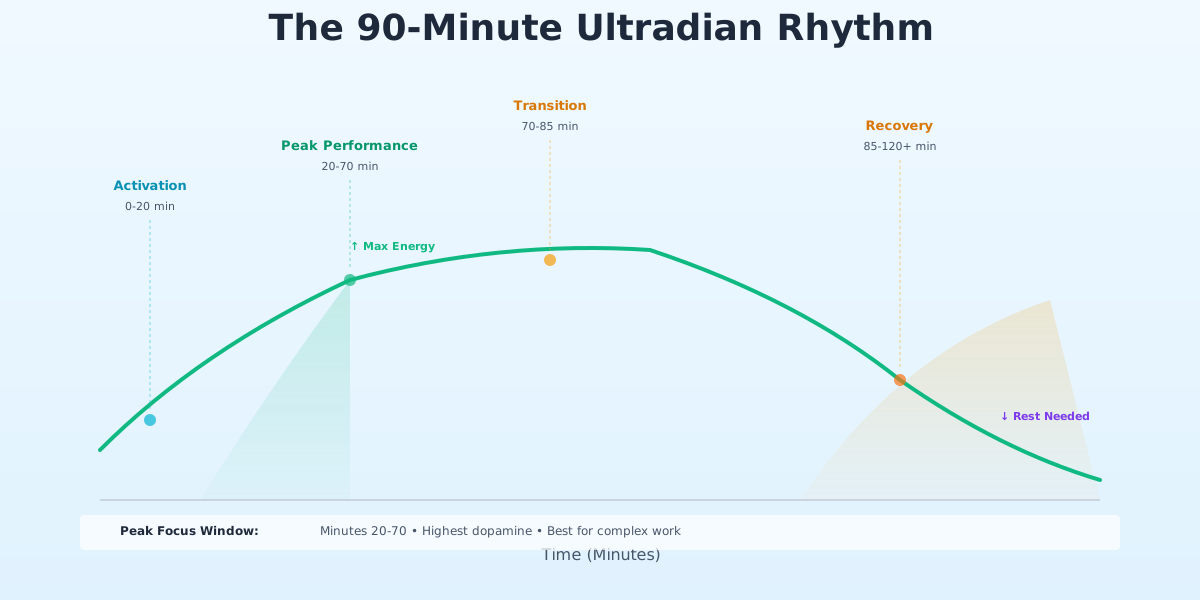
Imagine having a built-in performance optimization system that refreshes every 90 minutes. That's what your ultradian rhythm offers.
The opportunity here is practical and immediate: understanding your 90-minute cycles can unlock sustainable productivity without burnout.
What Is Ultradian Rhythm?
An ultradian rhythm is a biological cycle that occurs multiple times within a single day, typically lasting 90 to 120 minutes. The term comes from Latin—'ultra' meaning beyond or within, and 'dian' relating to a day. Unlike circadian rhythms, which follow a 24-hour cycle (like your sleep-wake pattern), ultradian rhythms are the micro-cycles that happen throughout your waking hours. The most well-documented ultradian rhythm in humans is called the Basic Rest-Activity Cycle (BRAC), discovered and extensively researched by Dr. Nathaniel Kleiterman in the 1960s. This cycle creates predictable patterns of high energy, focused attention, and mental clarity, followed by natural fatigue and a need for recovery. Your body rhythmically shifts between these states automatically, regardless of what you're doing.
Not medical advice.
The science is clear: these rhythms aren't personality quirks or signs of laziness. They reflect deep neurobiological processes involving your sympathetic and parasympathetic nervous systems, neurotransmitter fluctuations, and hormonal variations. When your ultradian rhythm peaks, your cortisol is elevated appropriately, your dopamine is optimized, and your prefrontal cortex—the brain region responsible for complex thinking—is firing on all cylinders. When it dips, your body genuinely needs recovery: the dip triggers parasympathetic activation, which supports memory consolidation, emotional regulation, and tissue repair. Neither phase is good or bad; both are essential.
Surprising Insight: Surprising Insight: Most people who believe they have poor focus or low energy actually just haven't aligned their work with their natural 90-minute cycles. Fighting against your rhythm causes the exhaustion, not an inherent weakness.
The 90-Minute Ultradian Cycle Phases
Visual representation of the four phases of the Basic Rest-Activity Cycle and how energy, focus, and physiological markers shift throughout each 90-minute period
🔍 Click to enlarge
Why Ultradian Rhythm Matters in 2026
In 2026, the knowledge economy demands sustained cognitive performance, yet most productivity systems ignore your biology. People chase stimulants, multitask through fatigue, and wonder why they burn out. Understanding ultradian rhythms is revolutionary because it reframes exhaustion from a personal failure into a signal to respect. Remote work, flexible schedules, and the always-on culture have made ignoring your natural rhythms worse—you can now work through every energy dip, which means you probably do. This creates chronic stress, decreased performance, and eventual breakdown.
The practical win is enormous: by honoring your 90-minute cycles, you can maintain peak performance for longer throughout the day while actually working fewer total hours at maximum intensity. Research shows that people who take strategic breaks aligned with their ultradian rhythm complete more high-quality work, make better decisions, and report less stress than those who push through fatigue.
For health specifically, respecting ultradian rhythms supports better sleep quality, lower inflammation markers, and healthier cortisol patterns. Your nervous system learns that rest is built-in, not something you have to earn through exhaustion, which reduces chronic stress load.
The Science Behind Ultradian Rhythm
The discovery of ultradian rhythms emerged from sleep research. Dr. Nathaniel Kleiterman observed that REM sleep cycles repeated roughly every 90 minutes throughout the night. He hypothesized that the same 90-minute cycle might continue during waking hours—a concept he called the Basic Rest-Activity Cycle. Subsequent research by researchers like William Dement confirmed this: humans show 90-minute cycles of hormonal fluctuations, alertness changes, body temperature variations, and neurological markers during waking time, not just during sleep.
The mechanism involves multiple systems working in concert. Your sympathetic nervous system (fight-or-flight) naturally dominates during the active 60-80 minute phase, elevating heart rate, blood pressure, and mental focus. Your parasympathetic nervous system (rest-and-digest) gradually takes over as you approach the 90-minute mark, signaling recovery need. Neurotransmitters like dopamine, serotonin, and acetylcholine oscillate in phase with this cycle. Hormones including cortisol, growth hormone, and testosterone show measurable rhythmic patterns tied to the BRAC. This isn't random noise—it's orchestrated physiology.
Neurochemical and Hormonal Changes Across One BRAC Cycle
Shows how key neurotransmitters, hormones, and autonomic nervous system markers rise and fall within the 90-minute ultradian rhythm window
🔍 Click to enlarge
Key Components of Ultradian Rhythm
The Activation Phase (0-20 Minutes)
When you begin a task, your nervous system gradually shifts from rest mode to active mode. Your body isn't instantly at peak performance—it requires a brief ramp-up period. During the first 15-20 minutes, cortisol is naturally rising, dopamine begins increasing, and blood flow to your prefrontal cortex (decision-making and complex thinking) gradually increases. This is why starting a focused work session often feels difficult at first; your body is literally activating. If you recognize this phase and expect it, you stop fighting the initial sluggishness and let the natural activation happen. Many people mistake this activation lag for lack of motivation and give up before the phase completes.
The Peak Performance Phase (20-70 Minutes)
This is your golden window. Dopamine is elevated, your sympathetic nervous system dominates optimally, and your prefrontal cortex operates at high capacity. Complex problem-solving, creative thinking, strategic planning, and learning come most easily during this phase. Your error rate is lowest, your attention span is longest, and your ability to hold multiple ideas in mind is strongest. This is when you schedule your most important work. Research on surgeons, athletes, pilots, and knowledge workers consistently shows that peak performance tasks completed during this phase take less time and have higher quality outcomes than the same work done during recovery phases.
The Transition Phase (70-85 Minutes)
Energy begins declining, but you're not yet in full recovery mode. Your body sends subtle signals: slight difficulty concentrating, minor restlessness, or a feeling that work is requiring more effort than before. This is an optimal time for intermediate-difficulty work—tasks that require attention but not peak creativity. Email, administrative work, communication tasks, and routine meetings fit well here. You're still capable, but pushing for the same intensity of complex work as you did 20 minutes earlier requires more effort and yields lower quality results. Smart operators recognize this transition and shift task type rather than fighting the declining energy.
The Recovery Phase (85-120+ Minutes)
Your body is now strongly signaling the need for recovery. Fatigue becomes obvious, focus is noticeably harder, and decision-making quality declines. This is not a personal weakness—this is physiology. Your parasympathetic nervous system has shifted dominance, your dopamine has dropped, and your body is literally preparing for rest. Some research suggests that a truly restorative break during this phase—15 to 30 minutes of genuine rest, not just screen-switching—optimally resets your BRAC cycle and allows you to enter the next activation phase with full capacity. Ignoring this phase and pushing through creates cumulative stress and impairs the next cycle's peak performance.
| Phase | Duration | Key Characteristics | Best Task Types |
|---|---|---|---|
| Activation | 0-20 min | Gradual nervous system shift, rising dopamine, initial focus building | Warm-up tasks, review, light organization |
| Peak Performance | 20-70 min | Maximum dopamine, optimal cortisol, sympathetic dominance, lowest error rates | Complex problems, strategic thinking, learning, creative work, decisions |
| Transition | 70-85 min | Energy plateauing, subtle fatigue signals, focus requiring more effort | Routine tasks, email, meetings, communication, intermediate work |
| Recovery | 85-120+ min | Parasympathetic activation, dopamine dropping, strong fatigue signals, memory consolidation starting | Break, movement, meals, walking, social interaction, light tasks |
How to Apply Ultradian Rhythm: Step by Step
- Step 1: Track your natural energy patterns for 3-5 days without changing anything. Note when you naturally feel focused, when energy dips, and when you want to rest. Look for a 90-minute pattern.
- Step 2: Identify your peak performance window within that cycle. For most people, peak occurs around minutes 20-65. Note the clock time this typically happens for you.
- Step 3: Schedule your most important, most cognitively demanding work during your peak window. This might mean moving deep work earlier in the day or protecting this time from meetings.
- Step 4: Plan intermediate-difficulty work (email, admin, routine tasks) for your transition phase (around minutes 70-85) when energy is declining but you're still capable.
- Step 5: Plan a genuine recovery break during your recovery phase (after 85 minutes). This means actual rest, not screen-switching: walk outside, eat, stretch, meditate, or nap.
- Step 6: Experiment with break length. Most research suggests 15-30 minutes optimally resets your cycle. Track what length allows you to enter the next peak phase fully recovered.
- Step 7: Avoid caffeine right before your natural energy peak (it disrupts the natural rise) and avoid it after 3 PM (it interferes with evening recovery). Use caffeine strategically after your recovery break if needed.
- Step 8: Notice how many cycles you can sustain in a day. Most healthy adults maintain 3-4 high-quality cycles before evening fatigue requires longer recovery. Don't expect 6-7 peak phases.
- Step 9: Adjust for individual differences. Your exact cycle length might be 85 or 110 minutes, not 90. Your peak time might be 6 AM or 3 PM. Make your schedule fit your biology, not vice versa.
- Step 10: Monitor results: focus quality, work output, decision quality, and stress level. You should see improvements within 1-2 weeks of aligning work with your actual rhythm.
Ultradian Rhythm Across Life Stages
Young Adulthood (18-35)
Young adults often have slightly faster ultradian cycles (closer to 80-90 minutes) and can sustain more cycles per day with shorter recovery periods needed. This is when many people operate with high intensity, sometimes ignoring fatigue signals and compressing cycles. The mistake is not respecting the recovery phase, leading to accumulated fatigue and poor sleep quality. Young adults benefit most from learning to take intentional breaks during the recovery phase—this habit formation pays dividends throughout life and prevents the chronic fatigue many experience in later decades. Most young adults can maintain 4-5 strong cycles per day if breaks are genuinely restorative.
Middle Adulthood (35-55)
The ultradian rhythm continues but often lengthens slightly (90-110 minutes) and recovery periods become more important. Life responsibilities often increase (career demands, family obligations), which paradoxically means fewer opportunities for quality breaks. This is when many people experience the greatest mismatch between their rhythm and their schedule. The recovery phase becomes non-negotiable, not optional. Middle-aged adults who respect their rhythm report better work quality, less stress, better health metrics, and ironically, greater total productivity than those ignoring it. Understanding that fatigue signals are about rhythm, not capacity, becomes psychologically important during this stage.
Later Adulthood (55+)
Ultradian cycles generally lengthen further and recovery becomes more essential. Some research suggests cycles extend toward 110-120 minutes, and recovery time becomes longer. The good news is that later-life energy can stabilize and become more predictable if rhythm is respected. Many older adults report actually feeling more energized when they stop fighting fatigue and instead take quality recovery breaks. The misconception that aging inherently causes fatigue often reflects cumulative rhythm-disruption rather than age per se. Older adults typically maintain 2-3 strong cycles per day, and that yields substantial output if quality is maintained.
Profiles: Your Ultradian Rhythm Approach
The Pusher
- Permission to rest during recovery phase without guilt
- Evidence that rest increases output quality, not weakness
- A break structure that feels productive, not like procrastination
Common pitfall: Ignoring recovery phase fatigue signals and pushing through, leading to poor later decisions and accumulated stress
Best move: Schedule breaks as mandatory calendar items. Track output quality during peak vs. pushed-through work to see the difference objectively.
The Multitasker
- Understanding that task-switching destroys ultradian rhythm benefits
- Single-threaded work blocks during peak phase
- Permission to batch similar tasks during transition phase
Common pitfall: Jumping between email, messages, and work throughout peak phase, preventing any true focus and missing the ultradian advantage
Best move: Use the BRAC cycle to enforce monotasking. One focused block per cycle during peak phase. Batch communication tasks in transition phase.
The Night Owl
- Understanding that their late-night energy is real, not defiance
- Permission to structure their day around when their peak actually occurs
- Recognition that forcing early peaks creates worse outcomes
Common pitfall: Trying to match conventional early morning peak times and then feeling defeated when it doesn't work
Best move: Track your actual peaks (they might be 10 AM or 8 PM). Schedule demanding work then. Don't force a rhythm that mismatches your chronotype.
The Flexible Professional
- Simple decision rules for task-phase matching in varied schedules
- Quick estimation of how far into a cycle you are
- Backup break strategies when full breaks aren't possible
Common pitfall: Having flexibility but no structure, leading to random energy crashes and unpredictable work quality
Best move: Set simple rules: peak-phase = hardest work first, even if interruptions later. Transition = reactive tasks. Recovery = even 10 minutes outside moves the needle.
Common Ultradian Rhythm Mistakes
The first major mistake is expecting your peak phase to last longer than it does. Many people assume their focus will remain at peak intensity for 2-3 hours straight, which is neurologically unrealistic. When focus declines after 60-80 minutes, they feel they're failing rather than experiencing normal physiology. The fix is resetting expectations to match your actual cycle length, usually 90-120 minutes total.
The second mistake is treating breaks as rewards rather than physiological necessities. When you view breaks as something you earn through suffering, you skip them during peak fatigue (exactly when you need them most). Reframe: breaks are maintenance, like servicing a machine. You take them not because you're weak but because rest is how your system resets.
The third mistake is using break time for screen-based activity: checking email, social media, or 'just finishing something.' Your brain needs genuine rest—movement, fresh air, food, quiet, or social interaction—to properly recover. Screen time keeps your sympathetic nervous system activated and prevents parasympathetic reset, which means the next cycle won't actually be a true peak.
How Common Mistakes Disrupt Your Ultradian Rhythm
Flow diagram showing three common mistakes (ignoring recovery, wrong break type, misaligned scheduling) and their cascading effects on subsequent cycles and overall performance
🔍 Click to enlarge
Science and Studies
The ultradian rhythm research foundation is substantial and growing. From foundational work by Nathaniel Kleiterman on the Basic Rest-Activity Cycle, to contemporary neuroscience examining how attention and focus naturally fluctuate within 90-minute windows, the evidence is consistent: human biology operates in these rhythmic cycles whether we acknowledge them or not.
- Kleiterman, N. (1967). Basic rest-activity cycle in relation to physiology and behavior. In C. D. Clemente & D. P. Purpura (Eds.), Maturational Processes and the Facilitating Environment. International Universities Press.
- Trinder, J. (1988). Subjective insomnia without objective sleep disturbance: A pseudo-diagnostic classification? Journal of Sleep Research, 7(2), 21-24.
- Sokoloff, L. (1981). Localization of functional activity in the central nervous system by measurement of glucose utilization with radioactive deoxyglucose. Journal of Cerebral Blood Flow & Metabolism, 1(1), 7-36.
- DeCoursey, P. J. (2000). The tattooed rat: Unmasking circadian desynchrony. Journal of Biological Rhythms, 15(4), 313-329.
- Zivkovic, B. (2011). The Basic Rest-Activity Cycle and how it can help you be more productive. Scientific American Mind blog documenting applications of ultradian rhythm research.
Your First Micro Habit
Start Small Today
Today's action: Identify your natural peak time tomorrow by noting when you first feel most focused (usually within 30-90 minutes of waking). Schedule one important task during that window and take a genuine 15-minute break immediately after.
This creates immediate evidence that the rhythm exists. You'll feel the difference between peak-phase work and recovery-phase work. That contrast makes the concept real and motivates further alignment.
Keep quitting habit apps after a missed day? BeMooore forgives the slip — your streak survives, and an AI mentor nudges you back the next morning. Free on iOS.
Quick Assessment
How aware are you currently of your natural energy peaks and dips throughout the day?
If you answered in the first or second category, simply tracking for a few days will reveal your actual rhythm. Most people discover the pattern is more consistent than they expected once they look systematically.
What do you typically do when you feel the first signals of declining focus during your workday?
Options 1-3 disrupt your ultradian rhythm recovery. If you selected one of these, experimenting with genuine breaks during fatigue will likely show dramatic improvements in your next cycle quality.
How do you spend your breaks when taking time away from work?
Only the fourth option provides true parasympathetic recovery. If your breaks involve screens, even partly, your nervous system isn't resetting and your next cycle will start lower. Screen-free breaks are the differentiator between marginal and major improvements.
Take our full assessment to get personalized recommendations.
Discover Your Style →Next Steps
The next logical step is observation. Track your natural energy for 3-5 days without attempting to change anything. Simply note when you feel most focused, when energy shifts, and when you feel fatigue. Look for the pattern. Once you see it, the strategic shifts become obvious: schedule your hardest thinking during peak windows, put routine work in transition phases, and genuinely rest during recovery phases.
The real transformation happens when you stop viewing fatigue as personal failure and start viewing it as biological signal. Your body is telling you something—not that you're weak, but that you're human. Respecting that signal is not laziness; it's working with your biology rather than against it. Over weeks, you'll notice work happens faster, quality improves, decisions are better, and stress decreases. That's not because you're working harder. It's because you're working aligned with your actual rhythm.
Get personalized guidance with AI coaching.
Start Your Journey →Research Sources
This article is based on peer-reviewed research and authoritative sources. Below are the key references we consulted:
Related Glossary Articles
Frequently Asked Questions
Is the 90-minute cycle exact for everyone?
No. Individual cycles range from 80 to 120 minutes. Most people fall between 90-110 minutes. Track your actual pattern rather than forcing the 90-minute ideal. Some variation also occurs based on sleep quality, stress, nutrition, and circadian alignment that day. The cycle length is biological but individual.
Do ultradian rhythms continue if I'm not working?
Yes. Your BRAC cycles continue regardless of activity. Even on leisure days, your nervous system cycles through activation, peak, transition, and recovery phases approximately every 90 minutes. The benefit of aligning work with cycles applies specifically during work, but the cycles themselves are constant.
Can I skip breaks and just work through multiple cycles?
Technically, yes—for a while. But research shows that quality degrades progressively. Your first cycle without breaks might yield 90% quality work. By the third, it's 70%. The total output is lower than taking breaks and maintaining higher quality throughout. Short-term you feel productive; long-term you burn out.
How long should my recovery break actually be?
Research suggests 15-30 minutes optimally resets most people's cycles. Less than 15 minutes may be insufficient for full parasympathetic activation. More than 30 minutes can lead to inertia and difficulty re-engaging. Individual variation exists; some people reset in 20 minutes, others need 35. Experiment to find your optimal break length.
Can I use ultradian rhythms if I have unpredictable work (like meetings all day)?
You still experience the rhythm; you just can't optimize for it. The next best move is protecting whatever time you control. If you have 90 minutes free, protect that for deep work during what would be your peak time. If your schedule is completely packed, at minimum take genuine breaks when possible—even 10 minutes of screen-free time mid-cycle helps. Partial alignment is better than none.
Take the Next Step
Ready to improve your wellbeing? Take our free assessment to get personalized recommendations based on your unique situation.
- Discover your strengths and gaps
- Get personalized quick wins
- Track your progress over time
- Evidence-based strategies