Somatic Healing
Your body remembers what your conscious mind has long forgotten. That persistent tightness in your shoulders, the knot in your stomach before difficult conversations, the shallow breathing that arrives without warning — these are not random physical quirks. They are your body's way of holding onto experiences it never fully processed. Somatic healing offers a path to listen to these signals and, finally, let them go. What if the key to <a href="/g/emotional-healing.html">emotional healing</a> was not thinking harder but feeling deeper?
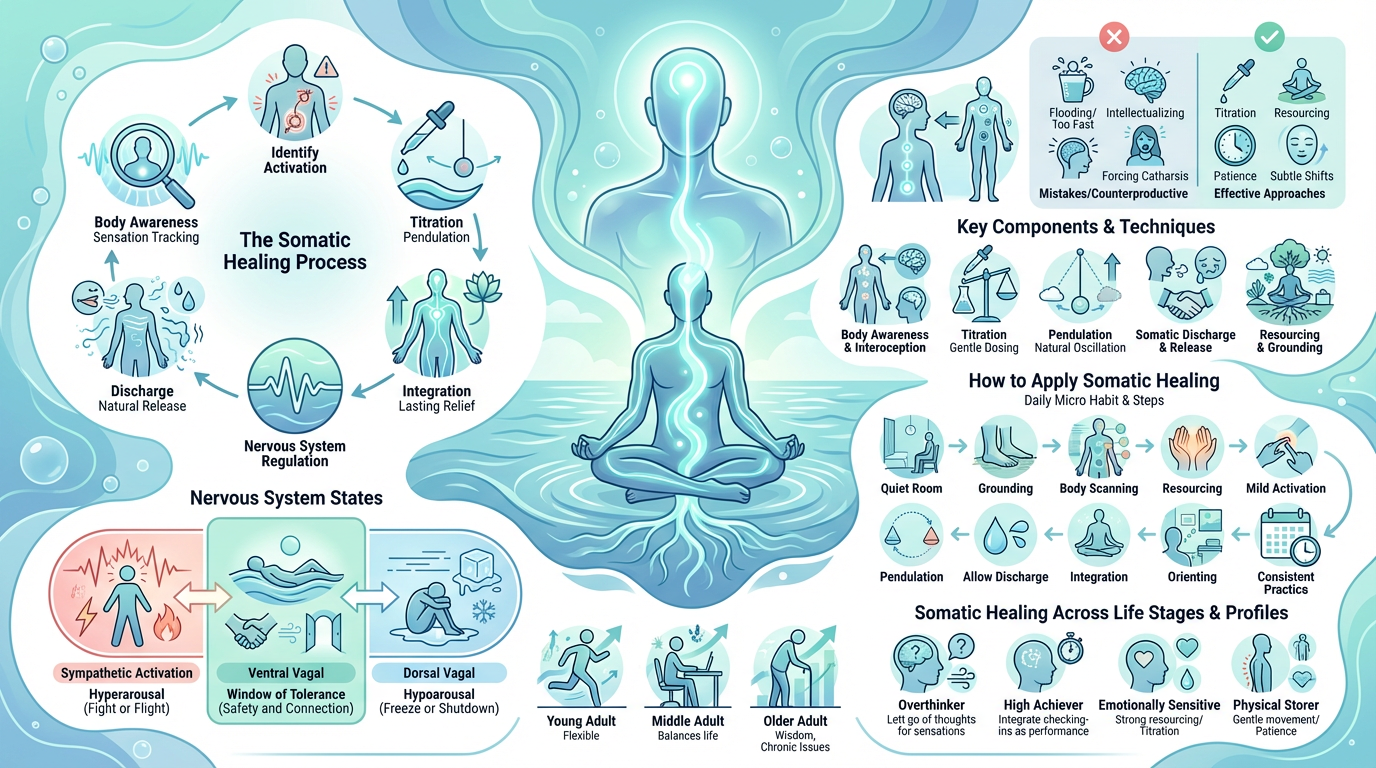
In this guide, you will discover how somatic healing works at the nervous system level, why traditional talk therapy alone sometimes falls short, and the specific body-based practices that research supports for lasting <a href="/g/emotional-recovery.html">emotional recovery</a>.
Whether you are navigating chronic tension, processing difficult life experiences, or simply seeking a deeper connection between your mind and body, somatic healing provides practical tools grounded in neuroscience and decades of clinical practice.
What Is Somatic Healing?
Somatic healing is a body-centered therapeutic approach that addresses the physical manifestations of emotional and psychological distress. The word "somatic" comes from the Greek "soma," meaning body. Unlike traditional talk therapies that work primarily through cognitive processing, somatic healing recognizes that the body stores experiences — particularly overwhelming or traumatic ones — in muscular tension patterns, postural habits, and nervous system activation states. By working directly with bodily sensations, movement, and breathing techniques, somatic healing helps release this stored tension and restore the nervous system to a regulated state.
Not medical advice.
Somatic healing encompasses several established modalities, including Somatic Experiencing (SE) developed by Peter Levine, Sensorimotor Psychotherapy, Hakomi Method, and various forms of body-based mindfulness practice. What unites these approaches is the understanding that healing must include the body — not just the mind. The autonomic nervous system, which governs our fight, flight, and freeze responses, plays a central role in how we process and recover from overwhelming experiences. When this system becomes dysregulated, somatic healing offers specific techniques to restore balance through emotional regulation and body awareness.
Surprising Insight: Surprising Insight: Research published in the European Journal of Psychotraumatology found that Somatic Experiencing produced significant improvements in PTSD symptoms, with effects maintained at follow-up — suggesting that body-based approaches can create lasting change where cognitive methods alone sometimes plateau.
The Somatic Healing Process
How somatic healing moves from body awareness to nervous system regulation and emotional release.
🔍 Click to enlarge
Why Somatic Healing Matters in 2026
Modern life places extraordinary demands on the nervous system. Constant digital stimulation, sedentary work environments, and the accelerating pace of daily life create chronic activation patterns that traditional stress management approaches often fail to address. The body accumulates this tension over months and years, leading to persistent physical symptoms, anxiety, sleep disruption, and diminished energy management capacity. Somatic healing offers a direct pathway to address these accumulated patterns at their source.
The growing recognition of the mind-body connection in mainstream medicine has elevated somatic approaches from alternative therapy to evidence-informed practice. Harvard Health has noted the rising interest in somatic therapy as a complement to traditional treatment, particularly for conditions where cognitive approaches alone show limited effectiveness. As our understanding of the brain function and nervous system deepens, the case for body-based healing grows stronger. Polyvagal theory, developed by Stephen Porges, has provided a neurological framework that explains why somatic interventions work — they engage the vagus nerve and social engagement system to shift the body from defensive states into safety and connection.
The demand for holistic health solutions continues to rise as people seek approaches that treat the whole person rather than isolated symptoms. Somatic healing meets this need by bridging the gap between physical health, emotional wellness, and psychological wellbeing. Whether practiced as a standalone modality or integrated with other therapeutic approaches, somatic healing addresses a fundamental truth: the body and mind are not separate systems but deeply interconnected aspects of human experience that must be treated together for complete healing and repair.
The Science Behind Somatic Healing
The scientific foundation of somatic healing rests on our understanding of the autonomic nervous system (ANS) and how it responds to perceived threat. When a person encounters an overwhelming experience, the ANS activates survival responses — fight, flight, or freeze. In healthy functioning, these responses complete naturally: the threat passes, and the nervous system returns to baseline through discharge of the mobilized energy. However, when this completion cycle is interrupted — through suppression, dissociation, or social constraints — the energy remains trapped in the body's tissues. This is the mechanism that creates the persistent tension, hypervigilance, and emotional resilience challenges that somatic healing addresses.
Research from the National Center for Biotechnology Information demonstrates that Somatic Experiencing produces measurable changes in interoceptive awareness — the ability to sense internal bodily states. A randomized controlled study published in the Journal of Traumatic Stress found that SE participants showed significant reductions in PTSD symptom severity compared to waitlist controls. The study also noted improvements in depression and overall wellbeing, suggesting that somatic approaches influence multiple systems simultaneously. These findings align with the broader neuroscience of cognitive function, which shows that the body's physiological state profoundly shapes emotional processing, mental health, and brain health.
Nervous System States in Somatic Healing
The three primary nervous system states and how somatic healing helps regulate them.
🔍 Click to enlarge
Key Components of Somatic Healing
Body Awareness and Interoception
The foundation of all somatic healing work is developing the capacity to notice bodily sensations without judgment or interpretation. This skill, known as interoception, involves tracking the subtle signals your body produces — warmth, tingling, pressure, constriction, expansion, pulsing, and temperature changes. Most people have learned to override or ignore these signals, prioritizing cognitive processing over bodily wisdom. Somatic healing retrains this awareness, creating a direct channel of communication between conscious attention and the autonomic nervous system. This capacity for emotional awareness through the body becomes the primary tool for all subsequent healing work.
Titration and Pendulation
Peter Levine introduced two essential concepts that distinguish somatic healing from other body-based approaches. Titration refers to approaching overwhelming material gradually — touching into activation in small, manageable doses rather than flooding the system. This prevents retraumatization and allows the nervous system to build new capacities incrementally. Pendulation describes the natural oscillation between states of activation and relaxation. By guiding awareness between areas of tension and areas of ease in the body, practitioners help clients experience the body's innate ability to self-regulate. Together, these techniques create a safe framework for processing stored tension without becoming overwhelmed, supporting deeper psychological flexibility.
Somatic Discharge and Release
When the nervous system begins to release stored activation, it often produces observable physical responses known as discharge. These may include spontaneous trembling or shaking, deep sighing or yawning, warmth spreading through the limbs, tears, gentle rocking, or changes in skin color. These responses indicate that the body is completing interrupted survival responses and returning to a regulated state. Unlike cathartic approaches that encourage intense emotional expression, somatic discharge occurs naturally and at the body's own pace. This gentle, organic process supports lasting rest and recovery rather than temporary relief.
Resourcing and Grounding
Before working with activation, somatic practitioners help clients build internal and external resources — experiences of safety, stability, and pleasure that provide a foundation for deeper work. Grounding techniques connect the body to the present moment through sensory engagement: feeling the feet on the floor, the support of a chair, or the texture of an object. Resourcing draws on positive memories, relationships, or places that evoke feelings of calm and security. These practices strengthen the ventral vagal system — the branch of the nervous system associated with safety and social connection — creating resilience that supports ongoing emotional health and coping strategies.
| Technique | Primary Focus | Best For |
|---|---|---|
| Somatic Experiencing | Nervous system regulation through sensation tracking | Trauma resolution, chronic stress patterns |
| Sensorimotor Psychotherapy | Body-mind integration with cognitive processing | Complex developmental patterns |
| Hakomi Method | Mindfulness-based somatic exploration | Self-understanding, emotional patterns |
| Breathwork | Nervous system regulation through breath | Anxiety, tension release, daily regulation |
| Body Scanning | Systematic awareness of bodily sensations | Building interoception, stress awareness |
How to Apply Somatic Healing: Step by Step
- Step 1: Find a quiet, comfortable space where you will not be interrupted. Sit or lie down in a position that feels supported and safe. Begin by taking three slow, natural breaths without trying to change anything about how you breathe.
- Step 2: Bring your awareness to your body as a whole. Notice the places where your body makes contact with the surface beneath you — the weight, the pressure, the temperature. This is body wellness grounding, establishing your physical presence in the present moment.
- Step 3: Slowly scan through your body from your feet to the top of your head. Notice areas of sensation without trying to change them — warmth, coolness, tightness, softness, tingling, numbness, or any other quality you detect. Practice the <a href="/g/acceptance.html">acceptance</a> of whatever you find.
- Step 4: Identify one area where you notice pleasant or neutral sensations. Rest your attention there for several breaths. Notice how focusing on this comfortable area affects the rest of your body. This is resourcing — building your capacity for regulation.
- Step 5: Now gently bring awareness to one area of mild tension or discomfort. Do not choose the most intense area. Stay with this sensation briefly, noticing its qualities: shape, size, temperature, movement. Practice <a href="/g/deep-breathing-techniques.html">deep breathing techniques</a> as you observe.
- Step 6: Pendulate: shift your attention back to the pleasant or neutral area you identified earlier. Notice any changes. Then return briefly to the area of mild tension. Move back and forth several times, allowing your nervous system to practice its natural oscillation between activation and rest.
- Step 7: If you notice any spontaneous body responses — sighing, yawning, trembling, warmth spreading, tears — allow them to happen without trying to control or amplify them. These are signs of natural discharge and nervous system regulation.
- Step 8: After pendulating several times, bring your awareness back to the whole body. Notice if anything has shifted — in the area of tension, in your overall sense of <a href="/g/emotional-wellness.html">emotional wellness</a>, in your breathing pattern, or in your general sense of ease.
- Step 9: Take a moment to orient to your environment. Look around the room slowly, noticing colors, shapes, and objects. Feel the surface beneath you. Listen to ambient sounds. This completes the cycle by reengaging your social engagement system.
- Step 10: Practice this sequence daily for five to ten minutes. Over time, increase your capacity to work with slightly more activated areas. Consider working with a trained somatic practitioner for deeper exploration, especially when addressing significant <a href="/g/emotional-healing.html">emotional healing</a> needs.
Somatic Healing Across Life Stages
Young Adulthood (18-35)
Young adults often carry unprocessed experiences from childhood and adolescence that manifest as anxiety, relationship difficulties, or chronic physical tension. This life stage involves significant transitions — education, career beginnings, forming partnerships — that can activate stored stress patterns. Somatic healing during this period can prevent these patterns from becoming deeply entrenched. Young adults frequently respond well to movement-based somatic practices including yoga, dance, and flexibility work that combine body awareness with physical engagement. Building somatic literacy early creates a foundation of self-improvement and resilience that serves throughout life.
Middle Adulthood (35-55)
By middle adulthood, accumulated stress often presents as chronic health conditions, persistent pain, fatigue, or emotional numbness. The demands of career, family, and caregiving can deplete nervous system resources without adequate recovery optimization. Somatic healing during this stage often involves addressing long-standing patterns that have become so familiar they feel like personality traits rather than nervous system adaptations. Many people in this age group discover somatic healing after traditional therapies have provided cognitive understanding without full relief. The body-based approach offers a missing piece — the physical release that allows intellectual insight to become embodied change, improving general health and comprehensive health.
Later Adulthood (55+)
Later life brings both accumulated bodily tension and the wisdom to approach it with patience. Somatic healing for older adults emphasizes gentle, seated or lying-down practices that accommodate physical limitations while still accessing deep nervous system patterns. Grief, loss, and life transitions create new activation that layers onto existing patterns. The slower pace of somatic work particularly suits this life stage, allowing the body to release at its own rhythm without pressure. Many older adults find that somatic healing addresses chronic disease symptoms, sleep quality issues, and gut health concerns that have persisted for decades, finally creating space for genuine disease prevention and wellbeing.
Profiles: Your Somatic Healing Approach
The Overthinker
- Structured body awareness exercises that redirect attention from thoughts to sensations
- Grounding practices that engage multiple senses simultaneously
- Permission to not analyze or understand every sensation that arises
Common pitfall: Trying to figure out what each sensation means instead of simply experiencing it
Best move: Start with a daily five-minute body scan focusing only on temperature and pressure, building the habit of sensation-based attention through consistent <a href="/g/meditation.html">meditation</a> practice
The High Achiever
- Integration of somatic awareness into existing productivity routines
- Understanding that slowing down is not weakness but nervous system intelligence
- Measurable progress markers that satisfy the drive for achievement
Common pitfall: Approaching somatic healing as another goal to conquer rather than a practice of receptivity and <a href="/g/compassion.html">compassion</a>
Best move: Schedule brief somatic check-ins between work blocks, treating nervous system regulation as a <a href="/g/personal-growth.html">personal growth</a> performance enhancement strategy
The Emotionally Sensitive
- Extra emphasis on resourcing and grounding before approaching activation
- Smaller doses of sensation work with longer integration periods
- Validation that high sensitivity is a capacity, not a liability
Common pitfall: Diving too deeply into bodily sensations without adequate resourcing, leading to overwhelm
Best move: Build a rich library of internal resources before working with activation, and practice <a href="/g/emotional-regulation.html">emotional regulation</a> through titration
The Physical Storer
- Acknowledgment that chronic pain and tension may have emotional components
- Gentle movement practices that build awareness without triggering protective guarding
- Patience with the gradual nature of somatic release
Common pitfall: Expecting immediate physical relief instead of allowing the body's own timeline for release
Best move: Combine somatic awareness with gentle movement like <a href="/g/flexibility-training.html">flexibility training</a>, noticing emotional shifts alongside physical changes
Common Somatic Healing Mistakes
The most frequent mistake in somatic healing is moving too fast. Many people, eager for relief, attempt to process intense bodily activation without first building adequate resources. This approach can overwhelm the nervous system rather than regulate it, reinforcing the very patterns that somatic healing aims to resolve. The principle of titration — working in small, manageable doses — exists precisely because the nervous system needs time to integrate each shift. Rushing the process ignores the body's wisdom about its own pace of healing and can undermine effective coping mechanisms.
Another common error is intellectualizing the somatic experience. When a sensation arises during practice, the thinking mind often jumps in to analyze, interpret, or create a narrative about what the sensation means. While understanding can be valuable, premature cognitive processing actually pulls attention away from the body and back into the head, interrupting the somatic process. The goal is to stay with the raw sensation — its quality, location, and movement — without layering stories on top. This requires a particular kind of emotional expression that values direct experience over interpretation, building genuine emotional awareness.
A third mistake involves confusing intensity with depth. Some people believe that effective somatic healing must involve dramatic cathartic releases — screaming, pounding, or intense emotional expression. While such releases can occur naturally, seeking them out often bypasses the subtle regulatory work that creates lasting change. True somatic healing often looks unremarkable from the outside: a slight shift in breathing, a subtle softening of facial muscles, a small involuntary movement. These micro-shifts represent genuine nervous system reorganization and are far more meaningful than dramatic displays. Effective behavioral health change happens gradually through consistent, gentle practice.
Somatic Healing: Effective vs. Counterproductive Approaches
Comparing approaches that support genuine somatic healing versus those that can hinder progress.
🔍 Click to enlarge
Somatic Healing and the Vagus Nerve
The vagus nerve — the longest cranial nerve in the body — serves as a primary communication highway between the brain and body, and it plays a central role in somatic healing. Polyvagal theory, developed by neuroscientist Stephen Porges, describes three hierarchical states of the autonomic nervous system mediated by different branches of the vagus nerve. The ventral vagal complex supports feelings of safety, social engagement, and connection. The sympathetic nervous system mobilizes fight-or-flight responses. The dorsal vagal complex triggers freeze, shutdown, and conservation responses when threat overwhelms the capacity to fight or flee.
Somatic healing works directly with these vagal states. By building awareness of which state the nervous system currently occupies, practitioners help clients develop the capacity to shift from defensive states (sympathetic or dorsal vagal) toward the ventral vagal state of safety and engagement. Specific somatic techniques — including vocal toning, gentle neck stretches, cold water exposure, and social co-regulation — directly stimulate the vagus nerve, promoting parasympathetic activation and supporting anxiety relief. This understanding transforms somatic healing from a vague body-awareness practice into a precise, neurologically informed approach to holistic wellness and functional health.
Integrating Somatic Healing with Daily Life
Somatic healing is most effective when it extends beyond formal practice sessions into everyday life. The nervous system does not distinguish between therapeutic settings and daily experiences — it responds to all stimuli through the same regulatory mechanisms. Building somatic awareness into your daily routine means pausing periodically to check in with your body: noticing your posture, your breathing pattern, and areas of tension or ease. These micro-moments of awareness create ongoing opportunities for regulation and prevent the accumulation of unconscious tension that develops during body systems stress.
Simple practices can be woven into existing routines. Before eating, take three breaths and notice your stomach sensations. During commutes, scan your hands and feet for temperature and pressure. Before sleep, practice a gentle body scan as part of your sleep quality routine. When you notice stress building during the day, pause for thirty seconds to feel your feet on the ground and orient to your surroundings. These small investments in somatic awareness compound over time, building a resilient nervous system that recovers more quickly from activation and maintains a broader window of tolerance for life's challenges. This approach supports both depression management and sustainable energy management.
Movement practices offer another integration point. Walking with attention to the sensations in your feet and legs transforms exercise into somatic practice. Gentle stretching with awareness of breath and sensation patterns brings flexibility training into the somatic domain. Even household activities like washing dishes or cooking can become opportunities for embodied presence when approached with sensory attention. The goal is not to add more tasks to your day but to bring somatic quality to activities you already do, enhancing health and self-compassion simultaneously.
Somatic Healing for Specific Conditions
While somatic healing is broadly applicable, research and clinical experience highlight particular effectiveness for certain conditions. Post-traumatic stress responds well to somatic approaches because the core issue — incomplete survival responses stored in the body — is directly addressed through somatic techniques. A scoping review published in the European Journal of Psychotraumatology found preliminary evidence supporting SE for PTSD symptoms, with additional benefits for affective and somatic symptoms in both traumatized and non-traumatized populations. These findings support somatic healing as a tool for emotional coping across a range of experiences.
Chronic pain conditions often benefit from somatic approaches because persistent pain frequently involves nervous system sensitization rather than ongoing tissue damage. By addressing the nervous system component of pain, somatic healing can reduce the amplification cycle that maintains chronic discomfort. Similarly, anxiety disorders — which are fundamentally disorders of nervous system regulation — respond to somatic interventions that directly address the physiological arousal underlying anxious thoughts. Building capacity for emotional resilience through body-based work provides a foundation that cognitive strategies alone cannot create.
Somatic healing also shows promise for addressing the physical manifestations of emotional wellness challenges including digestive issues, headaches, insomnia, and autoimmune conditions where stress and emotional factors contribute to symptom severity. By reducing chronic nervous system activation, somatic approaches can lower inflammatory markers and improve immune function, supporting disease prevention and general health. The biohacking community has increasingly recognized vagal tone and nervous system regulation as foundational metrics for optimizing health science outcomes.
Science and Studies
The evidence base for somatic healing has grown substantially over the past decade, moving from case studies and clinical observations toward controlled research. While the field is still developing the robust evidence base that characterizes more established therapies like CBT, the existing research provides meaningful support for body-based approaches to emotional recovery and nervous system regulation.
- Brom et al. (2017) conducted a randomized controlled trial published in the Journal of Traumatic Stress showing that Somatic Experiencing produced significant reductions in PTSD symptom severity compared to waitlist controls, with improvements maintained at 15-month follow-up.
- Payne et al. (2015) published research in the Journal of Bodywork and Movement Therapies demonstrating that somatic interventions improved interoceptive awareness and self-regulation capacity in participants with chronic stress.
- Harvard Health (2023) published an overview recognizing somatic therapy as a growing field in mind-body medicine, noting its potential for addressing conditions where traditional talk therapy shows limitations.
- Porges (2011) developed polyvagal theory, providing the neurological framework that explains how somatic interventions influence autonomic nervous system states and support the shift from defensive to socially engaged functioning.
- Müller-Engelmann et al. (2019) published a scoping review in the European Journal of Psychotraumatology finding preliminary evidence for positive effects of SE on PTSD-related symptoms, affective symptoms, and wellbeing indicators.
Your First Micro Habit
Start Small Today
Today's action: Three times daily, pause for sixty seconds. Place one hand on your chest and one on your belly. Notice which hand moves more with your breath. Without changing anything, simply observe for five breath cycles. This builds the body awareness foundation that all somatic healing rests upon.
This micro practice trains interoceptive awareness — the ability to sense internal bodily states — which research identifies as the core capacity for nervous system regulation. By pausing regularly, you interrupt unconscious tension patterns and create moments of somatic connection that compound into genuine body literacy over time.
Keep quitting habit apps after a missed day? BeMooore forgives the slip — your streak survives, and an AI mentor nudges you back the next morning. Free on iOS.
Quick Assessment
When you notice physical tension in your body, what is your typical response?
Your awareness of bodily tension reveals your current level of interoception — the foundation of somatic healing. Moving from ignoring to exploring sensations is the first step toward body-based regulation.
What is your primary goal in exploring somatic healing?
Each goal aligns with a different entry point into somatic healing. Physical tension benefits from body scanning and gentle movement. Emotional processing requires resourcing and titration. Stress resilience builds through daily regulation practices. Mind-body deepening involves sustained interoceptive training.
How do you typically process stressful experiences?
Your processing style indicates where somatic healing can add the most value. Thinkers benefit from redirecting attention to bodily sensations. Talkers can deepen insight through embodied awareness. Movers can refine their physical processing with somatic precision. Pushers benefit most from learning to pause and feel.
Take our full assessment to get personalized recommendations.
Discover Your Style →Next Steps
Beginning your somatic healing journey starts with the simplest possible step: paying attention to your body right now. Notice where you feel at ease and where you feel tension. Notice your breathing without changing it. This moment of awareness is already somatic healing in its most basic form. From here, you can explore the daily micro-habit described above, gradually building your capacity for interoception and self-regulation. As your body literacy grows, you may choose to explore specific modalities like Somatic Experiencing, Sensorimotor Psychotherapy, or somatic yoga with a qualified practitioner who can guide you through deeper work safely.
Remember that somatic healing is not about fixing what is broken — it is about restoring what was always there. Your nervous system already knows how to regulate itself. The accumulated tension you carry represents interrupted natural processes, and somatic healing simply creates the conditions for those processes to complete. Be patient with yourself. Trust the body's pace. And know that every moment of genuine body awareness — however brief — contributes to a more regulated, resilient, and vital nervous system that supports your overall holistic health and emotional resilience.
Get personalized guidance with AI coaching.
Start Your Journey →Research Sources
This article is based on peer-reviewed research and authoritative sources. Below are the key references we consulted:
Related Glossary Articles
Frequently Asked Questions
What does a somatic healing session typically involve?
A typical somatic healing session involves sitting or lying comfortably while a trained practitioner guides your attention to bodily sensations. You may be asked to notice areas of tension, track how sensations shift, and allow natural responses like sighing or trembling to occur. Sessions are gentle and proceed at your body's pace. Some modalities include light touch with your consent. Most sessions last 50 to 60 minutes and feel quite different from talk therapy because the focus is on what you feel in your body rather than what you think about your experiences.
How long does somatic healing take to show results?
Many people notice shifts within a single session — a sense of lightness, easier breathing, or reduced tension. However, lasting change typically requires consistent practice over weeks to months, depending on the depth and duration of the patterns being addressed. Simple stress-related tension may resolve relatively quickly, while deeply held patterns from early life experiences may require sustained engagement. The body has its own timeline for healing that cannot be rushed, but regular practice — even brief daily exercises — tends to produce noticeable improvements in overall <a href="/g/emotional-wellbeing.html">emotional wellbeing</a> within four to eight weeks.
Can I practice somatic healing on my own, or do I need a practitioner?
Basic somatic practices like body scanning, grounding, and breath awareness can be safely practiced independently and provide meaningful benefits for everyday <a href="/g/stress-management.html">stress management</a> and nervous system regulation. However, working with significant activation or deeply held patterns is best done with a trained practitioner who can provide guidance, pacing, and co-regulation. A qualified somatic practitioner helps prevent overwhelm and ensures the process moves at a pace the nervous system can integrate. Consider starting with self-practice for daily regulation and seeking professional support for deeper exploration.
Is somatic healing the same as massage or bodywork?
While somatic healing and massage both work with the body, they operate on fundamentally different principles. Massage primarily addresses muscular tension through manual manipulation. Somatic healing addresses nervous system regulation through awareness, tracking, and allowing the body's own discharge processes. Some somatic approaches include touch, but it is typically light and intended to bring awareness rather than manipulate tissue. The changes in somatic healing come from the nervous system reorganizing itself, not from external force applied to muscles.
Who should avoid somatic healing?
Somatic healing is generally safe for most people, but certain situations require caution. People experiencing active psychosis, severe dissociation, or acute crisis may need stabilization through other means before engaging in somatic work. Those with certain medical conditions affecting body sensation should consult their healthcare provider. Additionally, somatic healing is not a substitute for emergency medical or psychiatric care. A qualified practitioner will conduct an initial assessment to determine readiness and adapt the approach to your specific needs and capacity for <a href="/g/emotional-regulation.html">emotional regulation</a>.
How does somatic healing differ from traditional talk therapy?
Traditional talk therapy works primarily through cognitive processing — understanding, reframing, and developing new thought patterns. Somatic healing works through the body — tracking sensations, allowing discharge, and restoring nervous system regulation. Talk therapy asks 'What do you think about this?' while somatic healing asks 'What do you notice in your body right now?' Many practitioners integrate both approaches, using cognitive understanding to inform body-based work and using somatic awareness to deepen cognitive insight. Neither approach is superior; they address different dimensions of the same healing process.
Take the Next Step
Ready to improve your wellbeing? Take our free assessment to get personalized recommendations based on your unique situation.
- Discover your strengths and gaps
- Get personalized quick wins
- Track your progress over time
- Evidence-based strategies