Solopreneur
Imagine building a thriving business on your own terms—no employees to manage, no office politics, just your skills, your vision, and complete control over every decision. That's the solopreneur lifestyle. In 2026, over 29.8 million solopreneurs in the United States generate $1.7 trillion in annual revenue, proving that one person can create significant wealth and impact without a traditional team structure. From freelance consultants to digital product creators, solopreneurs are redefining entrepreneurship itself.
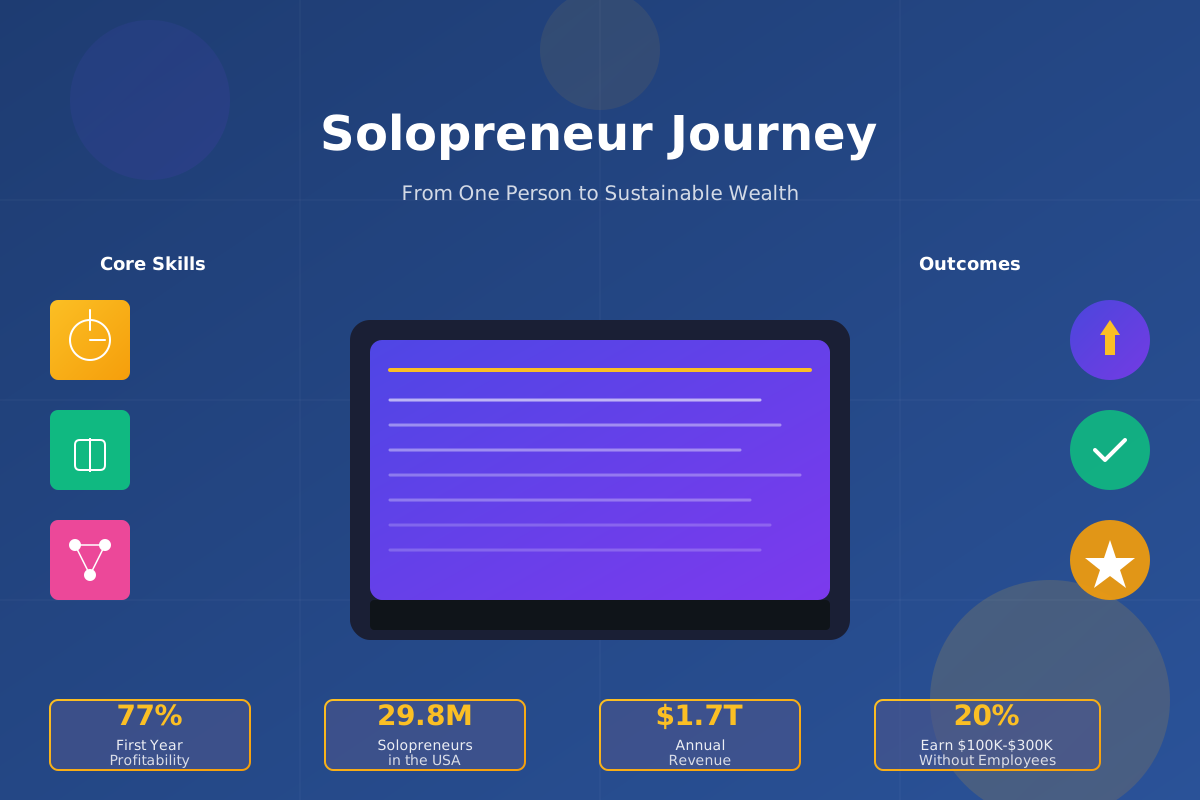
The solopreneur path isn't easy—it requires wearing every hat in your business, from marketing to finance to operations. But for those who master it, the rewards are substantial: 77% achieve profitability in their first year, unparalleled freedom in how and when you work, and the ability to keep 100% of your profits.
This guide reveals the essential components of solopreneurship, proven strategies for productivity and profitability, and practical systems to scale without sacrificing the independence that drew you to this path in the first place.
What Is Solopreneur?
A solopreneur is a business owner who operates entirely on their own, without any full-time employees. Unlike traditional entrepreneurs who build teams and scale operations hierarchically, solopreneurs intentionally maintain lean businesses where they personally handle most or all aspects of the operation—from product development to customer service to accounting. This isn't simply a freelancer taking gigs; it's a deliberate business model where the owner is the core asset and primary decision-maker.
Not medical advice.
The distinction between a solopreneur and a self-employed person is subtle but important. A self-employed person may eventually hire help or transition to hiring employees. A solopreneur, by design, chooses to remain independent and scale by improving systems, raising prices, or niche selection—not by building a payroll. This choice creates a fundamentally different business psychology and operational strategy than traditional small business ownership.
Surprising Insight: Surprising Insight: Women now represent the majority of new solopreneurs at over 50%, with immigrants comprising 14% of solopreneur startups—solopreneurship is rapidly becoming the first entrepreneurial choice for previously underrepresented groups.
The Solopreneur Business Ecosystem
Visual map showing how a solopreneur integrates core business functions, technology tools, and revenue streams into a unified, self-managed system.
🔍 Click to enlarge
Why Solopreneur Matters in 2026
In 2026, solopreneurship has shifted from a niche career path to a mainstream economic force. The rise of remote work, digital tools, and creator economies has demolished the traditional barriers to entry. Technology now enables one person to build, market, and scale a business with minimal overhead—something impossible just a decade ago. Cloud services, automation platforms, and AI assistants make it feasible for solopreneurs to compete with larger businesses.
Economic autonomy matters more than ever. Over 50% of solopreneurs entered this path specifically for the freedom to work for themselves and be their own boss. With traditional employment offering limited security and career progression in many fields, building your own venture provides tangible control over your income and future. Solopreneurs earn their wealth on their terms, which directly impacts not just financial outcomes but psychological wellbeing and life satisfaction.
The wealth potential is documented and real. About 20% of solopreneurs earn between $100,000 and $300,000 annually without hiring a single employee. This income level reaches the top 20% of household earners in most developed nations, achieved through service delivery, digital products, or specialized expertise—all delivered by one person managing time intelligently.
The Science Behind Solopreneur
Research on solopreneurship reveals patterns in what drives success and sustainability. The economic data shows that 77% of solopreneurs achieve profitability in their first year, compared to roughly 40% of traditional startups that require employees. This higher success rate stems from solopreneurs' natural discipline around unit economics—they must immediately balance revenue against personal income needs, forcing profitable thinking from day one.
Psychologically, solopreneurship creates a unique cognitive state. Decision-making autonomy releases motivation that employment rarely provides; you're not just executing someone else's vision. However, research also shows that 35% of solopreneurs report high stress levels (versus 26% of business owners with employees), highlighting the emotional weight of bearing all responsibility. This stress-autonomy tradeoff is central to understanding solopreneur sustainability and why burnout prevention systems matter.
Solopreneur Profitability Timeline
Growth pattern showing typical solopreneur income progression from launch through scale, with profitability milestones and revenue inflection points.
🔍 Click to enlarge
Key Components of Solopreneur
Self-Management Systems
The foundation of solopreneur success is creating systems that function without constant personal attention. This means documenting your processes, automating routine tasks, and building checklists that preserve quality while freeing your cognitive energy for high-value work. Successful solopreneurs treat their own time as the scarcest resource and systemize relentlessly. Digital tools like project management platforms, email sequences, and billing automation transform a chaotic solo operation into a predictable revenue engine.
Time Blocking & Deep Work
Time management is cited by 41% of solopreneurs as their top operational challenge, yet it's also the area with the most leverage for improvement. Effective solopreneurs segment their calendar into distinct time blocks: client delivery time, business development time, administrative time, and strategic planning time. Within each block, they practice deep work—uninterrupted, cognitively demanding focus on tasks that directly drive revenue or business growth. This prevents the trap of staying busy with low-value activities while neglecting income-generating work.
Financial Vigilance
Solopreneurs must maintain active financial discipline to ensure long-term stability. This includes understanding your true hourly rate (total revenue divided by actual billable hours), tracking profit margin by service type, maintaining a 3-6 month cash reserve, and separating business and personal finances completely. Profitability isn't just revenue—it's revenue minus all costs (software, taxes, equipment, education), retained at the end of each month. Many struggling solopreneurs confuse high revenue with high profit and fail to adjust pricing or cut low-margin work.
Market Positioning & Niche
Solopreneurs who thrive typically occupy a clear market niche where they command premium pricing because of specialized expertise, unique approach, or focused audience. Competing on price or trying to serve everyone creates race-to-the-bottom economics. Successful niching allows a solopreneur to become a recognized expert in a defined domain, making marketing easier and enabling higher rates. The niche positions you as the obvious choice for specific problems rather than a generalist competing against all alternatives.
| Business Model | Primary Advantage | Key Challenge |
|---|---|---|
| Service-Based (Consulting, Coaching) | High revenue per client, personal expertise | Income capped by hourly availability |
| Digital Products (Courses, Templates, Software) | Scalable revenue, passive income potential | High upfront creation costs, marketing difficulty |
| E-Commerce (Products, Dropshipping) | Physical product market, scalability | Inventory, logistics, customer service complexity |
| Content & Affiliate (Blog, YouTube, Podcast) | Long-term passive income, audience building | Slow revenue ramp, algorithm dependency |
How to Apply Solopreneur: Step by Step
- Step 1: Identify your core expertise or service that people will pay premium prices for—avoid being a generalist competing on features alone.
- Step 2: Define your target customer profile with specific pain points you solve, industries you serve, or problems you address better than alternatives.
- Step 3: Document your service delivery process or product creation workflow to ensure consistent quality and repeatable outcomes.
- Step 4: Set up legal and financial infrastructure: business structure (LLC, S-Corp, sole proprietorship), separate business bank account, and accounting system.
- Step 5: Price your services based on market value, target income goal, and realistic billable hours—not time costs or competitor pricing.
- Step 6: Build a minimal viable marketing presence: website, email list, one social platform, or referral network to attract initial clients.
- Step 7: Launch with early adopters or pilot customers to test product-market fit and gather testimonials before scaling.
- Step 8: Track profitability immediately: measure revenue, categorize expenses, and ensure each revenue stream is actually profitable before expanding.
- Step 9: Automate or systematize repetitive tasks within the first 6 months to protect your most valuable resource—your creative/strategic time.
- Step 10: Reinvest profits into tools, education, or marketing that extend your reach or increase your hourly value rather than just personal consumption.
Solopreneur Across Life Stages
Young Adulthood (18-35)
Young solopreneurs benefit from lower personal expenses, flexibility to invest swings in income, and energy to build systems from scratch. This stage is ideal for testing business models, building audience, and establishing your market position without the safety-net mentality that often limits growth. Many young solopreneurs successfully leverage digital platforms, content creation, and service delivery to build $50K-$150K businesses quickly. The risk tolerance at this life stage enables bold positioning and experimentation that pays dividends when you find product-market fit.
Middle Adulthood (35-55)
Mid-career solopreneurs typically have deeper expertise, established professional networks, and clearer understanding of their market value. This stage often produces the highest profitability because you know exactly who to serve and command premium rates. The challenge is often overcommitment—more revenue opportunities than time available. Mid-career solopreneurs must focus ruthlessly on high-margin work and develop systems to delegate or automate everything else. Many transition from service delivery to product-based models or premium positioning that doesn't require proportional time increases.
Later Adulthood (55+)
Established solopreneurs in this stage often transition toward sustainable, profitable operations rather than growth-at-all-costs mentality. Many shift toward advisory, mentorship, or premium service models that leverage decades of expertise and established reputation. Digital product creation becomes increasingly relevant as a way to generate passive income without ongoing service delivery. This stage offers the opportunity to build a business that provides security and purpose without requiring constant energy—the opposite of the startup grind. Some build asset-based businesses (courses, templates, subscription products) that generate revenue while they pursue other interests.
Profiles: Your Solopreneur Approach
The Specialist
- Deep expertise recognition in their specific domain
- Premium positioning that justifies higher rates
- Authority content and thought leadership visibility
Common pitfall: Underpricing because of imposter syndrome or underestimating market value of specialized knowledge.
Best move: Raise rates by 20-30% immediately, test market resistance, and invest in thought leadership (speaking, publishing, community visibility) to cement authority.
The Systems Builder
- Automation platforms and tools that handle routine operations
- Process documentation that enables scaling without hiring
- Metrics and KPIs to track business performance
Common pitfall: Over-engineering systems before they're needed, building automation for low-leverage activities.
Best move: Focus on automating revenue-blocking tasks first (lead capture, invoicing, scheduling), then move to efficiency improvements once profitability is stable.
The Network Multiplier
- Strong referral network and strategic partnerships
- Community visibility and professional reputation
- Collaborative opportunities with complementary services
Common pitfall: Spreading too thin across multiple partnerships, unclear positioning that muddies referrals.
Best move: Identify 3-5 strategic partners or communities where your ideal clients congregate, build deep relationships there, and make referrals your primary lead source.
The Product Creator
- Scalable digital product (course, template, software, app)
- Marketing funnel to reach audience without proportional time investment
- Proof of concept showing product-market fit before heavy promotion
Common pitfall: Building products before validating demand; creating solution-first without clear customer problems.
Best move: Start with service delivery to understand customer problems deeply, then create products that solve those specific problems, validated by existing customer feedback.
Common Solopreneur Mistakes
The most dangerous solopreneur mistake is confusing busyness with profitability. Many solopreneurs fill their days with client work, admin tasks, and busywork that generates revenue but produces only subsistence income. They're never profitable because they're never strategic—never stepping back to evaluate which revenue streams actually pay well, which clients are high-maintenance, or whether they're trading hours for dollars in a way that won't scale. Profitability requires conscious decisions about which work to prioritize and which to eliminate or automate.
The second critical error is failing to segment your own time across different functions. Solopreneurs often blur together client delivery, business development, finance, and operations into one chaotic day, context-switching constantly. This kills productivity and usually means business development starves when you're busy with delivery, then delivery stalls when you shift to sales. Effective solopreneurs time-block ruthlessly: specific hours for client work, specific hours for new business, specific hours for operations and strategy. This segmentation is what allows one person to outperform smaller teams.
The third mistake is not raising prices or expanding your service scope as demand increases. Many solopreneurs hit a ceiling where they're fully booked but underpaid, unable to grow without exhausting themselves. Instead of hiring, effective solopreneurs raise prices by 20-50%, niche deeper into higher-value problems, or transition toward product-based revenue. The psychological barrier to raising prices is often higher than the market barrier—most customers at premium prices simply fire the low-price competitors and move up-market when they encounter quality.
The Solopreneur Pitfalls & Recovery Path
Decision tree showing common failure points in solopreneur journeys and the strategic moves needed to escape low-profit traps.
🔍 Click to enlarge
Science and Studies
Research on solopreneur economics and business outcomes provides data-driven insights into what actually works. Extensive surveys tracking solopreneur demographics, income, and success rates reveal clear patterns: 77% achieve first-year profitability, 52% cite autonomy as their primary motivation, and women now represent the majority of new business startups in the solopreneur category. These statistics contradict the traditional entrepreneurship narrative of needing employees to build wealth, showing that single-person businesses can generate substantial income and meet financial goals.
- Founder Reports (2026): "Solopreneur Statistics - Income, Success Rates & More" - Comprehensive data on 29.8M U.S. solopreneurs, revenue generation, and profitability rates.
- Gusto Research (2025): "Behind the Boom in Solopreneurship" - Analysis of new solopreneur formation rates, demographic shifts, and technology enablers.
- QuickBooks Intuit (2024): "2024 Trends in Self-Employment and Solopreneurship" - Business formation data, financial performance metrics, and operational trends.
- SUCCESS Magazine: "The Entrepreneur Boom: 29.8M Americans Go Solo" - Coverage of the cultural shift toward solopreneurship and economic impact.
- Keny Armosh Research (2025): "The State of Solopreneurship - 10 Statistics" - Behavioral data on solopreneur stress, income satisfaction, and success factors.
Your First Micro Habit
Start Small Today
Today's action: Spend 30 minutes documenting one core business process (your most-repeated task or service delivery step). Write it down as a checklist or flowchart exactly as you currently do it. This single-session documentation is the foundation of every system that follows.
Solopreneurs rarely take time to document their own processes because they're always executing them. But the moment you write down what you actually do, you begin seeing inefficiencies, automation opportunities, and quality gaps that were invisible before. This micro-habit shifts you from operator mode to system-builder mode—the psychological breakthrough that enables scaling without hiring.
Keep quitting habit apps after a missed day? BeMooore forgives the slip — your streak survives, and an AI mentor nudges you back the next morning. Free on iOS.
Quick Assessment
Where are you currently in your solopreneur journey?
Your current stage determines which solopreneur strategies matter most—early-stage focus on product-market fit and cash flow; established businesses focus on profitability optimization and scaling without adding overhead.
What's your biggest operational challenge as a (potential) solopreneur?
Each challenge has specific leverage points: time challenges solve with systems and delegation; financial challenges solve with metrics and price increases; isolation solves with community and accountability partnerships; business-generation challenges solve with referral networks or positioning clarity.
Which solopreneur model appeals to you most?
Your choice of model directly affects your income potential and time requirements—service businesses have higher hourly rates but time ceilings; products have slow upfront investment but exponential scaling potential; hybrids balance stability with growth opportunity.
Take our full assessment to get personalized recommendations for your wealth-building journey.
Discover Your Style →Next Steps
Solopreneur success isn't mysterious—it's a combination of clear positioning (knowing exactly who you serve and why), ruthless time management (protecting high-value work from low-value distractions), financial discipline (measuring real profitability, not just revenue), and continuous improvement (testing new offerings, pricing, or marketing approaches). Your immediate next step is clarity: if you haven't already, define exactly what problem you solve, for whom, and at what price point. Everything else builds from that foundation.
The solopreneur path offers something increasingly rare in modern work: complete autonomy over your time, income, and impact. But it requires consciousness and systems that traditional employment doesn't demand. Start by implementing one of the frameworks in this article—time blocking, systematic documentation, or pricing review—and notice how that single change compounds over the next 3 months. Solopreneur success is built from dozens of these small, deliberate choices, accumulated over time.
Get personalized guidance with AI coaching for your specific solopreneur stage and challenges.
Start Your Journey →Research Sources
This article is based on peer-reviewed research and authoritative sources. Below are the key references we consulted:
Related Glossary Articles
Frequently Asked Questions
How much money do I need to start as a solopreneur?
Startup costs depend on your business model, but many solopreneurs launch with under $2,000—primarily for domain, basic website, and software tools. Service-based solopreneurs often need less than $500; product-based businesses typically need $5,000-$15,000 for initial inventory or production. The key is starting lean, validating demand, then scaling investment after proving profitability.
Can solopreneurs actually make $100K+ annually without hiring?
Yes. Research shows 20% of solopreneurs earn $100K-$300K annually. This typically requires: high-value niche positioning (premium pricing), productized services (better time leverage), passive income streams (digital products), or partnership/affiliate arrangements. It's not automatic, but it's documented and achievable with strategic positioning rather than just hustle.
What's the difference between a solopreneur and a freelancer?
Freelancers typically sell their time and labor to clients project-by-project; solopreneurs build a business with revenue systems, recurring clients, productized services, or passive income that doesn't require proportional time input. A freelancer scales by working more hours; a solopreneur scales by improving systems, raising prices, or building products. Both are one-person operations; the business model is different.
How do solopreneurs handle burnout and work-life balance?
Sustainable solopreneurs treat boundaries as business infrastructure, not luxury. This means: fixed working hours (no after-hours work except emergencies), protected personal time, delegating or eliminating low-value tasks, maintaining cash reserves to weather slow periods without panic, and building community or accountability to prevent isolation. Burnout isn't inevitable—it's a sign your systems or pricing need adjustment.
What tools and software do solopreneurs really need?
Start with essentials only: payment processing (Stripe, PayPal), email management, calendar/scheduling tool, basic accounting software, and one project tool for task management. As revenue grows, add: CRM (client tracking), email marketing platform, and automation tools (Zapier, Make). Don't over-tool; each new tool should directly increase revenue or save 5+ hours monthly to justify its cost.
Take the Next Step
Ready to improve your wellbeing? Take our free assessment to get personalized recommendations based on your unique situation.
- Discover your strengths and gaps
- Get personalized quick wins
- Track your progress over time
- Evidence-based strategies