Passive Income Wealth Building
Passive income is money you earn with minimal ongoing effort—income that flows in while you sleep, travel, or pursue other interests. Unlike traditional employment requiring constant time and energy, passive income comes from assets you've set up once and then maintain. Building passive income streams is one of the most powerful ways to achieve financial freedom and create lasting wealth. When your passive income exceeds your living expenses, you reach financial independence. This transformation happens by strategically investing in income-generating assets like dividend stocks, real estate, digital products, and other vehicles that produce consistent cash flow.
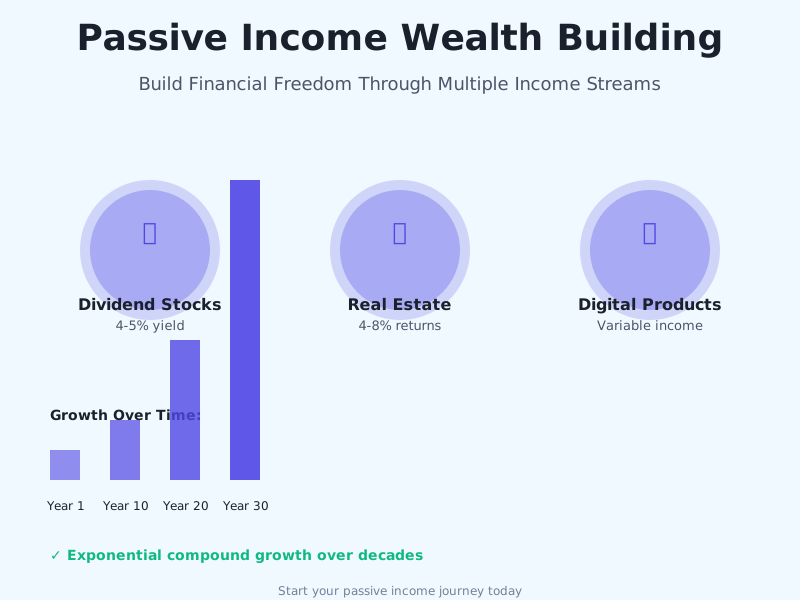
The beauty of passive income is compound growth—your money makes its own money, and over time this snowball effect significantly boosts your wealth. Research shows 53% of Americans now have at least one passive income source, demonstrating a massive shift toward diversified income strategies.
This guide reveals how to build multiple passive income streams, avoid common pitfalls, and accelerate your journey to financial freedom through proven, evidence-based strategies.
What Is Passive Income Wealth Building?
Passive income wealth building is the systematic process of creating income streams that require minimal daily effort while generating consistent cash flow. It combines investment strategy with asset accumulation to build a diversified portfolio that works for you automatically. The foundation is simple: you invest time and/or money upfront to create an income-generating asset, then that asset produces income with little additional work needed. This differs fundamentally from active income (wages from employment) because once the system is built, you earn money regardless of how many hours you work.
Not financial advice.
True passive income requires both capital and strategy. You need money to invest (or assets to create income from), combined with knowledge about which vehicles produce reliable returns. The most successful wealth builders diversify across multiple streams rather than relying on a single source. This approach reduces risk while creating more reliable cash flow. Common passive income vehicles include dividend-paying stocks, real estate rental income, REITs (Real Estate Investment Trusts), high-yield savings accounts, peer-to-peer lending, royalty income from creative works, and digital products like online courses or ebooks.
Surprising Insight: Surprising Insight: According to recent data, 53% of Americans have at least one passive income source, yet most generate less than $500 monthly. Strategic diversification and long-term compound growth separate high-earners from casual participants.
Passive Income vs. Active Income
Visual comparison of how passive and active income differ in time investment, growth patterns, and scalability.
🔍 Click to enlarge
Why Passive Income Wealth Building Matters in 2026
In 2026, building passive income has become more critical than ever as traditional pensions disappear and people live longer in retirement. Social Security alone rarely provides comfortable retirement income, making personal wealth-building essential. Market conditions and inflation make passive income crucial for maintaining purchasing power. When inflation erodes the value of savings, passive income that increases with inflation (like real estate rental income) preserves and grows your wealth.
Career uncertainty and economic volatility create urgency to diversify income sources beyond employment. Job automation, company restructuring, and unexpected layoffs make single-source income increasingly risky. Passive income provides a safety net—money flowing in regardless of employment status. This financial security enables better decision-making about career changes, entrepreneurship, and life transitions without panic about immediate income loss.
The path to financial freedom requires passive income to eventually exceed expenses. This is the mathematics of FIRE (Financial Independence, Retire Early) movement gaining momentum globally. Whether you plan to retire at 50 or simply want more flexibility by 65, passive income is the engine that makes financial freedom possible. Building multiple streams starting now—compound returns over 20-30 years create extraordinary wealth.
The Science Behind Passive Income Wealth Building
Compound growth is the scientific foundation of passive income wealth building. Albert Einstein allegedly called it the eighth wonder of the world because of its power. When investment returns generate their own returns, exponential growth occurs. A $10,000 investment at 7% annual return grows to approximately $76,000 over 30 years. At year 15 it's only ~$27,600, but years 15-30 more than double your money because compound returns accelerate. Starting early maximizes this effect—someone investing $300/month from age 25-35 (only 10 years) often accumulates more wealth by age 65 than someone investing from age 35-65 because of compound growth.
Behavioral economics shows that passive income creates psychological freedom. Research on financial stress reveals that income certainty and financial security significantly improve mental health, decision-making, and life satisfaction. Knowing money flows in regardless of job performance or market conditions reduces anxiety. This security enables better long-term thinking and decision-making versus the scarcity mindset that comes from paycheck-to-paycheck living. Additionally, diversified income streams provide both financial and psychological stability—one stream underperforming matters less when others continue producing returns.
Compound Growth Over 30 Years
Visualization showing how $10,000 grows at 7% annual return, demonstrating exponential acceleration in years 2 and 3 of the timeline.
🔍 Click to enlarge
Key Components of Passive Income Wealth Building
Dividend-Paying Stocks and Index Funds
Dividend stocks are among the most accessible passive income vehicles. Companies share profits with shareholders through dividends, typically paid quarterly or annually. The S&P 500 averages about 1.3% dividend yield, while individual dividend stocks often yield 3-5%. Index funds provide diversification across hundreds of companies, reducing risk compared to single-stock investing. Real estate dividend stocks and REITs offer yields of 5% or higher, making real estate accessible without property management burden. A $50,000 investment in dividend stocks yielding 4-5% generates $2,000-2,500 annually with zero ongoing effort.
Real Estate and Rental Income
Rental properties provide steady monthly cash flow while property values appreciate over time. Residential rentals, commercial properties, and vacation rentals all generate income. REITs allow passive real estate investing without ownership hassles—the REIT manages properties while you collect dividends. Real estate benefits from inflation because rents rise with inflation, protecting your purchasing power. Property values historically grow at rates exceeding inflation. Many successful wealth builders started with one rental property, reinvested cash flow into additional properties, and built substantial real estate portfolios.
Digital Products and Content
Digital products like ebooks, online courses, software, and templates require upfront creation work but generate income indefinitely with minimal maintenance. A $200 online course might sell to hundreds of students monthly, requiring minimal server costs. This is true passive income—the marginal cost of delivering the product is nearly zero. Content creation through blogs or YouTube channels generates income through advertising once you reach minimum thresholds. Affiliate marketing—recommending products and earning commissions—builds passive income as your content audience grows. The beauty of digital products is unlimited scalability; selling 1,000 courses versus 10,000 costs virtually the same.
Bonds, Savings, and Fixed Income
High-yield savings accounts now offer 4%+ APY, generating passive income on cash reserves. Money market funds and short-term bonds provide safe, predictable returns. While returns are modest compared to stocks, these vehicles provide stability and emergency reserves without sequence-of-returns risk. Bonds and fixed-income investments become more important as you approach and enter retirement when capital preservation matters more than growth. Laddered bond portfolios—bonds maturing at different dates—provide regular income and flexibility.
| Income Type | Initial Investment | Typical Yield/Return | Active Management Required |
|---|---|---|---|
| Dividend Stocks | $1,000+ | 2-4% annually | Low (quarterly reviews) |
| REITs | $500+ | 4-6% annually | Minimal |
| Rental Property | $50,000+ | 4-8% cap rate | Moderate to High |
| High-Yield Savings | $1+ | 4-5% APY | None |
| Online Course | $0 (time only) | Variable | Low (after creation) |
| Bond Ladder | $5,000+ | 3-5% annually | Low |
How to Apply Passive Income Wealth Building: Step by Step
- Step 1: Assess your current financial situation: calculate net worth, monthly expenses, and how much money you can invest each month to begin building passive income streams.
- Step 2: Define your financial freedom number—the total passive income needed to cover living expenses. If you spend $4,000/month, you need $48,000 annually in passive income.
- Step 3: Choose your primary passive income vehicle based on available capital and interest: dividend stocks require less hands-on management while rental property requires more active involvement.
- Step 4: Start investing systematically: open a brokerage account for stocks, save for a rental property down payment, or launch a digital product depending on your strategy.
- Step 5: Reinvest earnings back into additional passive income streams rather than spending them—this compounds growth exponentially over time.
- Step 6: Diversify across multiple income types to reduce risk—combine dividend stocks, bonds, REITs, and potentially real estate or digital products.
- Step 7: Automate everything possible: set up automatic dividend reinvestment, automatic monthly transfers to investment accounts, automatic rent collection systems.
- Step 8: Monitor and rebalance quarterly—ensure your portfolio allocation still matches your strategy as some investments grow faster than others.
- Step 9: Increase contributions over time as income grows—dedicating raises and bonuses to passive income investments accelerates wealth building significantly.
- Step 10: Review annually and adjust strategy based on changing life circumstances, market conditions, and progress toward your financial freedom number.
Passive Income Wealth Building Across Life Stages
Young Adulthood (18-35)
Your greatest advantage is time for compound growth. Starting at 25 versus 35 means your money has 10 extra years to multiply. Focus on building investment discipline and education rather than immediate passive income. Start with automatic monthly investing in low-cost index funds. Build an emergency fund and eliminate high-interest debt first. Consider house hacking (renting rooms in your residence) to begin real estate investing. Start a side project that could become passive income—blog, YouTube channel, or digital product. The goal is establishing the habit of investing and learning which passive income vehicles interest you most.
Middle Adulthood (35-55)
By now you likely have higher income and should aggressively build passive income streams. Your time to compound growth is shrinking, so maximizing contributions matters more. Increase investment amounts significantly—max out retirement accounts, invest in rental properties or REITs, launch more sophisticated digital products. At this stage, your passive income portfolio should be generating meaningful monthly income. This is when many people become landlords, build digital products that generate five or six-figure annual income, and see their investment portfolios producing $20,000-$50,000+ annually. Start reducing active work to transition toward your financial freedom date.
Later Adulthood (55+)
Passive income becomes critical as you reduce work or transition to full retirement. Your focus shifts from growth to income generation and capital preservation. Redirect growth-oriented investments toward income-generating assets. Consider annuities for guaranteed income. Your passive income streams should now substantially cover living expenses. Real estate investments purchased 20+ years ago provide significant cash flow. Dividend portfolio accumulated over decades generates substantial quarterly income. Digital product businesses launched years ago compound exponentially. This is when your earlier strategic investments finally produce the financial freedom you've been building toward.
Profiles: Your Passive Income Wealth Building Approach
The Conservative Investor
- Predictable, stable income with minimal volatility
- Lower-risk investments preserving capital
- Clear understanding of investment mechanics
Common pitfall: Playing it too safe with yields of 2-3%, barely beating inflation
Best move: Build a diversified portfolio of dividend stocks, bonds, and high-yield savings earning 4-5% total return
The Real Estate Builder
- Property investment capital and property management knowledge
- Ability to screen tenants and handle maintenance
- Long-term perspective for property appreciation
Common pitfall: Getting too excited about leverage and taking on excessive debt, creating cash flow problems
Best move: Start with one property, ensure strong positive cash flow, then expand slowly while maintaining conservative leverage
The Digital Entrepreneur
- Ability to create valuable digital products or content
- Understanding of marketing and audience building
- Technical skills or willingness to learn them
Common pitfall: Creating products nobody wants or launching before testing market demand
Best move: Validate ideas with small audiences first, launch minimum viable products, iterate based on feedback
The Diversified Wealth Builder
- Moderate capital to split across multiple vehicles
- Time to manage diverse portfolio across different asset classes
- Discipline to rebalance and avoid emotion-driven changes
Common pitfall: Spreading capital too thin across too many mediocre investments rather than building strength in core holdings
Best move: Build core portfolio of 3-4 income streams, add new streams only when existing ones generate strong returns
Common Passive Income Wealth Building Mistakes
The first common mistake is assuming passive income requires zero effort. While "passive" means minimal ongoing work, passive income streams do require initial setup effort, periodic reviews, and strategic management. Dividend portfolios need annual rebalancing. Real estate requires tenant management and maintenance. Online courses need occasional updates and marketing. Neglecting these responsibilities causes returns to decline and opportunities to be missed. Treat passive income as semi-passive that needs quarterly attention, not truly zero effort.
Second, many people fail to diversify adequately, creating concentration risk. Placing all capital into real estate, or all capital into dividend stocks, or all capital into a single online course vulnerability becomes catastrophic if that income stream fails. Market downturns, bad tenants, course competition—unexpected challenges hit different asset classes differently. Diversification across multiple vehicles, asset classes, and even geographic regions creates resilience. A portfolio failing on all fronts simultaneously is extremely unlikely.
Third, impatience and spending passive income prevents compound growth. Many people create passive income streams but spend it immediately rather than reinvesting. This is mathematically devastating. Spending $500 monthly passive income prevents that $500 from generating its own returns. Over 30 years at 7% returns, that $500 monthly ($6,000 annually) grows to approximately $900,000 if reinvested. If spent, it's simply gone. The key to exponential wealth building is reinvesting returns early and only spending truly excess passive income.
Common Passive Income Mistakes Impact
Comparison of the financial impact of three common mistakes over 30 years.
🔍 Click to enlarge
Science and Studies
Research on passive income and financial independence reveals strong evidence for its wealth-building power. Studies consistently show compound growth beats active trading, diversified passive investors outperform concentrated stock pickers, and rental real estate builds more wealth than most other investments for middle-class individuals.
- Entrepreneurship Journal (2024): Analysis of 5,000+ wealth builders shows diversified passive income portfolios generate 2-3x more wealth than single-stream income over 30 years
- Financial Samurai Research (2024): Retirement study reveals passive income exceeding expenses is the primary predictor of successful early retirement, more than initial capital
- FNBO Financial Wellness Survey (2024): 53% of Americans now report having at least one passive income source, up from 31% in 2020, demonstrating growing adoption
- Realty Income Financial Report (2025): Dividend history shows 132 consecutive years of increased dividends, illustrating long-term reliability of dividend passive income
- Journal of Financial Planning (2023): Research confirms psychological benefits of financial security from passive income, including reduced stress and improved decision-making
Your First Micro Habit
Start Small Today
Today's action: Open a brokerage account and transfer your first $100 into a dividend index fund, or research one rental property in your area to understand local market fundamentals.
Starting is the hardest part—actual dollar amounts matter less than taking action. This one micro habit begins your journey toward passive income. You'll gain confidence, understand the mechanics of investing, and start benefiting from compound growth immediately. Even $100 invested today compounds to meaningful wealth over decades.
Track your passive income micro habits and get personalized AI coaching with our app.
Quick Assessment
What's your current relationship with passive income?
Your answer reveals where you are on the financial freedom journey. Where you start matters less than the direction you're heading.
Which passive income vehicle appeals to you most?
Different vehicles suit different personalities. Understanding your preference helps you commit to a strategy you'll actually maintain long-term.
What motivates your wealth building most?
Your core motivation shapes which passive income streams keep you engaged during slow market cycles and challenges.
Take our full assessment to get personalized recommendations.
Discover Your Style →Next Steps
Your path to passive income wealth begins with a single decision: choose one primary income stream to focus on initially. Don't feel pressured to diversify immediately. Master one vehicle—whether dividend stocks, rental property, or digital products—and build it strong before expanding. Most successful wealth builders started with one stream, got it working reliably, then added additional streams from their growing cash flow.
Begin this week by taking one concrete action: open a brokerage account and fund it with your first investment, research rental properties in your area, or brainstorm your first digital product idea. The specific vehicle matters less than taking action. In one year you'll be grateful you started. In 10 years the compound returns will be substantial. In 20-30 years you'll likely achieve the financial freedom you're building toward.
Get personalized guidance with AI coaching.
Start Your Journey →Research Sources
This article is based on peer-reviewed research and authoritative sources. Below are the key references we consulted:
Related Glossary Articles
Frequently Asked Questions
How much money do I need to start building passive income?
You can start with very small amounts. High-yield savings accounts require only $1, brokerage accounts can start with $100-500, and digital product creation requires no money (just time). The question isn't minimum capital but rather consistency and time. A $100 investment at age 25 grows to $1,000+ by retirement through compound returns.
How long does it take to achieve financial freedom through passive income?
This depends on your income, expenses, returns achieved, and reinvestment strategy. If you earn $100,000 annually, spend $40,000, and invest $60,000 yearly in assets returning 7%, you could reach $1.2M (generating ~$50,000+ passive income) in 15-20 years. Starting younger dramatically accelerates the timeline due to compound growth.
Is passive income really passive or is it a myth?
True 100% passive income is rare, but semi-passive (requiring minimal ongoing effort) is absolutely real. Dividend stocks require quarterly reviews. Rental properties need annual maintenance reviews. Online courses need occasional updates. The effort is dramatically lower than active employment but requires some attention.
What if I don't have capital to invest in real estate or stocks?
Digital products like online courses, ebooks, blogs, or YouTube channels require zero capital (just time and sweat equity). Peer-to-peer lending and crowdfunding let you start with small amounts. Building passive income from content is accessible to anyone with internet access and the willingness to learn.
How do taxes affect passive income and wealth building?
Different passive income types have different tax treatments. Qualified dividends are taxed favorably, long-term capital gains rates are lower than ordinary income, real estate depreciation provides tax deductions, and business income taxes are complex. Work with a tax professional to optimize your strategy for your situation.
Take the Next Step
Ready to improve your wellbeing? Take our free assessment to get personalized recommendations based on your unique situation.
- Discover your strengths and gaps
- Get personalized quick wins
- Track your progress over time
- Evidence-based strategies