Etsy Digital Products
Selling digital products on Etsy represents one of the most accessible pathways to creating passive income in 2026. Unlike physical inventory that requires storage, shipping, and management, digital files—once created—can be sold repeatedly to unlimited customers at near-zero marginal cost. Whether you're a graphic designer, teacher, productivity enthusiast, or entrepreneur, Etsy's massive audience of buyers searching for everything from printable planners to Lightroom presets makes it an attractive marketplace. The barrier to entry is remarkably low: a $0.20 listing fee per item, transaction fees only when you make sales, and the ability to reach millions of buyers without building your own website or audience. Yet the reality is nuanced—while some sellers generate five-figure monthly income, most face intense competition from AI-generated content and must deliver genuine value to stand out.
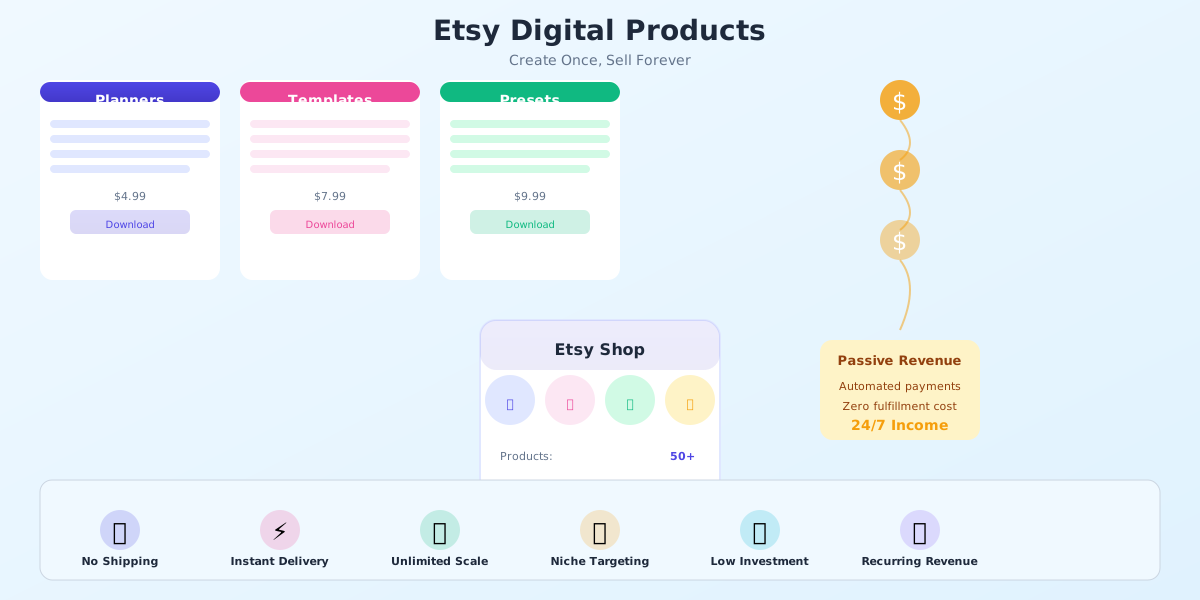
The digital products market on Etsy has evolved dramatically. In 2024, Etsy reported $2.8 billion in annual revenue, with digital downloads representing one of the fastest-growing categories. Successful digital product shops average $29,324 in annual revenue with $5,865 yearly profit, though top performers generate $5,000+ monthly by scaling across multiple product listings and building strong seller reviews.
This guide walks you through the complete ecosystem of selling digital products on Etsy—from identifying profitable niches and creating compelling products, to optimization strategies and avoiding common pitfalls that derail new sellers.
What Is Etsy Digital Products?
Etsy digital products are downloadable files—PDFs, images, templates, presets, and guides—sold through the Etsy marketplace without physical inventory or shipping. When a buyer purchases a digital item, Etsy automatically delivers the file(s) via email and account download. The seller retains ownership while the buyer receives a personal-use or commercial-use license depending on product terms. Categories include printable planners, wall art, Canva templates, Lightroom presets, AI prompt guides, Notion templates, eBooks, social media templates, branding kits, and patterns for crafting (crochet, embroidery, sewing). The defining characteristic: unlimited scalability with zero fulfillment costs after the initial creation.
Not medical advice.
The Etsy platform handles payment processing, customer communication templates, and delivery automation. Sellers manage product creation, listing optimization, customer support (technical questions about file usage), and marketing. Unlike third-party e-commerce platforms, you don't manage servers, payment gateways, or hosting—Etsy abstracts this complexity. The tradeoff: Etsy takes ~6.5% in transaction fees plus 3% + $0.20 payment processing fees per sale, limiting initial margins but enabling access to millions of monthly visitors searching for specific products.
Surprising Insight: Surprising Insight: In 2026, static images are insufficient. Buyers want to see digital products 'in action'—real mockups showing how printables look printed and framed, or templates actually populated with sample data. Sellers who provide animated preview videos or multiple lifestyle mockups see 40-60% higher conversion rates than those showing files alone.
Digital Product Value Chain
Shows the flow from product creation through Etsy listing, buyer discovery, purchase, and seller revenue realization.
🔍 Click to enlarge
Why Etsy Digital Products Matter in 2026
Economic pressure on household budgets has made passive income creation essential. Traditional employment offers limited wealth-building acceleration, and active side hustles consume time. Digital products represent the intersection of low-time-investment and high-scalability, allowing someone to earn income while sleeping. In 2026, with AI automation reducing demand for certain labor categories, income diversification through digital assets has become economically prudent rather than aspirational.
Psychological freedom increases dramatically when income flows from systems you've built rather than hourly work. Creating 20 digital products on Etsy that each generate $100/month produces $2,000 monthly passive income—equivalent to a $24,000 annual side income without trading additional hours. This creates psychological buffer during career transitions, economic downturns, or unexpected life changes. The wealth-building effect compounds: each new product added represents recurring monthly revenue that never requires additional marketing or fulfillment.
2026 market conditions favor focused, quality-driven sellers over those distributing low-effort AI-generated content. Etsy's buyer base has matured—they seek curated systems, hyper-specific solutions, and human-verified quality. Buyers explicitly trust sellers who show process, provide detailed mockups, answer technical questions thoughtfully, and build community rather than transactions. This quality-over-volume shift creates opportunity for dedicated sellers while penalizing bulk content strategies.
The Science Behind Etsy Digital Products
Behavioral economics explains digital product success through scarcity perception and solution specificity. When a buyer searches for 'productivity planner for ADHD professionals,' they're not seeking generic templates—they're seeking confirmation that someone understands their exact situation and created a targeted solution. This psychological matching (buyer-product alignment) produces dramatically higher conversion rates than generic 'best planner template.' Research on decision-making shows buyers experiencing choice overload default to products with highest review counts and most specific product descriptions, as these reduce perceived risk. Digital product pricing between $3-15 occupies the 'impulse purchase' threshold where buyers decide within seconds, favoring high conversion but requiring volume scale.
Network effects amplify Etsy's value. The platform has ~100 million monthly visitors searching for specific products. This organic traffic—already actively seeking items you sell—is effectively free marketing compared to cold audience building on social media. Your first Etsy listing competes for attention in a 1M+ product marketplace, yet an Etsy visitor searching 'wedding planning checklist printable' represents buyer intent multiple orders of magnitude higher than a random Instagram user. This conversion efficiency makes Etsy particularly valuable for sellers without existing audiences.
Etsy Buyer Decision Psychology
Illustrates how specific product targeting, social proof, and perceived quality influence purchase decisions.
🔍 Click to enlarge
Key Components of Etsy Digital Products
Product Creation & Design Tools
Popular tools include Canva (user-friendly templates, commercial license available via premium subscription), Adobe Creative Cloud (professional design, learning curve), Affinity Designer (one-time purchase, no subscription), Notion (template systems), and Google Docs/Sheets (for collaborative guides and worksheets). Critical rule: never use standard Canva templates directly for commercial sale—these are licensed personal-use only. You must either purchase commercial-license templates, create designs from scratch, or use Canva Pro which includes commercial rights. Many sellers starting out violate this unknowingly, risking account suspension. Investment ranges from $0 (free tools) to $100+/month (Adobe), but ROI is exceptional—$5 product sold 100 times = $500 revenue from $50 tool subscription.
Strategic Niche Selection
Success depends on finding intersection of three variables: buyer demand (enough people searching), low competition (niche-specific rather than generic), and your genuine expertise or passion. Trending 2026 categories include productivity systems (planners, organizing templates, time-blocking worksheets), AI prompt libraries (ChatGPT, Midjourney, image generators), business templates (invoices, social media content calendars, email sequences), printable home decor (wall art, organization labels, motivational quotes), and Lightroom presets (photography, mobile photography editing). Avoid ultra-competitive niches like 'wall art printables' where 50,000+ sellers compete. Instead, specify: 'minimalist wall art for modern home offices with Scandinavian aesthetic, ready-to-print 16x20, include frame mockups.' Specificity reduces competition by 90% while increasing conversion among your target buyer.
Listing Optimization & SEO
Etsy's search algorithm rewards relevance and conversion metrics. Use keyword research tools like eRank or Marmalead to identify high-volume, lower-competition keywords. Format matters: title should include primary keyword plus descriptor (e.g., 'Productivity Planner Printable | ADHD-Friendly Weekly Organizer | Digital Download'). Tag all 13 available slots with long-tail keywords. Write product descriptions answering 'What will I get?' (file types, quantity, dimensions) and 'How do I use it?' (print, import to Notion, upload to Canva). Include video—a 30-second walkthrough showing template pages or product setup increases conversion 25-35%. Upload 8-10 lifestyle mockup images: the product in actual use (on printed paper in a frame, on a desk, in a digital device), not just the raw file. Transparency builds trust; buyers want to see exactly what they're purchasing.
Pricing Strategy & Psychology
Digital products operate on volume economics. Pricing between $3-8 optimizes impulse purchases and volume (100+ monthly sales possible). Pricing $15-25 targets serious buyers but reduces monthly volume (10-20 sales typical). Bundling multiplies revenue: sell single planner for $5 or bundle of 5 related planners for $12 (perceived 40% savings, actual 20% discount, buyer receives more perceived value, you capture higher per-unit revenue). Seasonal pricing captures demand spikes—New Year resolution planners sell 3x volume in December-January, justifying $2 price increase. Study competitor pricing: if 50 sellers offer similar products at $4.99, pricing at $3.99 triggers algorithm preference for higher conversion; pricing at $9.99 targets quality-conscious buyers willing to pay premium for superior mockups or niche focus. Test pricing over 30 days—raise price if you're getting 50+ monthly sales (leave money on table), lower if under 3 sales (demand signal weak).
| Product Category | Monthly Demand Signal | Competition Level | Avg Price Range |
|---|---|---|---|
| Printable Planners | Very High | Very High | $3.99-$7.99 |
| AI Prompt Libraries | Very High | Medium | $4.99-$12.99 |
| Notion Templates | High | Medium | $9.99-$19.99 |
| Social Media Templates | High | High | $2.99-$5.99 |
| Lightroom Presets | Medium | Medium-High | $7.99-$19.99 |
| Branding Kits | Medium | Medium | $15.99-$29.99 |
How to Apply Etsy Digital Products: Step by Step
- Step 1: Validate your niche: Search Etsy for products in your target category, note top listings, review their mockups, descriptions, pricing, and review counts. If no listings exist, the market may lack demand. If 10,000+ listings exist with high reviews, competition is intense—either over-specify your niche or reconsider.
- Step 2: Research keywords: Use eRank's free tools or Marmalead to identify 5-10 low-competition keywords with 500+ monthly searches in your niche. Document these for later listing optimization.
- Step 3: Create your first 3-5 products: Start with quantity over perfection. 5 average products outsell 1 perfect product because each listing is a traffic funnel. Create templates, planners, or guides in your chosen niche, designing with Canva, Notion, Adobe, or comparable tool.
- Step 4: Design high-conversion mockups: Use Photoshop, Canva, or MockUp generator sites to show each product in realistic contexts—printed and framed on walls, displayed in digital devices, held in hands. Include 3-5 lifestyle mockups per listing minimum.
- Step 5: Create your Etsy shop: Open account, customize shop banner and about section with professional photo and 50-word bio explaining your niche expertise. Link to social media or website if you have following.
- Step 6: Upload your first product: Create detailed listing with primary keyword in title, add mockup images, write description answering what buyer receives and how they use it, set price in impulse zone ($3.99-$7.99 initially), assign all 13 tags with long-tail keywords, upload short video walkthrough.
- Step 7: Implement shipping: Set 'Digital' delivery method. Etsy handles instant file delivery via email and account download. No shipping costs, no shipping time delays.
- Step 8: Launch 5 complementary products: Add related products targeting similar search audience. If your first product is 'ADHD Planner,' add 'ADHD Focus Blocks,' 'ADHD Daily Checklist,' 'ADHD Budget Template,' 'ADHD Habit Tracker.' Bundled searches increase visibility.
- Step 9: Gather initial reviews: Encourage first buyers with excellent communication, fast customer service, and follow-up emails (Etsy templates available). First 10-20 reviews are critical—algorithms reward velocity of review accumulation.
- Step 10: Monitor and iterate: Check shop stats weekly. Identify which listings generate traffic but not sales (description or mockup issue), which convert well (replicate template or pricing), and which underperform (consider keyword revision or discontinuation after 30 days).
Etsy Digital Products Across Life Stages
Young Adulthood (18-35)
Young adults typically have limited capital and time but high digital fluency. Strategy: Start with free or low-cost design tools (Canva free, Notion free tier, Figma free). Niches align with peer pain points—productivity for students, side-hustle templates for entry-level workers, affirmation card packs for mental health focus. Young adults build audience faster on social media; cross-promote Etsy links on TikTok, Instagram, YouTube Shorts. Time-box creation: 5-10 hours per product maximum using templates as foundation (don't reinvent; iterate existing designs). Volume strategy works—20 lower-quality products typically outperform 3 premium ones when just starting. First-year revenue targets: $500-$2,000 (proof of concept).
Middle Adulthood (35-55)
Middle-aged sellers often possess deep expertise from career, parenting, or hobbies—translating into highly specific, valuable products. Strategy: Invest in quality design ($30-50 per product for professional mockup creation or template purchase). Niches reflect life experience: parent-teacher collaboration templates, business workflow optimization guides, health-conscious meal planning systems, career transition planners. Middle-aged sellers have existing networks to cross-promote. Time-box differently: fewer products (5-8 high-quality items) targeting higher-price points ($12-25) and higher conversion per listing. Quality-over-volume captures professional and premium buyer segments willing to pay for expertise. First-year revenue targets: $2,000-$8,000 (established side income). Focus on bundling and premium positioning rather than competition on price.
Later Adulthood (55+)
Later-adulthood sellers bring decades of expertise and credibility. Strategy: Position as 'authority' (e.g., 'Business Consultant Builds Workflow Template' vs. 'Workflow Template'). Create comprehensive guides and systems leveraging professional experience. Partner with younger family members for design execution while providing content and expertise. Digital products work exceptionally well for encore careers—generating income without full-time commitment while building legacy (your knowledge captured in product form). Later-adulthood sellers benefit from storytelling in product descriptions and social proof of experience. First-year revenue targets: $3,000-$12,000 (meaningful supplemental income, passive after initial creation). Premium positioning and quality emphasis produce best returns.
Profiles: Your Etsy Digital Products Approach
The Quick-Start Builder
- Simple, template-based products requiring 3-5 hours creation per item
- Niches with existing proof of concept (50+ competitor listings, trending search terms)
- Tools that automate design (Canva, stock template sites, drag-and-drop builders)
Common pitfall: Launching 20 similar low-quality products instead of 5 thoughtfully differentiated ones. Results in algorithm confusion—all products compete with each other rather than dominating different search terms.
Best move: Create 5 products covering different search keywords (e.g., 'ADHD planner,' 'adhd daily checklist,' 'adhd budget template,' 'ADHD time blocking,' 'ADHD goals tracker'). Each targets specific search, reduces cannibalization, and teaches you which keywords convert.
The Niche Authority
- Deep expertise or passion in specific domain (career, hobby, health condition, creative field)
- Budget for professional design or tool subscriptions ($50-100/month for premium Canva, Adobe, Notion)
- Willingness to invest 4-8 weeks building 8-12 premium products before expecting significant revenue
Common pitfall: Perfectionism delays launch indefinitely. Spending 6 months on 'perfect' product instead of launching 4 good products in same timeframe and iterating based on buyer feedback.
Best move: Publish products after 80% completion threshold. Gather real reviews and feedback (better than imagined perfection). Update products monthly based on buyer questions and review insights. Completed work generates income; perfect work in draft generates zero.
The Portfolio Builder
- Social media audience or email list to cross-promote (TikTok, YouTube, Instagram, newsletter)
- Content-first mindset—Etsy shop is extension of existing content, not separate business
- Products directly related to existing content (e.g., YouTuber creates templates related to videos, TikTok creator packages dance scripts as downloadable guides)
Common pitfall: Assuming social media followers automatically become buyers. Requires direct call-to-action and trust-building. Viewers are entertained; buyers need to believe product solves their specific problem.
Best move: Create 'value ladder': free YouTube videos teaching concepts → promoted Etsy products deepening those concepts → email list for product launch announcements. Example: YouTube video 'How to Organize Your Life' links to Etsy 'Organization System Template.' This conversion path converts 3-5x better than cold Etsy traffic alone.
The Passive Income Optimizer
- Portfolio approach with 20-50 products generating recurring $100-500 monthly total revenue
- Systems for minimal ongoing maintenance (templates that auto-update, descriptions needing updates only quarterly)
- Clear understanding that 'passive' income requires 6-12 months active setup but delivers 3-5+ years recurring revenue
Common pitfall: Expecting passive income after 1-2 months. Etsy algorithm rewards velocity—new listings, fresh reviews, consistent quality. 6 months of consistent effort (2-3 new products monthly) required before true passive phase.
Best move: Front-load effort: 12 months of intense product creation (3-4 products monthly), then maintenance-mode (1-2 new products monthly for algorithm freshness). After 36 months of active development, expect 50-75% revenue flowing from established products requiring minimal updates.
Common Etsy Digital Products Mistakes
Mistake #1: Using unlicensed Canva templates for commercial sale. Canva's free and standard templates are personal-use only; selling products containing these violates terms and invites DMCA strikes, account suspension, or refund requests. Solution: Upgrade to Canva Pro ($120/year) for commercial rights, or design from scratch using standard design tools. Cost of one DMCA strike (account suspension, refund liability, reputation damage) vastly exceeds Canva Pro subscription.
Mistake #2: Writing generic product descriptions instead of specific buyer-focused language. Description 'Beautiful planner template' converts at 2-5%. Description 'ADHD-friendly weekly planner with time-blocking, dopamine-reward checkboxes, and distraction management worksheets—exactly what professionals with ADHD need' converts at 15-25%. Buyers don't search for 'planner'—they search for solutions to specific problems. Your description must mirror their specific pain point.
Mistake #3: Neglecting video mockups, especially in 2026. Static image of product file converts poorly. 15-30 second video showing template pages, user interacting with printable, or digital file in actual use increases conversion 25-35%. Buyer wants to see 'in action' context before purchasing. This is no longer optional for competitive niches.
Common Mistakes vs. Recovery Path
Shows common errors and the corrective actions that restore seller performance.
🔍 Click to enlarge
Science and Studies
Research on passive income systems reveals consistent patterns: income scales with product count (each new product = potential new revenue stream), but only if products avoid cannibalization (targeting different keywords/buyer personas). Studies on marketplace psychology show buyers spending under $10 make impulse decisions (3-5 seconds), while $15+ purchases trigger deliberation (review reading, competitor comparison). Conversion optimization research confirms mockups showing 'in use' context produce 2-3x higher conversion than product files alone. E-commerce research on niche specificity demonstrates highly specific products (targeting 50,000 monthly searches) actually convert better than generic products (targeting 500,000+ searches) due to lower competition and stronger buyer-solution alignment.
- Marmalead & eRank studies (2024): Long-tail keywords (3-5 words, 500-2,000 monthly searches) offer optimal risk/reward balance for new sellers; competing on keywords with 100,000+ searches produces under 3% conversion rate without paid advertising.
- Etsy 2024 Market Report: Digital products represent 18% of total Etsy GMV (up from 12% in 2020), with average digital product price $8.74 and average seller producing $29,324 annual revenue across portfolio.
- ConvertKit Research (2024): Content creators with email lists convert newsletter subscribers to product buyers at 2-5% rate, versus cold marketplace traffic at 0.5-1% conversion, making audience ownership dramatically valuable for digital product sales.
- Behavioral Economics (impulse pricing research): Price points $3.99-$7.99 trigger minimal deliberation; $9.99+ products require review/comparison; $19.99+ products enter premium tier. Strategy choice depends on conversion velocity vs. margin targets.
- YouTube Study (Commerce): Product listings with video demonstrations generate 30-40% higher conversion rates than static images; video recommendations by creators (even without affiliate commission) generate 15-25% higher conversion than no endorsement.
Your First Micro Habit
Start Small Today
Today's action: Spend 15 minutes researching 3 niches where you have genuine knowledge or interest. For each niche, search Etsy and count competitor listings. Pick the niche with 100-1,000 listings (not 50, not 50,000). Write 3 specific product ideas for that niche. Bookmark 5 top-selling competitors' listings and note their mockup style, description length, price, and review count. This single session (15 min) delivers the research foundation for 90% of Etsy sellers who skip this step.
Niche validation prevents wasted effort. Researching before creating ensures you're entering a market with proven demand but reasonable competition. Studying successful competitors teaches what buyers respond to without reinventing. 15-minute investment saves 10-20 hours of creation in wrong direction.
Keep quitting habit apps after a missed day? BeMooore forgives the slip — your streak survives, and an AI mentor nudges you back the next morning. Free on iOS.
Quick Assessment
What is your primary goal with selling digital products on Etsy?
Your answer reveals optimal strategy. Quick cash seekers should launch high-volume low-quality products. Sustainable income seekers should invest in 8-12 quality products. Long-term passive seekers should plan 2-3 year portfolio build with 30-50 products. Testing seekers should validate market appetite before significant investment.
What is your current capacity for product creation?
Skill level determines tool choices and time investment. No-skill sellers should maximize Canva, Notion templates, and PLR (Private Label Rights) packs as starting point. Basic-skill sellers should focus on niche specificity over design sophistication. Intermediate-skill sellers can compete on design quality. Professional-skill sellers should position as premium and price accordingly.
How much time can you consistently dedicate to this monthly?
Time commitment determines realistic revenue timeline. Under 5 hours monthly works only for maintaining existing shop (not starting). 5-15 hours produces $300-1,000 monthly within 12 months. 15-30 hours produces $1,000-4,000 monthly within 12 months. 30+ hours produces $3,000-10,000+ monthly within 12 months. Honesty about time capacity prevents unrealistic expectations.
Take our full assessment to get personalized recommendations.
Discover Your Style →Next Steps
Your immediate action: Identify 1-2 niches where you have genuine expertise or passionate interest. Today, spend 15 minutes researching competitor landscape (100-1,000 listings = sweet spot). Bookmark 5 top-performing competitors and analyze their mockup style, description approach, pricing, and review volume. This validation session prevents wasted product creation effort and reveals actual market demand. By tomorrow, you'll have research-backed niche validated by real buyer behavior rather than guesses.
Week 1 priority: Create 3-5 initial products for your validated niche. Use free or low-cost tools. Don't pursue perfection—target 'good enough' completion standard. Publish first product with mockups and video by end of Week 1. Launch and observe: which keywords trigger clicks, which mockup styles get interacted with, which price points attract early reviews. Real data from market beats theoretical perfection every time.
Get personalized guidance with AI coaching.
Start Your Journey →Research Sources
This article is based on peer-reviewed research and authoritative sources. Below are the key references we consulted:
Related Glossary Articles
Frequently Asked Questions
How much money do I need to start selling digital products on Etsy?
Etsy entry is extremely low-cost: $0 to start (free Canva, free Notion, free design tools available), $0.20 per listing, transaction fees only on sales (6.5% total). First realistic investment: $50-100 for Canva Pro commercial license or basic design tool if using free tools for initial learning. Zero shipping costs, zero inventory. Total startup cost to launch 5 products: under $25 if using free tools, $50-100 if purchasing one design subscription.
How long until I make my first sale on Etsy?
Typical timeline: 2-4 weeks for first sale (if product/niche selection solid), 2-3 months to establish 10+ reviews (building credibility), 6-12 months to reach $500+ monthly revenue (portfolio maturity). Some sellers see sales within days (niche validation strong), others wait months (niche choice misaligned with market demand). Key variable: how well product matches buyer search intent and mockup quality.
Do I need to mark products 'Created with AI' if I use AI tools like Midjourney or ChatGPT?
Yes—Etsy requires transparency. If your design process includes AI image generation, AI copy writing, or AI template modification, disclose it by checking 'Created with AI' checkbox in listing details. In 2026, buyers are becoming AI-aware; transparency builds trust and actually increases conversion for AI-generated products positioned as 'AI-optimized.' Hiding AI origin risks account suspension if discovered.
What is the difference between personal-use and commercial-use licenses?
Personal-use license: buyer can use product for their own purposes only (print planner for themselves, use template for personal project). Cannot resell, remix, or use commercially. Commercial-use license: buyer can use product for business purposes, sell services incorporating your product (reselling directly prohibited, but using in client deliverables allowed). Etsy allows you to offer both license types on same product at different prices ($5 personal, $15 commercial common pricing strategy).
How do I handle customer support for digital products?
Common questions: 'How do I print this?' 'What file format is this?' 'Can I edit this in [software]?' Pro-tip: pre-empt 80% of questions in product description and help file included with download. Include 1-page quick-start guide. Respond to messages within 12-24 hours (builds five-star reviews). For refund requests, generally honor refunds within 14 days if buyer claims product didn't meet expectations (cost of building positive reputation lower than defending every refund). Keep tone warm and solution-focused.
Take the Next Step
Ready to improve your wellbeing? Take our free assessment to get personalized recommendations based on your unique situation.
- Discover your strengths and gaps
- Get personalized quick wins
- Track your progress over time
- Evidence-based strategies