Emotionally Focused Therapy
When conflict becomes a dance of disconnection—criticism followed by withdrawal, pursuit followed by shutdown—couples get trapped in cycles that feel impossible to escape. Emotionally Focused Therapy (EFT) interrupts these patterns by addressing what's really happening beneath the surface: a breakdown in secure attachment. Developed by Dr. Sue Johnson in the early 1980s, EFT has become one of the most rigorously researched and effective interventions for couples therapy. It works because it targets the root of relationship distress: the need to feel safe, seen, and valued by the person you love.
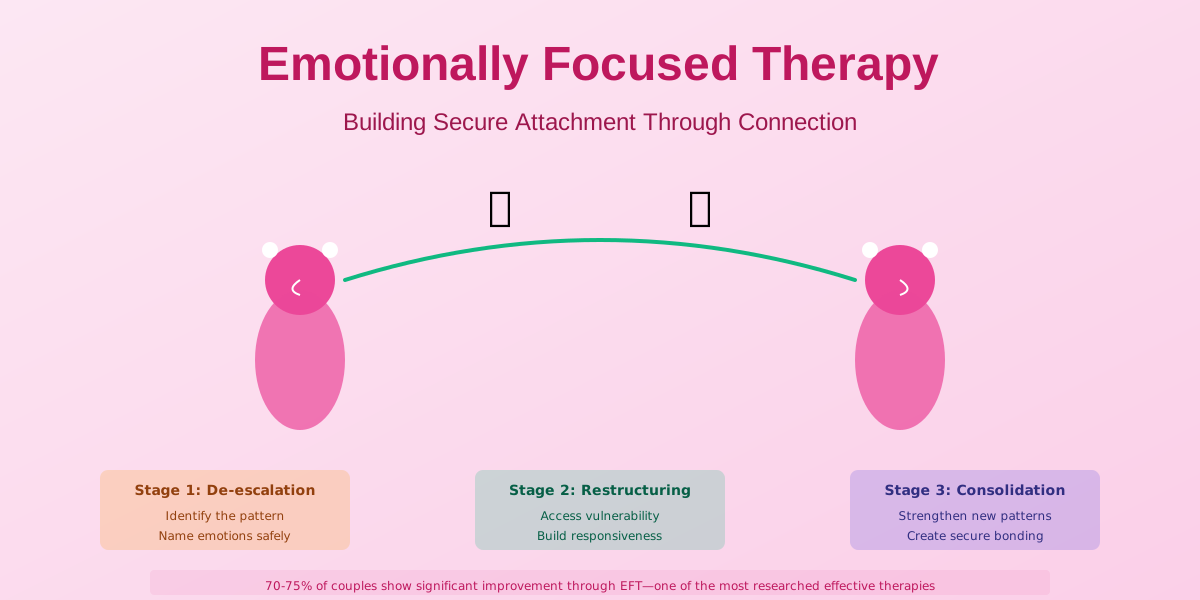
EFT is built on attachment theory—the idea that humans are fundamentally wired for connection. When that bond feels threatened, we activate defensive responses: we fight, flee, or freeze. The therapy helps couples recognize these protective patterns and replace them with genuine vulnerability and mutual reassurance.
The power of EFT lies in its simplicity: it's not about teaching better communication skills or managing anger better. It's about helping partners understand their own emotional needs and respond to their partner's vulnerabilities with compassion instead of defensiveness.
What Is Emotionally Focused Therapy?
Emotionally Focused Therapy (EFT) is a brief, evidence-based couples therapy that integrates attachment theory, systems psychology, and experiential techniques to resolve relationship distress. The core premise is that romantic conflict doesn't stem from poor communication or incompatibility—it comes from insecure attachment patterns, where each partner's protective responses trigger the other's fears. When Partner A feels criticized and withdraws, Partner B feels abandoned and pursues harder, intensifying the cycle. EFT interrupts this negative pattern by helping partners access the vulnerable emotions underneath their defensive behavior, rebuild trust, and create secure emotional bonds.
Not medical advice.
EFT typically involves 12-20 sessions (briefer than traditional therapy) and follows a structured nine-step process organized across three stages: Cycle De-escalation (identifying and naming the negative pattern), Restructuring (accessing vulnerability and shifting responses), and Consolidation (reinforcing new patterns). The therapist acts as a coach and guide, helping each partner understand what the other truly needs and how to respond with genuine connection rather than defense.
Surprising Insight: Surprising Insight: Over 35 years of peer-reviewed research shows EFT has a 70-75% success rate for couples, making it one of the most effective couples therapies available—better outcomes than many individual therapies.
The Negative Cycle in EFT
Visual representation of how defensive responses trigger each other in couples, creating a self-reinforcing negative pattern.
🔍 Click to enlarge
Why Emotionally Focused Therapy Matters in 2026
Relationship distress is at an all-time high. In 2025-2026, couples report higher levels of conflict, disconnection, and loneliness than in previous decades. Stressors like economic uncertainty, remote work, social media comparison, and pandemic aftereffects have strained many partnerships. Many couples try traditional couples therapy focused on communication skills, conflict resolution techniques, or behavioral exercises—and find these approaches insufficient because they don't address the underlying emotional rupture.
EFT matters because it directly targets what couples actually need: to feel emotionally safe and genuinely understood by their partner. It works with the brain's attachment system rather than against it. In a world where many people feel isolated and misunderstood, having a partner you can truly lean on and be vulnerable with is increasingly precious. EFT provides a path to that kind of secure, resilient partnership.
Additionally, EFT has expanded beyond couples to help individuals and families heal from attachment wounds. The same principles—accessing primary emotions, building safe connections, creating secure bonds—apply across all relationships, making this framework increasingly relevant in 2026.
The Science Behind Emotionally Focused Therapy
EFT is grounded in decades of neuroscience and attachment research. John Bowlby and Mary Ainsworth's attachment theory established that humans have a fundamental need for a secure emotional base. Sue Johnson translated this theory into a practical model for healing adult romantic relationships. Brain imaging studies show that when partners feel securely attached, stress-response systems calm down, allowing for greater emotional openness and rational problem-solving.
Meta-analyses and randomized controlled trials consistently demonstrate EFT's effectiveness. A meta-analysis published in peer-reviewed journals found medium to large effect sizes for couples experiencing relationship distress. Approximately 70-75% of couples show significant improvement, with sustained gains at follow-up. EFT also shows benefits for depression, anxiety, and trauma when relationship conflict is addressed. The research indicates that when couples feel more securely attached to each other, both partners experience improved mental health overall.
How EFT Shifts the Nervous System
The three-stage progression from threat detection to safety and connection.
🔍 Click to enlarge
Key Components of Emotionally Focused Therapy
Cycle Recognition
The first step is identifying the negative cycle: the predictable pattern of reactions and counterreactions that keeps couples stuck. Common cycles include Pursue-Withdraw (one partner pursues connection, the other withdraws), Demand-Defend (criticism triggers defensive justification), or Critical-Shutdown (harsh words lead to emotional shutdown). EFT therapists help couples name and externalize this cycle—it becomes 'the problem,' not 'you are the problem.' This shift is crucial; suddenly, both partners are allies against the cycle rather than opponents fighting each other.
Emotion Accessing
Beneath defensive reactions (anger, criticism, withdrawal) lie primary emotions: fear, loneliness, shame, or hurt. EFT helps partners access these softer, more vulnerable emotions. When a partner gets past the anger and touches the fear underneath, their tone shifts. They become less defended, more human. Their partner, seeing this vulnerability, naturally drops defenses and softens. This emotional shift is the real turning point—it's not a cognitive insight but a felt experience of safety and care.
Responsive Engagement
As partners access their deeper emotions, they learn to share them clearly: 'I'm not criticizing you because you're lazy. I'm scared that you don't care about me or our family.' The listening partner practices empathic attunement—truly hearing and receiving their partner's vulnerability without problem-solving or defending. The EFT therapist guides this responsive dance, coaching partners toward genuine connection rather than automatic defensiveness.
Secure Bonding
Through repeated experiences of vulnerability met with compassion, partners gradually build a secure bond. They practice new ways of reaching out and responding. The relationship shifts from a minefield of triggers to a safe base from which each partner can explore the world. This isn't a temporary fix; it's a fundamental rewiring of how they relate to each other.
| Stage | Focus | Therapist Role |
|---|---|---|
| Stage 1: Cycle De-escalation | Identify negative pattern, name secondary emotions, create safety | Detective: help couple see the cycle, reframe as 'us vs. the problem' |
| Stage 2: Restructuring | Access primary emotions, build responsive engagement, create turning points | Coach: help partners share vulnerability and practice empathic responses |
| Stage 3: Consolidation | Strengthen new patterns, practice secure bonding, plan for future | Mentor: help couple integrate changes and handle future conflicts with new tools |
How to Apply Emotionally Focused Therapy: Step by Step
- Step 1: Recognize your cycle: Notice the pattern. Do you pursue while your partner withdraws? Do you criticize and they defend? Name it: 'Our cycle is Pursue-Withdraw' or 'Demand-Defend.' Awareness is the first step.
- Step 2: Pause the automatic response: When you feel triggered (criticized, rejected, ignored), pause before reacting. Take a breath. Notice: 'I'm about to withdraw' or 'I'm about to attack.' This creates space for a different choice.
- Step 3: Identify your deeper emotion: Ask yourself: What am I really feeling underneath the anger or shutdown? Fear? Loneliness? Shame? Hurt? What do I actually need from my partner?
- Step 4: Share vulnerability: When it's safe, tell your partner the truth: 'When you don't respond, I feel abandoned and scared you don't care.' This is vastly different from 'You never listen to me.'
- Step 5: Listen with empathy: When your partner shares vulnerability, resist the urge to defend or problem-solve. Simply receive it: 'I hear you. You're scared. That makes sense.'
- Step 6: Respond with reassurance: Follow with a response that meets their need: 'I do care about you. I'm here. I was just overwhelmed, not rejecting you.'
- Step 7: Practice this new pattern: These new responses feel awkward at first. Keep practicing. Repeat the cycle of vulnerability and responsiveness until it becomes natural.
- Step 8: Notice the shift: Over time, you'll feel different. Your nervous system will relax. You'll start to trust each other again. Conflicts will still happen, but you'll handle them from a place of partnership, not defense.
- Step 9: Build rituals of connection: Create small moments of secure attachment: a daily check-in, physical affection, words of reassurance. These reinforce the new bond.
- Step 10: Seek professional support: If the cycle is entrenched or trauma is involved, working with an EFT-trained therapist is invaluable. They provide expertise and a safe container for deep healing.
Emotionally Focused Therapy Across Life Stages
Young Adulthood (18-35)
Young couples often struggle with establishing secure attachment from the start. They may have insecure attachment styles from their families of origin and haven't yet learned to navigate conflict in partnerships. EFT helps young couples build secure foundations early. They learn to access emotions, communicate needs clearly, and respond with empathy. This early work prevents cycles from becoming entrenched and sets the stage for long-term resilience. Issues often include conflict around commitment, family involvement, and unmet emotional needs.
Middle Adulthood (35-55)
Mid-life couples often face significant stressors: career demands, parenting challenges, aging parents, financial pressures. These stressors can erode secure attachment if partners aren't actively maintaining connection. EFT helps middle-aged couples reconnect after years of neglecting their emotional bond. Many report that EFT revitalizes their partnership, helping them remember why they chose each other and rediscover passion. Issues often include emotional distance, unresolved resentments, and competing demands that leave little time for relationship.
Later Adulthood (55+)
Older couples bring decades of relationship history—both positive and painful. EFT helps resolve long-standing hurts and rebuild intimacy. Many discover that vulnerability becomes easier with age; they're less concerned with appearing strong and more interested in genuine connection. EFT supports aging couples in navigating health challenges, retirement, changing roles, and preparing for the final chapter of life together. The therapy helps them feel secure and valued in their later years.
Profiles: Your Emotionally Focused Therapy Approach
The Pursuer
- Reassurance that your partner values the relationship and is committed to you
- Clear, specific expressions of care and affection from your partner
- Consistent engagement and responsiveness from your partner
Common pitfall: Pursuing harder when your partner withdraws, which intensifies their retreat. This often feels like neediness or control to your partner.
Best move: Practice pausing before pursuing. Reflect on your fear: 'I'm scared you don't care.' Then, from a calmer place, share that vulnerable feeling rather than demanding reassurance. This typically brings your partner closer.
The Withdrawer
- Space and time to process emotions and thoughts without immediate confrontation
- Respect for your boundaries and your way of coping
- Gradual, non-threatening invitations to connect rather than demands
Common pitfall: Shutting down when conflict arises, which your partner interprets as rejection or avoidance. This feeds their pursuit and escalates the cycle.
Best move: Practice staying present even when uncomfortable. Share why you need space without disappearing emotionally: 'I need a few minutes to calm down. I do want to talk about this with you.' Then follow through.
The Critic
- Acknowledgment that your concerns and standards matter
- Effort and improvement from your partner in areas important to you
- Respect and validation for your high expectations
Common pitfall: Using criticism as a tool to change your partner, which creates defensiveness and shame. Your partner feels attacked rather than motivated.
Best move: Recognize that criticism usually masks fear or hurt. Instead of 'You never help with the kids,' try 'When I manage everything alone, I feel unsupported and resentful. I need your partnership.' This invites collaboration.
The Defended
- A sense of autonomy and control over your own choices and feelings
- Protection from being blamed or made wrong
- Validation that your perspective matters even if it differs from your partner's
Common pitfall: Over-explaining or defending yourself when criticized, which your partner experiences as dismissal. Both partners feel unheard and misunderstood.
Best move: Practice listening to your partner's feelings without needing to defend yourself immediately. Then, from a calmer place, share your perspective. This breaks the defensive cycle and creates genuine dialogue.
Common Emotionally Focused Therapy Mistakes
Mistake 1: Focusing on surface conflict instead of underlying emotions. Couples often get stuck debating who's right about a specific issue ('You forgot my birthday' or 'You spend too much money') when the real issue is 'I don't feel valued' or 'I don't feel secure.' EFT prevents this by helping couples access what the conflict is really about. If you're repeatedly arguing about the same surface issue, dig deeper into the emotions.
Mistake 2: Using vulnerability as a manipulation tactic. EFT requires genuine vulnerability, not strategic sharing to get your way. Saying 'I'm hurt' just to prove your partner wrong isn't authentic connection. Real vulnerability means admitting your fears and needs without controlling your partner's response. If your vulnerability is always followed by blame ('I feel hurt because you...'), it's not true vulnerability.
Mistake 3: Skipping the cycle recognition step. Some couples rush to 'fix it' without understanding the pattern first. But if you don't recognize the cycle, you'll keep repeating it. The cycle recognition phase in EFT is essential; it creates awareness that the problem is the dance, not one person.
From Defensive Cycle to Secure Bond
The progression from conflict to connection through EFT stages.
🔍 Click to enlarge
Science and Studies
EFT has become one of the most rigorously researched couple therapies in modern psychology. Over 35 years of peer-reviewed clinical research has validated its effectiveness across diverse populations and presenting issues. Major research institutions and universities worldwide have conducted longitudinal studies, randomized controlled trials, and meta-analyses on EFT outcomes. The consistency of positive results—particularly the 70-75% recovery rate—has led the American Psychological Association and other professional bodies to recognize EFT as an evidence-based treatment.
- Emotionally Focused Couples Therapy: A Systematic Review of Its Effectiveness (PubMed, 2019): Meta-analysis showing EFT meets gold-standard criteria for psychotherapy research, with effect sizes at post-test (g = 0.73) and sustained gains at 6-month follow-up.
- The Efficacy of Emotionally Focused Couples Therapy and Behavioral Couples Therapy: A Meta-Analysis (PubMed, 2018): Comprehensive comparison showing EFT produces comparable or superior outcomes to other empirically supported couple therapies.
- Randomized Controlled Trial of EFT Compared to Treatment as Usual for Depression (PubMed, 2018): Demonstrates that couples receiving EFT showed greater improvement in depressive symptoms compared to usual care, indicating EFT benefits individual mental health.
- The Effect of EFT on Shame and Intimacy in Couples (PMC, 2024): Recent randomized controlled trial confirming that EFT significantly reduces shame and increases intimacy in distressed couples.
- Attachment Theory in Practice: EFT with Individuals, Couples, and Families (Susan Johnson, 2019): Comprehensive clinical guide showing how EFT principles extend beyond couples to individual and family therapy, expanding the theoretical and practical applications.
Your First Micro Habit
Start Small Today
Today's action: Tonight, ask your partner one question with genuine curiosity: 'When I [recent conflict moment], what were you feeling underneath your [defensive response]?' Then, listen without explaining or defending. Just receive their answer.
This single question opens the door to deeper understanding. It signals that you care about their emotional experience, not just proving your point. It shifts the conversation from blame to empathy. Most couples find this one question often leads to a meaningful connection moment.
Keep quitting habit apps after a missed day? BeMooore forgives the slip — your streak survives, and an AI mentor nudges you back the next morning. Free on iOS.
Quick Assessment
When conflict arises in your relationship, what's your first instinct?
Your answer reveals your attachment style. Expressers tend toward pursuing; withdrawers toward distancing; listeners toward secure responses; humor-makers toward deflection. None is 'bad'—but awareness of your pattern helps you make different choices.
What emotion is hardest for you to express to your partner?
The emotion you avoid is often your core wound. If you avoid fear, you may pursue connection aggressively (afraid of rejection). If you avoid anger, you may withdraw (afraid of conflict). EFT works by helping you access and share these avoided emotions in safe ways.
When your partner shares a vulnerable feeling, your instinct is usually to:
True empathic attunement (a core EFT skill) means listening without fixing, defending, or deflecting. If your instinct is anything but #3, EFT can help you develop genuine empathic response patterns.
Take our full assessment to get personalized recommendations.
Discover Your Style →Next Steps
If you recognize your relationship's negative cycle in this article, you're already on the path to change. Start with the micro habit: ask your partner one curious question tonight. Notice what shifts.
If you're ready for deeper work, find an EFT-trained therapist through ICEEFT (International Center for Excellence in Emotionally Focused Therapy) at iceeft.com. Look for certification credentials; not all therapists trained in EFT have the same level of expertise. Reading 'Hold Me Tight' by Sue Johnson or 'A Primer for Emotionally Focused Individual Therapy' can deepen your understanding and complement your therapy work.
Get personalized guidance with AI coaching.
Start Your Journey →Research Sources
This article is based on peer-reviewed research and authoritative sources. Below are the key references we consulted:
Related Glossary Articles
Frequently Asked Questions
How long does Emotionally Focused Therapy take?
Typically 12-20 sessions. Some couples see significant improvement within 8-12 sessions, while more complex issues may require 20+ sessions. EFT is considered brief therapy compared to traditional approaches. Many couples report feeling meaningfully different within 10-15 sessions.
Can EFT help if only one partner wants to work on the relationship?
Ideally, both partners engage in EFT. However, individual EFT (where one partner works with the therapist) can help that partner shift their responses and patterns, which sometimes catalyzes change in the dynamic. But couples EFT—with both partners present—is more effective and creates faster change.
Is EFT effective for infidelity or betrayal?
Yes. EFT has strong evidence for helping couples heal from infidelity. The process helps the betrayed partner process pain, helps the unfaithful partner understand the impact of their actions, and helps both partners rebuild trust through genuine connection and accountability.
Can EFT work if my partner is resistant or skeptical?
EFT can help. The therapist's job includes engaging resistant partners. Often, resistance comes from fear of vulnerability. As resistant partners see their partner soften in EFT and experience genuine connection, their resistance typically decreases. Choosing an EFT-trained therapist skilled in engaging all personality types is key.
What if we've been in conflict for years? Is it too late for EFT?
It's rarely too late. Long-standing patterns are entrenched but not irreversible. EFT's strength is precisely in interrupting deeply ingrained cycles. Many couples who've struggled for years report profound shifts once they understand their cycle and begin responding differently. Older relationships also benefit from the depth of history and commitment both partners often have.
Take the Next Step
Ready to improve your wellbeing? Take our free assessment to get personalized recommendations based on your unique situation.
- Discover your strengths and gaps
- Get personalized quick wins
- Track your progress over time
- Evidence-based strategies