Emotional Affair
An emotional affair cuts deeper than physical infidelity for many couples. While no sexual or physical contact occurs, the betrayal of sharing your innermost thoughts, desires, and emotional intimacy with someone outside your committed relationship shatters the foundation of trust. Whether you're concerned about boundary-crossing in your own relationship or trying to understand what you've experienced, this guide explores the neuroscience, warning signs, and evidence-based recovery pathways that help couples heal and rebuild stronger connections.
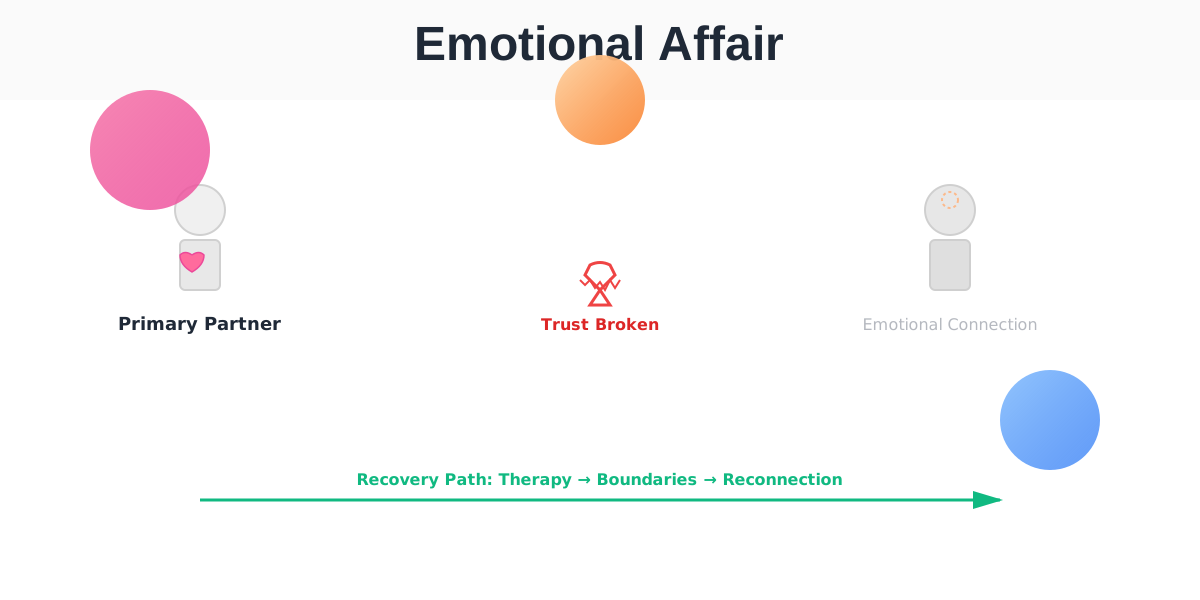
Research shows 76% of U.S. adults consider a secret emotional relationship to be cheating, and women report being more devastated by emotional infidelity than sexual betrayal. Yet despite how common emotional affairs are, most people don't recognize them until deep emotional damage has occurred.
Understanding the psychology and neuroscience behind emotional affairs—plus the attachment-based recovery framework—gives you concrete tools to either prevent them or rebuild after one happens.
What Is Emotional Affair?
An emotional affair is a deep emotional connection with someone outside your committed relationship that shares qualities normally reserved for your primary partner: vulnerability, intimate conversation, emotional support, and special secrecy. Unlike physical affairs, no sexual contact occurs, yet the emotional intimacy can feel like a deeper betrayal because it involves sharing your authentic self with someone else.
Not medical advice.
Emotional affairs exist on a spectrum. They might start innocently as a friendship with a coworker, evolve into late-night conversations with an online connection, or develop through texting someone who 'gets you' better than your partner. The defining feature isn't how it started—it's the secrecy, emotional exclusivity, and the feeling that this person matters more than your relationship's wellbeing.
Surprising Insight: Surprising Insight: Women are significantly more likely than men to have emotional affairs. Research shows women more often stray due to emotional dissatisfaction—feeling neglected or unloved—while men typically cite sexual boredom or opportunity.
Emotional vs. Physical Infidelity: Gender Perception
Brain activation differences: men show more amygdala activation to sexual betrayal; women show greater posterior superior temporal sulcus activation to emotional betrayal.
🔍 Click to enlarge
Why Emotional Affair Matters in 2026
In 2026, emotional affairs are more common and more complex than ever. Digital connectivity means someone you connect with emotionally might be across the globe, available 24/7 through messaging apps, social media, and professional networks. Work-from-home arrangements blur boundaries between professional and personal relationships. Online communities, gaming platforms, and interest-based groups create opportunities for deep emotional connections outside your marriage or committed partnership.
The rise of emotional affairs has clinical implications. Couples therapy success rates show 67-75% of couples move from distress to recovery when they seek professional help, compared to 35-45% who don't. Understanding emotional affairs early—before they escalate—dramatically improves relationship outcomes and reduces divorce risk.
Beyond statistics, emotional affairs touch your mental health, stress levels, and capacity for intimacy. Whether you're the betrayed partner or the one who crossed boundaries, the experience affects your emotional wellbeing for months or years without proper support.
The Science Behind Emotional Affair
Neuroscience reveals why emotional affairs feel so powerful. Three distinct brain systems govern romantic partnership: lust (driven by testosterone and estrogen), romantic attraction (driven by dopamine, noradrenaline, and serotonin), and attachment (driven by oxytocin and vasopressin). These systems operate independently. You can feel deep attachment to your primary partner while experiencing intense romantic love for someone else and sexual desire for yet another person. This biological reality explains why emotional affairs feel 'real' and confusing to both people involved.
fMRI research shows significant gender differences in brain activation during emotional betrayal scenarios. Men demonstrate greater activation in the amygdala and hypothalamus—regions associated with aggression and sexual response—suggesting sexual betrayal triggers more intense alarm. Women show greater activation in the posterior superior temporal sulcus, a region involved in understanding others' minds and emotions, suggesting emotional betrayal triggers greater processing of relationship violation. This neurological difference explains why recovery strategies must be tailored: men often need reassurance and restoration of sexual exclusivity; women need emotional reconnection and restoration of intimate conversation.
Three Brain Systems in Romantic Partnership
Independent neural systems governing lust, romantic love, and attachment can activate separately, explaining how emotional affairs develop despite commitment.
🔍 Click to enlarge
Key Components of Emotional Affair
Secrecy and Deception
The hallmark of emotional affairs is the deliberate concealment. If asked directly, the partner having the affair hesitates or lies. They might say 'it's just a coworker' or 'we're just friends,' but avoid mentioning late-night conversations, shared vulnerabilities, or how much this person means to them. Secrecy itself signals boundary crossing—if it were innocent, there would be no reason to hide it.
Emotional Intimacy and Vulnerability
Emotional affairs involve sharing the 'real you'—your fears, dreams, insecurities, and authentic feelings—with someone outside your committed relationship. This person becomes a confidant for things you haven't told your primary partner. You share struggles at work, conflicts with family, sexual concerns, or future ambitions with this person first, sometimes exclusively. The emotional support, understanding, and validation they offer feels unique and irreplaceable.
Emotional Exclusivity
While your primary partner supports you in practical ways, this other person becomes your emotional priority. When you have news—good or bad—they're the first person you want to tell. When you're struggling, you seek their advice before your partner's. Your emotional energy, attention, and focus shift toward this person, leaving your primary partner feeling neglected or secondary.
Boundary Violations and Role Confusion
What started as professional friendship, online connection, or casual contact crosses into territory normally reserved for primary partners. You find reasons to spend time together, create opportunities for private conversations, remember details about their life that would normally matter only in intimate relationships, and develop inside jokes or special language. The relationship takes on romantic elements—lingering eye contact, compliments on appearance, or flirtation—without physical contact.
| Context | Early Warning Signs | Red Flags |
|---|---|---|
| Work/Professional | Extended private conversations; sharing work stress | Decline in job performance; frequent after-hours contact; spending lunch alone with coworker |
| Online/Digital | Active engagement in forums or gaming; daily messaging | Secretive about accounts; defensive when questioned; hours spent in conversation |
| Friendship Circle | One friend becomes a sounding board; increased vulnerability | Partner feels excluded; defensive when you mention this person; their opinion influences major decisions |
| Family/In-Law | Confiding in sibling or parent instead of partner; seeking their counsel | Family member becomes mediator in conflicts; partner feels alienated from family discussions |
How to Apply Emotional Affair: Step by Step
- Step 1: Recognize the warning signs: Notice if you're sharing more vulnerable thoughts with someone outside your relationship, seeking their support before your partner's, or hiding your connection from your partner.
- Step 2: Assess your relationship foundation: Reflect on why the emotional affair appealed to you. Is your primary relationship lacking emotional attunement, <a href="/g/active-listening.html">active listening</a>, or <a href="/g/communication.html">communication</a>?
- Step 3: Establish firm boundaries: If the affair hasn't been disclosed yet, immediately reduce contact with the other person. No private conversations, no frequent texting, no one-on-one meetings.
- Step 4: Disclose with honesty and accountability: Tell your partner what happened, when, and why, taking full responsibility without minimizing or justifying. This is essential for trust rebuilding.
- Step 5: Create physical and digital separation: Remove the person from your social media, block their number if necessary, transfer to a different department at work, or find new community spaces. Complete separation, not 'just being friends.'
- Step 6: Engage in couples therapy: Seek a therapist trained in attachment-based methods or Emotionally Focused Therapy (EFT). Individual therapy alone won't rebuild the relationship.
- Step 7: Understand the attachment injury: With your therapist, explore how the betrayal damaged your partner's sense of safety and your attachment security. Name the specific moments of hurt.
- Step 8: Practice emotional and digital transparency: Share passwords, location information, and your schedule as a rebuilding step. This temporary loss of privacy is necessary for trust recovery.
- Step 9: Rebuild emotional intimacy: Schedule dedicated time for vulnerable conversation. Share your fears and dreams with your partner first. Prioritize <a href="/g/connection.html">connection</a> over convenience.
- Step 10: Monitor for recurring patterns: For 1-2 years, notice if you're beginning to emotionally distance again, have new secretive relationships, or are avoiding your partner's <a href="/g/emotional-expression.html">emotional expression</a>. Address patterns early.
Emotional Affair Across Life Stages
Young Adulthood (18-35)
Early-stage relationships are most vulnerable to emotional affairs because young adults are still forming communication patterns and intimacy skills. Online connections feel safer than face-to-face intimacy. Work environments offer exciting new friendships. Emotional affairs often start when partners haven't learned to process vulnerability together. Recovery at this stage offers the strongest advantage: couples have decades to rebuild and can establish healthier patterns early.
Middle Adulthood (35-55)
This is the peak period for emotional affairs. Careers are demanding, children create parental stress, and partners often feel more like co-managers than lovers. One person might confide in a work peer about the pressures of parenting; another might find deep understanding in an online community or old friend. The affair often reflects dissatisfaction with the relationship's emotional climate rather than the primary relationship itself. Recovery requires addressing underlying burnout, work-life balance, and reigniting partnership beyond logistics.
Later Adulthood (55+)
Emotional affairs in later adulthood often reflect decades of unmet emotional needs. One partner might develop a deep connection with an old friend, reconnect on social media, or find understanding in a new relationship circle. These affairs can be particularly painful because they signal that fundamental relationship needs have gone unaddressed for years. However, research shows older couples who engage in therapy often achieve the most dramatic relationship transformations because they're motivated by mortality awareness and have less time to waste on disconnection.
Profiles: Your Emotional Affair Approach
The Avoidant Partner
- Learning that <a href="/g/vulnerability.html">vulnerability</a> strengthens rather than weakens relationships
- Permission to have needs and to communicate them
- Structured conversation time (not spontaneous emotional moments)
Common pitfall: After the affair surfaces, retreating further into emotional distance and using busyness as an escape. This signals distrust in recovery.
Best move: Schedule weekly dates specifically for emotional conversation. Use prompts like 'Today I felt...' and practice listening without solving. Start small: 15-minute conversations twice weekly.
The Pursuing Partner
- Reassurance that the affair wasn't about their lack of attractiveness
- Understanding of their role in relationship patterns (pursuing often triggers avoidance)
- New ways to <a href="/g/connection.html">connect</a> beyond pursuing
Common pitfall: Becoming hypervigilant, checking social media, and trying to control the unfaithful partner's every movement. This escalates distrust and prevents genuine recovery.
Best move: Shift from monitoring to communicating needs directly. Instead of checking their phone, say 'I need to know you're thinking of me today.' Build trust through consistent follow-through, not surveillance.
The Person Who Had the Affair
- Understanding why the affair felt necessary (what was missing?)
- Space to grieve the <a href="/g/relationship-building.html">relationship</a> ending if that's what partner decides
- Clear actions to rebuild—boundaries, transparency, and consistent commitment
Common pitfall: Minimizing the betrayal, saying 'it wasn't that serious,' or rushing recovery. This prevents the hurt partner from feeling truly heard.
Best move: Acknowledge the full impact: 'I betrayed your trust in a profound way. I understand this will take time to rebuild. Here's what I'm doing daily to earn your trust back.' Then do it consistently.
The Betrayed Partner
- Full honesty about what happened (answers to hard questions)
- Genuine <a href="/g/forgiveness.html">forgiveness</a> from themselves before forgiving their partner
- Support in processing trauma (individual therapy alongside couples work)
Common pitfall: Deciding to stay 'for the kids' or 'to work on it' without genuine willingness to heal. This leads to resentment that surfaces later.
Best move: Make a conscious choice to either commit fully to recovery or end the relationship respectfully. Half-commitment serves no one. If choosing recovery, invest completely in therapy and new patterns.
Common Emotional Affair Mistakes
The biggest mistake people make during recovery is underestimating the depth of the betrayal. Partners often say things like 'well, at least it wasn't physical' or 'we didn't do anything wrong.' This minimization prevents the hurt partner from feeling truly heard and extends recovery. Research shows couples who acknowledge the full emotional weight of the affair—validating how it shattered trust and attachment security—recover faster than couples who rationalize it.
Another critical error is attempting recovery without professional help. While some couples successfully rebuild on their own, couples therapy accelerates healing by 3-5x. A trained therapist helps both partners understand underlying patterns, validates both perspectives, and provides tools specifically designed for attachment injury repair. Therapists trained in Emotionally Focused Therapy (EFT) show the highest success rates: 70-75% of couples move from significant distress to secure attachment within 12-20 sessions.
The third major mistake is failing to address the underlying issues that created vulnerability to the affair. If one partner felt emotionally neglected, that pattern returns unless addressed. If one partner used the affair to escape anxiety or stress, they'll find another escape if they don't develop coping mechanisms. Successful recovery requires understanding the 'why' behind the affair and building new relationship patterns.
Recovery Success vs. Failure Pathways
Couples who acknowledge the betrayal, seek professional help, and address underlying patterns recover; those who minimize, avoid therapy, or ignore root causes face continued disconnection or eventual separation.
🔍 Click to enlarge
Science and Studies
Emotional affairs are increasingly studied in academic literature because their prevalence has grown and their impact on relationship outcomes is significant. Recent research provides clear, evidence-based recovery pathways.
- Psychology Today (2024): Analysis of nearly 100,000 individuals found women are significantly more likely than men to have emotional affairs, with women citing emotional dissatisfaction as the primary driver and men citing sexual boredom or opportunity.
- American Journal of Family Therapy (2012): Emotionally Focused Couples Therapy for attachment injury resolution shows 70-75% of couples achieving secure attachment recovery within 12-20 sessions.
- Institute for Family Studies: National survey found 76% of U.S. adults consider a secret emotional relationship to constitute cheating; 72% include online emotional relationships in their definition of infidelity.
- NeuroImage (2006): fMRI studies show men and women activate different brain regions during emotional betrayal scenarios—men show greater amygdala activation (aggression/sexual response), women show greater temporal sulcus activation (social understanding).
- Couples Therapy Inc. (2024): Gottman Method research identifies three stages of affair recovery—Atone, Attune, Attach—with success highest when both partners actively engage in each stage.
Your First Micro Habit
Start Small Today
Today's action: Ask your partner one vulnerable question this week: 'What have you felt disconnected from me about lately?' and listen for 10 minutes without defending or solving. Just listen.
This single action directly addresses the root cause of most emotional affairs—lack of emotional attunement and understanding between partners. It signals that you value their inner world and opens space for them to feel heard.
Keep quitting habit apps after a missed day? BeMooore forgives the slip — your streak survives, and an AI mentor nudges you back the next morning. Free on iOS.
Quick Assessment
How emotionally connected do you feel to your primary partner right now?
If you chose 'minimally' or 'disconnected,' this vulnerability creates openness to emotional affairs. Rebuilding daily emotional connection is your first step.
Do you have a relationship with someone outside your partnership where you share vulnerabilities you don't share with your primary partner?
Answering 'moderate' or 'significant' suggests emotional boundary crossing. Reflecting on why this person has become your primary confidant reveals important information about your relationship's emotional climate.
If your partner asked about your closest relationships right now, how comfortable would you feel being completely honest?
Discomfort with transparency is itself a warning sign. Your own instinct tells you a boundary has been crossed. Addressing this now prevents deeper emotional affair formation.
Take our full assessment to get personalized recommendations.
Discover Your Style →Next Steps
If you're concerned about emotional boundaries in your relationship, start now. Don't wait for the affair to deepen or for your partner to discover it. The earlier you address boundary crossing, the easier the repair. Have a conversation with your partner about emotional connection and where you both feel understood or misunderstood. If you discover an emotional affair has occurred, recognize that recovery is absolutely possible with commitment and professional support. Within 1-2 years of consistent effort, most couples report feeling more secure and connected than they did before the affair.
Whether you're in the early stages of relationship building, navigating challenging partnership dynamics, or recovering from betrayal, emotional affairs are an opportunity to deepen your understanding of attachment patterns and commit to authentic intimacy. The couples who recover successfully often report their relationships become the strongest because they've learned to prioritize emotional attunement, vulnerability, and communication.
Get personalized guidance with AI coaching.
Start Your Journey →Research Sources
This article is based on peer-reviewed research and authoritative sources. Below are the key references we consulted:
Related Glossary Articles
Frequently Asked Questions
Is an emotional affair as serious as physical infidelity?
Research shows 65% of women report being more devastated by emotional infidelity than sexual cheating. Emotional affairs involve sharing your authentic self with someone outside your relationship and often indicate deeper disconnection. For many couples, emotional affairs are actually harder to recover from because they represent a violation of emotional exclusivity that defined the committed relationship. However, recovery success depends on both partners' commitment, not on whether infidelity was emotional or physical.
Can a marriage recover from an emotional affair?
Yes. Research shows 67-75% of couples who engage in professional therapy achieve significant recovery, with many reporting their relationship becomes stronger than before. The key factors: both partners must acknowledge the full depth of the betrayal, engage in couples therapy (preferably EFT), establish firm boundaries with the third party, and address the underlying relationship issues that created vulnerability to the affair. Recovery typically takes 1-2 years, not months.
What if I'm the person who had the emotional affair?
Take full accountability without justifying or minimizing. Share complete honesty about what happened and when. Establish immediate boundaries with the other person—no contact is essential for rebuilding trust. Understand that your partner will need time to process the betrayal, and they may ask painful questions repeatedly. Engage in individual therapy to understand why you sought emotional connection outside the relationship. In couples therapy, focus on understanding your partner's hurt rather than defending yourself.
How do I know if what I have with someone is crossing into emotional affair territory?
Ask yourself: Would my partner feel comfortable knowing the depth of my emotional connection with this person? Do I share vulnerabilities with them that I don't share with my partner? Do I hide the time I spend with them or make excuses? Do I think about them frequently throughout the day? Would I be upset if my partner had an equally intimate connection? If you answered yes to more than two, you're likely in boundary-crossing territory. Have a conversation with your partner about the relationship and establish clear boundaries.
What are the most effective therapy approaches for emotional affair recovery?
Emotionally Focused Therapy (EFT) and the Gottman Method show the highest success rates. EFT focuses on understanding the attachment injury caused by betrayal and rebuilding secure attachment between partners. The Gottman Method emphasizes three stages: Atone (acknowledging the betrayal), Attune (understanding each other's pain), and Attach (rebuilding connection). Both typically require 12-20 sessions. Individual therapy alone won't rebuild the relationship—couples therapy is essential.
Take the Next Step
Ready to improve your wellbeing? Take our free assessment to get personalized recommendations based on your unique situation.
- Discover your strengths and gaps
- Get personalized quick wins
- Track your progress over time
- Evidence-based strategies