Positive Self-Talk
Every moment, your inner voice is either building you up or tearing you down. Positive self-talk is the practice of consciously replacing negative, self-critical thoughts with encouraging, realistic affirmations that reshape how you perceive yourself and your abilities. This internal dialogue runs constantly in the background of your mind—influencing your confidence, resilience, and emotional wellbeing. The remarkable truth is that you have direct control over this voice. When you learn to harness positive self-talk, you're not just thinking happy thoughts; you're rewiring neural pathways in your brain, activating the same reward centers that respond to genuine achievements. Research from cognitive neuroscience shows that repeated positive affirmations physically change brain structure over time, strengthening regions associated with self-processing and emotional regulation. Whether you're facing a difficult challenge at work, struggling with self-doubt, or simply wanting to feel more capable and worthy, positive self-talk is one of the most evidence-backed tools for building lasting self-esteem and mental resilience. This guide will show you exactly how to develop this powerful habit.
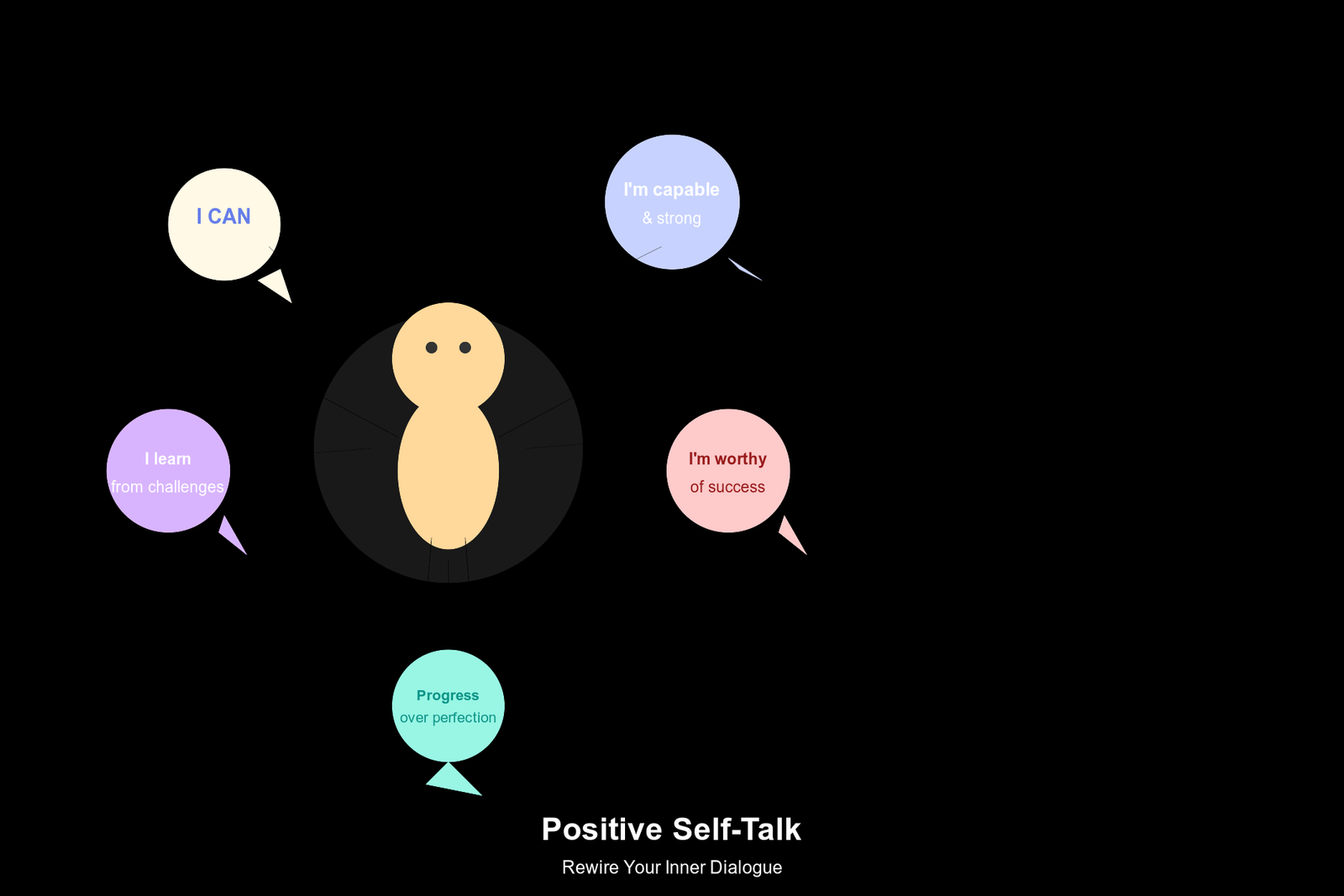
Did you know? Studies show that 80% of our thoughts are negative by default—but that same research proves this can be changed through consistent positive self-talk practice in just weeks, not months.
The path to genuine confidence isn't about ignoring real challenges or pretending problems don't exist. It's about developing an internal dialogue that acknowledges difficulties while maintaining belief in your capacity to handle them—and that balance is exactly what positive self-talk teaches you.
What Is Positive Self-Talk?
Positive self-talk is the intentional practice of using encouraging, realistic, and compassionate internal dialogue to replace automatic negative thoughts. It's the voice you use when talking to yourself about your abilities, worth, and experiences. Unlike forced positivity or empty affirmations that feel dishonest, genuine positive self-talk acknowledges reality while emphasizing your agency, strength, and capacity for growth. This might sound like: "I don't know how to do this yet, but I can learn" instead of "I'm terrible at this and always will be." The shift isn't about ignoring what's hard—it's about changing the narrative you construct around challenges. When you practice positive self-talk, you're essentially coaching yourself the way a supportive mentor would, offering encouragement while maintaining realistic expectations.
Not medical advice.
Positive self-talk exists at the intersection of cognitive behavioral therapy (CBT), sports psychology, and neuroscience. CBT, one of the most evidence-backed psychotherapy approaches, is fundamentally built on the principle that our thoughts influence our emotions and behaviors. By changing thought patterns, we can shift emotional states and create behavioral change. In athletics, coaches have used motivational self-talk for decades to enhance performance—and this same principle applies to any challenge you face, from managing anxiety to building confidence in social situations. The neuroscience behind it reveals why this works: your brain doesn't distinguish perfectly between vividly imagined experiences and real ones when it comes to emotional processing. When you tell yourself "I am capable," your brain activates the same regions as when you actually accomplish something, reinforcing neural pathways associated with competence and worth.
Surprising Insight: Surprising Insight: Brain imaging studies show that self-affirmation activates the ventromedial prefrontal cortex—the brain region responsible for self-related processing and positive valuation. This activation triggers dopamine and serotonin release, creating the same neurochemical environment as when you experience genuine success.
The Negative Thought Loop vs. Positive Intervention
Shows how automatic negative thoughts create a reinforcing cycle, and how positive self-talk interrupts this pattern to create empowering outcomes.
🔍 Click to enlarge
Why Positive Self-Talk Matters in 2026
In 2026, we face unprecedented levels of information overload, social comparison, and performance pressure. Social media algorithms are optimized to trigger self-doubt and inadequacy by constantly showing curated highlight reels of others' lives. Workplace expectations demand constant upskilling and adaptation. Personal relationships often feel more fragmented and transactional. In this environment, your internal dialogue has become your most reliable source of stability and support. Unlike external validation, which is unpredictable and often conditional, the voice you use to talk to yourself is always available. Positive self-talk isn't a luxury—it's essential mental health infrastructure in a world designed to make you question your worth. When you develop this skill, you create an internal resource that no one can take from you and that doesn't depend on external circumstances.
Research on resilience consistently shows that people who navigate major life challenges most effectively share one characteristic: they maintain a compassionate, encouraging internal dialogue even when things are difficult. This isn't about denial or toxic positivity. It's about maintaining realistic optimism—acknowledging what's hard while maintaining belief in your capacity to handle it. This exact skill is what separates those who recover from setbacks quickly from those who spiral into prolonged anxiety or depression. In today's high-stress world, this capacity is measurable and has real consequences for your mental health outcomes.
The scientific evidence for positive self-talk has grown substantially in recent years, with over 47 peer-reviewed studies in a comprehensive meta-analysis confirming its effectiveness for anxiety reduction, performance enhancement, confidence building, and emotional regulation. Organizations from professional sports teams to major corporations now teach self-talk training as a core wellbeing intervention. What was once considered fringe self-help is now standard psychological practice—because the evidence is simply too strong to ignore.
The Science Behind Positive Self-Talk
The foundation of positive self-talk's effectiveness lies in neuroplasticity—the brain's ability to rewire itself through experience and thought. When you repeatedly practice positive self-talk, you're not just thinking optimistic thoughts in isolation. You're activating specific neural pathways that strengthen with each repetition, similar to how practicing a physical skill strengthens muscle memory. Functional MRI studies have shown that positive self-affirmation activates the ventromedial prefrontal cortex (vmPFC), a brain region crucial for self-related processing, emotional regulation, and reward. This activation doesn't just feel good momentarily—it triggers the release of neurotransmitters like dopamine and serotonin, which improve mood, motivation, and overall wellbeing. Over time, this neurochemical environment becomes more stable, which means your baseline emotional state actually improves.
In cognitive behavioral therapy, the mechanism is understood through the Cognitive Model: events are processed through thoughts, which generate emotions, which produce behaviors, which then create outcomes that reinforce the original thoughts. By intervening at the thought level with positive self-talk, you interrupt this cycle before emotions are fully activated. Instead of thinking "I'll definitely fail this presentation" (which triggers anxiety, which manifests as avoidance), you replace it with "I'm prepared and I've done this before" (which triggers motivation, which produces engaged action). The behavioral outcome (successful presentation) then provides evidence that contradicts the original negative belief, permanently weakening its neural pathway. This is why cognitive interventions are so powerful—they work with your brain's natural learning mechanisms rather than against them.
How Positive Self-Talk Rewires Your Brain
Illustrates the neurochemical cascade triggered by positive self-talk, from thought activation through neural pathway strengthening.
🔍 Click to enlarge
Key Components of Positive Self-Talk
Self-Awareness of Automatic Thoughts
The first component is simply noticing what you're telling yourself. Most people's negative self-talk runs on autopilot—so automatic that they don't even realize it's happening. You might catch yourself thinking "I always mess this up" without consciously registering the thought. Self-awareness means pausing to notice these moments. This is what CBT therapists call the "thought record" phase. When you become aware of a negative thought, you've already won half the battle. The practice of noticing creates a tiny gap of consciousness where change becomes possible. Start by tuning in during moments when you feel anxious, inadequate, or discouraged. What's the specific thought running through your mind? "I'm not good enough," "Everyone else is doing better," "This is impossible"? Just noticing the thought pattern is the foundation.
Realistic Optimism (Not Toxic Positivity)
Effective positive self-talk isn't about ignoring reality or pretending challenges don't exist. It's about choosing a realistic, empowering narrative about your relationship to those challenges. The distinction matters enormously. Toxic positivity sounds like: "I'm going to ace this presentation, there's no way I'll be nervous." This creates pressure and sets you up for disappointment. Realistic optimism sounds like: "I'll probably feel some nervousness—that's normal. I'm prepared and I've handled nerves before." This acknowledges reality while anchoring you in your capability. The magic is in the "and" not the "but." "I'm struggling with this project AND I have the skills to figure it out" maintains both realistic assessment and belief in your capacity. This prevents the shame spiral where acknowledging difficulty feels like proof of inadequacy.
Emotional Attunement and Self-Compassion
Positive self-talk isn't about forcing cheeriness when you're genuinely struggling. It's about acknowledging your emotional experience while offering yourself the same kindness and encouragement you'd offer a good friend. When you're disappointed or anxious or frustrated, pretending you're not actually makes you feel invalidated. True positive self-talk includes statements like: "This is really hard right now, and that makes sense given the circumstances. I'm doing my best, and that's enough." The self-compassion component actually increases the effectiveness of positive self-talk because it prevents the resistance and denial that undermine forced positivity. You're not denying what you feel; you're contextualizing it within your larger capacity to cope.
Behavioral Alignment (Action-Based Reinforcement)
The most powerful positive self-talk is paired with actual behavior that confirms it. If you tell yourself "I'm capable of learning this skill" but then never attempt to practice, your brain doesn't receive evidence that the affirmation is true. Positive self-talk's neurological impact depends on creating real-world evidence that contradicts the original negative belief. This is why research shows that combining self-talk with actual skill-building or challenging activities produces much stronger results than affirmations alone. The alignment works like this: tell yourself something affirming, then take one small action that proves it true, then notice the result. This creates a positive feedback loop where your self-talk becomes increasingly credible because reality is confirming it.
| Type | Example | Best Used For |
|---|---|---|
| Motivational | "I can do this, I've prepared well" | Before challenges, performance situations, starting difficult tasks |
| Instructional | "Stay focused on one step at a time" | Complex problem-solving, learning new skills, managing overwhelm |
| Reframing | "This is difficult AND I'm learning something valuable" | Setbacks, failures, moments of self-doubt |
| Compassionate | "I'm struggling and that's okay, I'm doing my best" | After failures, during stress, when perfectionism rises |
| Grounding | "I'm safe right now, my body is okay" | Anxiety moments, panic, high stress, flashbacks |
| Affirming | "I am capable, worthy, and strong" | Building general self-esteem, morning/evening routines, identity reinforcement |
How to Apply Positive Self-Talk: Step by Step
- Step 1: Notice the Trigger: Pause when you feel anxious, inadequate, or discouraged. What situation triggered this feeling? Become the observer of your own internal experience without judgment. This awareness is your first tool for change.
- Step 2: Identify the Automatic Thought: Ask yourself: "What am I telling myself right now?" Write it down if possible. Negative automatic thoughts often sound absolute ("always," "never," "I can't") and evaluative ("I'm stupid," "I'm a failure"). Getting specific is crucial because you can't change what you don't clearly see.
- Step 3: Question Its Accuracy: Challenge the thought gently. Is it actually true? What evidence contradicts it? If you think "I always fail," can you remember times you succeeded? This isn't about denying real struggles—it's about getting accurate. Our brains often catastrophize or overgeneralize when stressed.
- Step 4: Create a Realistic Alternative: Develop a replacement statement that acknowledges reality while maintaining hope and agency. If the original thought was "This project is impossible," the alternative might be "This is challenging, and I have resources to work through it." The statement should feel credible to you—not like you're forcing false cheer.
- Step 5: Make It Personal and Specific: Generic affirmations like "I'm awesome" often feel hollow. Instead, anchor your statement in actual competence. "I've learned difficult things before and I can learn this" is more powerful than "I can do anything" because it's based on real evidence from your life.
- Step 6: Repeat It When Stressed: The moment you need the alternative thought most is during the actual trigger situation—the presentation, the difficult conversation, the moment of self-doubt. Return to your statement repeatedly in those moments. This is when repetition actually rewires neural pathways because your brain is in a heightened emotional state and therefore more plastic.
- Step 7: Pair It With Small Actions: Talk to yourself and then do one thing that confirms your statement is true. Tell yourself "I can handle this conversation" and then actually have it. Tell yourself "I'm learning" and then practice. The behavioral evidence transforms the affirmation from a wish into a fact your brain learns to believe.
- Step 8: Notice the Results: After you've practiced positive self-talk paired with action, notice what actually happens. Did your anxiety decrease? Did you perform better? Did you feel more capable? This observation phase is critical—your brain needs evidence that the practice works, which then motivates continued use. Document small wins to build motivation.
- Step 9: Build It Into a Routine: Instead of relying on positive self-talk only during crises, integrate it into daily routines. Morning affirmations set your neurochemical baseline for the day. Evening reflection on what you did well reinforces learning. Regular practice outside of high-stress moments makes the skill automatic so it's available when you most need it.
- Step 10: Adjust as You Learn: Notice which types of positive self-talk resonate with you. Some people respond best to motivational statements, others to compassionate self-talk, others to instructional guidance. Your nervous system is unique. As you practice, you'll discover what phrases actually shift your state rather than feeling hollow. Give yourself permission to customize rather than forcing generic affirmations.
Positive Self-Talk Across Life Stages
Adultez joven (18-35)
In young adulthood, the central self-talk challenge often involves comparisons and perfectionism. You're comparing your beginning to someone else's middle (or their edited highlight reel), which naturally generates inadequacy. You're building identity and establishing competence in new domains—work, relationships, life management—where you lack mastery and therefore feel like you "should" be further along. The most powerful positive self-talk for this life stage acknowledges that you're literally at the beginning of adult development and that everyone at your career stage, relationship stage, or life stage feels this way. "I'm early in this journey, not behind" is more accurate than "everyone else has figured this out already." Similarly, distinguishing between present lack of skill (which is changeable) and lack of capability (which isn't) helps. "I don't know how to do this yet" opens the door to learning. "I'm terrible at this" closes it.
Edad media (35-55)
Middle adulthood brings different self-talk challenges: the pressure to maintain competence in established domains while often taking on new responsibilities, the collision between earlier ideals and current reality, and sometimes the grief of paths not taken. The self-talk here often involves perfectionism rooted in "I should have figured this out by now" or comparison to previous versions of yourself. The most helpful positive self-talk for this stage acknowledges changing capacities and priorities. "I'm managing different seasons of life simultaneously and doing my best" is more realistic than "I should be able to do it all perfectly." Middle adulthood also often involves supporting others (children, aging parents, mentees) while maintaining your own development. Positive self-talk here includes: "I can't do everything, and I can do what matters most." This stage also benefits from affirmations rooted in accumulated experience: "I've navigated major transitions before and I can do this."
Adultez tardía (55+)
In later adulthood, self-talk often concerns shifting from productivity or achievement-based identity to one rooted in meaning, legacy, and relationship. The challenge is updating your self-concept as roles change—retirement from career, changes in family structure, shifts in physical capacity. Helpful positive self-talk in this stage might sound like: "My worth isn't dependent on my productivity," "I have valuable wisdom and perspective to share," and "This stage of life has its own gifts and challenges." The risk of negative self-talk increases here when identity hasn't been diversified beyond role or achievement. Someone whose entire self-concept was built on career identity can spiral into feelings of worthlessness when retirement arrives if their self-talk doesn't evolve. Proactive positive self-talk about meaning-making, relationship depth, and accumulated wisdom becomes crucial. This stage can also involve grief—for lost capacities, for time passed, for dreams unrealized—and the most honest positive self-talk acknowledges this grief while also affirming current capacity for meaning and joy.
Profiles: Your Positive Self-Talk Approach
The Perfectionist Self-Critic
- Permission for imperfection and learning curves
- Separation between current skill level and overall capability
- Evidence-based assessment rather than catastrophization
Common pitfall: Using positive self-talk to motivate by making the internal bar higher ("I should be able to do this perfectly") which paradoxically increases perfectionism and anxiety
Best move: Shift from "I should be able to do this" to "I'm learning to do this." Use positive self-talk that removes the timeline pressure. "Done is better than perfect" and "I'm progressing, not performing" interrupt the perfectionist loop by redefining what counts as success.
The Imposter Syndrome Spiral
- Documentation of actual competence and achievements
- Reframing luck as preparation meeting opportunity
- Regular reality checks against the narrative of fraudulence
Common pitfall: Believing positive self-talk contradicts reality ("I know I'm not really capable so saying I am is lying"), which actually strengthens imposter beliefs by creating cognitive dissonance
Best move: Build positive self-talk on documented evidence. "Every person who got this job deserved it, including me because I was hired" and "That success wasn't luck—it was preparation and effort." Ground affirmations in specific achievements, not vague positivity.
The Anxious Overthinker
- Grounding and present-moment focus
- Separating worry from reality
- Concrete coping statements rather than vague reassurance
Common pitfall: Using generic positive affirmations that feel hollow when anxiety is high ("Everything's fine" when you're catastrophizing), which actually increases frustration and sense of disconnection
Best move: Use instructional and grounding self-talk instead. "Right now, in this moment, I'm safe," "I can't control the future but I can handle what's in front of me," and "Worry is my brain trying to protect me; I'm choosing to trust my actual capacity to handle challenges." Anxiety often responds better to reality-checking and instruction than to forced positivity.
The Resilient Pragmatist
- Acknowledgment that positivity paired with realism is powerful
- Focus on capability rather than feelings
- Integration of challenges as growth opportunities
Common pitfall: Dismissing positive self-talk as 'woo' or unnecessary because you already manage challenges, missing the neurochemical and performance benefits of deliberate practice
Best move: Frame positive self-talk as a performance optimization tool, like it's used in professional sports. "I've gotten through hard things before, and this is the next one," and "Challenges are where I prove what I'm capable of." Pair self-talk with skill-building for maximum effect.
Common Positive Self-Talk Mistakes
The most common mistake is using affirmations that don't feel credible. When you tell yourself something that contradicts your actual belief, your brain detects the incongruence and the affirmation backfires—actually strengthening the opposite belief through a mechanism called "reactance." If you don't believe "I'm confident" then saying it repeatedly just reminds you that you're not. The solution is to choose affirmations that are one believable step ahead. "I'm becoming more confident" or "I've handled challenges before and I can do this again" feel achievable because they're grounded in truth. Start with what you can authentically believe, then build from there.
Another mistake is using positive self-talk as a substitute for addressing real problems. If you're in a toxic situation or facing genuine obstacles, telling yourself "I can handle this" isn't going to create the change you need—you also need to take action to change the situation. Positive self-talk is powerful for shifting your internal experience and capability, but it's not a substitute for problem-solving, boundary-setting, or seeking help when needed. The most effective use combines self-talk with action. Tell yourself you're capable, then actually take steps to address what's difficult. The action provides evidence that the affirmation is true.
A third mistake is treating positive self-talk as a one-time practice rather than an ongoing habit. You can't expect to do affirmations for a week and then have lasting change. Neuroplasticity requires repetition over time—usually weeks to months—for new neural pathways to become automatic. The practice works like physical exercise: consistency matters far more than intensity. Five minutes daily beats an hour once per month. This is actually good news because it means you don't need to do anything dramatic; you just need to build a sustainable routine where positive self-talk becomes normal, habitual, and part of how you talk to yourself every day.
The Affirmation Effectiveness Scale
Shows how affirmation credibility and alignment with behavior determine whether self-talk strengthens or undermines self-belief.
🔍 Click to enlarge
Ciencia y estudios
Research on positive self-talk has grown substantially and now includes randomized controlled trials, neuroimaging studies, and longitudinal research across diverse populations. A comprehensive meta-analysis of 47 studies found that positive, instructional, and motivational self-talk consistently produced beneficial effects on performance, confidence, anxiety reduction, and emotional regulation across domains including athletics, academics, workplace performance, and clinical mental health. In clinical applications, cognitive behavioral therapy uses self-talk modification as a core intervention for anxiety disorders, depression, and various forms of psychological distress, with strong evidence supporting its effectiveness. Neuroimaging research shows that self-affirmations activate brain regions associated with reward processing (ventral striatum) and self-related processing (ventromedial prefrontal cortex), triggering release of dopamine and serotonin. Recent studies on affirmations specifically found significant improvements in self-esteem, flourishing, and life satisfaction, with effects sustained over time when practice continues.
- Positive or Negative Self-Talk and Brain Functional Connectivity Study (Nature Scientific Reports, 2021) - Demonstrated that self-talk content directly affects brain connectivity patterns and cognitive task performance through neuroimaging
- Mechanisms of Self-Talk Performance Relationships (ResearchGate, 2024) - Analyzed how motivational self-talk improves self-confidence while reducing anxiety in performance situations
- Trait Mindfulness, Self-Compassion, and Self-Talk Correlational Analysis (PMC, 2023) - Found significant relationships between self-talk quality, mindfulness capacity, and self-compassion in young adults
- Effects of Self-Talk Systematic Review (PubMed, 2012) - Comprehensive review of 47 studies confirming effectiveness across athletics, academics, and mental health
- Self-Affirmations and Well-Being Study (APA, 2025) - Recent research showing self-affirmations boost well-being through activation of self-related brain regions and emotional regulation
Tu primer micro hábito
Comienza pequeño hoy
Today's action: Pick one recurring moment when you feel self-doubt or anxiety (commute, before meetings, lying in bed). At that moment, pause and ask yourself: "What am I telling myself right now?" Then create one realistic, encouraging alternative statement and repeat it three times. That's it. Just noticing, then replacing with one better thought. Do this daily for two weeks.
This micro-habit builds the foundational skill of self-awareness (noticing automatic thoughts) before you layer on anything else. Two weeks is long enough for the practice to become automatic without feeling like a big commitment. The three repetitions activate your brain's learning mechanisms through spaced rehearsal. By anchoring it to a specific moment, you remove the barrier of remembering to do it. And by focusing on just one thought replacement rather than overhauling your entire internal dialogue, you make the practice sustainable.
Track your micro habits and get personalized AI coaching with our app.
Evaluación rápida
When you face a challenge or setback, your immediate internal response tends to be:
Your default response style reveals your baseline self-talk pattern. If you selected option 1 or 2, developing positive self-talk could significantly shift your resilience and confidence. If you selected 3, you already have a strong foundation and can deepen the practice. If you selected 4, self-talk practice might help you engage more authentically with challenges.
What would change in your life if you genuinely believed you were capable of handling most challenges?
This reveals what self-belief would actually unlock for you—which is the real purpose of developing positive self-talk. The changes you imagine are usually what becomes possible when your internal dialogue supports rather than undermines you.
In your daily life, how much of your internal dialogue are you actually aware of?
Self-awareness is the prerequisite for changing self-talk patterns. If you scored in the lower range, starting with a simple noticing practice (the micro habit above) will be your most effective entry point. If you scored higher, you're ready to move into deeper work with reframing and deliberate affirmation practice.
Take our full assessment to get personalized recommendations.
Discover Your Style →Preguntas frecuentes
Próximos pasos
Start with the micro habit recommended above: pick one moment daily where you notice your automatic thoughts, then replace it with one realistic, encouraging alternative. Do this for two weeks before layering in anything more complex. This builds the foundational skill of awareness, which is essential for lasting change. Most people try to overhaul their entire internal dialogue at once and burn out—start small, build consistency, then expand.
As you develop the micro habit, begin documenting specific moments when positive self-talk actually helps. When did it change your behavior? When did it improve your performance or emotional state? This evidence builds your belief in the practice itself, which increases motivation to continue. Your brain learns through evidence, so creating evidence is how you make positive self-talk increasingly credible and automatic.
Get personalized guidance with AI coaching.
Start Your Journey →Research Sources
This article is based on peer-reviewed research and authoritative sources. Below are the key references we consulted:
Related Glossary Articles
Frequently Asked Questions
Is positive self-talk just toxic positivity or pretending problems don't exist?
No. Genuine positive self-talk acknowledges challenges while maintaining belief in your capacity to handle them. It's realistic, not delusional. "This is hard AND I've handled hard things before" is positive self-talk. "Everything is fine and nothing bothers me" is toxic positivity. The difference is that real positive self-talk is grounded in truth while toxic positivity denies reality.
How long does it take for positive self-talk to actually change how I feel and perform?
Most research shows noticeable changes in 2-4 weeks with consistent daily practice. However, the timeline depends on consistency and whether you're pairing self-talk with actual behavior change. Daily practice produces results faster than sporadic use. Your brain's neuroplasticity means that repeated neural activation gradually becomes more automatic, similar to learning any skill—consistency matters more than intensity.
Can positive self-talk actually change brain structure, or is that just marketing?
It's real. Neuroimaging studies show that repeated affirmations and positive self-talk activate specific brain regions (ventromedial prefrontal cortex, ventral striatum) involved in self-processing and reward. With repeated activation over time, these neural pathways actually strengthen—a process called synaptogenesis. Your brain physically restructures around what you repeatedly activate. This isn't metaphorical; it's measurable through brain imaging.
What if I don't believe the affirmations I'm using? Doesn't that make them useless or even harmful?
If an affirmation feels completely false, it can actually backfire through a mechanism called reactance—your brain resists the false statement and belief in the opposite strengthens. The solution is to choose affirmations that are credible to you. Use statements that feel like a realistic step forward, not a complete reversal. "I'm becoming more confident" lands better than "I'm extremely confident" if you don't currently feel confident.
Is positive self-talk something I need to do forever, or can I eventually stop?
Positive self-talk eventually becomes a habit—like good posture or healthy eating. You don't eventually "stop" needing them; rather, they become integrated into how you naturally think over time. Some people maintain regular affirmation practice daily, others use it situationally during challenging periods. Once the neural pathways are established, the practice becomes easier and more automatic, requiring less deliberate effort. Think of it as habit-building rather than a temporary intervention.
Take the Next Step
Ready to improve your wellbeing? Take our free assessment to get personalized recommendations based on your unique situation.
- Discover your strengths and gaps
- Get personalized quick wins
- Track your progress over time
- Evidence-based strategies