Macronutrients
Every bite of food you eat contains nutritional information your body uses to build, repair, and energize itself. But most people eat without understanding what their body actually needs. The three macronutrients—proteins, carbohydrates, and fats—are the building blocks of every meal, yet many people struggle to balance them correctly. This confusion often leads to fatigue, weight fluctuations, and missed opportunities for optimal health. The good news? Once you understand macronutrients, you gain control over your nutrition and can make choices aligned with your personal health goals. Whether you want more energy, better recovery, or sustainable weight management, knowing how to balance these three essential nutrients is the foundation.
Descubre cómo las proteínas reconstruyen el músculo, los carbohidratos alimentan tu cerebro y las grasas apoyan la producción de hormonas.
Aprende la ciencia detrás de las proporciones de macronutrientes y encuentra tu equilibrio óptimo.
¿Qué son los Macronutrientes?
Macronutrients are nutrients your body requires in large quantities to survive and function optimally. Unlike micronutrients (vitamins and minerals needed in smaller amounts), macronutrients provide the calories and structural components your body depends on daily. The three macronutrients are proteins, carbohydrates, and fats. Each serves distinct purposes: carbohydrates primarily provide energy, proteins build and repair tissue, and fats support hormone production and nutrient absorption. Your body needs all three in varying amounts depending on your age, activity level, health status, and personal goals.
No es consejo médico.
The concept of macronutrients has evolved significantly over the past century. Early nutritionists focused simply on calories, but modern nutrition science recognizes that the source of those calories matters deeply. A calorie from protein affects your body differently than a calorie from carbohydrates or fat. Current research shows that individual macronutrient needs vary widely based on genetics, metabolism, lifestyle, and health conditions. This is why cookie-cutter diet advice often fails—people need personalized macronutrient strategies that work for their unique bodies and lifestyles.
Surprising Insight: Surprising Insight: Your brain uses about 120 grams of glucose (carbohydrates) daily and accounts for roughly 20% of your body's total energy consumption, making carbohydrates essential for cognitive function, not just physical energy.
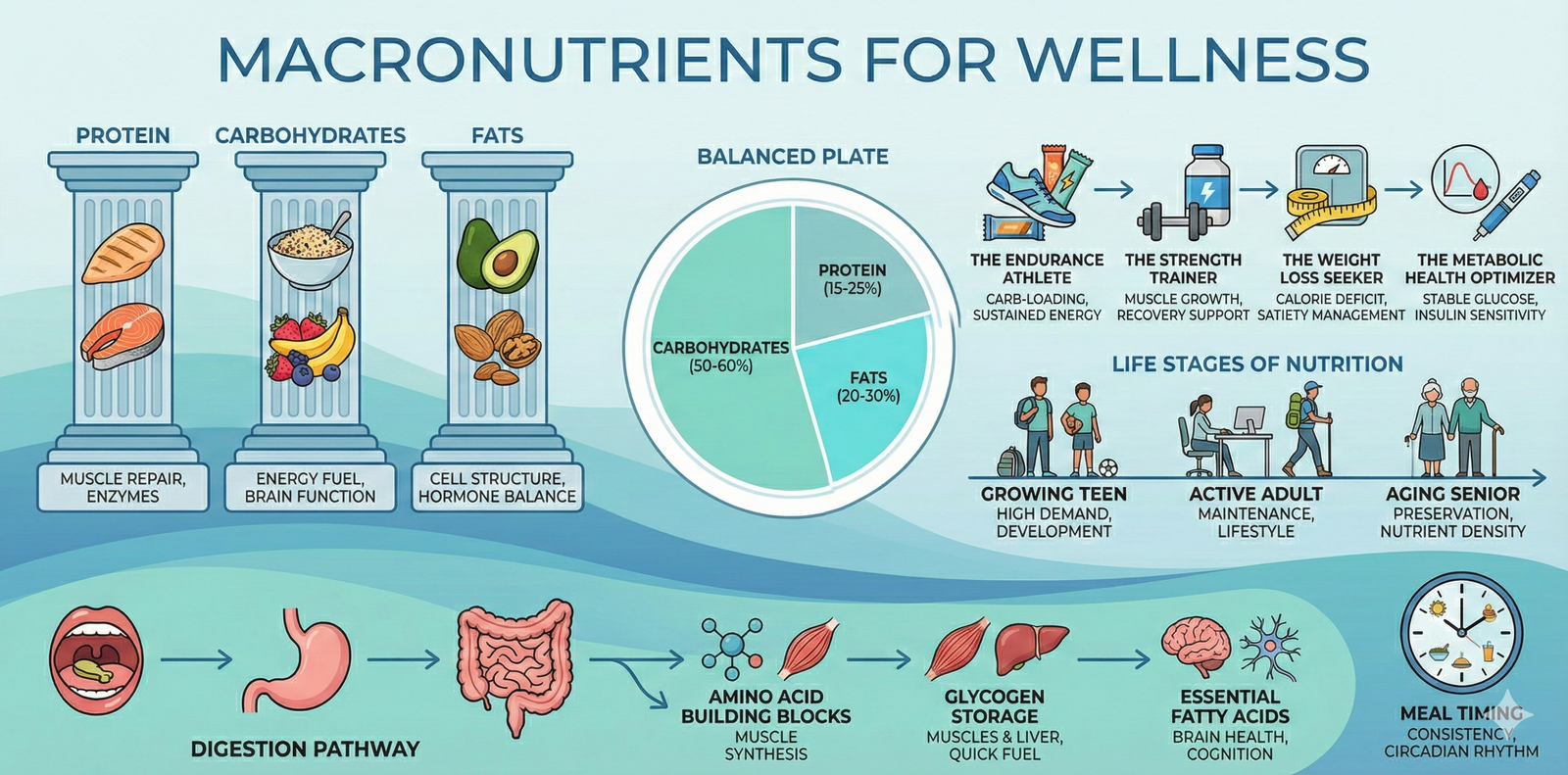
The Three Macronutrients at a Glance
Visual comparison showing the three macronutrients, their primary functions, calorie content, and common food sources.
🔍 Click to enlarge
Why Macronutrients Matter in 2026
In 2026, personalized nutrition has become the norm as science moves beyond one-size-fits-all dietary guidelines. Genetic testing, metabolic assessments, and AI-powered nutrition apps make it possible to understand your unique macronutrient needs. This personalization matters because genetic variations affect how efficiently your body processes different macronutrients. Some people thrive on higher carbohydrate intake, while others perform better with more protein and fat. Understanding your individual needs—rather than following generic advice—leads to better energy, body composition, and long-term health outcomes.
Chronic disease prevention now emphasizes macronutrient quality alongside quantity. It's not just about eating the right amount of protein; it's about choosing sources rich in micronutrients and free from excessive processing. The rise in metabolic disorders like type 2 diabetes and non-alcoholic fatty liver disease has highlighted how macronutrient distribution directly impacts metabolic health. Research from 2024-2025 shows that the balance between refined and whole-food carbohydrates, protein quality, and fat type matters more than previously thought.
Performance optimization across all domains—from athletic training to cognitive work—now relies on precise macronutrient timing and composition. Athletes use macronutrient cycling (varying ratios throughout the week), while knowledge workers optimize carbohydrate intake before mentally demanding tasks. This shift from basic nutrition to strategic macro-fueling represents a significant advancement in how people understand their relationship with food.
The Science Behind Macronutrients
Your body processes each macronutrient differently at the molecular level. Carbohydrates break down into glucose, which enters the bloodstream and triggers insulin release. This glucose serves as the primary fuel for your brain, red blood cells, and muscles during intense exercise. Proteins digest into amino acids, which your body uses to build and repair muscle fibers, enzymes, hormones, and antibodies. Fats break down into fatty acids and glycerol, which your body uses for sustained energy, hormone synthesis, and the absorption of fat-soluble vitamins A, D, E, and K.
The thermic effect of food—the energy your body uses to digest, absorb, and process nutrients—differs significantly by macronutrient. Protein has the highest thermic effect at 20-30% of calories consumed, meaning your body burns significant calories simply digesting protein. Carbohydrates have a thermic effect of 5-10%, while fat has the lowest at 0-3%. This means eating protein not only builds muscle but also generates more metabolic heat and increases daily calorie expenditure compared to the same number of calories from other macronutrients. This is one reason why increasing protein intake is often recommended for weight management.
Key Components of Macronutrients
Carbohydrates: Your Primary Fuel
Carbohydrates provide your body's preferred energy source and are essential for brain function. Simple carbohydrates (sugars) digest quickly and raise blood glucose rapidly, while complex carbohydrates (fiber-rich whole grains, vegetables) digest slowly and provide sustained energy. The recommended daily intake is 45-65% of total calories, but this varies based on activity level and individual metabolic response. Research shows that individuals engaging in high-intensity exercise require more carbohydrates to fuel their workouts and support recovery, while less active individuals may thrive with lower carbohydrate percentages.
Proteins: Builders and Repairers
Proteins are made of amino acids, nine of which your body cannot synthesize and must obtain from food (complete proteins). Animal proteins like meat, fish, eggs, and dairy contain all nine essential amino acids, while plant proteins often lack one or more. The recommended dietary allowance is 0.8 grams per kilogram of body weight for sedentary adults, but active individuals, older adults, and those building muscle typically need 1.2-2.2 grams per kilogram. Adequate protein intake supports muscle maintenance, bone health, immune function, and hormone production. Timing protein intake throughout the day—rather than consuming it all at one meal—optimizes muscle protein synthesis.
Fats: Essential and Protective
Fats are essential for numerous critical functions and should comprise 20-35% of daily calories. Saturated fats, found in animal products and coconut oil, should be limited to less than 10% of calories, while unsaturated fats (monounsaturated and polyunsaturated) should form the majority of fat intake. Omega-3 and omega-6 polyunsaturated fats are particularly important for brain health, inflammation regulation, and cardiovascular function. Contrary to outdated beliefs, dietary fat does not directly cause weight gain or heart disease when consumed in appropriate amounts and types. In fact, adequate fat intake supports satiety, hormone production, and the absorption of fat-soluble vitamins.
Caloric Density and Energy Impact
Understanding the caloric density of each macronutrient helps explain why different macronutrient distributions affect satiety and weight management. Carbohydrates and proteins provide 4 calories per gram, while fat provides 9 calories per gram. This doesn't mean fat is 'bad'—it means you need smaller portions to meet caloric needs, which can actually support satiety when consumed appropriately. A meal high in protein and fiber-rich carbohydrates with moderate fat tends to promote fullness and stable blood sugar, making it easier to maintain a caloric deficit for weight loss if that's your goal.
| Macronutrient | Primary Functions | Food Sources | Recommended % of Calories |
|---|---|---|---|
| Carbohydrates | Energy production, brain fuel, athletic performance, fiber for digestion | Whole grains, fruits, vegetables, legumes, beans, oats, rice | 45-65% |
| Proteins | Muscle building, tissue repair, enzyme production, immune function, hormone synthesis | Meat, poultry, fish, eggs, dairy, legumes, nuts, seeds, tofu, tempeh | 10-35% |
| Fats | Hormone production, vitamin absorption, brain function, inflammation regulation, energy storage | Nuts, seeds, avocado, olive oil, fatty fish, coconut oil, butter, nut butters | 20-35% |
How to Apply Macronutrients: Step by Step
- Step 1: Determine Your Daily Caloric Needs: Calculate your basal metabolic rate using online calculators or work with a nutritionist. This number varies based on age, sex, height, weight, and activity level. Most adults need between 1,600-2,400 calories daily, but your individual needs may differ significantly.
- Step 2: Identify Your Activity Level and Goals: Someone training for a marathon needs different macronutrient ratios than someone focused on gentle yoga and weight loss. Athletes typically need more carbohydrates and protein, while someone in a weight loss phase might use a higher protein percentage with moderate carbs and fats.
- Step 3: Choose Your Macronutrient Distribution: Start with the standard ranges—45-65% carbs, 10-35% protein, 20-35% fats—and adjust based on your response. Track your energy, recovery, mood, and performance for 3-4 weeks before making major changes.
- Step 4: Calculate Your Gram Targets: Convert percentages to grams by multiplying daily calories by the percentage, then dividing by the calorie content per gram. Example: A 2000 calorie diet with 50% carbs equals 1000 calories from carbs, which is 250 grams of carbohydrates (1000 ÷ 4).
- Step 5: Prioritize Whole Food Sources: Build your diet around minimally processed foods—whole grains instead of refined flour, lean proteins instead of processed meats, and healthy oils instead of trans fats. This ensures you get maximum nutrition alongside your macronutrients.
- Step 6: Track and Monitor: Use nutrition apps like MyFitnessPal, Cronometer, or MacroFactor to track your macronutrient intake for 2-3 weeks. This builds awareness of how different foods contribute to your daily targets and reveals patterns in your eating habits.
- Step 7: Assess Your Response: After 3-4 weeks of consistent tracking, evaluate how you feel. Do you have steady energy throughout the day? How's your recovery? Is your performance improving? Use these observations to fine-tune your ratios.
- Step 8: Adjust Based on Results: If you feel fatigued, you might need more carbohydrates or overall calories. If you're not recovering well from exercise, increase protein slightly. Personalization comes from honest self-observation and willingness to experiment.
- Step 9: Time Your Macronutrients Strategically: Consider consuming more carbohydrates before or after intense activity for energy and recovery, spread protein throughout the day rather than concentrating it at dinner, and pair all meals with healthy fats for satiety and nutrient absorption.
- Step 10: Review and Refine Quarterly: Every 3 months, reassess your needs as your activity level, body composition, or goals change. Macronutrient needs are not static—they should evolve with your life.
Macronutrients Across Life Stages
Adultez joven (18-35)
Young adults typically have faster metabolisms and higher activity levels, making them well-suited for moderate to higher carbohydrate intake if they exercise regularly. This is an ideal time to establish healthy eating patterns that will support long-term wellness. Young adults building muscle through resistance training benefit from protein intake at the higher end of the spectrum (1.6-2.2 grams per kilogram of body weight). Young adults should also prioritize nutrient density, as early nutritional choices establish the foundation for bone health, hormonal balance, and disease prevention throughout life.
Edad media (35-55)
Metabolism begins to slow during this stage, and hormonal changes (especially for women approaching or in menopause) can affect how the body processes macronutrients. Many people experience increasing difficulty maintaining weight, making protein intake even more important to preserve muscle mass and support metabolism. This is also when chronic diseases often begin to develop, making the quality of macronutrient sources increasingly important. Middle-aged adults should focus on maintaining adequate protein, choosing complex carbohydrates over refined options, and emphasizing unsaturated fats while limiting saturated fat intake.
Adultez tardía (55+)
Aging comes with increased protein requirements to combat age-related muscle loss (sarcopenia). Research recommends 1.0-1.2 grams of protein per kilogram of body weight for older adults, higher than the standard recommendation. Carbohydrate quality becomes increasingly important for blood sugar control and disease prevention. Adequate fiber from whole grains, fruits, and vegetables supports digestive health and chronic disease prevention. Healthy fats, particularly omega-3 fatty acids, support cognitive function and cardiovascular health. Older adults benefit from working with healthcare providers to ensure their macronutrient intake supports their specific health conditions and medication interactions.
Profiles: Your Macronutrient Approach
The Endurance Athlete
- Higher carbohydrate intake (55-60% of calories) to fuel sustained activity
- Adequate protein (1.4-1.6 g/kg) to support muscle repair
- Moderate fat intake with emphasis on omega-3 sources for recovery
Common pitfall: Undereating overall calories, especially carbohydrates, leading to fatigue and poor recovery
Best move: Calculate caloric needs based on weekly training volume and fuel workouts strategically. Time carbohydrates around training for optimal energy and recovery.
The Strength Trainer
- Higher protein intake (1.8-2.2 g/kg) for muscle building
- Moderate carbohydrates (45-50%) for workout performance and recovery
- Healthy fats (25-30%) for hormone production and joint health
Common pitfall: Focusing on protein while neglecting adequate carbohydrates and fats, limiting performance and recovery
Best move: Prioritize overall caloric surplus or maintenance first, then ensure adequate protein spread throughout the day. Include strength-building nutrients like carbs before workouts.
The Weight Loss Seeker
- Higher protein (25-35% of calories) to preserve muscle during caloric deficit
- Moderate carbohydrates (40-45%) from high-fiber sources for satiety
- Moderate fats (25-30%) for satiety and hormone health
Common pitfall: Cutting calories too aggressively and eliminating entire food groups, leading to nutrient deficiencies, fatigue, and unsustainable habits
Best move: Create a moderate caloric deficit (300-500 calories below maintenance), prioritize protein and fiber for fullness, and maintain regular movement to preserve muscle mass.
The Metabolic Health Optimizer
- Lower refined carbohydrates with emphasis on low-glycemic sources
- Adequate protein (1.2-1.6 g/kg) for metabolic support and satiety
- Emphasis on unsaturated fats from whole food sources for anti-inflammatory benefits
Common pitfall: Becoming rigid about macronutrient percentages without considering individual metabolic response and food quality
Best move: Experiment with carbohydrate types and timing based on how they affect your blood sugar, energy, and mood. Prioritize whole foods and observe your individual response.
Common Macronutrient Mistakes
One of the most common mistakes is assuming all calories are equal. A 500-calorie meal of chicken and vegetables affects your body differently than 500 calories of processed snacks. The protein in chicken triggers satiety signals and requires energy to digest, while the refined carbohydrates in processed snacks may cause blood sugar spikes and energy crashes. This is why counting calories without considering macronutrient composition often leads to unsustainable weight loss attempts and nutritional deficiencies.
Another frequent error is completely eliminating one macronutrient group—especially fats. Low-fat diets gained popularity decades ago but have been largely debunked by modern research. When people eliminate fats, they often increase refined carbohydrates to compensate, which can actually worsen metabolic health and increase cravings. Fats are essential for hormone production, vitamin absorption, and satiety. The key is choosing healthy fat sources and consuming them in appropriate amounts, not avoiding them entirely.
Ignoring protein is another critical mistake, particularly as people age or attempt weight loss. Many people consume adequate protein at one meal but nearly zero at other meals. This pattern means your body cannot optimize muscle protein synthesis, which happens throughout the day when amino acids are regularly available. Distributing protein evenly across meals (20-30 grams at each meal) optimizes muscle health better than consuming it all at dinner.
Common Macronutrient Mistakes and Solutions
Visual breakdown of the most common macronutrient mistakes people make and practical solutions to avoid them.
🔍 Click to enlarge
Ciencia y estudios
The science of macronutrients has evolved significantly over the past two decades. Early research focused on fat and cardiovascular disease, leading to the low-fat diet trend. However, contemporary research published in high-impact journals between 2020-2025 reveals that the quality of macronutrients matters far more than crude quantity. Studies from the National Institutes of Health, conducted through federally funded nutrition research, show that different macronutrient ratios produce different metabolic outcomes depending on individual genetics, baseline health status, and lifestyle factors.
- MD Anderson Cancer Center research demonstrates that balanced macronutrient intake supports both weight management and cancer prevention, with emphasis on whole-food carbohydrates and lean proteins.
- CDC and USDA Dietary Guidelines emphasize that evidence-based macronutrient recommendations should be personalized based on individual health conditions, activity levels, and personal preferences rather than applying one ratio to all people.
- NIH Office of Dietary Supplements confirms that the 45-65% carbohydrate, 10-35% protein, 20-35% fat ranges represent optimal starting points, but individual requirements vary based on genetics, metabolism, and health status.
- National Institute of Aging research highlights that protein requirements increase with age to prevent sarcopenia (muscle loss), with older adults needing up to 1.2 grams per kilogram of body weight rather than the standard 0.8 grams.
- StatPearls NCBI research on macronutrient imbalances documents that both deficiency and excess of macronutrients can contribute to chronic diseases, emphasizing the importance of balance tailored to individual needs.
Tu primer micro hábito
Comienza pequeño hoy
Today's action: At your next meal, assess the macronutrients on your plate. Identify the protein source (meat, beans, eggs, dairy), the carbohydrate source (grains, vegetables, fruit), and the fat source (oils, nuts, avocado). Take a photo and note whether all three are represented. Do this for one meal today.
This single action builds macronutrient awareness without requiring calculation or restriction. You begin recognizing patterns in your current eating and developing the foundation for intentional choices. Most people are shocked to realize entire meals contain minimal protein or how many meals skip healthy fats.
Track your micro habits and get personalized AI coaching with our app.
Evaluación rápida
When you think about your current eating habits, how balanced do your meals typically feel?
Your answer reveals your starting point. If you're already balanced, you're likely optimizing an already solid foundation. If meals feel unbalanced, this is your biggest opportunity for improvement and will likely have immediate energy and recovery benefits.
What's your primary nutrition goal right now?
Different goals require different macronutrient distributions. Athletes need more carbohydrates and protein; weight loss often benefits from higher protein percentage; general health typically thrives on balanced ratios. Your answer guides which macro distribution would serve you best.
How do you typically respond when you eat very large amounts of carbohydrates?
This reveals your individual carbohydrate tolerance. Some people thrive on 55-60% carbohydrate intake, while others perform better at 40-45%. Your answer indicates whether you might benefit from adjusting your carbohydrate percentage or focusing on carbohydrate quality (complex vs. refined).
Take our full assessment to get personalized recommendations.
Descubre Tu Estilo →Preguntas frecuentes
Próximos pasos
Understanding macronutrients is the foundation of intentional nutrition. You now know that balanced macronutrient intake supports energy, performance, recovery, and long-term health. But knowledge without action remains abstract. Your next step is to choose one meal today and assess its macronutrient composition. Does it include protein? Complex carbohydrates? Healthy fats? This simple observation builds the awareness necessary for sustainable change.
Over the next week, track your meals using a simple method: photograph each meal and note whether it contains all three macronutrients. After one week, you'll have patterns and insights into your current eating style. Do you skip protein at breakfast? Do lunch meals lack healthy fats? Are you relying heavily on refined carbohydrates? These observations, not rigid tracking, guide your next micro-adjustments. Real change comes from gradual awareness and small, consistent improvements rather than dramatic overhauls.
Get personalized guidance with AI coaching.
Comienza Tu Viaje →Research Sources
This article is based on peer-reviewed research and authoritative sources. Below are the key references we consulted:
Related Glossary Articles
Frequently Asked Questions
How do I calculate my personal macronutrient needs?
Start by calculating your daily caloric needs using online calculators (search 'TDEE calculator'). Then apply percentages based on your goals: strength training typically uses 25-30% protein, endurance uses 45-50% carbs, and weight loss often uses 25-35% protein. Work with a registered dietitian for personalized calculations based on your specific health conditions and goals.
Can I follow a high-protein diet and still be healthy?
Protein intake up to 2.2 grams per kilogram of body weight is generally safe for healthy adults and is supported by substantial research. High-protein diets can support muscle building, weight loss through increased satiety, and metabolic health. However, ensure adequate hydration, include whole food sources over supplements, and maintain adequate carbohydrates and fats for overall health.
Are carbohydrates essential or can I follow a very low-carb diet indefinitely?
While your body can produce glucose from protein through gluconeogenesis, carbohydrates are the preferred energy source for your brain (120+ grams daily) and are essential for optimal cognitive and physical performance. Very low-carb diets may work short-term for weight loss but are difficult to maintain long-term and may compromise performance, hormonal health, and nutrient intake. A moderate approach with quality carbohydrates is sustainable for most people.
How should I adjust macronutrients if I'm trying to lose weight?
Create a moderate caloric deficit of 300-500 calories below your maintenance level. Increase protein percentage (25-35% of calories) to preserve muscle during weight loss, include plenty of fiber from carbohydrates for satiety, and maintain healthy fats for hormone production. This approach preserves lean muscle mass, reduces hunger, and supports sustainable long-term weight management.
Do macronutrient needs change as I age?
Yes, significantly. Protein requirements increase from 0.8 g/kg for young adults to 1.0-1.2 g/kg for adults over 55 to prevent age-related muscle loss. Carbohydrate quality becomes more important for blood sugar control. Healthy fats, particularly omega-3s, become increasingly important for brain health and cardiovascular function. Work with a healthcare provider to adjust your macronutrient strategy as you age.
Take the Next Step
Ready to improve your wellbeing? Take our free assessment to get personalized recommendations based on your unique situation.
- Discover your strengths and gaps
- Get personalized quick wins
- Track your progress over time
- Evidence-based strategies