Hidratación
Your body is roughly 60% water, yet most of us struggle to drink enough throughout the day. That small percentage difference between optimal hidratación and mild dehydration can mean the difference between peak mental clarity and brain fog, between sustained energía and afternoon crashes, between glowing skin and persistent fatigue. Water isn't just another beverage you consume—es the fundamental medium through which every biological process in your body operates. From delivering oxygen to cells and regulating temperature to cushioning joints and supporting digestion, hidratación touches every aspect of your physical salud. Yet despite knowing water is essential, many people unknowingly drift through their days in a chronic state of mild dehydration, missing out on better focus, healthier skin, improved athletic rendimiento, and protection against preventable chronic diseases. The question isn't whether hidratación matters—it absolutely does. The real question is: are you getting enough?
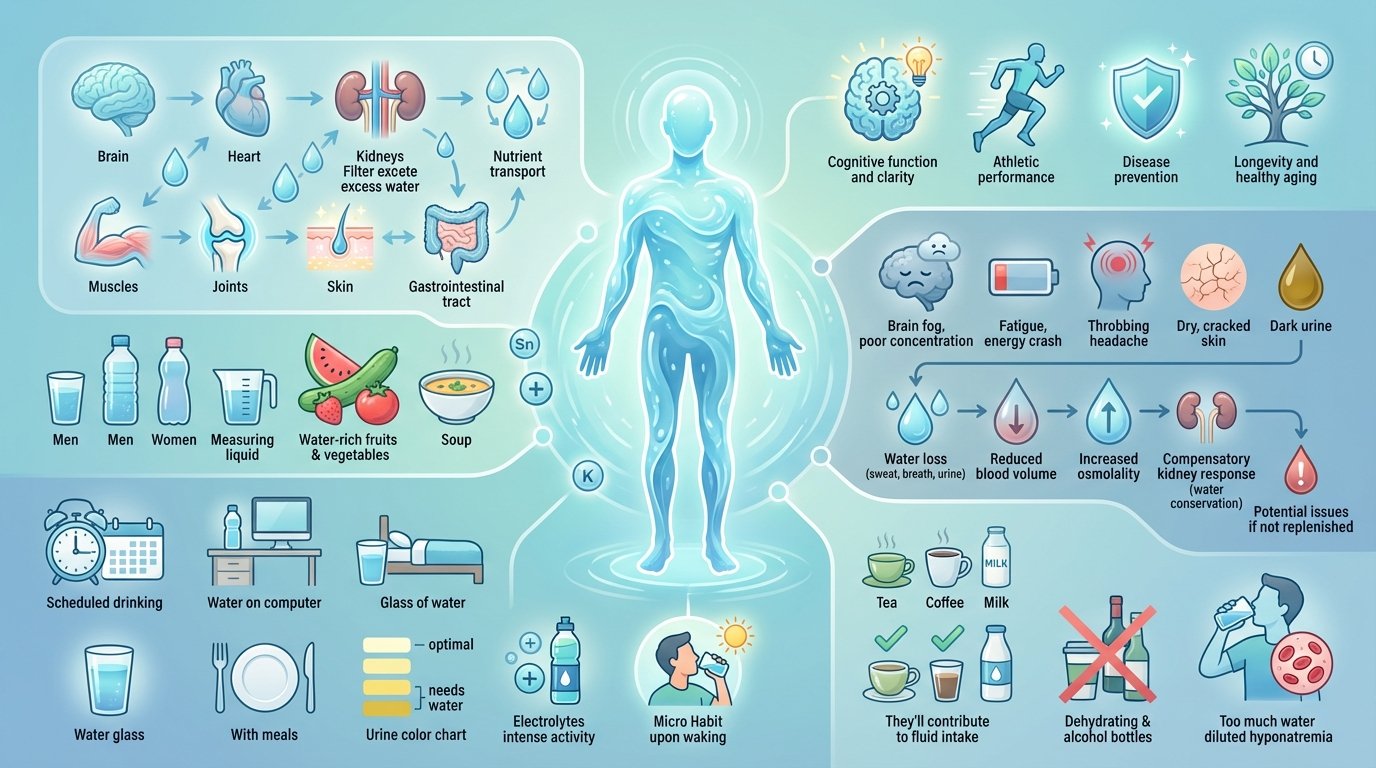
Recent research from the National Institutes of Salud reveals that adults who maintain good hidratación develop fewer chronic conditions like heart disease and diabetes, live longer, and experience better cognitive function as they age.
Understanding hidratación means understanding how water moves through your body, what factors increase your needs, and how to develop practical habits that feel sustainable rather than like another chore on your bienestar checklist.
What Is Hidratación?
Hidratación is the process of ensuring your body has adequate water to maintain optimal fluid balance. It refers both to the state of having sufficient water in your body and to the ongoing practice of replenishing water throughout the day. Your body constantly loses water through perspiration, respiración, urination, and digestion—every single day, whether you're exercising or sitting at a desk. Hidratación is about replacing those losses to maintain the delicate balance of water and electrolytes your cells need to function.
Not medical advice.
At the cellular level, water serves as the medium for virtually every biochemical reaction. It transports nutrients and oxygen to your cells, removes metabolic waste products, regulates your core temperature, lubricates your joints, and cushions your organs. When your body's water content drops even slightly—sometimes as little as 2% of your body weight—you experience noticeable changes in how you think, feel, and perform. That's why understanding hidratación goes beyond just drinking water; es about recognizing water as a fundamental nutrient that deserves the same attention you give to protein, vitamins, and minerals.
Surprising Insight: Surprising Insight: Even mild dehydration as small as 2% fluid loss impairs memory, concentration, alertness, and reaction time—often before you consciously feel thirsty.
How Water Moves Through Your Body
Visual representation of water distribution and movement through body systems, including intake, cellular use, and elimination routes.
🔍 Click to enlarge
Why Hidratación Matters in 2026
In 2026, we face unprecedented lifestyle challenges that increase our hidratación needs: more sedentary work (sitting in climate-controlled offices depletes fluids), increased estrés (which elevates cortisol and increases water loss), exposure to dry artificial environments, and paradoxically, easier access to dehydrating beverages like caffeine and alcohol that mask thirst signals. Meanwhile, our understanding of hidratación's role in disease prevention has evolved dramatically. Large-scale studies now show that people who maintain adequate hidratación are significantly less likely to develop chronic diseases, maintain better cognitive function as they age, and have more resilient inmunológico systems.
The stakes are personal too. Dehydration contributes to recurring headaches, afternoon energía crashes that feel like you need more coffee, difficulty concentrating on important work, poor skin appearance, digestive issues, and reduced athletic rendimiento. For many people, simply optimizing hidratación can resolve multiple complaints that they attributed to aging or other factors.
Beyond individual salud, there's growing recognition in the bienestar community that hidratación is a foundational habit. You can have the best nutrición plan, ejercicio routine, and sueño schedule, but if you're chronically dehydrated, none of those optimizations work as effectively as they could. Hidratación forms the base layer of any salud improvement effort.
The Science Behind Hidratación
Your kidneys are exquisitely sensitive to your body's hidratación status. They continuously monitor blood osmolality—essentially, the concentration of dissolved particles in your blood—through specialized sensors. When osmolality rises (indicating dehydration), your pituitary gland releases antidiuretic hormone (ADH), which signals your kidneys to conserve water by producing more concentrated urine and reducing urine volume. Conversely, when you drink excess water and osmolality drops, ADH release decreases, and your kidneys excrete more dilute urine. This elegant system keeps your blood chemistry remarkably stable, but it has limits. If dehydration becomes severe enough that your kidneys can't compensate, cascading problems emerge.
The brain is uniquely sensitive to hidratación status. About 75% of your brain tissue is water, and dehydration reduces blood volume and oxygen delivery to brain cells. Even 1-2% dehydration measurably impairs cognitive function—your thinking becomes slower, short-term memory falters, reaction times increase, and mood darkens. This is why students studying for exams or professionals working on demanding projects perform better when consistently hydrated. The effect is so consistent that some researchers argue mild dehydration should be considered a cognitive stressor equivalent to fatigue.
Dehydration's Cascade Effect on Body Systems
Shows how initial water loss triggers compensatory mechanisms and eventually leads to system-wide dysfunction if not addressed.
🔍 Click to enlarge
Key Components of Hidratación
Water Volume and Daily Intake
The commonly cited '8 glasses a day' guideline oversimplifies hidratación, though es not entirely wrong. The National Academies of Medicine recommends about 3.7 liters (about 15-16 cups) of total water for men and 2.7 liters (about 11-12 cups) for women daily. Importantly, this includes water from food (especially fruits, vegetables, and soups), beverages other than pure water, and plain water itself. About 20% of total water intake typically comes from food. Your individual needs vary based on climate, activity level, salud status, medications, and body composition. The practical approach is to use thirst as your primary guide while understanding that by the time you feel thirsty, you're already mildly dehydrated. For optimal rendimiento, especially during ejercicio or in hot conditions, you should drink before you feel thirsty.
Electrolytes and Mineral Balance
Water alone isn't quite the whole story. Your body's hidratación status depends on the balance between water and electrolytes—primarily sodium, potassium, and chloride. These minerals are essential for nerve transmission, muscle contraction, and maintaining proper fluid distribution between intracellular and extracellular spaces. Drinking pure water without electrolytes can actually impair hidratación if you drink excessive amounts, because the resulting decrease in blood osmolality triggers excessive urination and ADH suppression. This is why sports drinks with small amounts of sodium and carbohydrates work better than pure water for intense or prolonged ejercicio. For everyday hidratación, eating a balanced diet with adequate salt ensures electrolyte needs are met alongside water intake.
Fluid Distribution Across Body Compartments
Water no stay uniformly distributed throughout your body. Approximately 60% of your body weight is water, distributed as: intracellular fluid (inside cells, about 40% of body weight), plasma (the liquid portion of blood, about 4-5% of body weight), and interstitial fluid (the space between cells, about 15% of body weight). Electrolytes determine which compartment water resides in. Sodium is primarily extracellular, drawing water out of cells. Potassium is primarily intracellular, drawing water into cells. This compartmentalization matters because dehydration can be compartment-specific. For example, heat exposure causes fluid loss primarily from the intracellular space through sweating, while blood loss causes loss from the vascular space. Your kidneys, sensing osmolality, adjust water retention and urinary output to keep osmolality relatively constant, prioritizing critical functions like brain and heart function.
Thirst Mechanisms and Sensory Signals
Thirst is your body's warning system for dehydration, but es not always reliable. Osmoreceptors in your hypothalamus detect rising blood osmolality, triggering thirst. However, thirst lags behind actual dehydration—by the time you consciously feel thirsty, you're already about 0.8-1% dehydrated. This lag is why relying solely on thirst can allow rendimiento declines. Additionally, certain factors suppress thirst inappropriately: aging blunts thirst sensation, depression and ansiedad can override normal thirst signals, and in some cases, medications interfere with thirst recognition. For optimal hidratación, especially for athletes, older adults, and people managing certain salud conditions, drinking on a schedule rather than waiting for thirst is more effective. A practical approach is to drink regularly throughout the day, aiming for pale yellow urine as a visual marker of adequate hidratación.
| Life Stage/Group | Daily Water Intake (Total) | Primary Source |
|---|---|---|
| Adult Women (19+ years) | 2.7 liters (11-12 cups) | National Academies of Medicine |
| Adult Men (19+ years) | 3.7 liters (15-16 cups) | National Academies of Medicine |
| Pregnant Women | 3.0 liters (13 cups) | National Academies of Medicine |
| Breastfeeding Women | 3.8 liters (16 cups) | National Academies of Medicine |
| Children (4-8 years) | 1.7 liters (7 cups) | National Academies of Medicine |
| Athletes (during ejercicio) | Individual + 400-800ml per hour | American College of Sports Medicine |
| Older Adults (55+) | 2.4-2.8 liters (10-11 cups) | Age & salud adjusted |
How to Apply Hidratación: Step by Step
- Step 1: Establish a baseline by tracking your current water intake for 3-5 days without judgment. Simply notice how much water and other fluids you're consuming. Use a simple note app or water bottle to count cups. This awareness alone often naturally increases intake.
- Step 2: Calculate your personalized water target based on your body weight (roughly 0.5-1 ounce per pound of body weight is a starting estimate), your activity level, climate, and salud status. Don't fixate on exact numbers—use your baseline as a reference point and adjust from there.
- Step 3: Develop a hidratación schedule rather than relying on thirst. Try drinking 1-2 cups of water upon waking, with each meal, between meals, and before bed. Spread intake throughout the day rather than frontloading—your kidneys can only process about 1 liter per hour.
- Step 4: Create environmental cues that make hidratación automatic. Keep a water bottle at your desk, in your car, by your bed. Fill it at the start of each day. Some people use time-marked water bottles that suggest drinking targets for different hours.
- Step 5: Choose hydrating foods intentionally. Eat plenty of water-rich foods like watermelon, strawberries, cucumbers, lettuce, tomatoes, and soups. These contribute meaningfully to daily fluid intake and provide vitamins and minerals alongside water.
- Step 6: Link hidratación to existing habits. Drink water when you wake up before coffee, with every meal, before and after ejercicio, and before bed. These anchor points make hidratación feel automatic rather than effortful.
- Step 7: Monitor hidratación status using urine color as a visual guide. Pale yellow indicates good hidratación; dark yellow suggests you need more water. This simple check-in replaces guesswork and provides real-time feedback.
- Step 8: Adjust intake based on activity level and conditions. On ejercicio days, add 400-800ml for every hour of ejercicio. On hot days or at high altitude, increase intake by 25-50%. During illness with fever or diarrhea, proactively increase intake to prevent dehydration.
- Step 9: Include electrolytes during intense ejercicio or prolonged heat exposure. If exercising more than 60 minutes or sweating heavily, choose beverages or foods with sodium and carbohydrates (not pure water) for better hidratación and rendimiento.
- Step 10: Track the impact on how you feel. After two weeks of consistent hidratación, notice changes in energía, mental clarity, skin appearance, digestion, and athletic rendimiento. These personal observations often provide powerful motivation to maintain the habit.
Hidratación Across Life Stages
Adultez joven (18-35)
Young adults typically have the most resilient hidratación regulation and the highest metabolic demands. However, this life stage often involves new challenges: increased caffeine consumption (coffee, energía drinks), irregular eating patterns, intense ejercicio or sports, and sometimes travel or changing environments. Young adults often no prioritize hidratación, assuming they can 'bounce back' from dehydration. Yet research shows that optimizing hidratación during these years supports skin salud, athletic rendimiento, cognitive function during school or work, and establishes hidratación habits that pay long-term dividends. Young adults training for athletic objetivos or working cognitively demanding jobs benefit most from structured hidratación plans.
Edad media (35-55)
Middle adulthood brings metabolic changes, increased estrés, and often sedentary work environments. Thirst sensation begins to decline slightly, making reliance on thirst less reliable. Many people in this stage manage salud conditions (prediabetes, hypertension, migraines) that either increase hidratación needs or respond positively to better hidratación. Recuperación from ejercicio takes longer, making adequate hidratación increasingly important for athletic rendimiento and injury prevention. Additionally, hormonal changes in women approaching menopause increase sweat production and fluid loss, increasing daily hidratación needs. Middle adulthood is an ideal time to reassess and optimize hidratación as a preventive salud measure.
Adultez tardía (55+)
Older adults face the most significant hidratación challenges. Thirst sensation declines measurably due to aging of the nervous system. Kidneys become less efficient at concentrating urine, increasing water loss. Medications commonly used in this age group (diuretics, anticholinergics, stimulants) interfere with hidratación regulation. Reduced mobility may decrease overall fluid intake simply because reaching for water becomes more effortful. Yet research from the NIH shows that maintaining good hidratación in older adults significantly reduces chronic disease desarrollo, improves cognitive function, prevents falls and delirium, and supports longevity. For this age group, proactive, scheduled hidratación (rather than waiting for thirst) and involvement of caregivers in monitoring intake becomes increasingly important.
Profiles: Your Hidratación Approach
El profesional ocupado
- Hydration that fits into hectic schedules without adding complexity
- Water bottles that travel easily and reminder systems that don't require thought
- Integration with existing routines rather than new habits to manage
Common pitfall: Forgetting water entirely during focused work sessions, then attempting to 'catch up' by drinking large amounts in short periods, which is less effective and uncomfortable
Best move: Keep a water bottle at your desk and commit to finishing one bottle by noon and one by end of day. Drink a full glass with each meal and snack. Use calendar reminders or app notifications if helpful.
The Athlete
- Hydration plans that account for sweat loss during training and competition
- Knowledge of when water alone is sufficient vs. when electrolytes and carbohydrates are needed
- Recovery protocols that include rehydration as a core component
Common pitfall: Drinking only water during intense or prolonged exercise, leading to dilution of blood electrolytes and reduced performance, or conversely, overcomplicating hydration with unnecessary supplements
Best move: Drink 400-600ml of water per hour during exercise lasting 60+ minutes, with sodium and carbohydrates included. Practice hydration during training so your body adapts. Rehydrate after exercise with electrolyte drinks if sweat loss was significant.
The Health-Conscious Optimizer
- Evidence-based information about hydration and health outcomes
- Practical metrics to measure hydration status objectively
- Understanding of how hydration interacts with other health optimization efforts
Common pitfall: Over-analyzing hydration (obsessing about exact liters), becoming paralyzed by contradictory advice, or spending money on expensive 'optimal' hydration systems rather than focusing on basics
Best move: Use the National Academies recommendations as a starting point, adjust based on your activity level and environment, and monitor urine color and how you feel. Simple consistency beats perfection.
The Older Adult
- Proactive hydration since thirst sensation is diminished and unreliable
- Family or caregiver support in maintaining consistent intake
- Awareness of medications that affect hydration and kidney function
Common pitfall: Reducing fluid intake due to incontinence concerns, waiting until feeling unwell (confusion, dizziness, weakness) to seek intervention, or not adjusting intake during illness
Best move: Establish a daily hydration schedule: water with breakfast, mid-morning water, water with lunch, afternoon water, water with dinner. Review medications with your doctor to understand hydration effects. Ensure fluids are easily accessible.
Common Hidratación Mistakes
The most common hidratación mistake is relying entirely on thirst. Thirst emerges only after dehydration has begun, making it an imperfect guide for prevention. You can feel fine while already mildly dehydrated, experiencing only subtle decrements in cognitive function, mood, and physical rendimiento. Additionally, thirst sensation becomes increasingly unreliable with age, during estrés, and with certain medications. The solution is drinking on a schedule before you feel thirsty, using urine color as a real-time feedback mechanism.
Another major mistake is drinking massive volumes all at once rather than spacing intake throughout the day. Your kidneys can process approximately 1 liter of water per hour. Drinking 4 liters in one sitting overwhelms this capacity, leading to excessive urination and actually poor hidratación status. Es also uncomfortable and can potentially cause hyponatremia (dangerously low blood sodium) in extreme cases. Effective hidratación means distributing intake throughout waking hours.
Many people assume 'hidratación' means pure water only, missing that beverages like tea, coffee, herbal infusions, and even milk contribute to fluid intake. While some caffeinated beverages have mild diuretic effects, the fluid they provide still exceeds the water lost through increased urination. Modern research shows that even caffeine no significantly impair overall hidratación status in regular consumers because the body adapts. The practical takeaway: all fluids contribute to hidratación, though water and unsweetened beverages are optimal because they lack added sugars and calories.
What Counts as Hidratación Compared to Dehydrating Factors
Visual breakdown showing beverages and foods that contribute to hidratación vs. factors that increase water loss.
🔍 Click to enlarge
Ciencia y estudios
Recent research has elevated our understanding of hidratación far beyond 'drink 8 glasses daily.' Large prospective studies tracking thousands of adults over years reveal that those maintaining good hidratación status develop fewer chronic diseases, including heart failure, diabetes, and dementia. A landmark 2023 NIH study published in Nature Medicine found that middle-aged adults (45-66 years) with higher serum sodium levels (indicating lower hidratación status) had significantly increased risk of chronic disease desarrollo and shorter lifespans. The Journal of the American Society of Nephrology has published multiple studies demonstrating that even mild chronic dehydration accelerates aging at the cellular level and impairs kidney function. Research on cognitive function consistently shows that 2% dehydration measurably impairs memory, concentration, attention, and reaction time—effects observable in both laboratory tests and real-world rendimiento tasks.
- NIH (2023) - 'Serum sodium and long-term risk of cardiovascular disease and mortality' found that suboptimal hidratación predicted chronic disease desarrollo across diverse populations.
- Harvard School of Public Salud - Long-term studies show adequate hidratación associated with lower rates of heart disease, stroke, and diabetes compared to inadequate hidratación.
- American Physiological Society - Research demonstrates that 1% dehydration reduces aerobic ejercicio capacity and increases perception of effort, affecting athletic rendimiento.
- Nutrients Journal (2024) - Systematic review found that water intake interventions improved cognitive function, reduced falls in older adults, and decreased healthcare costs.
- The Physiologist Magazine - Comprehensive review of hidratación science shows water is essential for thermoregulation, inmunológico function, nutrient transport, and cognitive rendimiento across all age groups.
Tu primer micro hábito
Comienza pequeño hoy
Today's action: Drink one full glass of water immediately after waking up, before coffee or breakfast. Do this for 7 days. On day 8, add a second glass with your lunch. Keep adding small increments weekly until you reach your personalized target.
Morning hidratación resets fluid balance after 8 hours without water while you sueño, enhancing alertness and jumpstarting your metabolismo. Starting tiny (one glass) is easy to sustain. Adding gradually prevents overwhelm. This builds automaticity—within weeks, reaching for water feels as natural as brushing your teeth. You'll quickly notice improvements in morning energía and afternoon focus that motivate continuing.
Track your daily hydration and get personalized AI coaching with our app.
Evaluación rápida
How do you currently approach hidratación throughout your day?
Your answer reveals whether you're relying on thirst (reactive) or proactive planning (preventive). Those using thirst-driven approaches often experience afternoon energía dips, while those with structured routines report sustained energía and clarity.
What's your primary motivation for wanting to improve hidratación?
Your motivation shapes the best hidratación strategy for you. Focus on the specific benefit most relevant to your life to maintain motivation and see results you care about.
Which barriers most often prevent you from drinking enough water?
Identifying your specific barrier lets you design a solution that actually works. Those who forget need environmental cues (water bottle visibility). Those uncertain need simple guidelines. Those inconvenienced need accessibility solutions.
Take our full assessment to get personalized recommendations.
Discover Your Style →Preguntas frecuentes
Próximos pasos
Start with your one micro habit: a full glass of water immediately after waking. Do this consistently for one week before adding complexity. You'll likely notice improved morning energía and afternoon clarity within days. These personal observations—how hidratación actually makes you feel—are more powerful than any statistic for sustaining change.
After one week, assess your baseline intake. You no need perfect data—just a rough sense of current volume. Then gradually increase toward your personalized target (roughly 0.5-1 ounce per pound of body weight, adjusted for activity level and climate). Use urine color as your real-time feedback system. Pale yellow indicates good hidratación; dark yellow signals you need more. Link hidratación to existing habits (water with meals, water before bed) rather than trying to create entirely new routines. Simple, consistent hidratación beats complicated optimization.
Get personalized guidance with AI coaching.
Start Your Journey →Research Sources
This article is based on peer-reviewed research and authoritative sources. Below are the key references we consulted:
Related Glossary Articles
Frequently Asked Questions
Is it possible to drink too much water?
Yes, though it's rare in typical circumstances. Drinking excessive water in short periods (several liters in an hour) can dilute blood sodium to dangerously low levels, a condition called hyponatremia. This primarily affects endurance athletes during prolonged events or people with certain medical conditions. For normal daily intake, your kidneys are excellent at excreting excess water, so overhydration through drinking too much water is unlikely unless you're intentionally consuming extreme amounts. The practical limit is around 1-1.5 liters per hour for most people.
Does drinking water help with weight loss?
Water itself doesn't directly cause weight loss, but it supports weight management through several mechanisms. Water increases feelings of fullness, reducing overall calorie intake. Adequate hydration optimizes metabolism and fat oxidation. Water-induced thermogenesis (your body burning calories to warm consumed water) contributes minimally. Most importantly, replacing sugary beverages with water eliminates liquid calories, a major contributor to weight gain. Studies show people who increase water intake tend to eat fewer calories and lose weight, though the effect is modest without other dietary changes.
How does caffeine affect hydration?
Caffeine has mild diuretic properties, increasing urine output compared to equal volumes of water. However, the amount of fluid delivered by a caffeinated beverage exceeds the extra water lost due to caffeine's diuretic effect. Research shows that regular caffeine consumers adapt physiologically, further minimizing any diuretic impact. The practical takeaway: caffeinated beverages like coffee and tea contribute meaningfully to daily fluid intake. They're not dehydrating, though water and other non-caffeinated beverages are slightly more hydrating per unit volume. Limiting caffeine after 2 PM helps sleep quality, a separate consideration from hydration.
What are the early signs of dehydration?
Early signs include thirst, dry mouth, reduced urination or dark-colored urine, mild headache, decreased energy, and difficulty concentrating. More obvious signs of moderate dehydration include dizziness, rapid heartbeat, muscle cramps, and nausea. Severe dehydration (5%+ fluid loss) causes confusion, extreme weakness, and requires immediate medical attention. The key is that by the time you feel thirsty, you're already mildly dehydrated. This is why proactive drinking is more effective than thirst-driven intake, especially during exercise or in hot conditions.
Does water temperature affect hydration effectiveness?
Water temperature doesn't meaningfully affect hydration status—cold, room-temperature, and warm water all hydrate equally well. Temperature is a matter of preference and comfort. Some people drink more water when it's cold, others when it's warm. In hot environments, cold water may feel more pleasant and encourage higher intake. During cold or illness, warm water is more comforting. The practical approach: drink water at the temperature that ensures you'll actually consume adequate amounts. The 'best' temperature is the one you'll drink consistently.
Take the Next Step
Ready to improve your wellbeing? Take our free assessment to get personalized recommendations based on your unique situation.
- Discover your strengths and gaps
- Get personalized quick wins
- Track your progress over time
- Evidence-based strategies