Honestidad
Honestidad is the quiet force that construyes everything we value most. When you tell the truth, you're not just sharing facts—you're inviting someone into your genuine self. A recent University of Notre Dame study found something powerful: people who reduce lying experience fewer salud mental complaints and stronger relaciones. Yet honestidad isn't always simple. It requires courage, especially when a lie feels safer. This guía explores why honestidad matters, how it rewires your brain for better relaciones, and practical steps to construye a life rooted in truth.
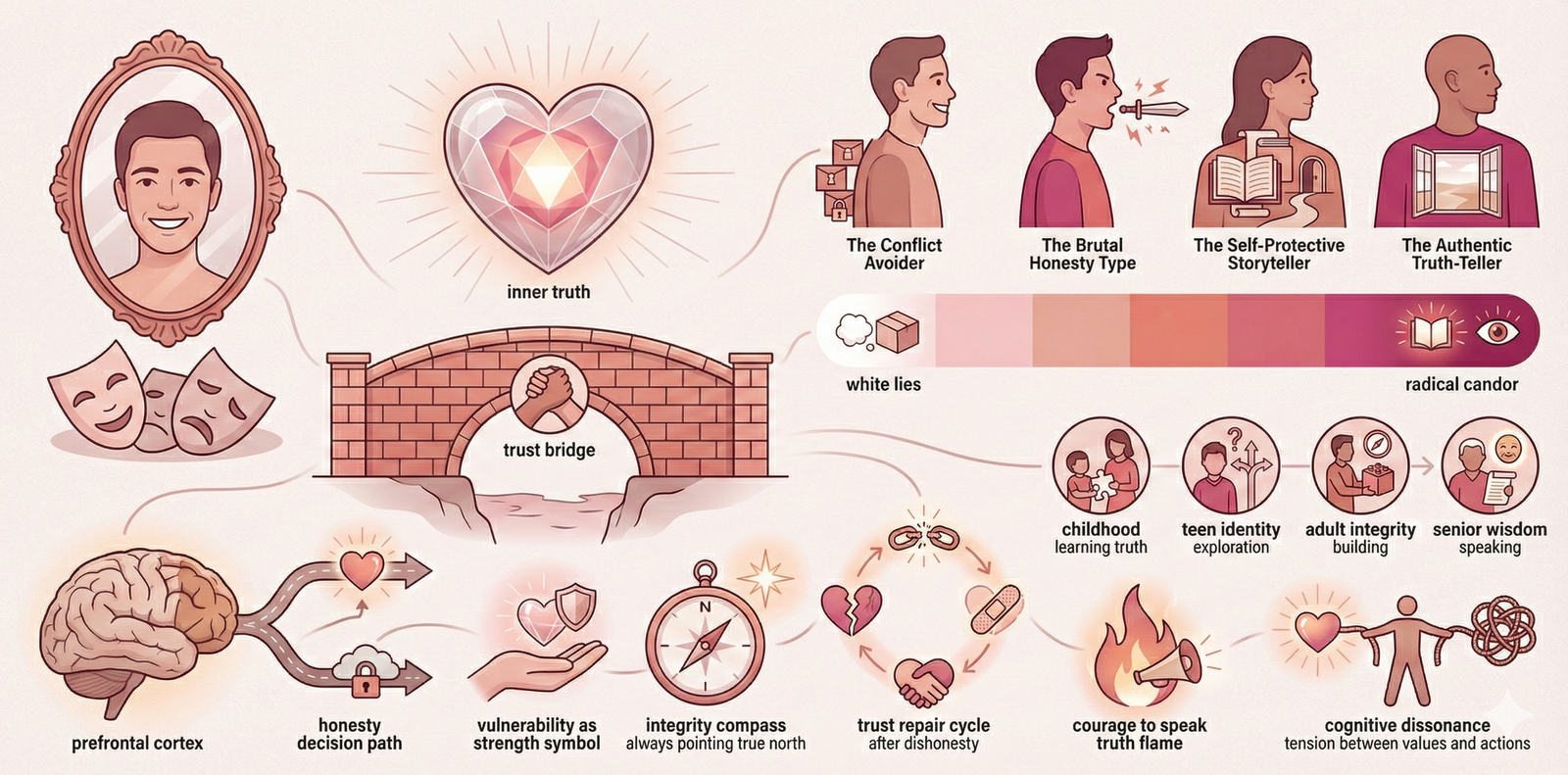
Imagine knowing exactly how someone really feels. Imagine being fully known and accepted. That's the gift honestidad creates—it demolishes the walls we construye to protect ourselves.
Studies show honest people report deeper connections, less ansiedad, and greater peace. But construyeing honestidad is a skill. It takes practice, boundaries, and compassion—for others and yourself.
What Is Honestidad?
Honestidad is the practice of telling the truth and representing yourself authentically. It's more than avoiding direct lies—it includes not omitting important information, not spreading misinformation, and communicating truthfully even when a lie would be easier. Honestidad-humility, a core personality trait, reflects sincerity, fairness, and genuine concern for others rather than material gain or status.
No es consejo médico.
Honestidad exists on a spectrum. Some honestidad is about facts (telling the truth about what happened). Other honestidad is about feelings (sharing what you genuinely think or feel). The deepest honestidad is about who you are when no one's watching. It's the alignment between your words, actions, and values.
Surprising Insight: Descubrimiento Sorprendente: Research from 2025 shows that people who practice greater honestidad have 11% lower risk of depression compared to those who score lowest on integrity measures. Your words literally shape your salud mental.
The Three Layers of Honestidad
Visual breakdown of factual honestidad, emotional honestidad, and authentic honestidad as foundational levels
🔍 Click to enlarge
Why Honestidad Matters in 2026
In 2026, we're living in an age of information overload and digital distortion. Trust is more valuable than ever. When you practice honestidad, you stand out. You become the person others lean on, confide in, and construye real relaciones with. Honestidad creates psychological safety—the feeling that it's safe to be yourself.
The research is clear: honestidad mejoras salud mental. People who avoid lying experience less ansiedad, fewer physical complaints, and better sleep. They worry less because they're not managing lies or protecting false versions of themselves. Honestidad also fuerzaens relaciones by creating transparency and reducing the energy spent on deception.
In a world of increasing isolation and superficial connections, honestidad is radical. It's saying: I'm showing you who I really am, and I trust you enough to see the messy, imperfect truth. That vulnerability creates the deepest bonds.
The Science Behind Honestidad
Neuroscience reveals that honestidad activates specific brain regions. When you tell the truth, the ventromedial prefrontal cortex (VMPFC) activates—the region responsible for self-referential thinking and processing moral decisions. This activation fuerzaens connections to the temporoparietal junction, which supports social understanding and perspective-taking. Essentially, honestidad makes you more socially connected at a neurological level.
The cognitive control required for honestidad is fascinating. Honest people show longer reaction times when making moral decisions because they're actively processing the right choice rather than impulsively choosing self-interest. Brain imaging studies show reduced activity in dishonest individuals' cognitive control regions when making unethical choices—suggesting dishonestidad becomes automatic and psychologically cheaper the more you practice it.
How Honestidad Activates Brain Networks
Brain regions and connectivity patterns that activate during honest decision-making and communication
🔍 Click to enlarge
Componentes Clave of Honestidad
Truthful Communication
This is the foundation—saying what is actually true. It means avoiding direct lies, not exaggerating, and not presenting false information as fact. Truthful communication includes being honest about uncertainties. Sometimes the most truthful thing you can say is 'I don't know' or 'I'm not sure.'
Emotional Authenticity
Beyond facts, emotional authenticity means sharing your genuine feelings and perspectives. It's telling someone when you're hurt, afraid, or disagree—even when it's uncomfortable. Emotional authenticity construyes intimacy because it shows you trust the other person with your real self.
Information Completeness
Honestidad includes not deliberately omitting important information. This is especially crucial in relaciones and professional contexts. Silence about relevant facts can be as dishonest as an outright lie. The key is judgment—sharing what's relevant and necessary, not overwhelming someone with everything.
Integrity Through Consistencia
Real honestidad means your words, actions, and values align over time. It's not just what you say in the moment—it's following through, keeping commitments, and behaving the same way whether someone's watching or not. Integrity is honestidad in action.
| Dimension | With Honesty | With Dishonesty |
|---|---|---|
| Salud Mental | Lower ansiedad, better sleep, fewer complaints | Higher estrés, rumination, guilt |
| Relaciones | Deeper trust, authentic connection, safety | Shallow bonds, constant guard, isolation |
| Self-Image | Alignment between values and behavior | Cognitive dissonance, shame |
| Energy | More available for growth and presence | Spent managing lies and narratives |
| Decision-Making | Clearer values-based choices | Compromised by protecting falsehoods |
How to Apply Honestidad: Step by Step
- Step 1: Start with small truths in low-stakes situations to construye your honestidad muscle—share a genuine opinion with a friend or acknowledge a mistake at work.
- Step 2: Examine your motivations before speaking—ask yourself if you're being honest for the right reason (clarity, connection, protection) or avoiding honestidad out of fear.
- Step 3: Use 'I statements' to share honest feelings without blame—say 'I felt hurt when...' instead of 'You always hurt me when...' to keep honestidad constructive.
- Step 4: Create safety first in relaciones before sharing vulnerable truths—ensure the other person has shown they can maneja honestidad with compassion.
- Step 5: Practice the pause before responding—take a breath to ensure your words reflect your true thoughts rather than reactive emotion.
- Step 6: Acknowledge what you don't know—admit uncertainty instead of fabricating answers or pretending to understand something you don't.
- Step 7: Balance honestidad with compassion by considering timing and delivery—true honestidad serves the relationship, not just unburdening yourself.
- Step 8: Set boundaries around what you'll tolerate dishonestidad in—communicate what kinds of honestidad matter most to you in key relaciones.
- Step 9: Model honestidad consistently—let others see that you tell the truth even when it costs you, construyeing trust through demonstrated integrity.
- Step 10: Forgive yourself and others for failed honestidad—perfectionism about truth-telling creates shame that blocks genuine communication.
Honestidad Across Life Stages
Adultez joven (18-35)
In young adulthood, honestidad is about finding your authentic voice. You're often navigating pressure to conform, perform, or present a curated self. The honestidad challenge here is distinguishing between who others expect you to be and who you actually are. Starting to practice honest communication—about your values, boundaries, and dreams—sets the foundation for all future relaciones.
Edad media (35-55)
Middle age brings the complexity of managing multiple relaciones with authenticity. You may have partners, children, colleagues, aging parents. Honestidad becomes balancing transparency with protecting others' needs and feelings. This is when many people descubre that the masks they've worn cost more than honestidad ever could—and they recommit to truthfulness.
Adultez tardía (55+)
In later life, honestidad often becomes simpler and more profound. With less to prove, many people drop the need for self-protection and embrace truth-telling. La investigación muestra that people who've maintained integrity throughout life report greater life satisfaction, fewer regrets, and stronger relaciones with adult children.
Perfiles: Your Honestidad Enfoque
The Conflict Avoider
- Permission to say difficult truths without destroying relaciones
- Practice expresaing disagreement kindly but clearly
- Understanding that some people respect honestidad more than agreement
Common pitfall: Staying silent to keep peace, which breeds resentment and prevents real intimacy.
Best move: Start with small truths in safe relaciones. Say what you think, then listen to their response. Most people respect courage more than agreement.
The Brutal Honestidad Type
- Aprendeing that honestidad without compassion creates wounds
- Desarrollaing awareness of timing and delivery
- Understanding the difference between truth and opinion
Common pitfall: Thinking that bluntness equals honestidad, when really it's avoiding the emotional labor of kind communication.
Best move: Before speaking a hard truth, pause and ask: Is this kind? Is this necessary? Is this mine to say? Filter truth through compassion.
The Self-Protective Storyteller
- Recognizing the cost of false narratives to yourself and others
- Gradual exposure to being seen as you are
- Construyeing trust in people's ability to accept your real self
Common pitfall: Crafting versions of truth that protect your image but isolate you from genuine connection.
Best move: Share one small truth about yourself with someone safe. Notice that acceptance feels better than agreement built on false versions.
The Authentic Truth-Teller
- Ways to deepen honestidad beyond words into actions and consistencia
- Tools to maintain honestidad under pressure
- Compassion for others who struggle with truth-telling
Common pitfall: Impatience with others who aren't as committed to honestidad, creating judgment instead of bridge-construyeing.
Best move: Use your integrity as an anchor for others. Be curious about why people lie rather than critical. Model what honestidad looks like.
Common Honestidad Mistakes
The first mistake is confusing silence with honestidad. Many people think not lying is enough. But honestidad includes speaking important truths when withholding them harms the relationship. If you're silently resentful, secretly disagree, or hide something relevant, you're not being honest—you're being cowardly.
The second mistake is brutal honestidad without compassion. Telling someone every critical thought isn't honestidad—it's aggression dressed up as truth. Real honestidad asks: Is this necessary? Is this kind? Will this serve the relationship? Wisdom is knowing when truth needs a gentle delivery.
The third mistake is expecting honestidad to solve everything instantly. Reconstruyeing trust after dishonestidad takes time. Being honest going forward doesn't erase past lies. Honestidad is a practice you commit to long-term, not a gesture that fixes everything at once.
Honestidad Mistakes & Recovery Paths
Common pitfalls in honestidad practice and how to redirect toward authentic communication
🔍 Click to enlarge
Ciencia y estudios
Recent research demonstrates compelling links between honestidad, salud mental, and relationship quality. A landmark University of Notre Dame study assigned half of 110 participants to avoid all major and minor lies for 10 weeks. Those who reduced lying showed significantly fewer salud mental complaints (like ansiedad and sadness), fewer physical health complaints (like headaches and sore throats), and reported mejoraments in close relaciones and social interactions.
- The Science of Honestidad: A Review and Research Agenda (2025) - ScienceDirect publishes comprehensive meta-analysis of 15+ years of behavioral honestidad research, examining when and why people lie in realistic settings.
- Cognitive Control in Honestidad and Dishonestidad Study (2024) - Frontiers in Psychology documents how honest individuals show significantly longer reaction times and fewer self-interest biases in moral decision-making.
- Expresaed and Perceived Honestidad in Relaciones (2025) - Rochester Lab shows that honestidad beneficios relaciones even when couples are not perfectly accurate, emphasizing perceived honestidad's role in trust-construyeing.
- Neural Representations of Honestidad Predict Trust (2019) - Nature Communications reveals that brain activity in posterior cingulate and ventromedial prefrontal cortex during honest decisions predicts future trust behavior.
- Honestidad-Humility and Depression Risk (2023) - Character fuerza research finds that individuals scoring high in honestidad and integrity have 11% lower risk of depression.
Tu primer micro hábito
Comienza pequeño hoy
Today's action: Choose one small truth you've been avoiding saying (like a genuine opinion, a boundary, or an apology) and expresa it kindly to someone safe today. One sentence. That's it.
Honestidad becomes a hábito through small repetitions, not grand gestures. Each time you choose truth over silence, you rewire your brain to make honestidad feel normal. You also experience the relief that comes from being genuine. Small wins construye momentum and confidence for bigger honestidad.
Track your micro habits and get personalized AI coaching with our app. Log your honesty moments, get feedback on building authentic communication patterns, and celebrate when your relationships deepen because of your truth-telling.
Evaluación rápida
How do you currently maneja situations where honestidad might create conflict?
Your enfoque to honest communication reveals whether you lean toward protecting relaciones at the cost of authenticity, or pursuing truth without regard for connection.
In your closest relaciones, how fully known do you feel?
The degree to which you're known correlates directly with how much honestidad you've risked in relaciones. Greater authenticity creates deeper belonging.
What's your biggest challenge with honestidad?
Identifying your honestidad edge helps you practice in that specific area and construye the capability that matters most for your relaciones.
Take our full evaluación to get personalized recommendations for construyeing honestidad in your life.
Descubre Your Style →Preguntas frecuentes
Próximos pasos
Honestidad is not a destination—it's a practice. Start by identifying one relationship where you want more authenticity. Choose one small truth you've been avoiding and expresa it kindly. Notice how it feels. Notice how the other person responds. Most people respond to vulnerability with aprecio, not rejection.
As you practice honestidad, you'll descubre something profound: the people worth having in your life respect you more for being genuine than for being perfect. Your truth, shared with courage and compassion, construyes the deepest bonds and the most lasting peace.
Get personalized guidance with AI coaching to construye authentic relaciones through honestidad.
Comienza Tu Camino →Research Sources
This article is based on peer-reviewed research and authoritative sources. Below are the key references we consulted:
Related Glossary Articles
Frequently Asked Questions
Is it ever okay to lie to protect someone's feelings?
Context matters. Small protective lies (like pretending to like a gift) are different from hiding information that affects someone's life. The deeper question: Does this lie serve the relationship, or does it protect me from discomfort? Real honestidad with compassion is usually the answer. Instead of lying, try honest kindness: 'I appreciate the gift—can I share how I'm feeling about it?'
How do I reconstruye trust after being dishonest?
First, acknowledge the lie and take responsibility without excuses. Second, explain what led to the dishonestidad (fear, shame, self-protection)—not to justify it, but to show understanding. Third, commit to honestidad going forward and be consistent over time. Trust reconstruyes slowly through demonstrated integrity, not through apologies alone. People need to see you choosing truth repeatedly.
¿Y si honestidad threatens my safety?
Safety comes first. Honestidad in abusive or unsafe relaciones may not be wise. You can practice truthfulness with safe people while protecting yourself in unsafe dynamics. Consider working with a therapist to identify where it's safe to be honest and where protective strategies are necessary.
Can I be too honest? Is radical honestidad actually healthy?
Yes, context matters. Radical honestidad without wisdom becomes aggression or oversharing. Saludy honestidad asks: Is this true? Is it necessary? Is it kind? Will it serve this relationship? You can be honest and still respect others' emotional capacity. Timing, delivery, and compassion transforma truth from wounding to healing.
How do I know if someone is being honest with me?
Look for consistencia between their words and actions over time. Honest people acknowledge uncertainty ('I don't know') rather than bluffing. They follow through on commitments. They're willing to share difficulties or things that don't make them look good. Most importantly, you feel safe with them—not because they always tell you what you want to hear, but because you trust their integrity.
Take the Next Step
Ready to improve your wellbeing? Take our free assessment to get personalized recommendations based on your unique situation.
- Discover your strengths and gaps
- Get personalized quick wins
- Track your progress over time
- Evidence-based strategies