Attachment Patterns
Your attachment pattern is the invisible blueprint that shapes how you love, trust, and connect with others. Formed in your earliest relationships, these deeply ingrained patterns determine whether you lean into intimacy or pull away, whether you seek reassurance constantly or maintain emotional distance. Understanding your attachment style isn't just psychological theory—it's the key to breaking cycles that keep you stuck in unfulfilling relationships and finally building the secure, stable connections you deserve. Whether you're anxiously seeking validation, avoidantly protecting yourself, or securely navigating intimacy, your attachment pattern holds powerful insights into your relational happiness.
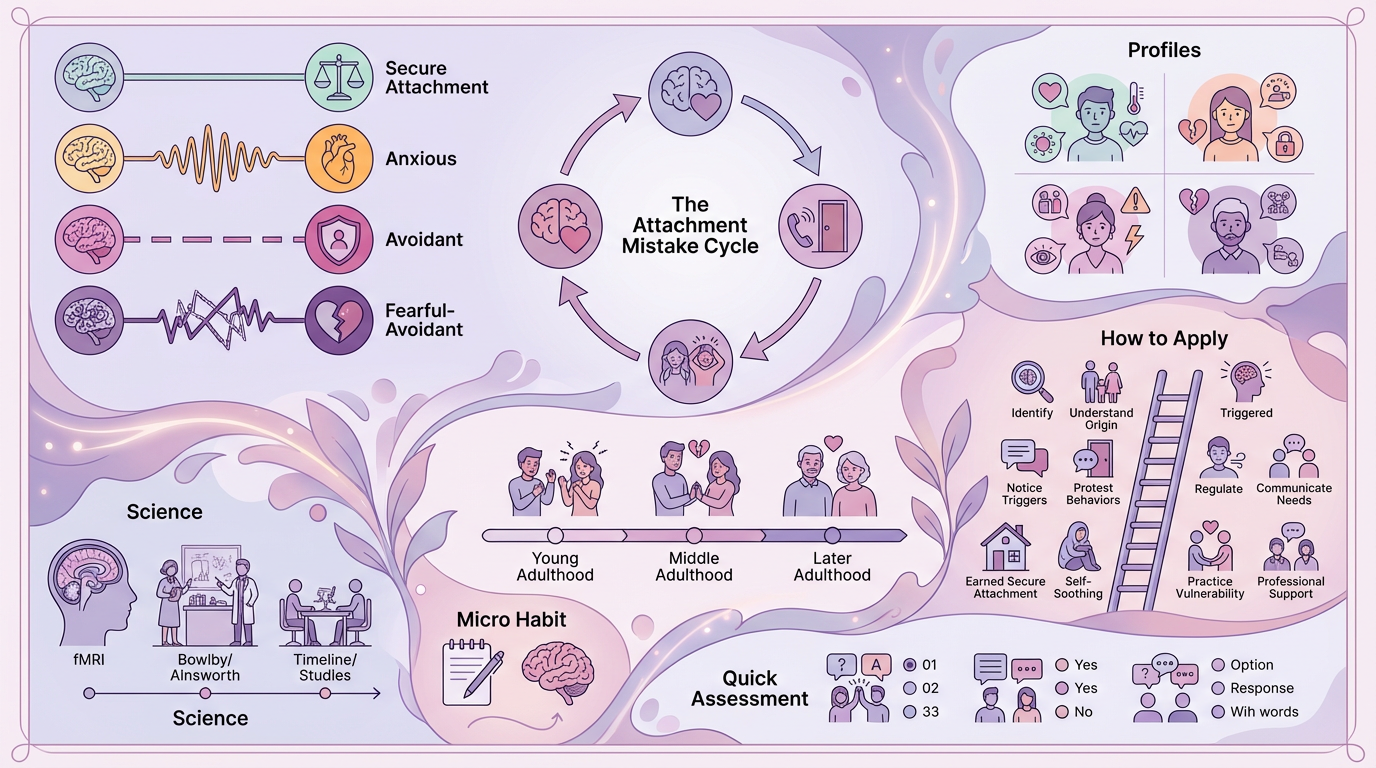
The groundbreaking research by John Bowlby and Mary Ainsworth revolutionized how we understand human bonding, revealing that our earliest caregiving experiences literally wire our brains for connection or disconnection.
Research shows that approximately 50-60% of adults have secure attachment, while 40-50% struggle with insecure patterns—patterns that can be transformed through awareness and intentional practice.
What Is Attachment Patterns?
Attachment patterns refer to consistent ways of thinking, feeling, and behaving in intimate relationships that develop from early interactions with primary caregivers. These patterns reflect your learned beliefs about whether others are trustworthy, whether you are worthy of love, and how to navigate emotional closeness and distance. Your attachment style operates largely outside conscious awareness, influencing how you interpret your partner's actions, regulate your emotions during conflict, and seek comfort when stressed. These patterns aren't fixed personality traits—they're adaptive strategies your nervous system developed to maximize safety and connection in your earliest relationships.
Not medical advice.
Attachment patterns emerge during infancy and early childhood when caregivers respond (or fail to respond) to a child's needs for comfort, safety, and connection. When a caregiver is consistently available and attuned to the child's emotional states, the child develops a secure attachment pattern—a foundation of trust that relationships are reliable and that their needs matter. When caregivers are inconsistently available, emotionally distant, rejecting, or even frightening, the child develops insecure attachment patterns as protective strategies. These patterns then generalize to all future relationships, coloring expectations about love, intimacy, and commitment throughout adulthood.
Surprising Insight: Surprising Insight: Your attachment pattern can shift significantly with a securely attached partner or through deliberate therapeutic work—it's not a life sentence, but a pattern you can consciously reshape.
The Four Attachment Styles Spectrum
Visual representation showing how attachment styles exist on two axes: anxiety (need for reassurance) and avoidance (need for independence), creating four distinct patterns.
🔍 Click to enlarge
Why Attachment Patterns Matter in 2026
In 2026's increasingly digital and fragmented relationship landscape, understanding attachment patterns has become essential for relationship success. With social media promoting unrealistic relationship standards, dating apps enabling endless options, and remote work blurring personal boundaries, insecure attachment patterns now trigger more relationship crises than ever. People with unexamined anxious patterns ghost partners impulsively, those with avoidant patterns commit to relationships they don't want, and those unaware of their patterns repeat the same relationship failures with different partners. Recognizing and working with your attachment style is no longer optional psychology—it's foundational relationship literacy.
Attachment patterns directly predict relationship satisfaction, sexual intimacy, conflict resolution ability, and long-term commitment stability. Studies consistently show that higher levels of both attachment anxiety and avoidance are linked to lower relationship satisfaction, increased anxiety and depressive symptoms, and shorter relationship duration. Yet this is precisely what makes attachment awareness so powerful—when people understand their patterns, they can interrupt automatic reactions, communicate their needs more clearly, and build the secure connections that buffer against loneliness, depression, and relationship dissolution.
Beyond romantic relationships, your attachment pattern influences friendship formation, family dynamics, professional collaboration, and even your relationship with yourself. Anxious attachers struggle with self-soothing and require constant external validation. Avoidant attachers develop strong independence but at the cost of emotional intimacy. Understanding these patterns allows you to leverage your strengths while consciously addressing your vulnerabilities across all relational contexts.
The Science Behind Attachment Patterns
Attachment theory, developed by British psychiatrist John Bowlby in the 1930s, revolutionized psychology by demonstrating that infants have an innate need for emotional connection—not merely for food or physical comfort. Bowlby's observations of emotionally troubled children revealed that maternal separation and inconsistent caregiving created lasting psychological damage. His breakthrough insight: attachment is a biological imperative, a survival mechanism that keeps infants close to their caregivers. When this attachment system operates reliably, the child develops secure internal working models—mental representations of themselves as worthy and others as trustworthy.
Mary Ainsworth, collaborating with Bowlby, developed the Strange Situation laboratory paradigm that identified three infant attachment classifications: secure, insecure-avoidant, and insecure-resistant (now called anxious). Her careful observations in Uganda and Baltimore established that secure attachment resulted from maternal sensitivity and responsiveness—caregivers who accurately read their baby's needs and responded consistently. Modern neuroscience has confirmed Bowlby and Ainsworth's theories, showing that secure attachment activates the child's parasympathetic nervous system (the calming branch), while insecure attachment triggers chronic activation of the sympathetic nervous system (the stress-response branch). This neurobiological foundation explains why attachment patterns persist into adulthood and why changing them requires both cognitive awareness and nervous system regulation.
How Attachment Forms: Caregiver Response → Attachment Pattern
A flowchart showing the chain reaction from caregiver behavior through child neurobiology to adult attachment patterns.
🔍 Click to enlarge
Key Components of Attachment Patterns
Secure Attachment
Secure attachment develops when caregivers are consistently available, emotionally attuned, and responsive to the child's needs. Securely attached adults feel comfortable with both intimacy and independence, can express emotions openly, trust their partners, and navigate conflict constructively. They view themselves as worthy of love and others as generally reliable. This represents approximately 50-60% of adults in most studies. Securely attached people experience greater relationship satisfaction, have better conflict resolution skills, exhibit healthier stress regulation, and are more likely to maintain long-term partnerships. They can ask for what they need without fear of abandonment and can give support without losing their sense of self.
Anxious Attachment
Anxious attachment (also called preoccupied attachment) develops when caregivers are inconsistently responsive—sometimes warm and attentive, sometimes neglectful or emotionally distant. The child learns that emotional expression and clinging behaviors sometimes elicit care, creating a mixed message that relationships are unpredictable. Anxiously attached adults crave emotional closeness, fear abandonment intensely, and require frequent reassurance that they're loved. They're hypervigilant to their partner's moods and behaviors, interpret ambiguous actions negatively, pursue their partners when conflict arises, and often suppress their own needs to maintain connection. Representing approximately 20% of adults, anxious attachers often struggle with jealousy, insecurity, and anxiety in relationships, creating a self-fulfilling prophecy where their clingy behavior actually triggers the very abandonment they fear.
Avoidant Attachment
Avoidant attachment (dismissive attachment) develops when caregivers are emotionally distant, rejecting, or punitive in response to the child's bids for connection. The child learns that emotional expression is dangerous or ineffective, that independence is the only safe strategy, and that intimacy brings pain. Avoidantly attached adults are uncomfortable with emotional closeness, value independence above all, minimize their need for relationships, and withdraw when partners seek connection. They often become defensive when challenged emotionally, rationalize their emotions, prioritize career or hobbies over relationships, and struggle to trust others' care and commitment. Representing approximately 25% of adults, avoidant attachers often don't recognize they have an attachment issue until they lose a relationship they actually valued, by which point their distance has killed the connection.
Fearful-Avoidant Attachment
Fearful-avoidant (disorganized) attachment develops when caregivers are both a source of safety and fear—perhaps inconsistently abusive, frightening when angry, or creating an environment where the child can't predict which version of the caregiver will appear. This creates an impossible internal conflict: the child both needs connection to the caregiver and fears that connection. As adults, fearfully-avoidant people display a push-pull pattern—they crave intimacy intensely, then panic when they get it and withdraw, then feel lonely and pursue again, cycling endlessly. They often date people who are unavailable or unreliable, recreating their childhood chaos. Representing approximately 5% of adults, fearful-avoidant attachers often benefit most from trauma-informed therapy, as their attachment confusion often masks deeper relational wounds.
| Attachment Style | Core Belief About Self | Core Belief About Others |
|---|---|---|
| Secure | I am worthy and capable of love | Others are trustworthy and reliable |
| Anxious | I need others to feel complete and valued | Others will eventually leave me if I'm not perfect |
| Avoidant | I don't need anyone; I'm self-sufficient | Others will disappoint or control me if I let them close |
| Fearful-Avoidant | I am unlovable and undeserving of care | Others are both necessary and dangerous |
How to Apply Attachment Patterns: Step by Step
- Step 1: Identify Your Attachment Style: Take an online attachment quiz or reflect honestly on your relationship patterns—do you pursue closeness or create distance? Do you fear abandonment or independence? Your consistent relational patterns are your attachment fingerprint.
- Step 2: Understand Your Origin Story: Reflect on your primary caregivers' availability and responsiveness. Were they warm and predictable, inconsistent, distant, or frightening? Your childhood dynamics directly shaped your current relationship expectations.
- Step 3: Notice Your Triggers: Observe what relationship situations activate your attachment anxiety or avoidance. Does rejection trigger panic? Does commitment trigger suffocation? Awareness of triggers is the first step to managing them.
- Step 4: Identify Your Protest Behaviors: Anxiously attached people might text excessively, check social media obsessively, or create drama to test their partner's commitment. Avoidant people might cancel plans, emotionally withdraw, or create distance through work. Name your specific protest behaviors.
- Step 5: Regulate Your Nervous System: When activated, your nervous system drives your attachment responses. Practice grounding techniques, breathwork, or movement to shift from threat-response mode to calm-connection mode before processing relationship concerns.
- Step 6: Communicate Your Attachment Needs: Tell your partner your attachment style and what you need to feel secure. Anxious people need consistent contact and reassurance; avoidant people need autonomy and space; both need to negotiate these needs consciously.
- Step 7: Build Earned Secure Attachment: Seek partners with secure attachment or commit to developing it together. Secure partners can hold space for anxious partners' fears without becoming responsible for soothing them, and can respect avoidant partners' space without interpreting it as rejection.
- Step 8: Develop Self-Soothing Capacity: Practice calming yourself without requiring your partner's reassurance. This is crucial for anxious attachers (reducing clingy behavior) and avoidant attachers (developing comfort with interdependence).
- Step 9: Practice Vulnerability Incrementally: If avoidant, gradually increase emotional expression and physical affection in small, manageable doses. If anxious, practice trusting without constantly seeking reassurance. Small steps build new neural pathways.
- Step 10: Consider Professional Support: Attachment patterns rooted in childhood trauma or repeated relationship failures often benefit from therapy, especially attachment-focused therapies like EMDR or Internal Family Systems, which can rewire your nervous system's relationship responses.
Attachment Patterns Across Life Stages
Adultez joven (18-35)
In young adulthood, attachment patterns become glaringly obvious through dating and early serious relationships. Anxiously attached young adults often move quickly into relationships, intensity-seek, and display jealousy in new connections. They're vulnerable to 'anxious-avoidant' couples where the anxious partner pursues increasingly and the avoidant partner withdraws further. Avoidantly attached young adults might avoid commitment entirely, cycle through casual relationships, or sabotage promising connections when they threaten their independence. This is an optimal period for attachment awareness because relationship patterns are still forming—a 25-year-old can develop secure attachment much faster than a 45-year-old with decades of entrenched patterns.
Edad media (35-55)
By middle adulthood, insecure attachment patterns have often calcified into chronic relationship dissatisfaction, divorce, or long-term partnerships marked by distance or conflict. Many people in this stage are dealing with the consequences of their attachment patterns—divorces, custody battles, estrangements, or feeling trapped in unfulfilling marriages. This is often when people finally seek therapy or relationship coaching, motivated by the realization that 'my pattern keeps repeating.' The advantage of this stage is motivation and life experience—people understand deeply that change is necessary. The challenge is neuroplasticity; after 30-40 years of automatic responses, rewiring requires sustained, intentional effort.
Adultez tardía (55+)
In later adulthood, attachment patterns significantly impact life satisfaction, health outcomes, and even longevity. Securely attached older adults have stronger social networks, better mental health, and lower mortality rates. Anxiously attached older adults are vulnerable to increased isolation as they age (if their partners die or relationships dissolve) and may become more clingy or dependent. Avoidantly attached older adults might face unexpected loneliness when they finally have time for relationships—their lifetime of independence often comes at the cost of deep friendship and partnership networks. This stage offers both gifts (wisdom, acceptance, less ego) and challenges (reduced neuroplasticity, established life patterns) for attachment transformation.
Profiles: Your Attachment Patterns Approach
The Secure Connector
- Continued investment in healthy relationship skills and communication
- Awareness that security isn't complacency—ongoing intentionality maintains it
- Partners who reciprocate security or are actively working toward it
Common pitfall: Assuming their secure attachment makes them immune to relationship challenges or responsible for 'fixing' insecurely attached partners
Best move: Model healthy relationship behavior, maintain clear boundaries, choose partners who are self-aware and growing, and remember that security isn't rescue
The Anxious Pursuer
- Consistent reassurance but not from constantly seeking it—building self-trust
- Partners who appreciate their capacity for emotional depth and consistency
- Tools to self-soothe when activated rather than externalizing their need for comfort
Common pitfall: Mistaking pursuit for love, texts for connection, and overwhelming partners with the intensity of their emotional needs
Best move: Develop a secure internal support system (therapy, friends, self-care), practice asking for what you need clearly and then trusting the answer, notice when you're seeking reassurance vs. genuine connection
The Avoidant Protector
- Safe partners who won't force intimacy or use your independence against you
- Permission to gradually increase vulnerability without losing your valued autonomy
- Recognition that interdependence ≠ dependence; you can need someone and still be strong
Common pitfall: Mistaking emotional distance for independence, sabotaging good relationships to protect yourself, and justifying coldness as 'honesty'
Best move: Consciously practice small acts of vulnerability, name your fear of engulfment directly, recognize that your partner's bids for connection aren't demands for your surrender
The Fearful-Avoidant Cycler
- Trauma-informed therapy to address the roots of their simultaneous need and fear
- Extremely patient partners or professional support who won't abandon during the push-pull cycles
- Nervous system regulation tools to interrupt the alarm-state that drives the cycling
Common pitfall: Unconsciously recreating their childhood chaos by dating people who are unreliable or unavailable, repeating their core wound
Best move: Prioritize trauma therapy, develop a strong sense of internal safety before entering relationships, practice observing the push-pull pattern without judgment as it happens
Common Attachment Patterns Mistakes
The first common mistake is assuming your attachment style is permanent or destiny. Insecure attachment patterns feel natural because they're familiar—they've been your survival strategy since childhood. But neuroscience proves that attachment can shift with conscious effort and a different relational experience. Many people resign themselves to 'I'm just anxious' or 'I'm not good at relationships' and stop trying. This is precisely backward: awareness that your patterns are learned is liberating because learned patterns can be relearned.
The second mistake is blaming your attachment style for relationship failure rather than taking responsibility for your choices. If you're anxious, you can't blame your partner for leaving when your pursuit becomes suffocating. If you're avoidant, you can't blame them for finding someone more emotionally available. Attachment styles explain your automatic responses; they don't excuse damaging behavior. Secure attachment requires accepting that your nervous system's first response might be anxious or avoidant, and then consciously choosing a different action.
The third mistake is expecting a partner to complete your attachment work. Anxious people often unconsciously seek partners who will give them the consistent caregiving they lacked as children. But relying on a romantic partner to heal your childhood attachment wound is impossible and unfair—it's the job of professional support, friendships, self-compassion, and new relational experiences. A secure partner can support your work, but they can't do it for you.
The Attachment Mistake Cycle: How Insecure Patterns Self-Perpetuate
A circular diagram showing how insecure attachment triggers behaviors that confirm the core fear, creating a self-fulfilling prophecy.
🔍 Click to enlarge
Ciencia y estudios
Research on attachment patterns spans nearly a century, from Bowlby's pioneering observations through contemporary neuroscience. Modern studies consistently demonstrate the profound impact of attachment on relationship satisfaction, mental health, sexual intimacy, and even physical health outcomes. Longitudinal research shows that securely attached individuals have lower rates of depression and anxiety, higher life satisfaction, stronger immune function, and longer lifespans than their insecurely attached peers.
- Bowlby (1969) established attachment theory as the foundation for understanding human bonding and demonstrated that secure attachment in infancy predicts psychological adjustment across the lifespan.
- Ainsworth (1978) classified infant attachment into secure, anxious, and avoidant patterns using the Strange Situation paradigm, work that has been validated in thousands of subsequent studies.
- Fraley & Shaver (2000) extended attachment theory to adult romantic relationships, demonstrating that attachment styles are stable across time yet responsive to relational experiences.
- Coan & Sbarra (2015) used fMRI brain imaging to show that secure attachment literally changes how the brain processes threat and stress, with securely attached individuals showing reduced amygdala activation during pain.
- Mikulincer & Shaver (2007) showed that attachment anxiety and avoidance independently predict lower relationship satisfaction, that anxious individuals are hypervigilant to rejection cues, and that avoidant individuals suppress emotional expression and connection.
Tu primer micro hábito
Comienza pequeño hoy
Today's action: For the next 3 days, after a conversation with your partner, write one sentence about what you noticed in your own attachment response—did you seek reassurance, create distance, or communicate directly? This single awareness practice interrupts automatic patterns.
Attachment patterns operate outside conscious awareness. By pausing to observe yourself without judgment, you create the neurological space where change becomes possible. This micro-moment of awareness is where secure attachment begins.
Track your micro habits and get personalized AI coaching with our app.
Evaluación rápida
When your partner is emotionally distant, what's your first instinct?
Your immediate reaction to emotional distance reveals your core attachment fear—abandonment anxiety, engulfment fear, or secure trust in reconnection.
In conflict, what do you typically do?
Your conflict style is directly shaped by your attachment pattern and determines whether conflict brings you closer or creates distance.
How do you feel about your partner having their own separate social life and interests?
Your comfort with interdependence vs. independence is a core attachment pattern indicator.
Take our full assessment to get personalized recommendations.
Discover Your Style →Preguntas frecuentes
Próximos pasos
Your attachment pattern was shaped by your earliest relationships and has operated mostly outside your awareness—until now. The fact that you're reading this means you're ready to understand this invisible force and reclaim agency over how you love. Understanding attachment isn't psychology for its own sake; it's the pathway to breaking cycles, healing wounds, and building the secure, intimate, stable relationships you deserve. Whether you're secure, anxious, avoidant, or fearful-avoidant, the next step is the same: observe your patterns without judgment, communicate your needs clearly, and practice new responses until they become your new automatic default.
The scientific evidence is clear: secure attachment is learnable at any age. Your childhood didn't determine your destiny—your conscious choices now do. Start with the micro habit, take the assessment, and consider seeking professional support if your patterns have created relationship pain. The relationships that change our lives—with partners, friends, family, and ourselves—are built one conscious choice at a time.
Get personalized guidance with AI coaching.
Start Your Journey →Research Sources
This article is based on peer-reviewed research and authoritative sources. Below are the key references we consulted:
Related Glossary Articles
Frequently Asked Questions
Can attachment patterns change, or are they fixed for life?
Attachment patterns can absolutely change through conscious effort, new relational experiences, and often therapy. This is called 'earned secure attachment'—when someone with insecure attachment develops security through a healthy relationship or therapeutic work. However, change requires awareness and intention; your automatic pattern won't shift through wishes alone.
Do anxious and avoidant partners always fail, or can they make it work?
Anxious-avoidant pairs are extremely common but notoriously challenging because their core fears directly trigger each other's deepest wounds. However, they can absolutely work if both partners understand their patterns and actively regulate their nervous systems rather than reacting automatically. The key is conscious communication about attachment needs rather than blaming each other.
If I had secure attachment as a child, could I still develop insecure patterns later?
Yes, though less commonly. Significant relationship trauma, grief, betrayal, or prolonged stress can shift someone toward insecurity. This is why some people who had secure childhoods still struggle in adult relationships—their internal working models were disrupted by adult experiences.
Is it better to date someone with the same or different attachment style?
Generally, secure partners create the healthiest relationships regardless of your attachment style because they can handle anxious or avoidant behaviors without taking them personally. Two anxious people can amplify each other's fears; two avoidant people might never create real intimacy. A secure person with an insecure person who's self-aware and growing often creates the fastest transformation.
How long does it take to develop a more secure attachment style?
With consistent effort and professional support, you might notice shifts in 3-6 months. Deeper rewiring typically takes 1-3 years. The timeline depends on how entrenched your patterns are, how secure your current relationship is, and your willingness to practice new behaviors even when they feel uncomfortable and unnatural.
Take the Next Step
Ready to improve your wellbeing? Take our free assessment to get personalized recommendations based on your unique situation.
- Discover your strengths and gaps
- Get personalized quick wins
- Track your progress over time
- Evidence-based strategies