Neuroplasticity Exercises
Your brain isn't hardwired like a computer—it's more like a living forest that constantly reshapes itself based on experience. Every time you practice a new skill, learn something challenging, or change your habits, your neural pathways physically reorganize. This remarkable ability, called neuroplasticity, means your brain can literally rewire itself at any age. Whether you're recovering from injury, learning a new language, or simply wanting to sharpen your mind, neuroplasticity exercises activate this natural brain-building mechanism. The science is clear: deliberate practice combined with novel challenges creates measurable changes in brain structure and function.
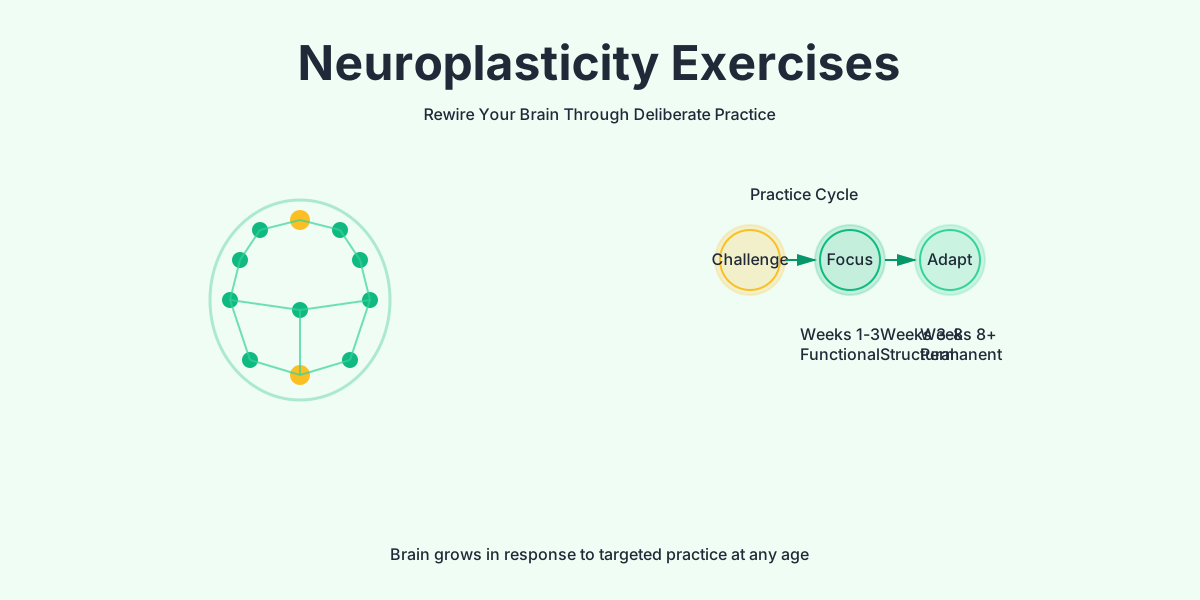
Neuroplasticity exercises work by creating demand on specific neural networks. When you engage in focused, challenging activities—especially ones that feel slightly uncomfortable—your brain allocates resources to strengthen those pathways. The repetition signals importance, while novelty forces adaptation.
The practical truth: most people underestimate how quickly they can improve cognitive skills when using the right approach. You're not limited by your current abilities; you're limited only by how you practice.
What Is Neuroplasticity Exercises?
Neuroplasticity exercises are deliberate, challenging activities designed to stimulate brain adaptation and rewiring. They work by engaging neural pathways in novel ways, creating structural and functional changes in brain tissue. The exercises might involve learning new motor skills, acquiring languages, solving complex problems, or forcing your brain to process information through unusual routes.
Not medical advice.
These exercises leverage the brain's fundamental property: neurons that fire together wire together. By repeatedly activating specific neural circuits while also challenging the brain with novelty, you strengthen existing pathways and create new connections. The key difference between passive thinking and neuroplasticity exercises is attention, challenge, and repetition. Simply thinking about something doesn't trigger significant rewiring; deliberately struggling with something new does.
Surprising Insight: Surprising Insight: Brain imaging studies show that intensive neuroplasticity training can increase gray matter density in specific regions within weeks—meaning the brain literally grows in response to targeted practice, regardless of age.
The Neuroplasticity Exercise Cycle
How deliberate practice creates lasting neural changes through repetition, novelty, and attention
🔍 Click to enlarge
Why Neuroplasticity Exercises Matter in 2026
In 2026, cognitive demands are higher than ever. The information landscape moves faster, problem-solving requires integrating knowledge from multiple domains, and career longevity depends on continuous learning. Traditional passive learning—reading, watching, listening—rarely triggers neuroplasticity. The brain optimizes for efficiency; once it learns something, it stops allocating resources unless challenged further.
Neuroplasticity exercises matter because they directly counter cognitive decline and accelerate skill acquisition. Unlike supplements or passive techniques, neuroplasticity training creates measurable structural changes. Research shows that people engaging in regular neuroplasticity exercises maintain sharper minds longer, recover faster from brain injuries, and develop expertise more rapidly than those using conventional approaches.
Beyond cognitive performance, neuroplasticity exercises improve emotional regulation, reduce anxiety, enhance creativity, and increase resilience. The brain adaptability you build through neural rewiring extends to managing stress and responding to life's unpredictable challenges.
The Science Behind Neuroplasticity Exercises
The foundation of neuroplasticity lies in synaptic plasticity—the brain's ability to strengthen or weaken connections between neurons based on experience. When you perform a neuroplasticity exercise, several biological processes activate simultaneously. First, neurons in target regions fire repeatedly. Second, neurotransmitters flood the synapse. Third, immediate early genes activate, triggering protein synthesis that physically strengthens the connection. Over weeks of repetition, the synapse physically changes: dendritic spines grow, connections multiply, and the neural pathway becomes more efficient.
Long-term potentiation (LTP) and long-term depression (LTD) are the mechanisms that make this possible. LTP occurs when repeated stimulation strengthens synapses; LTD weakens unused connections. Neuroplasticity exercises harness both—strengthening useful pathways while allowing outdated ones to fade. The process requires attention: unfocused repetition doesn't trigger the same rewiring as deliberate, challenging practice.
Synaptic Strengthening: From Activity to Structure
Biological cascade showing how neural activity becomes permanent structural change
🔍 Click to enlarge
Key Components of Neuroplasticity Exercises
Novelty and Challenge
The brain prioritizes what matters. Routine activities—driving your usual commute, making breakfast—activate autopilot mode and minimal neuroplasticity. Effective exercises require genuine novelty: something your brain hasn't optimized yet. This is why learning a new language rewires your brain more than reviewing vocabulary you already know. Challenge is essential; activities slightly above your current ability level trigger the maximum rewiring response. Too easy, and the brain doesn't allocate resources. Too hard, and frustration interferes with learning.
Focused Attention
Neuroplasticity requires active attention. Multitasking, distraction, or passive participation dramatically reduce rewiring. When attention is scattered, the brain's reward systems don't activate, neuromodulators that enable synaptic strengthening aren't released, and the activity remains surface-level. Deep focus during practice is what signals the brain that this skill matters and deserves resource investment.
Repetition and Consolidation
Neural rewiring requires distributed repetition over time. Single exposure creates no lasting change. Spaced repetition—practicing with increasing intervals between sessions—optimizes memory consolidation and neural adaptation. Research shows that spacing practice sessions by 1-3 days works better than daily practice or massed practice. This spacing allows the brain to consolidate changes, integrate learning into existing networks, and prepare for the next challenge.
Emotional Engagement
Emotions amplify neuroplasticity. When you care about learning something, when there's meaningful reward or consequence, the brain releases dopamine, norepinephrine, and acetylcholine—neurochemicals that enhance synaptic plasticity. Activities you find intrinsically motivating create more rewiring than forced practice. This doesn't mean exercises must feel easy or enjoyable; productive struggle combined with personal meaning creates optimal neuroplasticity.
| Exercise Type | Target Brain Region | Neuroplasticity Outcome |
|---|---|---|
| Language learning | Left temporal & frontal regions | Strengthened phonetic processing, vocabulary networks, grammar pathways |
| Motor skill training | Motor cortex & cerebellum | Expanded motor maps, improved coordination, increased white matter density |
| Pattern recognition | Visual cortex & parietal regions | Enhanced pattern detection, faster processing, improved spatial reasoning |
| Working memory tasks | Prefrontal cortex & parietal cortex | Increased capacity, faster recall, improved executive function |
| Attention training | Anterior cingulate & prefrontal cortex | Enhanced focus, better impulse control, stronger selective attention |
How to Apply Neuroplasticity Exercises: Step by Step
- Step 1: Identify a skill you want to develop or a challenge you're facing, then be specific about the target. Instead of 'improve memory,' choose 'remember names of new people I meet' or 'recall historical dates for my exam.'
- Step 2: Research evidence-based exercises for your goal. Language learning apps, instrumental music training, and deliberate practice protocols have strong neuroplasticity evidence. Avoid exercises marketed as 'brain games' unless backed by peer-reviewed research.
- Step 3: Start with an assessment of your current ability level. Establish a baseline so you can measure progress and adjust difficulty. This initial assessment also activates relevant neural pathways.
- Step 4: Set up spaced practice: plan sessions 2-3 days apart rather than daily. Spacing optimizes consolidation. Schedule 30-60 minute focused sessions; beyond 90 minutes, attention typically declines and neuroplasticity benefits drop.
- Step 5: Create environmental conditions for deep focus. Eliminate notifications, find a quiet space, and remove distractions. Your brain's attention networks require stable, low-distraction input to trigger strong rewiring.
- Step 6: Begin each session with a brief review of previous progress. This reactivation helps integrate new learning with existing neural networks and triggers consolidation of previous sessions.
- Step 7: Engage in deliberate practice on the specific skill. This means focused effort on aspects you find challenging, not just repetition of what you already know. The struggle is essential.
- Step 8: Increase difficulty gradually. When an exercise becomes comfortable, your brain has optimized it and stops allocating rewiring resources. Progress to harder variations to maintain neuroplasticity.
- Step 9: Practice across contexts and variations. A pianist who only plays classical won't develop the same neural flexibility as one who experiments with jazz, contemporary, and different styles. Variation strengthens adaptability.
- Step 10: Track progress objectively. Use measurable metrics: words learned per week, problems solved per session, response time improvements. Progress feedback activates reward systems that enhance neuroplasticity.
Neuroplasticity Exercises Across Life Stages
Young Adulthood (18-35)
This stage offers peak neuroplasticity capacity. The brain is still pruning unused connections while strengthening those in frequent use. Young adults benefit most from intensive language learning, acquiring complex motor skills, and developing expertise in challenging domains. Neuroplasticity exercises during this stage—whether learning an instrument, mastering a sport, or studying difficult technical subjects—create neural scaffolding that persists throughout life. The skills developed now become the foundation for future learning and cognitive reserve.
Middle Adulthood (35-55)
Neuroplasticity remains strong but requires more deliberate practice and longer consolidation periods. Middle adults see best results from exercises targeting specific cognitive challenges—learning skills for career transitions, maintaining mental sharpness as demands increase, or developing hobbies that activate new brain regions. The advantage at this stage is motivation: middle adults often have clearer reasons for wanting to learn and stronger intrinsic engagement, both of which enhance neuroplasticity. Consistent practice becomes more important than intensity.
Later Adulthood (55+)
Neuroplasticity continues into advanced age, though requiring more repetition and longer consolidation. Older adults benefit most from exercises targeting maintenance of existing cognitive skills and development of new capabilities that provide meaningful engagement. Learning in this stage shows particular benefits for memory and executive function. Novel, engaging activities—new languages, musical instruments, complex hobbies—trigger measurable neural changes even in people in their 80s. The key is consistency and meaningful challenge rather than intensity.
Profiles: Your Neuroplasticity Exercises Approach
The Focused Specialist
- Deep expertise in a narrow domain
- Sustained focus over months or years
- Metrics showing mastery progression
Common pitfall: Over-optimizing becomes limiting; the brain stops rewiring once fully adapted to a fixed routine
Best move: Periodically introduce variations and new challenges within your domain. A programmer should learn new paradigms; a musician should explore new genres. Variation maintains neuroplasticity within your area of expertise.
The Perpetual Learner
- Variety and novelty across multiple domains
- Regular exposure to new challenges
- Freedom to explore different skills
Common pitfall: Skipping from activity to activity without sufficient depth; the brain needs consolidation time before switching tasks
Best move: Maintain 2-3 primary neuroplasticity projects with 6-12 week timelines. Rotate between them rather than constantly starting new ones. Give each skill enough time for structural rewiring.
The Recovery-Focused
- Targeted exercises for specific deficits
- Structured progression with clear milestones
- Support systems and realistic timelines
Common pitfall: Expecting rapid recovery; neural rewiring after injury requires months, not weeks, of consistent practice
Best move: Work with neuroplasticity specialists to design task-specific training. Focus on high-intensity, repetitive practice of the exact skill affected. Track small improvements weekly.
The Integrated Wellness Seeker
- Neuroplasticity exercises integrated with overall health
- Connection between cognitive, physical, and emotional practice
- Sustainable long-term approaches
Common pitfall: Treating neuroplasticity as isolated from lifestyle; brain rewiring works best with good sleep, exercise, and emotional regulation
Best move: Combine neuroplasticity exercises with cardio, sleep optimization, and stress management. A brain well-supported by lifestyle changes shows 2-3x faster neural adaptation.
Common Neuroplasticity Exercises Mistakes
Expecting neuroplasticity from passive consumption: Watching videos about learning languages doesn't rewire your brain. Reading about piano doesn't strengthen motor pathways. Neuroplasticity requires active, effortful engagement. The brain prioritizes activities that demand resources; passive inputs don't trigger rewiring.
Assuming routine repetition creates rewiring: Doing the same exercise repeatedly without increasing difficulty is maintenance, not neuroplasticity. Your brain optimizes for efficiency; once it learns a task, it stops allocating resources unless challenged beyond current ability. Progression is essential; if an exercise feels easy, it's no longer triggering rewiring.
Underestimating the consolidation period: Neuroplasticity isn't instant. Structural brain changes take weeks. If you skip sessions or practice inconsistently, your brain doesn't consolidate changes and you lose progress. Consistency matters more than intensity; three focused 45-minute sessions per week outperforms one eight-hour marathon session.
What Doesn't Trigger Neuroplasticity (And Why)
Common activities mistaken for neuroplasticity training and their actual neural effects
🔍 Click to enlarge
Science and Studies
Neuroplasticity research has revolutionized our understanding of brain development and learning capacity. Decades of neuroscience research confirm that the brain remains adaptable throughout life, capable of forming new connections and reorganizing existing ones in response to experience and learning.
- Maguire et al. (2003) in Nature Neuroscience demonstrated that London taxi drivers who learned spatial navigation developed enlarged hippocampi—structural brain changes visible on MRI—providing direct evidence that intensive learning creates measurable brain growth.
- Pascual-Leone et al. (1995) showed that when blindfolded sighted people practiced reading Braille for five days, their primary visual cortex began processing tactile information, proving rapid cortical reorganization in adults.
- Schlaug et al. (2009) found that musicians have larger anterior corpus callosums (the brain structure connecting hemispheres), indicating that intensive motor and auditory training physically reshapes brain architecture.
- Boyke et al. (2008) demonstrated gray matter changes in older adults learning a complex motor task over several weeks, proving neuroplasticity remains robust in aging.
- Draganski et al. (2004) showed that intensive learning of new motor skills increased white matter density within weeks, confirming structural brain changes occur relatively rapidly with focused practice.
Your First Micro Habit
Start Small Today
Today's action: Spend 10 minutes learning the first 10 words of a new language using spaced repetition (Anki cards, Duolingo, or flashcards). Schedule this at the same time daily. In two weeks, you'll notice improved recall; your brain will begin rewiring language pathways.
Language learning is one of the most evidence-based neuroplasticity exercises. Even 10 minutes daily activates multiple brain regions simultaneously: auditory processing, language comprehension, memory encoding, and motor planning for pronunciation. The spaced repetition format optimizes consolidation. Small daily practice beats weekly marathons for neural rewiring.
Keep quitting habit apps after a missed day? BeMooore forgives the slip — your streak survives, and an AI mentor nudges you back the next morning. Free on iOS.
Quick Assessment
How much time do you currently spend deliberately learning new skills or challenging your brain?
Research shows that 2-3 hours of focused neuroplasticity practice per week triggers measurable structural brain changes within 6-8 weeks. If you're below 1 hour weekly, even small increases will boost cognitive development.
When practicing a new skill, which best describes your approach?
The sweet spot for neuroplasticity is option 3-4: consistent, focused practice on material slightly above current ability. If you're in option 1-2, adjusting your practice approach will dramatically accelerate your brain's rewiring.
What's your biggest barrier to consistent neuroplasticity practice?
Most barriers respond to system design: choose activities you find intrinsically interesting (motivation), schedule fixed time blocks (consistency), and track small wins weekly (visible progress). The exercises work; the challenge is usually the system around them, not the practice itself.
Take our full assessment to get personalized recommendations.
Discover Your Style →Next Steps
The most important step is choosing one neuroplasticity exercise and committing to it for 6-8 weeks. Pick something aligned with your goals and interests—learning a language, musical instrument, complex skill, or cognitive challenge. Don't try multiple things simultaneously; focused effort on one domain creates better neuroplasticity than scattered effort across many.
Start with your current ability level, design progressive difficulty increases, schedule spaced practice sessions 2-3 days apart, and track measurable progress weekly. After 6-8 weeks of consistent practice, you'll notice cognitive improvements and structural brain changes. Once you've built momentum with one skill, you can add secondary neuroplasticity projects.
Get personalized guidance with AI coaching.
Start Your Journey →Research Sources
This article is based on peer-reviewed research and authoritative sources. Below are the key references we consulted:
Related Glossary Articles
Frequently Asked Questions
How long until I see results from neuroplasticity exercises?
Functional changes (improved performance) appear within 2-4 weeks with consistent practice. Structural brain changes (gray matter growth, increased connectivity) become measurable on imaging in 6-8 weeks. Don't expect overnight results, but expect noticeable improvement within a month of consistent, focused practice at the right difficulty level.
Is it too late to start neuroplasticity training if I'm over 60?
Absolutely not. The brain remains plastic throughout life. While neuroplasticity may require more repetition and longer consolidation after 60, studies show measurable neural adaptation and cognitive improvement even in people in their 80s and 90s. The key is consistent, challenging practice—not age.
Are brain training games effective for neuroplasticity?
Many commercial brain games show limited transfer to real-world cognition. The most effective neuroplasticity exercises target real skills you want to develop—learning languages, instruments, complex problem-solving—rather than abstract games. If you choose brain training, ensure it's based on published peer-reviewed research showing transfer benefits.
Can I do neuroplasticity exercises while multitasking?
No. Multitasking dramatically reduces neuroplasticity. When attention is divided, the brain doesn't allocate resources for rewiring. Optimal neuroplasticity requires focused attention on a single challenging task. Single-tasking during practice sessions is essential.
What role does sleep play in neuroplasticity exercises?
Sleep is crucial. During sleep, the brain consolidates learning from the day's practice sessions, strengthens neural connections, and integrates new information into existing networks. Poor sleep undermines neuroplasticity despite good daytime practice. Aim for 7-9 hours nightly for optimal brain rewiring.
Take the Next Step
Ready to improve your wellbeing? Take our free assessment to get personalized recommendations based on your unique situation.
- Discover your strengths and gaps
- Get personalized quick wins
- Track your progress over time
- Evidence-based strategies