Index Fund Investing Guide for Beginners
What if you could build substantial wealth without spending hours researching individual stocks, paying high advisory fees, or competing with professional traders? Index fund investing offers a powerful yet simple solution: own a tiny piece of hundreds or thousands of companies through a single fund. Since John Bogle pioneered the first S&P 500 index fund in 1975, passive investing has transformed from "Bogle's Folly" to a strategy managing over $12 trillion globally. Today, passive funds receive more new investment money than active funds, and here's why—data shows that 87% of actively managed funds fail to beat the S&P 500 over 15 years.
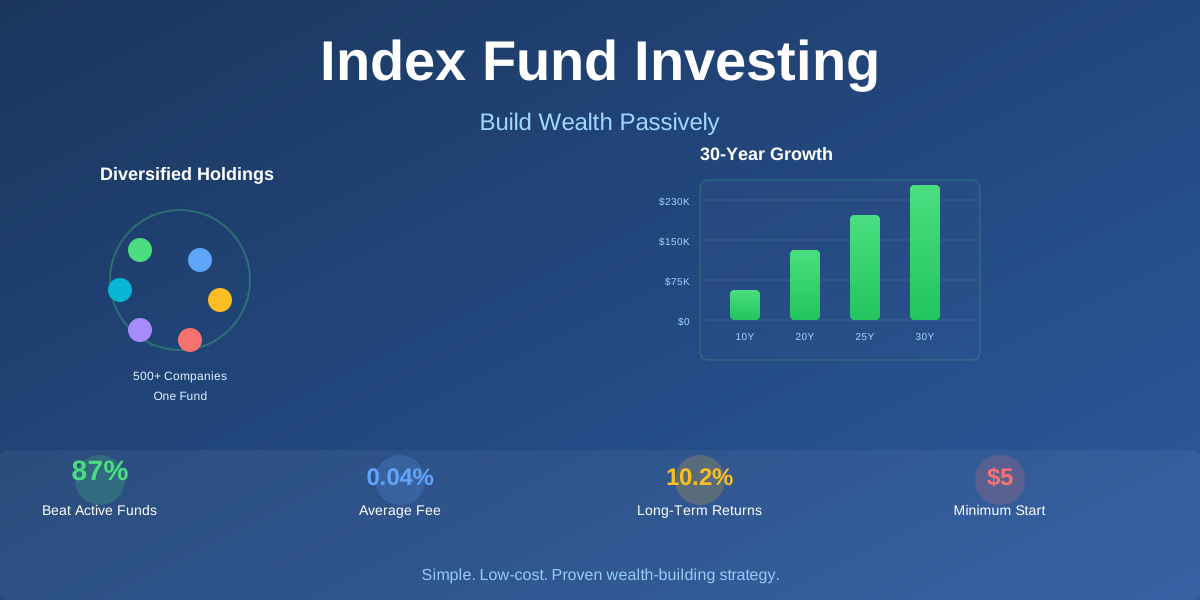
In 2026, index funds are no longer exotic investments for sophisticated traders; they're the foundation of modern wealth building for everyone from 20-year-old first-time investors to 60-year-old retirement planners.
This guide reveals how passive index fund investing works, why diversification through index funds beats stock picking, and how to start your journey with as little as $5.
What Is Index Fund Investing?
Index fund investing is a passive strategy where you buy a fund that automatically holds all (or representative samples) of the stocks in a financial index. An index is simply a basket of stocks chosen by a set formula—the S&P 500 tracks 500 large U.S. companies, the total stock market index includes 3,500+ U.S. stocks, and international indexes track foreign markets. Rather than paying a manager to handpick stocks, index funds follow the index automatically, cutting costs dramatically.
Not financial advice.
The power lies in simplicity: you're not trying to time the market, predict which companies will thrive, or pay 0.9% annual fees to active managers. Instead, you own the entire market (or a large slice of it) and pay fees as low as 0.015% yearly. This shift from active to passive has reshaped investing. In 2024, passive equity funds received $415 billion in new money while active funds lost $341 billion, according to the Investment Company Institute.
Surprising Insight: Surprising Insight: Only 13.2% of actively managed U.S. stock funds beat the S&P 500 in 2024, and this gap widens over longer periods. After 15 years, roughly 9 out of 10 active managers underperform their benchmark—yet investors still pay them higher fees.
Index Fund vs. Active Management: The Fee Impact
Visual comparison showing how expense ratios and performance differences compound over 30 years. A $10,000 investment in a 0.04% index fund grows to approximately $97,000, while the same investment in a 0.90% actively managed fund grows to around $71,000—a $26,000 difference due to fees alone.
🔍 Click to enlarge
Why Index Fund Investing Matters in 2026
In 2026, building wealth requires a strategy that works with time rather than against it. Index fund investing matters because traditional wealth-building paths—high-interest savings accounts offering 4.5% when inflation runs 3-4%, company pensions disappearing for private-sector workers, and job instability—have shifted responsibility for retirement to individuals. Index funds address this shift by offering automation, transparency, and historically proven returns. The S&P 500 has averaged 10.2% annual returns over 80+ years despite countless crashes, wars, and recessions.
Second, index funds democratize wealth. Starting with as little as $5 through fractional shares, you can own a piece of Apple, Microsoft, Walmart, and 497 other companies in an S&P 500 fund. This eliminates the barrier that once required thousands of dollars to diversify. Meanwhile, passive funds now dominate—they account for 57% of U.S. equity fund assets versus just 36% a decade ago, shifting market dynamics in your favor through lower costs and better liquidity.
Third, the psychological benefit of index investing reduces one of wealth's biggest killers: emotional decision-making. Data shows individual investors sell during crashes (locking in losses) and chase winners into bubbles (buying high). Index investing removes these temptations through a mechanical "buy and hold" approach. You set up automatic monthly contributions and let compounding work—research on Vanguard investors shows those who stayed invested through the 2008 crisis and market recoveries built substantially more wealth than those who tried timing the market.
The Science Behind Index Fund Investing
The science supporting index investing rests on the Efficient Market Hypothesis and decades of empirical data. The market prices securities efficiently as information flows in—meaning past stock performance doesn't predict future returns, and active managers can't consistently predict which stocks will outperform. Academic research from MIT, University of Chicago, and Vanguard confirms that expense ratios are the single strongest predictor of mutual fund returns. A 0.9% fee fund needs its managers to beat the market by 0.9%+ just to match a 0.04% index fund—a hurdle most can't clear consistently.
The research on performance gaps is striking: Morningstar tracked 3,900 actively managed U.S. stock funds and ETFs in 2024 and found 87% underperformed the S&P 500. Among the 13% that outperformed, most couldn't repeat the performance—the funds that beat the index one year frequently underperformed the next, suggesting luck rather than skill. This persistence problem is why legendary investor John Bogle called active management a "loser's game": before fees, stock markets are zero-sum (every buyer's gain is a seller's loss), but after fees, passive investors systematically win because they pay less.
Market Performance Compounding Over Time
Shows how the S&P 500's long-term average return of 10.2% compounds, turning modest monthly contributions into significant wealth. Starting with $200/month invested, after 10 years at historical returns you'd have ~$33,000; after 20 years ~$95,000; after 30 years ~$230,000—without a single stock-picking decision.
🔍 Click to enlarge
Key Components of Index Fund Investing
Index Selection: S&P 500 vs. Total Market
The S&P 500 includes 500 large-cap U.S. companies and accounts for roughly 80% of total U.S. stock market value. It's proven, well-known, and holds household names like Apple, Amazon, and Microsoft. Total market index funds include 3,500+ stocks—adding mid-cap and small-cap companies alongside large-caps. While total market offers fractionally more diversification, the performance difference is minimal (both heavily weight large-caps), and the S&P 500's dominance means it has better liquidity and lower fees. For beginners, the S&P 500 is simpler; for comprehensive exposure, total market is excellent. Both beat 87% of active funds.
Fund Vehicles: Mutual Funds vs. ETFs
Index funds come in two forms: mutual funds and exchange-traded funds (ETFs). Mutual funds are bought/sold once daily at closing price and typically require minimum investments ($3,000 for Vanguard, though many brokers offer $0 minimums through fractional shares). ETFs trade throughout the day like stocks on exchanges, often with no minimums because you can buy fractional shares. For passive investing, the differences are minimal—both track indexes with rock-bottom fees, both offer excellent tax efficiency through passive management, and both hold identical underlying stocks. Choose based on your broker's offerings and comfort level.
Fee Structures: The Hidden Wealth Killer
Expense ratios—annual fees charged as percentages—are where index funds shine. Fidelity's S&P 500 index fund charges 0.015% (lowest in 2024), Schwab charges 0.02%, and Vanguard charges 0.04%. Compare that to the 0.9% average for actively managed funds, and a tiny fee difference compounds dramatically. On a $100,000 investment, paying 0.04% costs $40/year while paying 0.90% costs $900/year—a $860 annual gap that grows to $50,000+ over 30 years after accounting for compounding. Always check the expense ratio before buying.
Diversification Within Your Portfolio
Index funds provide built-in diversification—the S&P 500 spreads risk across 500 companies across 11 sectors. However, portfolio diversification goes deeper. A balanced portfolio typically combines U.S. stock index funds with international stock index funds (for emerging market growth and currency hedging), bond index funds (for stability), and sometimes real estate index funds. A common beginner allocation is 85% stocks and 15% bonds; $200 invested could be $170 in a total U.S. stock market fund and $30 in a bond fund, creating a diversified portfolio immediately.
| Fund Name & Provider | Tracks | Expense Ratio |
|---|---|---|
| Fidelity ZERO Large Cap Index (FNILX) | S&P 500 (large-cap U.S.) | 0.015% |
| Vanguard 500 Index Fund Admiral (VFIAX) | S&P 500 (large-cap U.S.) | 0.04% |
| Vanguard Total Stock Market ETF (VTI) | Entire U.S. stock market | 0.03% |
| Schwab U.S. Broad Market ETF (SWTSX) | Entire U.S. stock market | 0.02% |
| Vanguard Total International Stock ETF (VXUS) | Non-U.S. developed & emerging markets | 0.08% |
How to Apply Index Fund Investing: Step by Step
- Step 1: Choose a brokerage platform: Select Fidelity, Vanguard, Schwab, or a low-cost broker like Webull or M1 Finance. Check for zero-commission stock/fund purchases and fractional share support.
- Step 2: Open an investment account: Create a brokerage account (regular taxable) or retirement account (401k, IRA). For most people starting out, a Roth IRA is optimal because contributions grow tax-free.
- Step 3: Fund your account: Link a bank account and make your first deposit. Start small—even $50 creates behavioral momentum. Set up automatic monthly deposits to benefit from dollar-cost averaging.
- Step 4: Research and select your index fund: Compare expense ratios on your chosen broker. For simplicity, pick one S&P 500 or total market fund. For diversification, use a 'three-fund portfolio': U.S. stock index, international stock index, bond index.
- Step 5: Place your first order: Search for your chosen fund by ticker symbol (e.g., FNILX, VFIAX, VTI) and enter your investment amount. You'll receive fractional shares if needed.
- Step 6: Set automatic monthly investments: Use your broker's automatic investment feature to invest a fixed amount monthly. This removes emotion and ensures consistent contributions.
- Step 7: Rebalance annually: Once yearly, adjust your portfolio back to your target allocation (e.g., 85% stocks / 15% bonds). Rebalancing forces you to sell winners and buy losers—the opposite of emotional trading.
- Step 8: Ignore short-term market noise: Markets drop 10%+ roughly once yearly and 20%+ roughly once per decade. During crashes, most people panic and sell at losses. Ignore this noise; historically every crash recovered within 3-5 years.
- Step 9: Track your progress quarterly: Review your account growth every 3 months, but don't obsess. Avoid daily checking, which encourages emotional decisions. Focus on whether you're meeting your savings rate, not daily price movements.
- Step 10: Increase contributions as income grows: As your salary increases, automatically bump up your monthly investment percentage. Small increases compound into massive wealth over decades.
Index Fund Investing Across Life Stages
Young Adulthood (18-35)
Young adults have the most powerful wealth-building tool: time. A 25-year-old investing $200 monthly into an S&P 500 index fund and holding until 65 accumulates roughly $1.2 million (adjusted for inflation). The same investment at 35 accumulates $600,000. In your 20s and early 30s, prioritize starting immediately over finding perfect funds—time in market beats timing the market. Use a Roth IRA ($7,000/year contribution limit for 2026) for maximum tax-free growth, then invest additional funds in a taxable brokerage account. Be aggressive: 90-100% stocks is appropriate because you have 30+ years to recover from crashes.
Middle Adulthood (35-55)
By 35-55, index fund investing is likely already paying dividends if you started earlier. Your focus shifts to optimization: ensure your allocation matches your goals (perhaps 70-80% stocks), maximize retirement account contributions (401k up to $23,500/year in 2026, IRA $7,000/year), and optimize tax efficiency by holding bonds in tax-advantaged accounts and stocks in taxable accounts. If you're just starting at 35, don't panic—you still have 30 years, which compounds nicely. The key is consistency: raise contributions with raises, rebalance annually, and avoid pulling money out early.
Later Adulthood (55+)
As retirement approaches (55-65), gradually reduce risk by increasing bond allocations from 15-20% to 30-40%, depending on your lifestyle needs and longevity expectations. Index investing remains ideal—you're not abandoning stocks (they still provide growth for potentially 30+ year retirements), but you're reducing volatility. Many advisors recommend keeping 5-7 years of expenses in cash/bonds to avoid selling stocks during downturns. After retirement, shift to taking withdrawals: the 4% rule suggests withdrawing 4% of your portfolio's initial value annually, adjusted for inflation—research shows this lasts 30+ years in most historical scenarios.
Profiles: Your Index Fund Investing Approach
The Nervous Beginner
- Simple entry point requiring minimal decisions
- Reassurance that one fund can build wealth
- Protection against emotional selling during crashes
Common pitfall: Freezing due to overwhelming options and fear of market timing.
Best move: Start with a single S&P 500 fund, set up automatic monthly investments, and hide your account for the first year to avoid panic selling. One fund + automatic deposits = 80% of success.
The Strategic Optimizer
- Data-driven fund selection and performance tracking
- Lowest possible fees and tax optimization
- Portfolio rebalancing strategies and asset allocation science
Common pitfall: Overthinking fund selection and spending hours on minor fee differences (0.04% vs. 0.015%) instead of maximizing contributions.
Best move: Choose three low-cost funds (U.S. stock, international stock, bonds), set allocation percentages (e.g., 60/20/20), automate everything, then ignore daily performance. The real wealth-builder is contribution amount, not fund tweaking.
The Busy Professional
- Complete automation with zero ongoing maintenance
- Target-date funds that adjust automatically as retirement approaches
- Integration with employer retirement plans (401k)
Common pitfall: Not maximizing employer 401k matches or delaying investing because the process feels complex.
Best move: Maximize your employer 401k match (free money!), invest 10-15% of salary into target-date index funds that auto-rebalance, then set it and forget it. This 30-minute setup generates decades of passive wealth.
The Sustainability Advocate
- Index funds aligned with ESG (environmental, social, governance) values
- Transparency on fund holdings and impact metrics
- Growth matching conventional index performance
Common pitfall: Believing ESG index funds underperform (they don't, after fees) or focusing only on ESG while ignoring fees.
Best move: Choose an ESG-screened index fund like Vanguard ESG U.S. Stock Index Fund (0.09% fee) or Fidelity U.S. Sustainability Index Fund, which provides ethical alignment without performance penalties. Returns match the broader market while supporting your values.
Common Index Fund Investing Mistakes
The biggest mistake is not starting because of perfectionism. Analysis paralysis—spending months comparing funds, waiting for the "perfect" entry point, or trying to time the market—means you miss actual years of returns. A $5,000 investment made imperfectly today beats a $10,000 investment made perfectly in 3 years. Start immediately with whatever low-cost fund is available; perfection isn't worth the delay.
Second, panic selling during crashes destroys wealth. The S&P 500 dropped 30% in 2008 during the financial crisis, but investors who held recovered fully by 2013 and tripled their money by 2024. Those who sold at the bottom missed the entire recovery. Research on Vanguard investor behavior shows that investors with automatic contributions who couldn't easily access their money built significantly more wealth than active traders.
Third, obsessing over tiny fee differences while ignoring contribution amounts. Saving an extra $50/month invested in index funds builds more wealth than spending 50 hours/year optimizing between 0.03% and 0.04% fees. A 0.01% fee difference on $10,000 costs $1/year. A $50/month increase invested for 30 years adds $230,000+ to your wealth. Focus energy accordingly.
Common Mistakes vs. Wealth Outcomes
Compares wealth accumulation for four investor types over 30 years: disciplined index investor ($230,000), panic seller during crash ($95,000), person waiting for perfect timing ($145,000), and fee-optimizer who started late ($110,000). Shows dramatically how starting immediately, staying invested, and ignoring noise dominate other factors.
🔍 Click to enlarge
Science and Studies
Decades of academic research and real-world data overwhelmingly support index fund investing. The evidence comes from peer-reviewed studies, fund performance analysis, and institutional investing trends. Here's what the research shows about why passive beats active and why index funds are foundational to modern wealth building:
- Morningstar 15-Year Persistence Study (2024): Analyzed 3,900 actively managed U.S. stock funds; only 13.2% beat the S&P 500 in 2024, and fewer than 10% maintain outperformance over 15-year periods, indicating performance is largely due to luck rather than skill.
- Vanguard Research on Investor Behavior: Tracked 500,000+ accounts across market cycles; investors with automatic investing and inability to easily access funds (like 401k) accumulated 50% more wealth than frequent traders despite similar market exposure.
- Fama-French Asset Pricing Research (University of Chicago): Nobel Prize-winning research showing that market returns are best explained by simple factors (market exposure, size, value) that index funds capture perfectly, while active management adds nothing after fees.
- S&P Dow Jones Global Indexes SPIVA Report (2024): Tracked 10,500 actively managed funds globally; 87% of U.S. equity funds underperformed their indexes over 15 years; similar patterns hold internationally.
- John Bogle Research Legacy: 50 years of data from Vanguard showing that funds with the lowest fees consistently outperform peers, and the lowest-fee passive index funds outperform 90%+ of actively managed funds over 20+ year periods.
Your First Micro Habit
Start Small Today
Today's action: Open an investment account and make your first deposit of $5-$50 into an S&P 500 index fund this week. No research paralysis, no waiting for the 'perfect' time—just open, fund, and buy one share fraction.
Action over perfection breaks analysis paralysis and starts compounding. A $50 investment made today + automatic $50/month contributions over 30 years becomes $230,000+. The psychological win of owning your first fund is worth more than choosing the perfect fund later.
Keep quitting habit apps after a missed day? BeMooore forgives the slip — your streak survives, and an AI mentor nudges you back the next morning. Free on iOS.
Quick Assessment
How would you describe your current investing experience?
Beginners benefit most from index funds; active investors often underperform and would gain from a passive transition. Your experience determines whether you should simplify or optimize.
What's your primary goal with investing?
Long-term retirement investing is index funds' strongest use case. Short-term goals need more conservative bonds. Income seeking requires dividend-focused funds. Speculation conflicts with index fund philosophy.
Which statement best describes your investing style?
Hands-off personalities thrive with index funds and automatic investing. Active managers fail 87% of the time, so your preference toward hands-on matters less than your discipline.
Take our full assessment to get personalized recommendations.
Discover Your Style →Next Steps
Index fund investing isn't complicated, but it requires action. Pick one brokerage (Fidelity, Vanguard, or Schwab are excellent), open an account this week, and invest your first $5-$50. Don't wait for the market to dip, don't wait for perfect fund selection, don't wait for a salary increase. Start today with whatever amount you can afford.
Your wealth-building journey compounds from this moment forward. A 25-year-old investing $200/month becomes a millionaire. A 35-year-old builds $600,000+. A 45-year-old still accumulates $160,000+. Every year you wait is money forever lost to compounding. The best time to plant a tree was 20 years ago; the second-best time is today.
Get personalized guidance with AI coaching.
Start Your Journey →Research Sources
This article is based on peer-reviewed research and authoritative sources. Below are the key references we consulted:
Related Glossary Articles
Frequently Asked Questions
Can I really build wealth with just $50/month?
Yes. Investing $50/month at the historical S&P 500 average return (10.2%) for 30 years grows to approximately $90,000 in today's dollars. Increase contributions as your income grows and that number approaches $230,000+. The key is starting immediately and staying consistent—time matters more than amount.
What if I buy at the market peak and it crashes right after?
This is a real fear but statistically irrelevant. Even if you invested at the absolute peak in 1999 (right before the crash), held through everything, and didn't invest again, you'd have made money by 2015 and substantial money by 2024. With regular monthly investments, you automatically buy more shares during crashes (dollar-cost averaging), which accelerates wealth building.
Is it too late to start investing at age 45?
No. A 45-year-old investing $300/month for 20 years until retirement accumulates approximately $160,000. While less than starting at 25, it's still substantial and better than zero. The power of compound interest works at any age; you just have less time to benefit.
Should I use a regular brokerage account or a retirement account (IRA/401k)?
Prioritize retirement accounts first—401k contributions reduce taxes (pre-tax) and often come with employer matching (free money). Max out your 401k match, then max out a Roth IRA (contributions grow tax-free forever), then use taxable brokerage accounts for additional investments. The tax advantages are substantial.
How often should I rebalance my portfolio?
Rebalance annually or when allocations drift more than 5% from targets. For example, if you target 80% stocks and 20% bonds but stocks have grown to 85%, sell some stocks and buy bonds to return to 80/20. This forces you to 'buy low and sell high'—the opposite of emotional trading.
Take the Next Step
Ready to improve your wellbeing? Take our free assessment to get personalized recommendations based on your unique situation.
- Discover your strengths and gaps
- Get personalized quick wins
- Track your progress over time
- Evidence-based strategies