How to Start a Rebalancing Strategy | Portfolio Managemen...
You've invested your money across different assets—stocks, bonds, cash—with carefully chosen percentages. But market moves have shifted your allocation. Your 60% stocks have grown to 70%, while bonds have shrunk to 25%. Without action, your portfolio drifts further from your original plan every quarter. Rebalancing brings it back. This isn't about chasing returns or timing markets. It's about maintaining the risk level you actually chose. By learning to rebalance effectively, you lock in gains, reduce unintended risk exposure, and stay true to your investment strategy. Whether you rebalance once yearly or when allocations drift past trigger thresholds, a structured approach separates confident investors from reactive ones.
Most people don't rebalance because they don't know where to start. They assume it requires constant monitoring or complicated trades. The truth is simpler: rebalancing is one of the few portfolio actions proven to reduce risk while staying aligned with your goals.
This guide walks you through every step—from assessing your current allocation to executing your first rebalance without triggering unnecessary taxes or fees. You'll discover which rebalancing method works best for your situation and learn how to automate it so it runs on its own.
What Is Rebalancing?
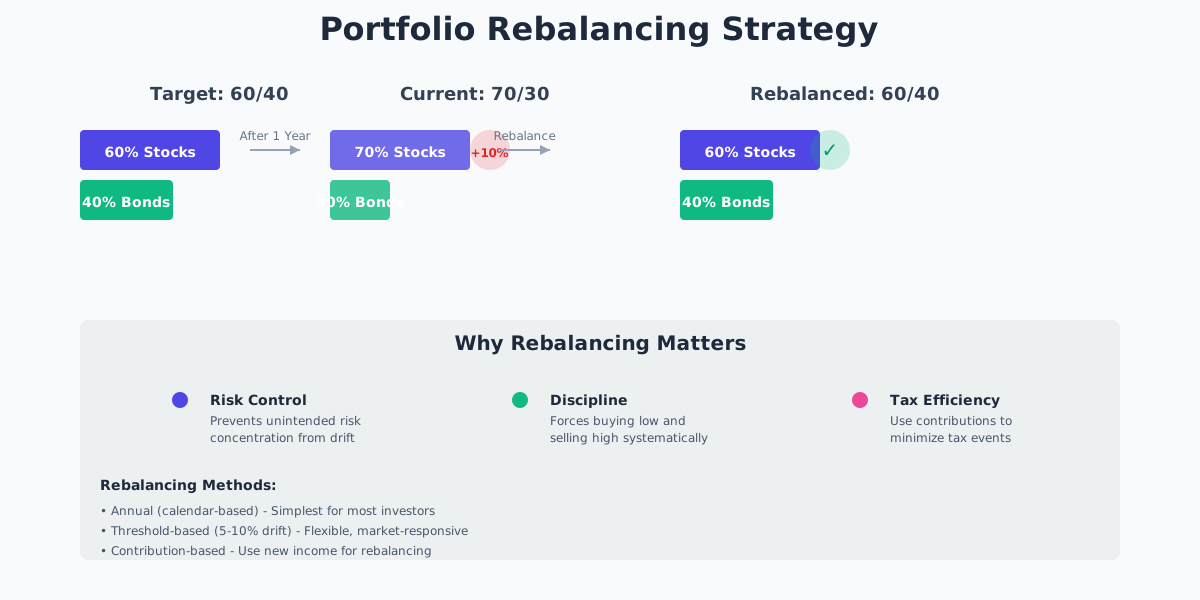
Rebalancing is the process of adjusting your portfolio back to your target asset allocation by selling investments that have grown larger than intended and buying those that have shrunk smaller than intended. If you chose a 60/40 portfolio (60% stocks, 40% bonds), but market movements have pushed it to 70/30, rebalancing means selling some stocks and buying bonds to return to 60/40. This isn't emotional. It's systematic. It forces you to sell high and buy low—the cornerstone of profitable investing.
Not medical advice.
Rebalancing matters because markets don't move equally. Over any given period, some assets outperform while others lag. Your portfolio becomes misaligned with your risk tolerance. A young investor who intended to take 70% equity risk but ended up with 80% equity risk is exposed to more volatility than planned. Conversely, a retiree who intended 40% equity risk but fell to 30% due to bond appreciation is taking on less growth opportunity than needed to sustain retirement. Rebalancing corrects these drifts systematically.
Surprising Insight: Surprising Insight: Research from Vanguard shows that annual rebalancing is often optimal. More frequent rebalancing (monthly or quarterly) can reduce returns by moving money out of winners too often. Less frequent rebalancing (every 2+ years) leaves your portfolio exposed to unintended risk. The sweet spot for most investors is once per year or when your allocation drifts 5-10% from target.
Portfolio Drift and Rebalancing Impact
Shows how market movements cause allocation drift over time, and how rebalancing realigns the portfolio to target allocation
🔍 Click to enlarge
Why Rebalancing Matters in 2026
In 2026, market volatility remains part of the investment landscape. Interest rate changes, inflation uncertainties, and sector rotation continue to create allocation drift. Investors who rebalance stay disciplined while those who don't drift toward unintended risk concentrations. This matters especially after a period of strong equity returns—many portfolios have become overweight stocks and underweight the bonds that provide stability.
Rebalancing also creates psychological stability. By following a plan rather than reacting to headlines, you avoid the emotional mistakes that cost investors dearly. Market crash? Your rebalanced portfolio forces you to buy when others panic. Market euphoria? Your rebalanced portfolio forces you to sell discipline. Both actions—counter to emotion—tend to improve long-term outcomes.
Tax efficiency has become more important as investors seek to keep more of their returns. Strategic rebalancing—using new contributions first, deploying dividends, or rebalancing within tax-deferred accounts—can cut your tax bill significantly while maintaining your target allocation. This is a tool most individual investors underutilize.
The Science Behind Rebalancing
Rebalancing reduces portfolio volatility by preventing any single asset class from dominating your holdings. When one asset grows much larger than intended, it increases your overall portfolio risk. By selling that asset and buying underweighted ones, you dampen volatility and reduce the chance of catastrophic losses if that asset class enters a downturn.
Research from multiple academic sources and institutions like Vanguard and T. Rowe Price confirms that rebalancing works best when it's systematic rather than emotional. Time-based rebalancing (yearly, quarterly) creates a mechanical discipline. Threshold-based rebalancing (triggered at 5% or 10% drift) adapts to market conditions. Both reduce sequence-of-returns risk—the danger that poor early returns in retirement can derail your entire plan.
Rebalancing Frequency Impact on Returns and Risk
Comparison of returns and volatility across different rebalancing frequencies from annual to biennial
🔍 Click to enlarge
Key Components of Rebalancing Strategy
1. Know Your Target Allocation
Before rebalancing, you must know what you're rebalancing toward. Your target allocation reflects your age, risk tolerance, time horizon, and financial goals. A 30-year-old with high risk tolerance might target 80% stocks and 20% bonds. A 65-year-old in retirement might target 50% stocks and 50% bonds. Your target is personal. It's determined by your situation, not by the market. This target becomes your anchor—the place you return to through rebalancing.
2. Track Your Current Allocation
Measuring drift requires knowing your current allocation across all holdings. If you have brokerage accounts at multiple institutions, this can be tedious but essential. Many platforms (Vanguard, Fidelity, Charles Schwab) offer consolidated views. Your current allocation is the sum of all your holdings—individual stocks, mutual funds, ETFs, bonds, cash—expressed as percentages. Document this snapshot as your baseline. This clarity prevents rebalancing mistakes.
3. Choose Your Rebalancing Method
Three primary methods exist: time-based (calendar), threshold-based (drift-triggered), and contribution-based (using new money). Time-based rebalancing is simplest—you rebalance on a set schedule (annually, quarterly). Threshold-based rebalancing triggers when an allocation drifts 5-10% beyond target. Contribution-based rebalancing (the most tax-efficient) directs new income and dividends to underweighted asset classes, avoiding sales and tax events entirely. For most individuals, annual time-based rebalancing is easiest to implement and maintain.
4. Execute With Tax Efficiency
Tax considerations separate advanced investors from beginners. If you're rebalancing in a taxable account, selling appreciated securities triggers capital gains taxes. Three tax-efficient tactics: (1) Rebalance inside 401(k)s and IRAs where trades are tax-deferred or tax-free. (2) Direct new contributions and dividend income to underweighted assets instead of selling winners. (3) Harvest tax losses—sell losers to offset gains in other positions. These approaches maintain your target allocation while minimizing tax drag.
| Method | Frequency | Best For |
|---|---|---|
| Time-Based (Annual) | Every 12 months | Disciplined investors, simple execution |
| Threshold-Based (5-10% Drift) | As needed | Active monitors, dynamic markets |
| Contribution-Based (Dividends/New Money) | Ongoing | Tax-efficient investors, taxable accounts |
How to Apply Rebalancing: Step by Step
- Step 1: Identify your target allocation by considering your age, risk tolerance, time horizon, and financial goals. Write it down. If unsure, a common baseline is: Age in bonds, remainder in stocks (30-year-old: 30% bonds, 70% stocks).
- Step 2: List all your holdings across every account (brokerage, 401k, IRA, Roth IRA). Include stocks, mutual funds, ETFs, bonds, money market funds, and real estate holdings.
- Step 3: Calculate your current allocation by taking each holding's value, dividing by total portfolio value, and converting to a percentage. Group by asset class (U.S. stocks, international stocks, bonds, cash).
- Step 4: Compare current allocation to target allocation. Identify which asset classes are overweight (above target) and underweight (below target). A 5% variance is noise; 10%+ requires attention.
- Step 5: Decide your rebalancing method: annual calendar date, drift threshold (5-10%), or contribution-based. Mark your choice on a calendar or set a phone reminder.
- Step 6: For calendar-based rebalancing, choose your rebalancing date (many pick their birthday or January 1). For drift-based, establish your monitoring frequency (quarterly check-ins work well).
- Step 7: When it's time to rebalance, direct new contributions and dividends to underweighted asset classes first. This avoids sales and minimizes taxes.
- Step 8: If contributions don't cover the allocation gap, execute trades carefully. Sell overweighted assets and buy underweighted ones in a single session to lock in the rebalance.
- Step 9: In taxable accounts, consider tax implications. Sell losing positions first (tax-loss harvesting). Keep winning positions in tax-advantaged accounts where possible.
- Step 10: Document your rebalance with a simple spreadsheet: date, old allocation percentages, new allocation percentages, trades executed, and any tax events. This record helps you learn and refine your approach.
Rebalancing Across Life Stages
Young Adulthood (18-35)
In your twenties and thirties, time is your greatest asset. Your portfolio can weather equity volatility. A typical target allocation might be 80-90% stocks and 10-20% bonds. Rebalancing at this stage is more about discipline-building than survival. You're establishing habits that compound into decades of advantage. Young adults should rebalance annually or when drift exceeds 10%. Most contributions during this stage are new money—perfect for directing toward underweighted assets without selling appreciated positions.
Middle Adulthood (35-55)
The middle years require balancing growth with stability. A typical allocation might shift to 60-70% stocks and 30-40% bonds. This is when rebalancing becomes truly valuable—you have enough assets that drift creates material risk. A portfolio that's drifted to 80% stocks instead of your intended 70% exposes you to unnecessary volatility. Rebalance annually or at 5-7% drift. This period often includes large contributions (401k, bonuses), making contribution-based rebalancing highly effective and tax-efficient.
Later Adulthood (55+)
As retirement approaches, protecting capital becomes critical. Allocations might shift to 40-50% stocks and 50-60% bonds. Rebalancing here serves a crucial function: it ensures you have enough stable assets to cover near-term needs while maintaining growth. Rebalance annually or at 3-5% drift. This is the stage where tax-efficient rebalancing (using dividends and new contributions) matters most, as large sales would trigger substantial capital gains taxes. Many investors shift rebalancing to accounts within retirement plans (IRAs) first, then tax-deferred if needed.
Profiles: Your Rebalancing Approach
The Hands-Off Investor
- Set-it-and-forget-it simplicity
- Minimal monitoring or adjustments
- Automatic dividend reinvestment to underweighted assets
Common pitfall: Ignoring portfolio drift for years, ending up with unintended risk exposure
Best move: Choose annual calendar-based rebalancing (January 1 or birthday). Set a phone reminder. Use robo-advisors that rebalance automatically. This investor avoids being overwhelmed by complexity.
The Active Monitor
- Regular portfolio reviews
- Flexibility to respond to market conditions
- Control over trade timing and tax decisions
Common pitfall: Over-monitoring and rebalancing too frequently, triggering unnecessary taxes and fees
Best move: Use threshold-based rebalancing with 5-7% drift triggers. Conduct quarterly reviews but only act when thresholds are breached. This approach satisfies the need for control without overdoing it.
The Tax Optimizer
- Strategies to minimize tax events
- Ability to coordinate multiple accounts
- Long-term tracking of cost basis and losses
Common pitfall: Overcomplicating rebalancing with excessive tax tactics, missing the core benefit of staying aligned with targets
Best move: Prioritize rebalancing within 401(k)s and IRAs first (tax-free). Use contribution-based rebalancing in taxable accounts. Harvest losses strategically. This investor maximizes after-tax returns.
The Goal-Driven Investor
- Rebalancing aligned with specific financial milestones
- Regular progress tracking toward targets
- Confidence that rebalancing supports long-term goals
Common pitfall: Abandoning rebalancing discipline during market downturns, panicking instead of rebalancing
Best move: Connect rebalancing to a specific financial goal (retirement date, college funding, home purchase). Review rebalancing alongside goal progress annually. This investor sees rebalancing as a tool serving larger purpose.
Common Rebalancing Mistakes
The first mistake: ignoring rebalancing entirely because it seems complicated. Many investors think rebalancing means active trading and expert analysis. It doesn't. Rebalancing is mechanical and simple—even an hour per year suffices for most people. By delaying, you allow drift to accumulate, unintentionally increasing risk.
The second mistake: rebalancing too frequently. Rebalancing every month or quarter generates transaction costs (fees, bid-ask spreads) and triggers short-term capital gains taxes. For most investors, annual rebalancing balances the need for discipline with the costs of trading. Less frequent rebalancing (every 2+ years) allows too much drift; more frequent rebalancing eats returns through costs.
The third mistake: not accounting for taxes. In taxable accounts, selling appreciated securities triggers capital gains taxes. Savvy investors direct new contributions and dividends to underweighted assets first, minimizing tax events. They rebalance within tax-advantaged accounts (401k, IRA) when possible. By ignoring taxes, you can negate rebalancing's benefits through unnecessary tax drag.
Rebalancing Mistakes and How to Avoid Them
Common errors in rebalancing execution and practical solutions to stay on track
🔍 Click to enlarge
Science and Studies
Research from academic institutions and major investment firms confirms rebalancing's effectiveness. Studies show that regular rebalancing reduces portfolio volatility without significantly harming long-term returns. More importantly, rebalancing helps investors stay the course during market downturns—a behavioral benefit that's hard to quantify but crucial for success.
- Vanguard's research on rational rebalancing shows that annual rebalancing is optimal for most investors, balancing risk reduction with transaction costs and taxes.
- T. Rowe Price studies demonstrate that threshold-based rebalancing (triggered at 5% drift) works well for investors who can monitor quarterly but prefer not to fix a rigid calendar schedule.
- Morningstar analysis reveals that rebalancing before major market moves (detected through drift monitoring) helps investors avoid being caught off-guard by sudden market shifts.
- Charles Schwab research confirms that tax-loss harvesting combined with rebalancing provides dual benefits: reduced taxes and portfolio alignment.
- Fidelity studies show that investors who rebalance systematically achieve higher risk-adjusted returns than those who either never rebalance or rebalance reactively during market stress.
Your First Micro Habit
Start Small Today
Today's action: Schedule your first rebalancing review: Pick a date (today is perfect), list all your holdings and their current values, calculate what percentage of your portfolio each represents, and compare to your target allocation. Even if you don't execute any trades, completing this assessment establishes the foundation for disciplined rebalancing.
Assessment creates clarity. Most investors don't know their actual allocation—they have vague ideas about their portfolio composition. This micro habit changes that. Once you know your allocation, rebalancing becomes obvious rather than mysterious. The knowledge compounds—next month, it takes five minutes instead of thirty.
Track your rebalancing schedule and get personalized AI coaching with our app.
Quick Assessment
How often do you currently monitor your portfolio allocation?
Your monitoring frequency shapes your rebalancing approach. If you never monitor, calendar-based annual rebalancing works well. If you monitor regularly, threshold-based rebalancing lets you act when drift is meaningful.
What matters most to you in rebalancing?
Your priority determines your method. Simplicity favors annual calendar rebalancing. Tax minimization favors contribution-based and tax-loss harvesting approaches. Flexibility favors threshold-based rebalancing. Returns improve most through systematic discipline.
How much drift from your target allocation concerns you?
Your drift tolerance shapes rebalancing frequency. Tight tolerance (under 5%) suggests quarterly or threshold-based rebalancing. Wider tolerance (10%+) supports annual rebalancing. Clear thresholds remove emotion from decisions.
Take our full assessment to get personalized recommendations.
Discover Your Style →Next Steps
Rebalancing is not complex, but it requires commitment. The difference between investors who rebalance and those who don't compounds over decades. Those who rebalance systematically experience less volatility, sleep better during market crashes, and end retirement with more wealth—not from better returns, but from disciplined risk management.
Your next step is specific: Calculate your current allocation this week. Write down your target allocation. Choose your rebalancing method (annual, threshold, or contribution-based). Set a reminder. Execute your first rebalance. The moment you complete these steps, you've joined the discipline-driven investor category. From there, it's automatic—a habit that protects and grows your wealth.
Get personalized guidance with AI coaching.
Start Your Journey →Research Sources
This article is based on peer-reviewed research and authoritative sources. Below are the key references we consulted:
Related Glossary Articles
Frequently Asked Questions
How often should I rebalance my portfolio?
For most investors, annual rebalancing is optimal. This balances the discipline of regular adjustment with transaction costs and taxes. However, if your portfolio drifts more than 5-10% from targets (faster in volatile markets), rebalancing at that threshold makes sense. Rebalancing more than quarterly typically reduces returns through excess costs without meaningful risk reduction.
Do I have to rebalance immediately, or can I use new contributions?
Using new contributions is tax-efficient and often better. Instead of selling appreciated positions and triggering taxes, direct new income, dividends, and contributions to underweighted asset classes. This achieves rebalancing without a tax bill. Only sell and trade if contributions can't fully rebalance your portfolio within a reasonable timeframe.
What if I have multiple accounts (401k, brokerage, IRA)?
Rebalance strategically across accounts. First priority: rebalance within 401(k)s and IRAs (no taxes). Second: rebalance in Roth IRAs (tax-free growth). Last: rebalance in taxable accounts (consider tax implications). Many investors view all accounts as one portfolio for asset allocation purposes but execute trades where taxes are minimized.
Should I rebalance during market downturns?
Yes, and this is where rebalancing shows its power. When markets crash, your stock-heavy portfolio becomes even heavier. Rebalancing forces you to buy stocks when prices are low (and others are selling). This is counterintuitive but profitable. Discipline, not emotion, wins long-term. Stick to your rebalancing plan through all market cycles.
What about rebalancing in retirement when I'm withdrawing money?
In retirement, rebalance by withdrawing from overweighted asset classes first. If your portfolio has drifted to 60% stocks instead of your intended 50%, withdraw from your stock holdings until the allocation is correct. This achieves rebalancing while reducing overall portfolio size. No new contributions required—the withdrawals do the work.
Take the Next Step
Ready to improve your wellbeing? Take our free assessment to get personalized recommendations based on your unique situation.
- Discover your strengths and gaps
- Get personalized quick wins
- Track your progress over time
- Evidence-based strategies