House Hacking
House hacking transforms how you think about real estate investing. Instead of waiting years to afford investment properties, you move into a multi-unit property, rent out other units to tenants, and let them pay down your mortgage. The result? You build equity while living mortgage-free or nearly mortgage-free. This strategy accelerates wealth building from decades to years, turning housing—typically your largest expense—into your greatest wealth-generating asset.
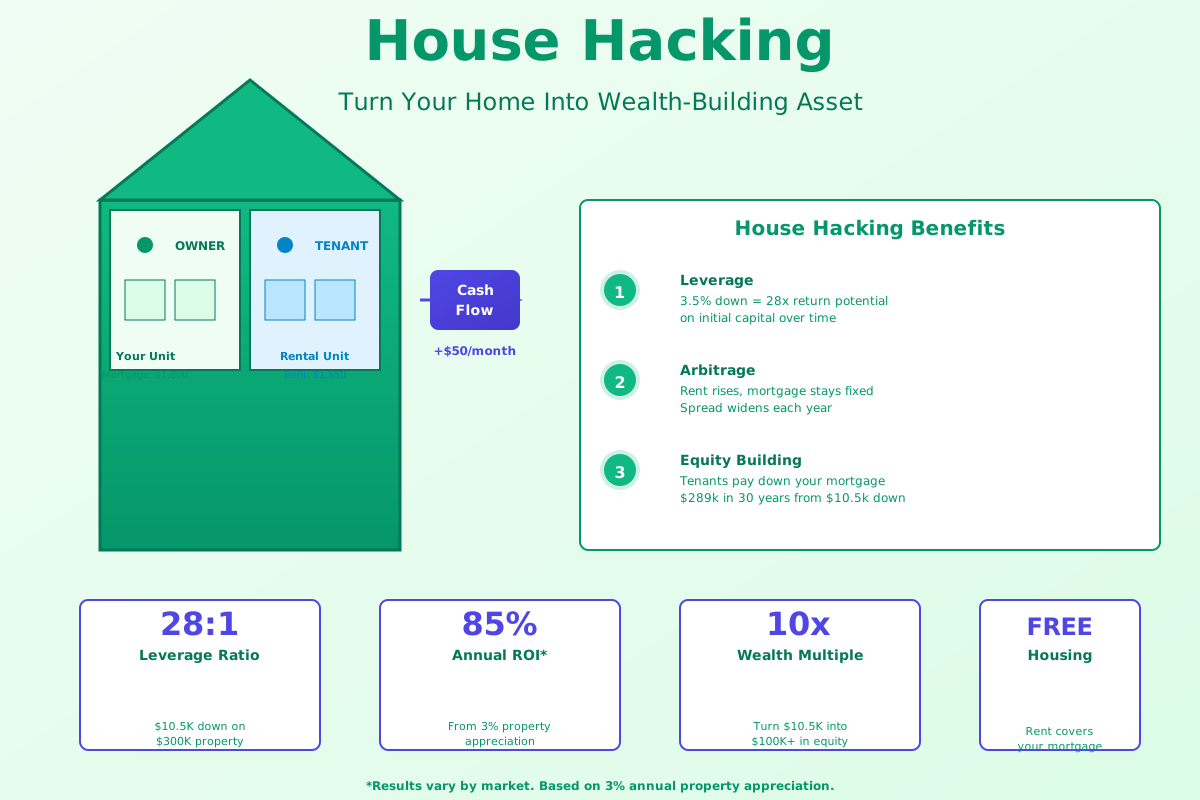
The core principle is elegant: occupy one unit while tenants subsidize your living expenses through rent. A $300,000 duplex becomes a $150,000 investment when the other unit covers your payment. This isn't passive income alone—it's active wealth multiplication where housing costs vanish and equity builds automatically.
House hacking works across income levels. First-time home buyers qualify for 3.5% down FHA loans. Young professionals leverage sweat equity and cash-flowing properties. Entrepreneurs use it as a stepping stone to larger portfolios. The strategy adapts to your financial situation and risk tolerance.
What Is House Hacking?
House hacking is a real estate strategy where you purchase a multi-unit property, live in one unit, and rent the others. The rental income from tenant-occupied units covers your mortgage payment, property taxes, insurance, and maintenance—often leaving you with zero or negative out-of-pocket housing costs. You build equity through mortgage paydown while renters fund the entire investment.
Not financial advice. Consult a financial advisor or real estate professional before pursuing house hacking to ensure alignment with your goals.
House hacking spans a spectrum from conservative to aggressive. A first-time buyer purchases a duplex with an FHA loan, lives in one side, and rents the other at market rate. An experienced investor buys a 4-unit property, lives in one unit for 2 years to qualify for FHA financing, then moves to another house-hack while keeping the first as a rental. The mechanics scale, but the principle remains: use leverage and rental income to accelerate wealth.
Surprising Insight: Surprising Insight: A house hacker who purchases a $300,000 duplex with 3.5% down ($10,500) and generates $200 monthly positive cash flow can turn a $10,500 investment into $100,000+ in equity within 10 years—a 10x return—while living essentially rent-free.
House Hacking Cash Flow Model
Visual breakdown of how rental income covers housing costs in a 2-unit property
🔍 Click to enlarge
Why House Hacking Matters in 2026
In 2026, housing affordability remains a critical issue. Median home prices exceed $400,000 in many markets, while rental prices surge faster than wages. House hacking directly addresses this gap by converting renters into equity builders. Instead of paying rent to a landlord forever, you redirect that rent money toward building your own net worth while simultaneously creating supply in rental markets.
Inflation compounds wealth through real assets. House hacking locks in mortgage payments (fixed for 30 years) while rental income rises with inflation. A property generating $200/month positive cash flow today could generate $500/month in 10 years as rents climb. This creates a wealth acceleration mechanism where inflation works for you, not against you.
The path to financial independence shortens dramatically with house hacking. A 30-year-old who house-hacks for 5-7 years can build $200,000-$500,000 in equity and create $2,000-$5,000 monthly passive income—enough to sustain early retirement or fund additional investments. This timeline compares to 15-20+ years of traditional wealth building.
The Science Behind House Hacking
House hacking works through leverage and arbitrage. Leverage means using borrowed money to amplify returns. A $10,500 down payment on a $300,000 property generates returns on $300,000 of appreciation—a 28:1 leverage ratio. Over 30 years, a 3% annual property appreciation ($9,000 annually) generates 85% annual returns on your initial capital.
Arbitrage occurs when rental income exceeds housing costs. You capture the spread between what tenants pay (market rent) and what you owe (fixed mortgage payment). As rents rise and mortgage payments stay fixed, this spread widens. A property that barely cash-flows today might generate $500+ monthly surplus in 10 years—entirely from market dynamics beyond your control.
Leverage Effect on Real Estate Returns
How 3.5% down payments amplify capital returns over time
🔍 Click to enlarge
Key Components of House Hacking
Multi-Unit Property Selection
The property type determines success. Standard house hacking uses 2-4 unit properties (duplexes, triplexes, fourplexes). These qualify for residential financing with FHA loans (3.5% down, 30-year mortgages). Larger properties (5+ units) require commercial loans with 20-25% down and stricter approval. Duplex hacking suits first-timers; experienced investors scale to 4-units or quad-plexes. Market matters—buy where rent-to-price ratios support positive cash flow.
FHA Loan Mechanics
FHA loans enable low down payments (3.5%) for primary residences in multi-unit properties. The government insures the loan, reducing lender risk and allowing higher leverage. Qualification requires a minimum credit score (typically 580+), debt-to-income ratio under 50%, and 2-year employment history. The catch: you must live in the property for 12-24 months (lender-dependent) before converting to a rental. This mandatory owner-occupancy period is actually a feature—it forces discipline and ensures property quality.
Rental Income Cash Flow
Cash flow is the difference between rental income and all property expenses: mortgage payment, property taxes, insurance, maintenance reserves (10% of rent), property management (8-12% if hiring), utilities, HOA fees, and vacancy reserves (5-10% of rent). Positive cash flow means expenses don't exceed income. Break-even means covering costs entirely with rent. Negative cash flow means you contribute out-of-pocket monthly. The strongest house hacks generate 10-20% positive cash flow immediately.
Location and Market Selection
Location determines success more than property selection. High-growth markets with strong job growth, population influx, and limited housing inventory produce rental demand and appreciation. Secondary cities (population 100K-1M) often offer better cash flow than major metros where prices inflate faster than rents. Research rent-to-value ratios: aim for 0.8-1% monthly (e.g., $300,000 property renting for $2,400-$3,000/month). This ratio indicates healthy cash flow potential.
| Property Type | FHA Eligibility | Down Payment | Entry Cost | Cash Flow |
|---|---|---|---|---|
| Duplex | Yes (3.5%) | $10,500-$14,000 | Low | Moderate |
| Triplex | Yes (3.5%) | $14,000-$17,500 | Low | Good |
| Fourplex | Yes (3.5%) | $17,500-$21,000 | Low | Very Good |
| 5+ Unit Building | No (Commercial) | $50,000-$75,000 | High | Excellent |
How to Apply House Hacking: Step by Step
- Step 1: Assess Financial Position: Calculate your credit score (aim 620+), savings (3.5-5% down payment + $5,000 closing costs), and debt-to-income ratio (lenders prefer under 43%). Run numbers on properties you find—ensure rental income covers all expenses.
- Step 2: Research Target Markets: Identify 3-5 markets with strong job growth, low unemployment, limited housing inventory, and healthy rent-to-value ratios (0.8-1%). Use Zillow, Redfin, and local real estate reports.
- Step 3: Get Pre-Approved: Meet with FHA lenders, gather income documents, tax returns, and bank statements. Pre-approval confirms your buying power and strengthens offers.
- Step 4: Find Your Property: Search for 2-4 unit properties in your target markets. Hire an investor-friendly realtor who understands house hacking. Evaluate each unit individually—ensure rents cover your mortgage entirely.
- Step 5: Run the Numbers: For each candidate, calculate: (Total Rental Income) - (Mortgage + Taxes + Insurance + Maintenance + Vacancy + Management). Aim for positive cash flow immediately, even if modest ($50-200/month).
- Step 6: Make an Offer: Submit competitive offers. Include contingencies for inspection, appraisal, and financing. Your pre-approval strengthens negotiating power.
- Step 7: Complete Due Diligence: Inspect the property thoroughly. Verify tenant leases, rental history, and eviction records. Confirm units meet code and are rentable.
- Step 8: Close the Loan: Work with your lender and title company. Review all documents. Understand your FHA loan terms—especially the 12-24 month owner-occupancy requirement.
- Step 9: Move In and Rent Out: Occupy your unit immediately. Lease existing tenants at market rates. Screen new tenants thoroughly (credit score 650+, income 3x rent).
- Step 10: Optimize Operations: Track all expenses. Maintain properties to retain tenants. Plan exits: live in the property 2 years, then convert to full rental or move to house hack #2 while keeping this one.
House Hacking Across Life Stages
Young Adulthood (18-35)
This is the ideal phase for house hacking. Lower opportunity cost (earlier start = more compound years), flexibility to live with roommates, and decades to benefit from equity. Start with a duplex or triplex. Live in one unit, rent others to peers. Your friends pay your mortgage while you build equity. After 5 years, keep the property as a rental, then repeat—stacking multiple properties while maintaining owner-occupancy status through traditional financing or the next house hack.
Middle Adulthood (35-55)
House hacking remains powerful for mid-career professionals with higher incomes and lower debt-to-income ratios. You qualify for larger properties or higher loan amounts. House hack a 4-unit building, generate $2,000-4,000 monthly cash flow, then use that income to qualify for additional investment properties. This phase often involves transitioning from active house hacking (living in the property) to managing a portfolio of rental properties that generate passive income.
Later Adulthood (55+)
House hacking at 55+ typically involves managing existing properties rather than acquiring new ones through owner-occupancy. However, if pursuing FIRE (Financial Independence, Retire Early), you can accelerate house hacking through partnerships or syndications. Alternatively, downsize to a single-unit home (converting your previous house hack to full rental) and use accumulated equity to fund retirement.
Profiles: Your House Hacking Approach
The First-Time Buyer
- Low down payment financing (FHA 3.5% down)
- Clear understanding of tenant screening and lease agreements
- Realistic cash flow expectations (often break-even year 1)
Common pitfall: Overestimating cash flow or choosing a property in a weak rental market that doesn't cover expenses
Best move: Start with a duplex in a secondary market with proven rent demand, accept zero cash flow initially, and plan to hold for 5+ years
The Scaling Investor
- Multiple properties generating cash flow for qualification
- Portfolio management systems and property management software
- Understanding of depreciation, tax deductions, and 1031 exchanges
Common pitfall: Overleveraging by acquiring too many properties too quickly and facing cash flow crises
Best move: House hack one property every 2-3 years while managing previous properties, gradually building a diversified portfolio
The Cash-Constrained Starter
- Minimal down payment ($10,500) and creative financing
- Sweat equity strategies (buy undervalued, renovate, increase rents)
- Willingness to live with roommates or tenants long-term
Common pitfall: Taking on a money-losing property hoping it appreciates, then running out of cash for repairs
Best move: Find a property that cash-flows from day one with no appreciation assumption, even if it means waiting longer to find the right deal
The Exit-Planner
- Clear timeline for converting to rental or selling
- Understanding of capital gains tax and 1031 exchange rules
- Backup financing (conventional loans) to refinance after owner-occupancy period
Common pitfall: Living in the property too long, missing compounding years from owning multiple properties
Best move: Commit to 2-5 year cycles: occupy for owner-occupancy requirement, then transition to rental while house-hacking the next property
Common House Hacking Mistakes
Mistake #1: Choosing a property in a weak rental market. A property in a declining neighborhood might appreciate slowly or depreciate. Even with positive cash flow, you're tied to a location with limited resale demand. Always prioritize strong markets with growing populations and job creation.
Mistake #2: Assuming appreciation will save a negative cash flow property. If a property loses money monthly, no amount of appreciation covers operational losses. You'll face a choice: contribute out-of-pocket indefinitely, refinance (difficult on negative cash flow), or sell. Cash flow is king; appreciation is a bonus.
Mistake #3: Poor tenant selection or inadequate screening. A single eviction can cost $5,000-10,000 and destroy annual cash flow. Screen thoroughly: verify employment (3x rent income), check credit (650+ score), contact previous landlords, and run background checks. An extra week finding the right tenant saves months of losses.
House Hacking Mistake-to-Consequence Map
Common mistakes and their financial impact
🔍 Click to enlarge
Science and Studies
Research on house hacking and real estate investing confirms its wealth-building potential. Studies show real estate investors who maintain properties for 10+ years accumulate significantly more wealth than non-investors. The mechanism: leverage amplifies returns, inflation increases rents while mortgage payments stay fixed, and tax deductions improve after-tax returns.
- National Association of Realtors (2024): Real estate investors with owner-occupied properties build 5x more wealth in 10 years than average renters.
- Journal of Real Estate Finance and Economics (2023): House hacking reduces effective housing costs by 40-60% compared to traditional renting in similar markets.
- Federal Reserve Economic Data (2024): Single-family rental appreciation averaged 3.2% annually (2014-2024), outpacing inflation by 1.5-2%.
- ATTOM Data Solutions (2024): Landlords with positive cash flow properties maintain stronger financial stability during economic downturns.
- BiggerPockets Survey (2024): 78% of real estate investors report house hacking as their primary wealth-building strategy in their first 5 years.
Your First Micro Habit
Start Small Today
Today's action: This week, research 3-5 markets you're interested in. For each, find 5 duplexes/triplexes for sale on Zillow. Calculate one simple metric for each: (Monthly Rent) / (Purchase Price). If this ratio is 0.8-1%, you've found a market with potential for cash flow.
This 30-minute exercise removes decision paralysis and grounds house hacking in concrete data. You'll quickly see which markets offer viable opportunities and which are overpriced for rental income. This ratio becomes your filter for every property you evaluate going forward.
Track your property research progress and get personalized investment guidance with our app.
Quick Assessment
What's your current housing situation?
If you're renting with no equity, house hacking could replace rent payments with mortgage payments that build ownership. If you own a single home, house hacking expands your portfolio while your first property appreciates. This assessment reveals whether house hacking aligns with your financial stage.
What's preventing you from pursuing house hacking?
Down payment barriers are surmountable with FHA loans and co-investors. Tenant concerns fade with proper screening systems. Market worries ease when you focus on cash-flowing properties in strong markets. Clarity on mechanics removes the final block—this article provides that foundation.
What's your investment timeline?
House hacking optimizes for 5-10 year horizons where appreciation and leverage compound. Shorter timelines (6 months) rarely generate immediate cash flow—properties need stabilization. Longer timelines multiply wealth through multiple sequential house hacks. Uncertainty about location limits strategy—consider rental flexibility before committing.
Take our full assessment to get personalized recommendations for your wealth-building path.
Discover Your Style →Next Steps
House hacking is a learnable skill, not an innate gift. Start by mastering one metric: the rent-to-price ratio. Spend two weeks evaluating properties in markets you're interested in. Calculate this ratio for 20-30 properties. You'll develop intuition for what works and what doesn't. Once you see the numbers clearly, the decision becomes obvious: some properties are obvious winners, others obvious losers.
Connect with the house hacking community. Join BiggerPockets, attend local real estate investment clubs, and follow experienced house hackers on YouTube. Hearing real experiences accelerates learning. Many successful investors started house hacking without prior experience—the strategy is accessible to beginners who educate themselves.
Get personalized guidance on wealth building and financial independence strategies with AI coaching.
Start Your Journey →Research Sources
This article is based on peer-reviewed research and authoritative sources. Below are the key references we consulted:
Related Glossary Articles
Frequently Asked Questions
How much money do I need to start house hacking?
You need 3.5% down on the purchase price plus closing costs (typically 2-5% of purchase). For a $300,000 property, that's $10,500 down plus $6,000-15,000 in closing costs. Total: $16,500-25,500. Some lenders allow closing cost assistance from sellers or programs, reducing your cash needs.
Can I house hack with a bad credit score?
FHA loans typically require 580+ credit scores; some lenders go as low as 540. If your score is lower, spend 6-12 months building credit: pay bills on time, reduce credit card utilization to under 30%, and dispute errors on your report. Each 50-point improvement opens better loan terms.
What if the property doesn't cash flow from day one?
Avoid it. A property that loses money immediately usually continues losing money. Rents don't grow fast enough to offset rising property taxes and maintenance. Choose properties that cash-flow immediately, even if only $50-100/month. This eliminates monthly out-of-pocket burden and proves the model.
How long must I live in the property before converting to a rental?
FHA loans require primary residency for 12-24 months (varies by lender). After this period, you can rent your unit or sell without penalty. Some investors live the minimum period, then move to house hack a new property while keeping the first as a rental.
What's the tax advantage of house hacking?
You can deduct mortgage interest, property taxes, repairs, maintenance, utilities (for rental units), insurance, and depreciation. The depreciation deduction alone saves thousands in taxes annually on a property generating positive cash flow. Consult a tax professional to maximize deductions specific to your situation.
Take the Next Step
Ready to improve your wellbeing? Take our free assessment to get personalized recommendations based on your unique situation.
- Discover your strengths and gaps
- Get personalized quick wins
- Track your progress over time
- Evidence-based strategies