Finance and Investing
Finance and investing form the foundation of sustainable wealth building. These interconnected disciplines help you understand how money flows, grows, and multiplies over time. Whether you're starting with your first paycheck or optimizing a six-figure portfolio, mastering the fundamentals of finance and investing is essential for achieving financial freedom. The journey to wealth isn't just about earning more—it's about making your money work smarter through strategic investing, calculated risk-taking, and disciplined financial management.
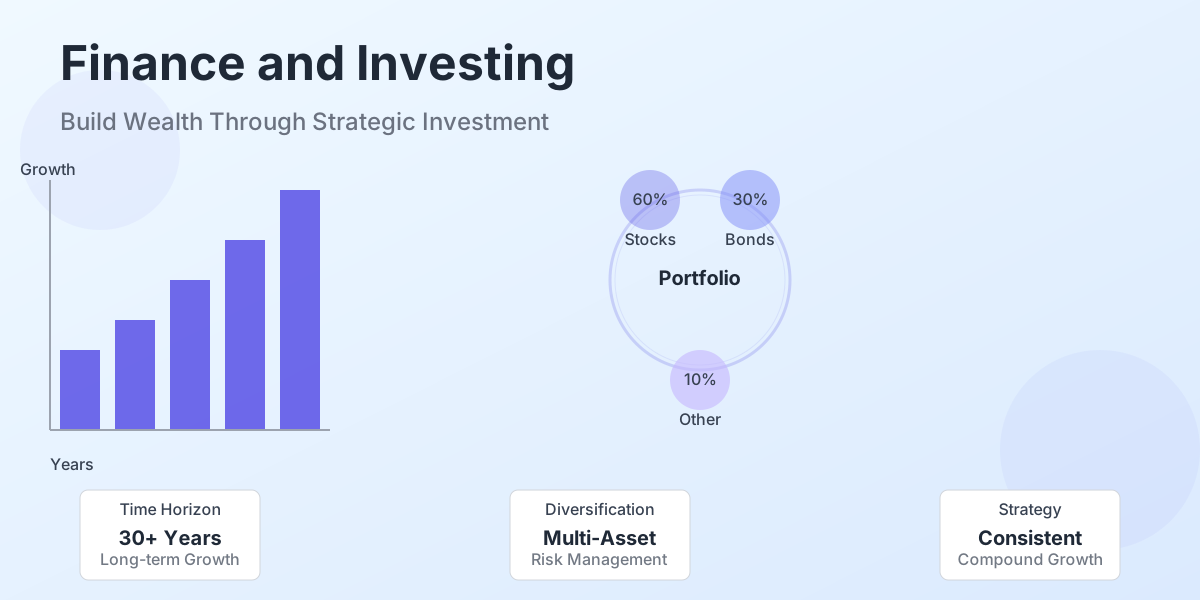
In 2026, investment opportunities have evolved dramatically. AI-driven capital spending is supporting economic growth, market fundamentals are strengthening with accelerating earnings growth, and successful investors are shifting from broad market chasing to selective, strategy-driven approaches.
This guide explores the essential components of finance and investing, providing you with actionable strategies to build wealth regardless of where you're starting from.
What Is Finance and Investing?
Finance is the science and practice of managing money, while investing is the strategic deployment of that money into assets expected to grow. Finance encompasses budgeting, saving, borrowing, and financial planning—the foundational skills needed to manage your income and expenses. Investing takes those saved resources and puts them into vehicles like stocks, bonds, real estate, and other assets designed to generate returns over time. Together, they create a comprehensive system for building lasting wealth.
Not medical advice.
The distinction between finance and investing is crucial. Finance manages what you have; investing multiplies what you have. A person with strong financial discipline but no investment strategy might save money but watch it lose purchasing power to inflation. Conversely, someone who invests without financial discipline may make risky decisions and lose capital. The optimal approach combines both: solid financial management creates the foundation, while strategic investing builds wealth acceleration.
Surprising Insight: Surprising Insight: 78% of people with a formal financial plan report confidence in their wealth-building strategy, compared to only 26% without a plan—the difference between success and hoping for the best.
The Finance and Investing Ecosystem
Shows how savings flow through diversified investments to create wealth growth
🔍 Click to enlarge
Why Finance and Investing Matter in 2026
The financial landscape in 2026 presents unique opportunities and challenges. AI capital spending is estimated to boost economic growth by 1.5%, expanding economy-wide revenues by $1.1 trillion. This creates new investment categories and opportunities for diversified portfolios. Additionally, earnings per share growth has accelerated to 12% from just 3% year-over-year, signaling strengthening market fundamentals beyond just technology sectors.
Secondly, the shift from broad market gains to selective investing requires smarter decision-making. Gone are the days of passive gains across all investments. Success in 2026 demands thoughtful position sizing, focused on high-probability outcomes. This shift makes financial literacy and investment knowledge more valuable than ever—those who understand the fundamentals will outperform those who chase trends.
Third, economic uncertainty makes portfolio resilience critical. Interest rate expectations, labor market dynamics, and geopolitical factors create volatility. A well-structured financial and investment strategy acts as your insurance policy against economic surprises, helping you maintain wealth during downturns and capitalize during upswings.
The Science Behind Finance and Investing
Finance and investing are grounded in behavioral economics and mathematical principles. Compound growth, the engine of wealth building, demonstrates that time and consistency matter more than massive single investments. A modest amount invested regularly over 30 years can outperform a lump sum invested once, thanks to compound returns. This is why starting early is one of the most powerful advantages in building wealth.
Portfolio theory, developed through rigorous academic research, shows that diversification reduces risk without proportionally reducing returns. By spreading investments across uncorrelated assets, you can achieve smoother returns with lower volatility. The mathematical principle is straightforward: when one asset category underperforms, others typically perform better, counteracting losses and maintaining portfolio stability.
How Compound Growth Transforms Your Wealth Over Time
Visualization showing exponential growth of invested capital with quarterly compounding over 30 years
🔍 Click to enlarge
Key Components of Finance and Investing
Budgeting and Financial Planning
The foundation of successful investing starts with understanding where your money goes. Budgeting isn't about restriction—it's about clarity and intentionality. By tracking income and expenses, you identify how much capital you can allocate to investments. A solid financial plan aligns your spending with your values and long-term goals, creating the cash flow necessary for consistent investing. People with formal financial plans report 78% confidence in their wealth-building approach, compared to 26% without a plan.
Asset Allocation and Diversification
Asset allocation is the strategic division of your portfolio among different asset classes: stocks, bonds, real estate, and alternatives. Your optimal allocation depends on your risk tolerance, time horizon, and financial goals. Diversification within each asset class further reduces risk. Instead of holding just one stock, you hold a basket across sectors, geographies, and company sizes. This approach has been proven to lower volatility while maintaining growth potential, making it the cornerstone of prudent investing.
Risk Management and Rebalancing
Risk management goes beyond just understanding your tolerance—it requires active portfolio maintenance. Rebalancing, the practice of periodically reallocating your portfolio back to target percentages, ensures you're maintaining intended risk levels. When stocks outperform bonds, rebalancing forces you to sell high-performing assets and buy underperforming ones—the classic buy-low-sell-high principle. Financial advisors recommend reviewing portfolios annually and rebalancing when allocations drift 5-10% from targets.
Investment Account Optimization
Where you invest matters as much as what you invest in. Tax-advantaged accounts like 401(k)s, IRAs, and HSAs allow your wealth to grow without immediate tax drag. These accounts can defer or eliminate taxes on investment gains, letting compound growth accelerate faster. Understanding the rules, contribution limits, and withdrawal strategies for different account types is essential for maximizing wealth accumulation and minimizing tax liability.
| Life Stage | Recommended Stock/Bond Mix | Primary Goals |
|---|---|---|
| Young Adulthood (20-35) | 80/20 or 90/10 | Growth through aggressive investing, long time horizon |
| Middle Years (35-55) | 60/40 or 70/30 | Balanced growth and stability, accumulation phase |
| Pre-Retirement (55-70) | 40/60 or 50/50 | Capital preservation, transitioning to income focus |
How to Apply Finance and Investing: Step by Step
- Step 1: Assess your current financial situation: Calculate net worth (assets minus liabilities), track monthly income and expenses for 3 months, and identify your true cash available for investing
- Step 2: Define clear financial goals: Set specific, measurable objectives like retirement age, investment target amount, home down payment, or financial independence number
- Step 3: Create a budget aligned with investing: Use the 50/30/20 rule (50% needs, 30% wants, 20% savings/investing) or another framework that works for your situation
- Step 4: Establish an emergency fund: Before investing, build 3-6 months of living expenses in accessible savings to protect against unexpected costs without derailing your investment plan
- Step 5: Open appropriate investment accounts: Select accounts based on your situation—401(k) through employer, IRA for self-directed investing, brokerage accounts for taxable investments, HSA if available
- Step 6: Determine your target asset allocation: Based on your age, risk tolerance, and time horizon, establish percentages for stocks, bonds, and other assets that align with your goals
- Step 7: Research and select investments: Choose low-cost index funds, ETFs, or individual stocks depending on your knowledge and preference; beginners often benefit from broad market index funds
- Step 8: Automate your investing: Set up automatic transfers to your investment accounts so you invest consistently regardless of market conditions—discipline beats timing
- Step 9: Monitor and rebalance quarterly or annually: Review your portfolio performance, ensure allocations remain on target, and rebalance when needed to maintain your risk profile
- Step 10: Continue learning and adjusting: Stay informed about market trends, adjust your strategy as life circumstances change, and maintain a long-term perspective to avoid emotional decisions
Finance and Investing Across Life Stages
Young Adulthood (18-35)
Youth is your greatest advantage in investing—time. With 30-50 years until retirement, you can take on higher equity risk and benefit from compound growth. Focus on starting early, even with small amounts. A $100/month invested at age 25 will grow far more than $500/month invested at age 45. This period is ideal for maximizing tax-advantaged accounts, building foundational investment knowledge, and establishing consistent investing habits. Market downturns, frightening to older investors, are opportunities for young investors to acquire assets at discounted prices.
Middle Adulthood (35-55)
This accumulation phase offers peak earning power and the stability to increase investment amounts significantly. You likely have more investment knowledge and established accounts. The focus shifts from starting to accelerating—maximizing contributions to retirement accounts, diversifying beyond basics, and considering additional income streams like real estate or business investing. Rebalancing becomes more important as portfolio values grow, and you may benefit from professional financial planning to optimize tax strategies and goal alignment.
Later Adulthood (55+)
As retirement approaches, the priority shifts from growth to preservation and income generation. Asset allocation typically becomes more conservative, emphasizing bonds and dividend-paying stocks. This period involves careful planning around Social Security timing, pension options, and required minimum distributions from retirement accounts. Estate planning becomes important to preserve wealth for heirs. Ironically, this stage often includes enjoying the fruits of decades of disciplined investing while ensuring capital lasts through a potentially 30+ year retirement.
Profiles: Your Finance and Investing Approach
The Cautious Builder
- Clear, step-by-step guidance with low-risk options
- Understanding of how much capital is actually at risk
- Regular reassurance from stable, predictable returns
Common pitfall: Keeping too much cash and missing compound growth opportunities due to fear of losses
Best move: Start with index funds in a target-date portfolio, automate contributions, and review only quarterly to reduce anxiety-driven decisions
The Growth Optimizer
- Aggressive strategies with proven growth potential
- Detailed market analysis and sector opportunities
- Regular updates on performance and market conditions
Common pitfall: Overtrading, chasing hot sectors, and letting emotions drive portfolio decisions that underperform long-term strategy
Best move: Maintain a structured investment plan with clear rebalancing rules, limit trades to defined intervals, and keep most portfolio in core holdings
The Holistic Planner
- Integrated financial plan connecting investing to life goals
- Tax optimization across accounts and investment types
- Professional guidance to coordinate complex financial picture
Common pitfall: Complexity overload where multiple strategies conflict or create redundant holdings, increasing fees and administrative burden
Best move: Work with a fee-only financial advisor to create integrated plan, consolidate accounts, and eliminate overlapping positions
The Independent Learner
- In-depth information about investment principles and strategies
- Resources to develop genuine financial literacy
- Tools for self-directed investing with appropriate guardrails
Common pitfall: Information overload leading to analysis paralysis, or insufficient due diligence resulting in unexpected risks or poor returns
Best move: Follow a structured learning path, start small with real money to learn practically, and keep a decision journal to track outcomes and improve
Common Finance and Investing Mistakes
Mistake #1: Starting too late. Many people postpone investing until they feel they have enough money or perfect knowledge. This delays compound growth and dramatically reduces final portfolio size. A person investing $200/month from age 25-65 will accumulate far more than someone investing $1000/month from age 45-65, despite contributing less total capital. The time value of money makes early starts disproportionately valuable.
Mistake #2: Inadequate diversification. Concentrating investments in a single company, sector, or even country dramatically increases risk. The financial crisis of 2008 destroyed portfolios concentrated in real estate and financials. A properly diversified portfolio reduces unnecessary risk while maintaining growth potential. Beginners often benefit from low-cost broad market index funds that provide instant diversification.
Mistake #3: Emotional decision-making. The psychology of investing is perhaps the biggest wealth killer. Fear causes people to sell during market downturns, locking in losses at the worst times. Greed causes people to pursue hot trends and overconcentrate in speculative assets. Automated investing removes emotion from the equation by maintaining consistency regardless of market conditions. Successful investors focus on process, not returns.
The Investing Mistakes Feedback Loop and How to Escape It
Diagram showing how common mistakes create negative cycles and strategies to break the pattern
🔍 Click to enlarge
Science and Studies
Decades of academic research validate the power of consistent, diversified investing over time. The Vanguard research on portfolio diversification shows that spreading investments across asset classes with low correlation significantly reduces volatility while maintaining growth. Fidelity's wealth-building studies confirm that people with formal financial plans are nearly three times more likely to feel confident about their financial success. Research from J.P. Morgan on market returns demonstrates that missing just the 10 best market days over 20 years reduces returns by nearly 50%, highlighting the critical importance of staying invested rather than timing the market.
- Vanguard: Portfolio diversification reduces volatility by 30-40% compared to concentrated portfolios, with minimal impact on long-term returns
- Fidelity: Investors with formal plans report 78% confidence in wealth-building success vs. 26% without plans
- J.P. Morgan research: Missing the 10 best market days can reduce 20-year returns by approximately 50%, demonstrating the cost of poor market timing
- BlackRock 2026 Investment Outlook: AI capital investment estimated to contribute 1.5% to economic growth and expand revenues by $1.1 trillion
- Research from Morningstar: Rebalancing portfolios annually improves risk-adjusted returns and maintains intended asset allocation through market cycles
Your First Micro Habit
Start Small Today
Today's action: Open one investment account (401k if available, IRA if self-employed, or brokerage account) and set up one automatic monthly transfer of $50-100. This establishes the investing habit and begins compound growth immediately, regardless of amount.
Starting with small amounts makes the commitment psychologically manageable while establishing the critical habit of consistent investing. Small, automatic contributions prevent procrastination and ensure you invest regardless of market conditions or emotions.
Keep quitting habit apps after a missed day? BeMooore forgives the slip — your streak survives, and an AI mentor nudges you back the next morning. Free on iOS.
Quick Assessment
When you think about your current financial situation, how confident are you that you're making the right investment decisions?
Your current confidence level reveals your readiness for the next step: highly confident investors benefit from advanced strategies; uncertain investors need foundational education and simple starting points.
What is your primary financial goal for the next 5-10 years?
Your goal determines your optimal asset allocation and investing approach. Retirement investors need different strategies than those pursuing near-term specific goals.
When markets decline significantly, what's your instinctive reaction?
Your market psychology reveals your true risk tolerance. Your investment strategy must match your actual emotional responses, not your intellectual beliefs.
Take our full assessment to get personalized recommendations.
Discover Your Style →Next Steps
Your journey to financial success through smart investing starts with a single decision to begin. Whether you're 25 or 65, employed or self-employed, starting with small consistent actions creates momentum. Open an account this week, automate a small monthly investment, and commit to learning more about personal finance. The difference between future financial freedom and financial stress is often determined by decisions made today.
Remember that investing is a marathon, not a sprint. Market volatility is normal and expected—it's the price of long-term growth. By understanding the fundamentals of finance and investing, automating your decisions, and maintaining perspective during downturns, you're positioned to build the wealth you deserve. The best time to plant a tree was 20 years ago; the second-best time is today.
Get personalized guidance with AI coaching.
Start Your Journey →Research Sources
This article is based on peer-reviewed research and authoritative sources. Below are the key references we consulted:
Related Glossary Articles
Frequently Asked Questions
How much money do I need to start investing?
You can start with minimal amounts—many brokerages have no minimum, and automated investments can begin with $25-50/month. The key is starting early and investing consistently rather than waiting for a large lump sum. Time in market outweighs timing the market.
Should I invest in individual stocks or funds?
Beginners typically benefit from low-cost index funds or ETFs that provide instant diversification across hundreds of companies. Individual stocks require significant research and create concentration risk. After building financial literacy, selective individual stock investing can complement a core fund portfolio.
How often should I rebalance my portfolio?
Annual rebalancing is standard and sufficient for most investors. Quarterly rebalancing adds little benefit but increases costs through trading fees and taxes. Review holdings quarterly but only rebalance when allocations drift 5-10% from target percentages.
Is it too late to start investing if I'm over 50?
Absolutely not. While younger investors benefit from longer compounding periods, investors 50+ can still build significant wealth. Catch-up contributions allowed in retirement accounts ($7,500 extra in 2026) and disciplined investing can substantially improve retirement security.
How much should I have in stocks versus bonds?
A common rule is 110 minus your age for stock percentage (50-year-old: 60% stocks/40% bonds). However, this should match your actual risk tolerance, time horizon, and goals. Someone with 30+ year horizon can handle higher stock percentages; those nearing retirement need more stability.
Take the Next Step
Ready to improve your wellbeing? Take our free assessment to get personalized recommendations based on your unique situation.
- Discover your strengths and gaps
- Get personalized quick wins
- Track your progress over time
- Evidence-based strategies